 0
0
 0
0
Esther Rantzen has died. She was 86. Her family announced it on 30 September 2026, and they said she should be remembered for her “endless capacity for joy.”
Most obituaries will start with the television. For years she hosted That’s Life!, a BBC show that mixed consumer complaints with jokes about funny-shaped vegetables. Millions of people in Britain grew up watching her.
But the thing she built that will outlast the TV clips is a phone number. Two of them, really. And both came from the same simple idea: some people are calling out, and nobody is picking up.
What Esther Rantzen Built: Childline and the Night of 50,000 Calls
On 30 October 1986, the BBC showed a programme called Childwatch. It was about child abuse, which was something British television almost never talked about plainly back then. Rantzen had pushed for it.
The team decided to put a phone number on screen at the end, so any child watching could call for help. The plan was modest. The helpline would stay open for 48 hours after the broadcast.
Then the phones started ringing. There were more than 50,000 attempted calls on that first night alone, according to accounts of the launch. Most came from children. Many were being abused.
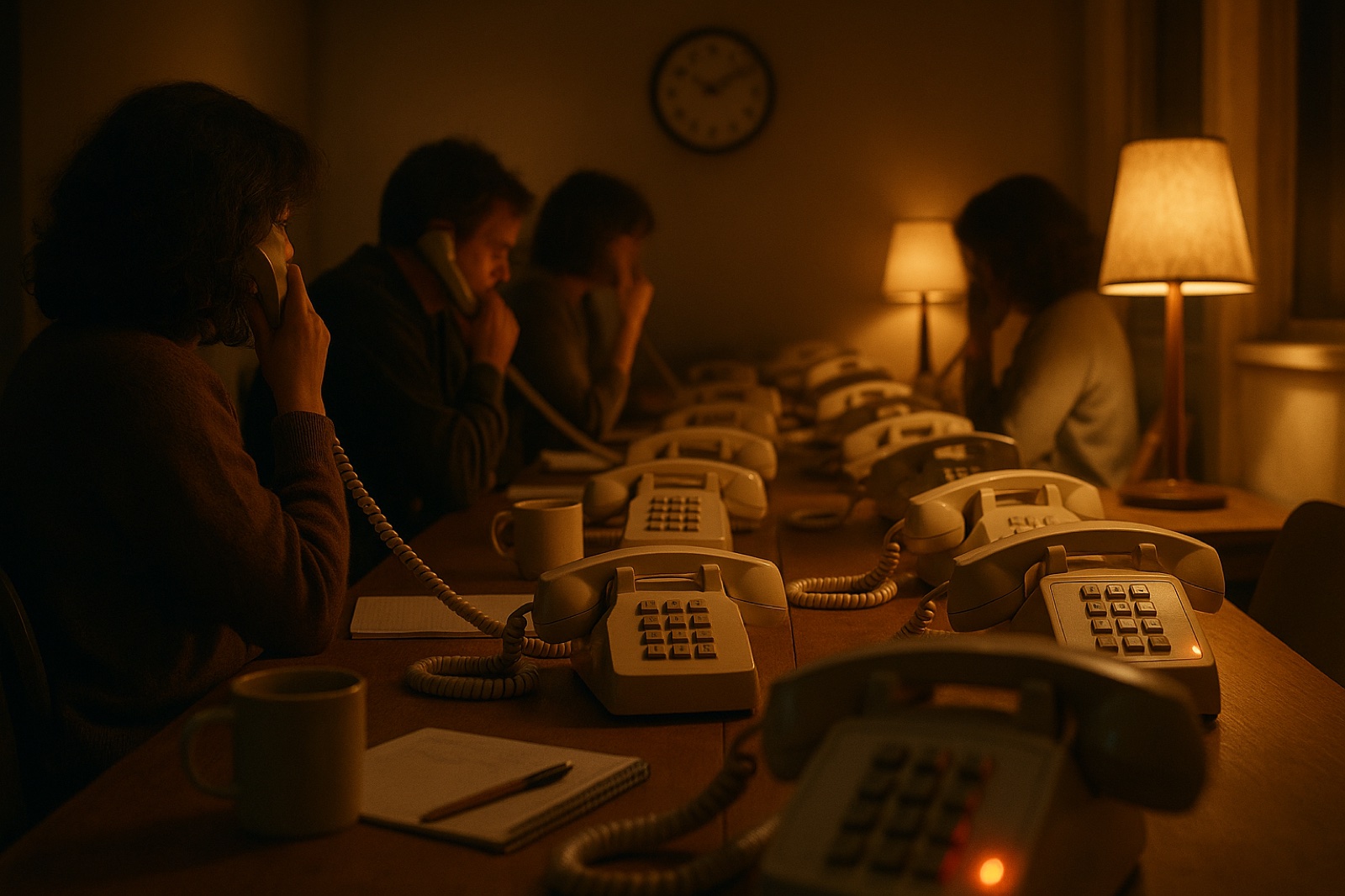
Read that word again: attempted. This is the detail that is easy to skim past. Fifty thousand calls is not fifty thousand conversations. No helpline set up for a single programme could answer that many calls in one night. So many of those children must have dialled, waited, and heard nothing, because there were not nearly enough people on the other end.
That is what changed everything. The calls that were answered showed the need. The calls that were not answered showed how big it was. Rantzen decided a 48-hour line was not enough. Children needed somewhere to call any hour of any day, all year round.
So Childline became a permanent, free, 24-hour service. In 2006 it joined the children’s charity the NSPCC, which now runs it. The NSPCC says Childline has helped children more than six million times through counselling sessions in the almost 40 years since that first night.
The Second Phone Line: The Silver Line, Born From Her Own Loneliness
Here is the part of her story that is told less often.
Rantzen’s husband, the film-maker Desmond Wilcox, died in 2000. Years later she wrote openly about how lonely she had become living on her own. For a famous, busy, confident woman, that was a brave thing to admit in public.
Her article struck a nerve. The response was huge, from older people who felt exactly the same and had never said it out loud. She called loneliness in old age “a creeping enemy” that “erodes confidence.” She also pointed out that loneliness carries a kind of shame, so people who feel it often will not even admit it.
So she did again what she had done in 1986. She set up a phone line. The Silver Line started as a pilot in the north of England, the Isle of Man and Jersey in November 2012, and went national on 25 November 2013. In the first two weeks after that national launch, 11,000 calls came in. By June 2019 it had taken its 2.5 millionth call. That year it joined forces with the charity Age UK.
The biggest single thing callers wanted to talk about was not a crisis. It was loneliness. Many simply wanted someone to talk to.
Why Esther Rantzen Kept Choosing the People Nobody Hears
Look at the two groups she spent her life on: children and very old people. They sit at the two ends of life. And they have something in common.
They are the easiest people in the world to ignore. Children often do not have the words, and when they do, adults do not always believe them. Old people are often quietly forgotten, left in a flat where the phone does not ring for days. Neither group can easily make a fuss.
Rantzen’s whole idea was almost too simple to be called an idea. Pick up the phone. Listen. Believe the person on the other end. Do it at three in the morning as well as three in the afternoon.
And here is the strange, hopeful thing. She did not build the second line from a distance. She built it from inside the feeling. The woman who gave lonely people someone to call had sat in her own quiet house and known that silence for herself.
What Her Life Says to Anyone Who Feels Unheard
You do not have to be a child or a pensioner to know what it is like to call out and get nothing back. Maybe it is a message left on “read.” Maybe it is a family where nobody asks how you really are. Maybe it is a house that has gone very quiet.
If that is you, two things from her story are worth holding on to.
First, the unanswered calls were not proof that nobody cared. They were proof that more people needed to be listening. The 50,000 did not fail. They were the reason the line stayed open.
Second, saying “I’m lonely” out loud is not weakness. When Rantzen said it, thousands of people realised they were not the only ones. If you are not sure how heavy your own loneliness has become, this free, private How Lonely Am I? check can help you put a name to it. And if it feels like no one gets what you are carrying, this piece on what to do when you feel like nobody understands is a good next read.
There is a very old belief, much older than any telephone, that the cry nobody else picks up is still heard. That God listens hardest to exactly the people the world finds easiest to ignore: the small child, the forgotten widow, the person who called and got no answer. Whatever you make of that, Esther Rantzen spent forty years acting as if it were true.
The Legacy of Esther Rantzen in One Line
People will argue about plenty in her long, loud, busy life. That is what happens to anyone who campaigns for things.
But somewhere tonight a child will dial a number and a trained volunteer will say hello. Somewhere an older person who has not spoken to anyone all week will hear a friendly voice ask how their day was. Neither of them may know her name.
That might be the best kind of legacy. Not a name people remember, but a phone that still gets answered.
If you are in the UK and you are a child or young person who needs to talk, Childline is free on 0800 1111. If you are an older person who feels alone, Age UK’s Silver Line is free on 0800 4 70 80 90. Wherever you live, it is worth finding out what your country’s free helplines are and keeping one number saved in your phone, for yourself or for someone else.
Sources: the history of Childline and The Silver Line; the NSPCC’s tribute.
Discussion Question
Esther Rantzen built help for the two groups she thought were easiest to ignore: children and the very old. Who do you think is the most overlooked group of people where you live today, and what would a simple “phone that gets answered” look like for them? Share your answer in the comments below.
Share This
Post 1: On the first night of Childline in 1986, there were 50,000 attempted calls. Many never got through. Those unanswered calls are the reason the line stayed open. RIP Esther Rantzen. https://bgodinspired.com/index.php/relationships-and-family/esther-rantzen-dies-childline-50000-calls/
Post 2: I didn’t know Esther Rantzen started The Silver Line after writing about her own loneliness as a widow. The person who gave lonely people someone to call had felt that silence herself. https://bgodinspired.com/index.php/relationships-and-family/esther-rantzen-dies-childline-50000-calls/
Post 3: Children and old people: the two groups easiest to ignore. Esther Rantzen spent 40 years giving both of them a phone that gets answered. Worth a read today. https://bgodinspired.com/index.php/relationships-and-family/esther-rantzen-dies-childline-50000-calls/
Q&A: Esther Rantzen, Childline and The Silver Line
When did Esther Rantzen die and how old was she?
Dame Esther Rantzen, the British broadcaster who founded Childline and The Silver Line, died on 30 September 2026 at the age of 86. She had been living with lung cancer since being diagnosed in 2023.
How did Childline start?
Childline grew out of a BBC programme called Childwatch, shown on 30 October 1986 and pushed for by presenter Esther Rantzen. A helpline number shown after the programme was planned to stay open for 48 hours, but it received more than 50,000 attempted calls on the first night, mostly from children, many of them being abused. That demand led to Childline becoming a permanent free 24-hour helpline for children in the UK.
How many children has Childline helped?
According to the NSPCC, which has run Childline since the two charities joined in 2006, Childline has helped children more than six million times through counselling sessions since it was founded in 1986.
Why did Esther Rantzen start The Silver Line?
Esther Rantzen started The Silver Line after writing publicly about her own loneliness following the death of her husband, Desmond Wilcox, in 2000. The huge response from older people who felt the same convinced her that lonely older people needed a free helpline. The Silver Line began as a pilot in November 2012, launched across the UK on 25 November 2013, and joined Age UK in 2019.
What is the Childline phone number?
Childline is a free, confidential helpline for children and young people in the UK. The number is 0800 1111, and children can also contact Childline online through its website.