 0
0
 0
0
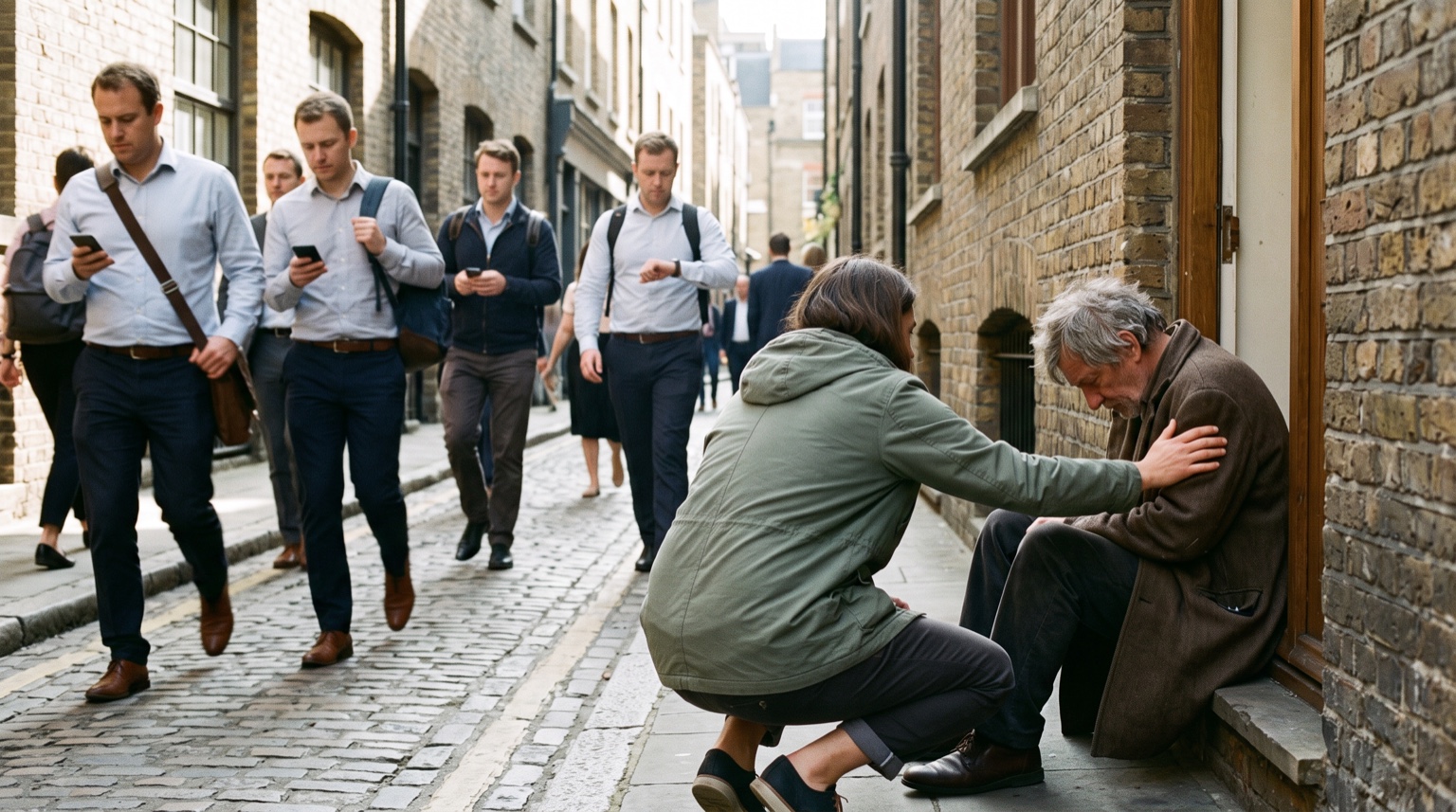
You’re running late. You’ve got somewhere to be, and someone is waiting on you. You turn down a side street to save a minute, and there’s a man sitting slumped in a doorway. Head down. Eyes shut. As you pass, he coughs twice and groans.
Do you stop?
Most of us would like to think we would. In 1973, two researchers at Princeton set up this exact scene to find out. The people they tested were trainee ministers. Some of them were on their way to give a talk about the most famous story ever told about stopping for a stranger. That study is one of the strangest and most honest things ever written about the bystander effect, and what it found is not what most people expect.
What Is the Bystander Effect?
The bystander effect is the finding that people are less likely to help someone in trouble when other people are around. It sounds backwards. More people should mean more help. But in lab studies through the 1960s and 1970s, psychologists kept finding the same pattern: the more people present, the more slowly each person moved, and the more likely each one was to do nothing.
The main explanation has a plain name: diffusion of responsibility. When you’re the only one who sees a problem, it’s clearly yours. When twenty people see it, the job gets split twenty ways in your head. Surely someone else has called for help. Surely someone who knows more than me will step in. Everyone thinks it. So nobody moves.
There is a second piece, too. When something odd happens in public, we look at each other’s faces to decide if it’s serious. If everyone else looks calm, we decide it must be fine, even while they are all doing the very same thing.
The famous story behind it was not quite true
Most textbooks trace the bystander effect back to the 1964 murder of Kitty Genovese in New York. A newspaper report at the time said 38 neighbours watched or heard the attack and did nothing. That number went around the world and became the standard example of people not caring.
But the story was wrong. In 2016, the newspaper that first reported it wrote that its original account had “grossly exaggerated the number of witnesses and what they had perceived.” Later reporting found that some people did call out, and at least one neighbour went down to her. The attack was real and the loss was real. The picture of 38 people coldly watching was not.
That matters, because it hints at something the rest of this article keeps finding. The real story of why people don’t help is less about cold hearts than we’ve been told.
The Good Samaritan Experiment: Seminary Students and a Man in a Doorway
In 1973, psychologists John Darley and Daniel Batson published a study with a title borrowed from an old road: “From Jerusalem to Jericho.” Their volunteers were 40 students at Princeton Theological Seminary, people training to become ministers.
Each student was told they would give a short talk in another building. Some were asked to talk about jobs for seminary graduates. Others were asked to talk about the parable of the Good Samaritan, the ancient story of a man beaten and left by the road, where two religious officials walk past him and a despised outsider, a Samaritan, is the one who stops. (If you want to know why a Samaritan was the most shocking possible hero for that story, it’s worth a read.)
Then came the twist. Before sending each student off, an assistant gave them one of three instructions:
- Low hurry: “It’ll be a few minutes before they’re ready for you, but you might as well head on over.”
- Medium hurry: “The assistant is ready for you, so please go right over.”
- High hurry: The assistant looked at a watch and said, “Oh, you’re late. They were expecting you a few minutes ago. We’d better get moving.”
On the way, in an alley, every student passed the same man: slumped in a doorway, head down, eyes closed. As they walked by, he coughed twice and groaned. He was an actor. The students did not know that.
Hurry Was the Thing That Mattered
Here is what the researchers found. Of the 40 students, 16 offered some kind of help. But look at how it broke down by hurry:
- Not in a hurry: 63% offered help.
- Medium hurry: 45% offered help.
- Told they were late: 10% offered help.
Now look at what did not make a clear difference.
The talk they were about to give didn’t. Students heading off to speak about the Good Samaritan helped somewhat more often than the others (53% against 29%), but in a group this small that gap was not strong enough to count as a real finding. The researchers’ own summary was blunt: thinking about the Good Samaritan did not increase helping, but being in a hurry decreased it.
How religious they were didn’t either. The students had filled in detailed questionnaires about their faith beforehand. None of those scores predicted who would stop.
And then there is the line from the paper that everyone remembers. The researchers wrote that “on several occasions, a seminary student going to give his talk on the parable of the Good Samaritan literally stepped over the victim as he hurried on his way!”
It’s easy to read that and laugh, or to feel smug. Hold that thought, because the researchers didn’t.
The Part of the Study Almost Nobody Quotes
Near the end of their paper, Darley and Batson did something unusual. They stopped and defended the people who walked past.
First, they said, a lot of the hurried students didn’t really see the man as someone in trouble. In interviews afterwards, almost all of them mentioned him and said that, looking back, he might have needed help. But in the moment, rushing, they hadn’t worked it out. The researchers compared it to a “narrowing of the cognitive map.” Hurry shrinks the world down to the path in front of you.
Second, some students clearly did notice, and chose to keep going anyway. They looked stirred up and anxious when they arrived. So the researchers asked: why were they hurrying at all?
Their answer is the best paragraph in the whole study. The students were hurrying because the assistant they were helping was depending on them to get somewhere fast. They were stuck between helping the man in the doorway and helping the person waiting for them. And that, the researchers wrote, “is often true of people in a hurry; they hurry because somebody depends on their being somewhere.” Their conclusion: “Conflict, rather than callousness, can explain their failure to stop.”
That changes the whole story. The students who walked past weren’t bad people. Most of them were being good in the way they’d been asked to be: reliable, on time, not letting anyone down. The trouble was that their day had no gap in it. There was only room for one person to be served, and the person in the doorway lost.
If that feels uncomfortably familiar, you’re not alone. If you want a quick, honest read on how stretched you are right now, try this free stress level check. It takes a couple of minutes.
Is the Bystander Effect Real? What Cameras Show
Here is some good news that hasn’t caught up with the textbooks yet.
In 2019, a team led by Richard Philpot looked not at lab set-ups but at real CCTV footage of 219 public arguments and fights in three very different cities: Lancaster in the UK, Amsterdam in the Netherlands, and Cape Town in South Africa. In about 9 out of 10 of those incidents, at least one bystander stepped in: calming someone down, pulling someone away, placing themselves between people. The study was published in American Psychologist in 2020 under a title that says it all: intervention is the norm.
They also found that the more people were around, the more likely it was that somebody would help. That doesn’t cancel the old lab findings, since each single person may still feel less pressure in a crowd. But it means a crowd is not a death sentence. Ordinary people step in far more often than the famous stories suggest, like the stranger who waded into floodwater to reach a man clinging to a tree.
Put the two findings side by side and a clearer picture forms. Most people want to help. What stops them is often not a lack of love. It’s a lack of room.
How to Beat the Bystander Effect
None of this needs money, training, or a special personality. It needs a little space and a few habits.
- Build in a gap. Leave five minutes earlier than you need to, when you can. That small cushion is the difference between the 10% and the 63%.
- Notice when you’re rushing. Hurry narrows what you see. When you feel it, lift your eyes for a second and look around on purpose.
- Ask one simple question. “Are you okay?” costs almost nothing. Most of the time the answer is yes. Sometimes it isn’t, and you’re the one who found out.
- Assume nobody else has done it. In a crowd, everyone thinks someone else called for help. Be the one who actually checks.
- If you need help, pick one person. Look at one face and say, “You, in the blue, please call for help.” A named person can’t pass the job to the crowd.
- Forgive the times you walked past. Guilt doesn’t make anyone kinder next time. Room does.
The Interruption Might Be the Point
There’s something quietly striking about where this study landed. The students were on their way to talk about love. The actual chance to love was sitting in a doorway on the way there, and it looked like a delay.
That story the seminarians were rehearsing was first told in answer to a simple question: who is my neighbour? The answer it gave was not a list of the right kind of people. It was whoever is in front of you, if you have the time to see them. And there’s a very old idea, far older than any psychology lab, that God is found less often in the plans we’re rushing toward than in the interruption we almost stepped over.
Maybe the man in the doorway isn’t in the way of the important thing. Maybe he is the important thing.
You don’t have to fix your whole life to live that out. You just need a little slack in your day. A few minutes you haven’t promised to anyone yet. Enough room that, when someone coughs twice and groans, you’re still able to hear it.
Discussion Question
Darley and Batson said the hurried students failed to stop because of “conflict, rather than callousness.” Do you agree, or do you think that lets people off too easily? Tell us what you think in the comments below.
Share This
“In 1973, trainee ministers on their way to talk about the Good Samaritan walked past a man groaning in a doorway. What decided who stopped? How late they were. https://bgodinspired.com/index.php/social-issues-and-justice/what-is-the-bystander-effect/”
“The line that stuck with me: people hurry ‘because somebody depends on their being somewhere.’ Most of us aren’t cold. We’re just out of room. Worth a read: https://bgodinspired.com/index.php/social-issues-and-justice/what-is-the-bystander-effect/”
“Turns out the famous ’38 witnesses’ story behind the bystander effect was badly exaggerated, and real CCTV shows people step in about 9 times out of 10. Good news for once: https://bgodinspired.com/index.php/social-issues-and-justice/what-is-the-bystander-effect/”
Questions People Ask About the Bystander Effect
What is the bystander effect in simple terms?
The bystander effect is the tendency for people to be less likely to help someone in trouble when other people are present. The main reason is diffusion of responsibility: when many people see the same problem, each person feels less personally responsible and assumes someone else will act. People also look to others’ calm faces and conclude the situation is not serious.
What was the Good Samaritan experiment?
The Good Samaritan experiment was a 1973 study by John Darley and Daniel Batson at Princeton. Forty seminary students were sent to give a talk in another building, some about the parable of the Good Samaritan, and passed an actor slumped and groaning in a doorway. About 63% of students not in a hurry offered help, compared with 45% in a medium hurry and 10% who were told they were late. The topic of their talk and their religious attitudes did not reliably predict who helped.
Why did the seminary students walk past the man in the doorway?
According to Darley and Batson, many hurried students did not register the man as someone in distress because time pressure narrowed their attention. Others noticed him but felt torn, because they were hurrying for someone who was depending on them to arrive. The researchers concluded that “conflict, rather than callousness” could explain why they did not stop.
Is the Kitty Genovese story about 38 witnesses true?
The original 1964 report that 38 neighbours watched Kitty Genovese’s murder and did nothing was badly inaccurate. In 2016 the newspaper that first published it said the account had “grossly exaggerated the number of witnesses and what they had perceived.” The attack was real, but some neighbours did respond, and the image of 38 people knowingly watching was wrong.
Do bystanders usually help in real life?
Real-world evidence suggests bystanders help far more often than the bystander effect’s reputation implies. A study by Richard Philpot and colleagues, published in American Psychologist in 2020, analysed CCTV footage of 219 public conflicts in Lancaster, Amsterdam and Cape Town and found that at least one bystander intervened in about 9 out of 10 cases, with intervention becoming more likely as the number of bystanders grew.