 0
0
 0
0
It is on coffee mugs, gym walls and graduation cards. It turns up in WhatsApp forwards after a job loss, and in the notes people leave for a friend going through a hard year. “Fall seven times, stand up eight.” Some people know it as “fall down seven times, get up eight,” or “fall seven times, rise eight.” In Japan it is four short words: nana korobi ya oki (七転び八起き).
It sounds like a simple push to keep going. But the saying has a strange little snag in it, one that people in Japan still argue about. And an older book, written a very long way from Japan, landed on the same number and the same picture of falling and rising. Nobody has shown that either one borrowed from the other. That is the interesting part.
What “Fall Seven Times, Stand Up Eight” Is Really Saying
Count it on your fingers. If you fall seven times and get up after each fall, you get up seven times. Not eight. The numbers do not match.
Most of us read past that. We hear “never give up” and move on. But we think the mismatch is the whole point, and here is our reading of it.
The saying does not promise you will stop falling. It expects seven falls. Seven is a lot. It treats failure as normal, not as a sign that something is wrong with you. What it cares about is the last move. Life is not scored by how many times you went down. It is scored by which way you were facing at the end.
And then there is that eighth rising. The one you cannot account for. It is sitting there in the arithmetic, one more than you earned. Hold on to that. We will come back to it.
There is also something the poster version leaves out. The proverb does not say falling is fine or that it will not hurt. Japanese has a twin phrase that shows exactly how much it can hurt. More on that below.
Where the Saying Comes From
A surprising first appearance
Nobody knows who first said it. It is a folk proverb, not a line from one famous writer. But Japan’s largest historical dictionary, the Nihon Kokugo Daijiten, cites an early example from 1680. It is not from a temple or a book of wisdom. It is from Yoshiwara Hitotabane, a “review book” about the courtesans of Edo’s Yoshiwara pleasure quarter. Books like this were a kind of gossip guide in their day.
The line there reads, roughly: “The world is a dream and an illusion. Seven falls, eight risings.” So one of the earliest recorded uses of this famous pep talk sits in a book about the lives of women who had very little control over their own lives. It was said about the ups and downs of fortune, not about a gym session.
That is the earliest example the dictionary gives. It does not mean nobody said it before 1680. It only means this is the oldest written use that scholars have pinned down and published.
The toy that will not stay down
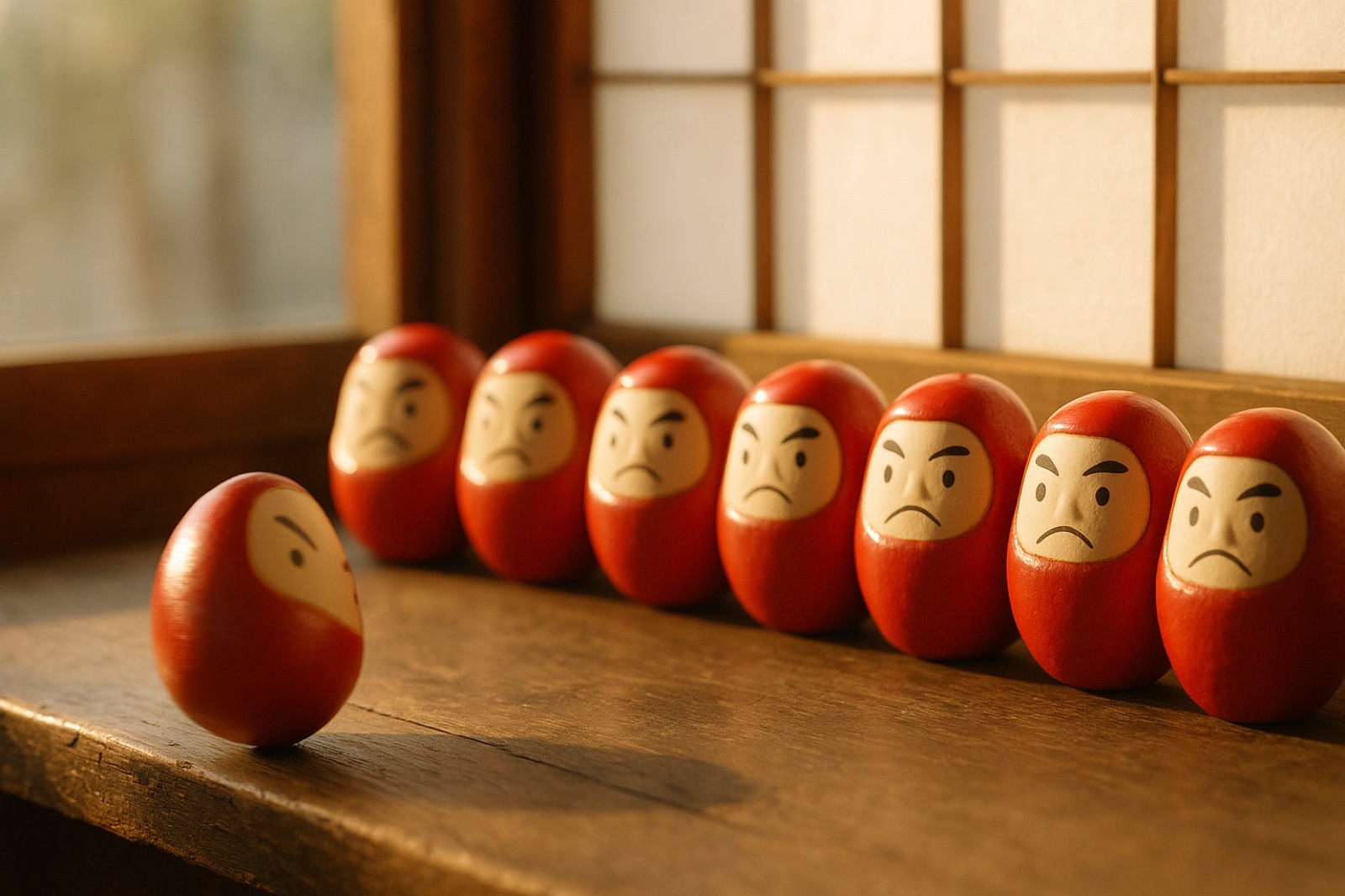
In Japan the saying goes with a toy. The okiagari-koboshi is a small round doll made of papier-mâché, weighted at the bottom. Knock it over and it rocks back upright. It is thought to be modeled on a Chinese toy called budaoweng, “the old man who does not fall down,” and it is mentioned in Japanese writing as early as the 1300s.
Later, the same self-righting shape became the daruma doll, the red, round figure based on the Buddhist teacher Bodhidharma. Today the daruma and “nana korobi ya oki” are almost always found together.
Here is the detail almost nobody notices. The doll does not get up because it tries hard. It gets up because of where its weight sits. Push it over and the heavy base pulls it back. Its rising is built in.
The twin phrase that goes the other way
Japanese has another phrase that starts the same way: shichiten battō (七転八倒). Seven falls, eight collapses. It means writhing in agony, rolling about in pain. Same seven falls. A completely different ending.
So the language itself holds both stories side by side. Two people can take the same seven hits. One ends up standing. One ends up on the floor. Japanese does not pretend the falls are gentle. It only says they do not have to be the last word.
So why eight?
Japanese writers still offer different answers to the counting puzzle. One is that seven and eight are just ways of saying “many times.” Another is that eight is a lucky number in Japan, because the written character 八 spreads wider at the bottom, like a future that opens out. And one explanation is the loveliest of all: the first time you ever stood up, as a baby, someone else lifted you. The extra rising was never yours to begin with. It was a gift.
None of these is settled. The proverb does not come with a footnote. But it is worth noticing which answer people reach for when they love the saying most.
A Just Man Falleth Seven Times
Now go back more than two thousand years, to the book of Proverbs in the Bible. In a short collection of sayings, there is this line:
“For a just man falleth seven times, and riseth up again: but the wicked shall fall into mischief.”
Proverbs 24:16 (KJV)
Seven falls. Rising again. One person gets up; another falls and stays in trouble. Two outcomes from the same falling, just like nana korobi ya oki and shichiten battō sitting side by side in Japanese.
We should be careful here. There is no evidence that the Japanese proverb came from the Bible. One Japanese magazine even lists “it comes from the Bible” among the theories for the eight. We could find nothing to support that. The 1680 example comes more than sixty years after Japan banned Christianity nationwide in 1614, and we know of no documented path by which this verse would have reached the people who were saying it. The honest answer is that these look like two separate traditions that arrived at the same place.
And that is more interesting than a borrowing would be. A Hebrew wisdom writer and generations of ordinary Japanese people, with an ocean and many centuries between them, both looked at human life and said the same two things. You will fall many times. And the falling is not what decides who you are.
Where the Rising Comes From
There is one place where the two traditions quietly lean the same way, and it is not about trying harder.
The daruma doll rises because of what it is, weighted at the base. The verse in Proverbs does not praise a person for effort, either. It does not say “a determined man” or “a strong man.” It says a just man. The rising is tied to what the person is rooted in, not to how many push-ups of willpower they have left. (We looked more closely at the verse right before this one, and what kind of falling it means, in Is Failure a Sin?)
That matters when you are on the ground for the sixth or seventh time. “Stand up eight” can feel like one more demand on someone who is already empty. But both of these old sayings hint that the getting up does not start with you. It starts with where your weight rests. And the gentlest reading of the eighth rising says the same thing: the first time, somebody lifted you.
People have been finding their way back to this idea for thousands of years, in places that never met. It seems we keep having to learn it again. We are not held up only by our own grip. Something steadier is underneath, and it is still there on the eighth morning. For people of faith, that steadier thing has a name. It is God, who does not leave the one who falls.
Back to the Mug on the Shelf
Next time you see “fall seven times, stand up eight,” you might notice the numbers that do not add up. One of its earliest known written uses sits in a gossip book about hard lives. It has a twin phrase that ends in pain. An ancient Hebrew proverb, with no known link to it, says the same thing.
And there is the extra one. The rising you did not earn. Maybe that is not a mistake in the math at all.
If you want a way to put a number on how you keep going, our free How Gritty Am I? quiz is a gentle place to start. And if you like proverbs that are older than they look, see what we found in “A Journey of a Thousand Miles Begins With a Single Step”.
Let’s Talk
When you have been knocked down, what actually got you back up: your own strength, or someone else’s hand? And which other saying have you always leaned on, without ever knowing where it came from? Tell us in the comments.
Questions People Ask About “Fall Seven Times, Stand Up Eight”
Where does “fall seven times, stand up eight” come from?
“Fall seven times, stand up eight” is an English version of the Japanese proverb nana korobi ya oki (七転び八起き). It is a folk saying with no single known author. Japan’s largest historical dictionary, the Nihon Kokugo Daijiten, cites an early written example from 1680, in a book called Yoshiwara Hitotabane. In Japan the proverb is closely linked with the daruma doll, a weighted toy that always rocks back upright.
What does “fall seven times, stand up eight” mean?
“Fall seven times, stand up eight” means that no matter how many times you fail, you get back up one more time. It treats falling as normal rather than shameful and puts the weight on the final move, not the number of failures. The numbers deliberately do not match: seven falls should give seven risings, and Japanese writers offer several explanations for the extra one, including that someone lifted you the very first time you stood.
Is “fall seven times, stand up eight” in the Bible?
No, “fall seven times, stand up eight” is not in the Bible; it is a Japanese proverb. But the Bible has a strikingly similar line in Proverbs 24:16 (KJV): “For a just man falleth seven times, and riseth up again: but the wicked shall fall into mischief.” There is no evidence that either saying borrowed from the other. They appear to be two separate traditions reaching the same conclusion.
Why does the saying say seven falls but eight risings?
The saying “fall seven times, stand up eight” does not add up on purpose, and there is no single agreed explanation. Common explanations in Japan are that seven and eight simply mean “many times,” that eight is a lucky number in Japanese culture, and that the first rising in anyone’s life happened when someone else lifted them up as a baby.
What is the difference between nanakorobi yaoki and shichiten battō?
Nanakorobi yaoki (七転び八起き) means “fall seven times, rise eight,” a saying about never giving up. Shichiten battō (七転八倒) begins with the same seven falls but means “writhing in agony.” The two phrases share their opening and have opposite endings, which is a good picture of what the proverb is really about: the falls are real, and what matters is how the story ends.
Share This
- I had no idea “fall seven times, stand up eight” doesn’t add up. Seven falls = seven risings. One Japanese explanation for the extra one: the first time you ever stood, someone lifted you.
- Just learned that one of the earliest written uses of “nana korobi ya oki” is from 1680, and Proverbs 24:16 says “a just man falleth seven times, and riseth up again.” Two traditions, no known link, same picture.
- Japanese has a twin phrase to “fall seven, rise eight”: same seven falls, but it means writhing in agony. Same hits, different endings. That one stayed with me.