 0
0
 0
0
It is late, and you have read the same line three times. “For many are called, but few are chosen.” You close the Bible, but the words stay open in your head.
What if you are one of the many, and not one of the few? What if there is a list, and your name is not on it, and nobody told you?
If that fear has kept you awake, you are not strange and you are not faithless. It is one of the most frightening sentences Jesus ever said, mostly because it is almost always read on its own. But Jesus did not say it on its own. It is the last line of a story, and the story changes everything about what it means.
What “Many Are Called, but Few Are Chosen” Means
Here is the short answer to the meaning of “many are called but few are chosen.” In Matthew 22:14, Jesus is not describing a lottery or a secret list. The line closes a parable about a king’s wedding feast, where the invitation went out to everyone the servants could find, “both bad and good.” “Called” means invited. “Chosen” describes the people who actually ended up at the table, because they came, and came on the host’s terms.
That is the summary. But the story itself is better than the summary, and the fear only really loosens when you walk through it slowly. So let’s do that.
The Story This Line Ends: Matthew 22:1-14
Jesus tells this parable in the temple in Jerusalem, in the last week before the cross. The people listening closest are the religious leaders who are already planning to be rid of Him. Matthew says that just before this, “when the chief priests and Pharisees had heard his parables, they perceived that he spake of them” (Matthew 21:45).
So this is not a quiet bedtime story. It is a story told to people who were sure they were on the inside.
It goes like this. “The kingdom of heaven is like unto a certain king, which made a marriage for his son” (Matthew 22:2). The king sends servants to the guests who were already invited. They “would not come.”
The king tries again. He sends more servants with a mouth-watering message: “Behold, I have prepared my dinner: my oxen and my fatlings are killed, and all things are ready: come unto the marriage” (Matthew 22:4).
And the invited guests “made light of it, and went their ways, one to his farm, another to his merchandise” (Matthew 22:5). Some of them even seize the servants and kill them.
Notice what the first guests’ problem was. It wasn’t that they weren’t wanted. They were wanted twice. They just had better things to do.
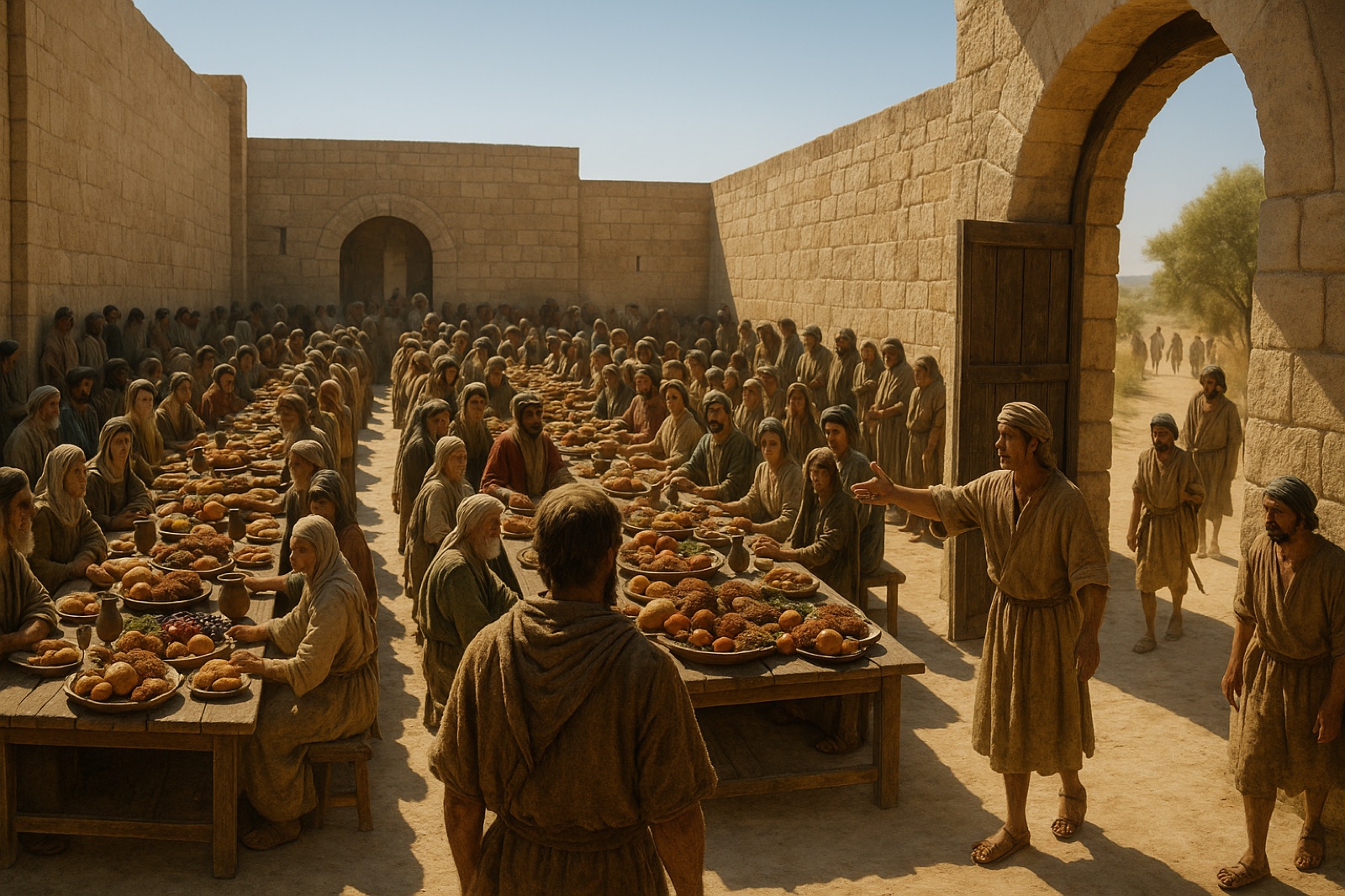
Then comes the turn in the story. The king says, “The wedding is ready, but they which were bidden were not worthy. Go ye therefore into the highways, and as many as ye shall find, bid to the marriage” (Matthew 22:8-9).
And the servants do exactly that: they “gathered together all as many as they found, both bad and good: and the wedding was furnished with guests” (Matthew 22:10).
Read that again slowly. Both bad and good. Nobody checked a list at the road. The hall filled up with whoever was out there.
Jesus often told stories like this to anyone willing to lean in and ask what they meant. (If you have ever wondered why He taught this way at all, we unpacked it in why Jesus spoke in parables.)
“Called” Is the Word the Whole Story Has Been Using
This is the detail that is easy to miss in English, and it is the key to the whole verse.
In the Greek of Matthew’s Gospel, the word behind “called” in verse 14 is kletoi. It comes from the ordinary verb kaleo, which means to call or to invite. And that same verb has been running through the entire parable. The King James Version just translates it a few different ways.
- Verse 3: the servants go “to call them that were bidden.” In Greek, that is almost “to invite the invited.”
- Verse 4: “Tell them which are bidden.”
- Verse 8: “they which were bidden were not worthy.”
- Verse 9: “as many as ye shall find, bid to the marriage.”
So when Jesus finishes with “many are called,” He is not introducing a new, mysterious idea. He is summing up the story in its own words. Many were invited. We just watched it happen. First the original guests, then everyone on the roads.
The other word, “chosen,” is eklektoi. It means picked out, selected. And in this story, who ends up at the table? Not the people who were invited and refused. Not the one man who came in but would not dress for the feast. The ones at the table are the ones who heard the invitation and came.
Christians have disagreed for centuries about how God’s choosing and our choosing fit together, and one article won’t settle that. But read on its own terms, this parable does not picture a crowd of people desperate to get in while a king secretly turns them away. It pictures a king working hard to fill his hall, and people turning him down.
The Man Without a Wedding Garment
This is the part of the story that scares people most, so let’s be honest about it.
“And when the king came in to see the guests, he saw there a man which had not on a wedding garment” (Matthew 22:11). The king has him bound and thrown “into outer darkness; there shall be weeping and gnashing of teeth” (Matthew 22:13). That is serious, and Jesus meant it to be.
But look at what the text does and does not say.
It does not say what the garment is. You will often hear that kings handed out wedding clothes at the door, so the man had no excuse. It is a lovely picture, but the evidence for that as a custom in Jesus’s day is thin, and the parable itself never says it. Readers have understood the garment in different ways. Augustine, writing in the early church, said it was love. Many later readers saw it as being clothed in a righteousness that is given, not earned, the way Isaiah sang, “he hath clothed me with the garments of salvation, he hath covered me with the robe of righteousness” (Isaiah 61:10). Others see a changed life. What those readings share is simple: this man came to a king’s wedding on his own terms.
He was not thrown out for being bad. The bad were already sitting at the tables. Verse 10 said so. This one guest was not singled out for his past.
The king called him “Friend.” “Friend, how camest thou in hither not having a wedding garment?” (Matthew 22:12). That greeting shows up two other times in Matthew. The vineyard owner uses it with a worker grumbling about his wages: “Friend, I do thee no wrong” (Matthew 20:13). And Jesus uses it in the garden, to Judas, at the very moment of betrayal: “Friend, wherefore art thou come?” (Matthew 26:50). In all three, someone is standing in the wrong place with the wrong heart, and the first word they hear is still “Friend.”
The king asked a question first. He gave the man room to answer. “And he was speechless.” The word Matthew uses there means silenced, muzzled. It is the same verb Matthew uses just a few verses later, when Jesus “put the Sadducees to silence” (Matthew 22:34). The man had nothing to say. No sorrow, no request, no explanation.
One more small, precise note. The King James Version also has “for many be called, but few chosen” at Matthew 20:16, after the parable of the vineyard workers. Most modern translations leave it out there, because many of the oldest Greek manuscripts do not have it. At Matthew 22:14, the line is a settled part of the text.
“The only people missing from the feast were the ones who didn’t care to come.”
Why the People Who Fear This Verse Usually Aren’t the Ones It Describes
Now put the whole story back together, and look at who actually misses the wedding.
There are the first guests, who “made light of it” and went off to their farms and their business. And there is one man who walked in but, when the king spoke to him kindly, had nothing to say at all.
Neither of them was lying awake worrying whether they were welcome. That is the part nobody tells you. The people shut out of this feast were not anxious about the invitation. They were indifferent to it.
So if you are the person reading Matthew 22:14 at midnight with a knot in your stomach, asking, “Am I one of the few?”, notice what you are doing. You are not making light of it. You are taking the King’s invitation very seriously. The fear is not proof that you are shut out. If anything, it looks a lot more like someone standing at the door, asking how to come in properly.
This is not a trick to make the fear go away. Feeling worried is not what saves anyone, and the story does ask something real of every guest. But what it asks is not that you guess whether your name is on a hidden list. It asks whether you will come, and whether you will come as the King’s guest instead of on your own terms. That is a question you can actually answer. Tonight, even.
And if part of the fear is a sense that you are simply not good enough to be wanted at a table like that, look at verse 10 one more time. “Both bad and good.” The good were never the only ones the servants brought in. (We sat with that feeling in Why Am I Not Good Enough? if it is the one that follows you around.)
The wedding was ready. The king wanted the hall full. The servants went out to the roads. Many are called. That part of the story is not frightening at all. It is the best news in it.
Actions to Take Today
- Read Matthew 22:1-14 out loud, slowly. Every time you hear a word about inviting (call, bidden, bid), tap the table. It takes about four minutes, and you will feel how much of the story is invitation.
- Answer the King’s question. The man without the garment was asked, “Friend, how camest thou in hither?” and said nothing. Take a scrap of paper or your phone and write one honest sentence back: “I came in because…” Don’t polish it.
- Name one place you are still coming on your own terms. A habit, a grudge, a part of your life you have kept for yourself. Say it to God plainly, in one sentence, and ask for help putting on what you need. If you want a gentle way to see where you stand right now, try our free How Close Am I to God? quiz. It is not a test you can fail.
Journaling Prompts
- When you first read “few are chosen,” what did you picture God doing? Where do you think that picture came from?
- The first guests weren’t bad people. They were busy. What is the “farm” or “merchandise” that most often keeps you from coming when you are invited?
- If the King greeted you tonight with “Friend,” what would you want to say back?
A Prayer
God, I have been afraid of this verse, and I have been afraid I’m not wanted. Thank you that the invitation went out to the roads, to the bad and the good, and that it reached me too. I don’t want to make light of it, and I don’t want to come on my own terms. Clothe me in what I can’t make for myself, and when you call me friend, help me answer. Amen.
Discussion Question
Why do you think Jesus ended such a generous story, a king filling his hall from the highways, with a line that sounds so frightening? Share your thoughts in the comments below. We would love to hear how you read it.
Share This
- “Many are called, but few are chosen” scared me for years. Then I read the whole story. The invitation went out to “both bad and good.” The only people missing were the ones who didn’t care to come.
- In Greek, “called” in Matthew 22:14 is the same word as “bidden” and “invited” all through the parable. Jesus wasn’t describing a secret list. He was summing up a story about a king who wouldn’t stop inviting people.
- The king called the man without a wedding garment “Friend” and asked him a question before anything else happened. Even at the door of judgment, the first word was kind.
Questions People Ask About “Many Are Called, but Few Are Chosen”
What does “many are called but few are chosen” mean?
“Many are called, but few are chosen” is the closing line of Jesus’s parable of the wedding feast in Matthew 22:1-14. In the Greek, “called” (kletoi) means invited, and it uses the same verb that runs through the whole parable for the king’s invitations. The saying sums up the story: many people were invited to the king’s son’s wedding, including “both bad and good” from the highways, but only those who accepted the invitation and came on the host’s terms ended up at the feast. The parable does not describe a secret list of people God refuses to let in.
Where is “many are called but few are chosen” in the Bible?
The phrase “many are called, but few are chosen” appears in Matthew 22:14 in the King James Version, at the end of the parable of the wedding feast. The King James Version also includes “for many be called, but few chosen” at Matthew 20:16, after the parable of the workers in the vineyard, but most modern translations omit it there because many of the oldest Greek manuscripts of Matthew do not contain it at that verse.
What is the wedding garment in Matthew 22?
The parable of the wedding feast in Matthew 22 never says what the wedding garment is. Christian readers have understood it in several ways: Augustine said it represented love, many later interpreters saw it as a righteousness given by God rather than earned, echoing Isaiah 61:10’s “garments of salvation,” and others read it as a changed life. The common claim that ancient kings handed out wedding clothes to guests is not well supported by historical evidence. What the parable does make clear is that the man was not excluded for being bad, since “both bad and good” were invited, but for coming in on his own terms and having no answer when the king asked about it.
Does “few are chosen” mean only a few people will be saved?
In the parable of the wedding feast in Matthew 22, “few are chosen” is contrasted with people who refused the invitation or ignored its terms, not with people who wanted to come and were turned away. The king’s servants filled the wedding hall with everyone they could find on the roads, “both bad and good.” Christians hold different views on how God’s choosing and human response relate, but the parable itself presents a king eager to fill his feast, and it places the problem with those who “made light of it,” not with a hidden limit on who is welcome.
Why did the king call the man without a wedding garment “friend”?
In Matthew 22:12 the king says, “Friend, how camest thou in hither not having a wedding garment?” Matthew records the same greeting two other times: the vineyard owner speaking to a grumbling worker in Matthew 20:13, and Jesus speaking to Judas at the betrayal in Matthew 26:50. In each case the person addressed is in the wrong place with the wrong heart, yet is spoken to kindly and given a chance to respond. The king asks a question before any judgment, and the man is “speechless,” using a verb that means silenced.