 0
0
 0
0
It’s late. You’ve prayed about the same thing for weeks, and it feels like talking to a ceiling. So you open an app. A horoscope. A tarot reading. A video from someone who says they can tell you what’s coming. You don’t really believe it. You just want somebody, anybody, to tell you what happens next.
The story of the Witch of Endor is the oldest version of that night. It’s in 1 Samuel 28. A king who couldn’t get an answer from God went looking for one somewhere else. What happened in that house is stranger, sadder, and kinder than most people remember.
Who Was the Witch of Endor?
Here’s the first surprise. The Bible never calls her a witch in the story itself. The King James Version calls her “a woman that hath a familiar spirit.” That means a medium, someone people went to so they could try to talk with the dead. “Witch of Endor” is a nickname that came later, from chapter headings and tradition.
Endor was a town in the north of the land, not far from where the armies were gathering. We never learn her name. We never learn her age, or whether she had a family. We only learn what she did on one night, when a frightened stranger came to her door.
And the stranger was the king.
If God has felt far away lately, we made a free video guide and companion PDF about noticing God in the ordinary moments of real life. It’s yours if you want it.
Why King Saul Went to a Medium
Saul was Israel’s first king. By this point in his story, things had gone badly wrong. Years earlier, the prophet Samuel had told him the kingdom was being taken from him because he had rejected what God said (1 Samuel 15:23). Now Samuel was dead. And a huge Philistine army was camped nearby.
“And when Saul saw the host of the Philistines, he was afraid, and his heart greatly trembled.” (1 Samuel 28:5)
So Saul prayed. And nothing came back.
“And when Saul enquired of the LORD, the LORD answered him not, neither by dreams nor by Urim, nor by prophets.” (1 Samuel 28:6)
Dreams. The Urim, the sacred lots the priests used. Prophets. Those were the normal ways people in Israel expected to hear from God. All three went quiet.
Here’s a detail most retellings skip. Saul had already banned mediums himself. The same chapter says he “had put away those that had familiar spirits, and the wizards, out of the land” (1 Samuel 28:3). Now he was asking his servants to find him one. They found her at Endor.
Saul put on ordinary clothes and went at night with two men. When the woman got nervous and reminded him that the king had cut people like her off from the land, Saul made her a promise. Listen to how he said it:
“And Saul sware to her by the LORD, saying, As the LORD liveth, there shall no punishment happen to thee for this thing.” (1 Samuel 28:10)
He swore by God’s name to protect the very thing God’s law forbade (Deuteronomy 18:10-11). That’s what desperation can do. It can make us use God’s name to cover the exact moment we stop trusting God.
What Really Happened When Samuel Appeared
Saul asked her to bring up Samuel. Then this:
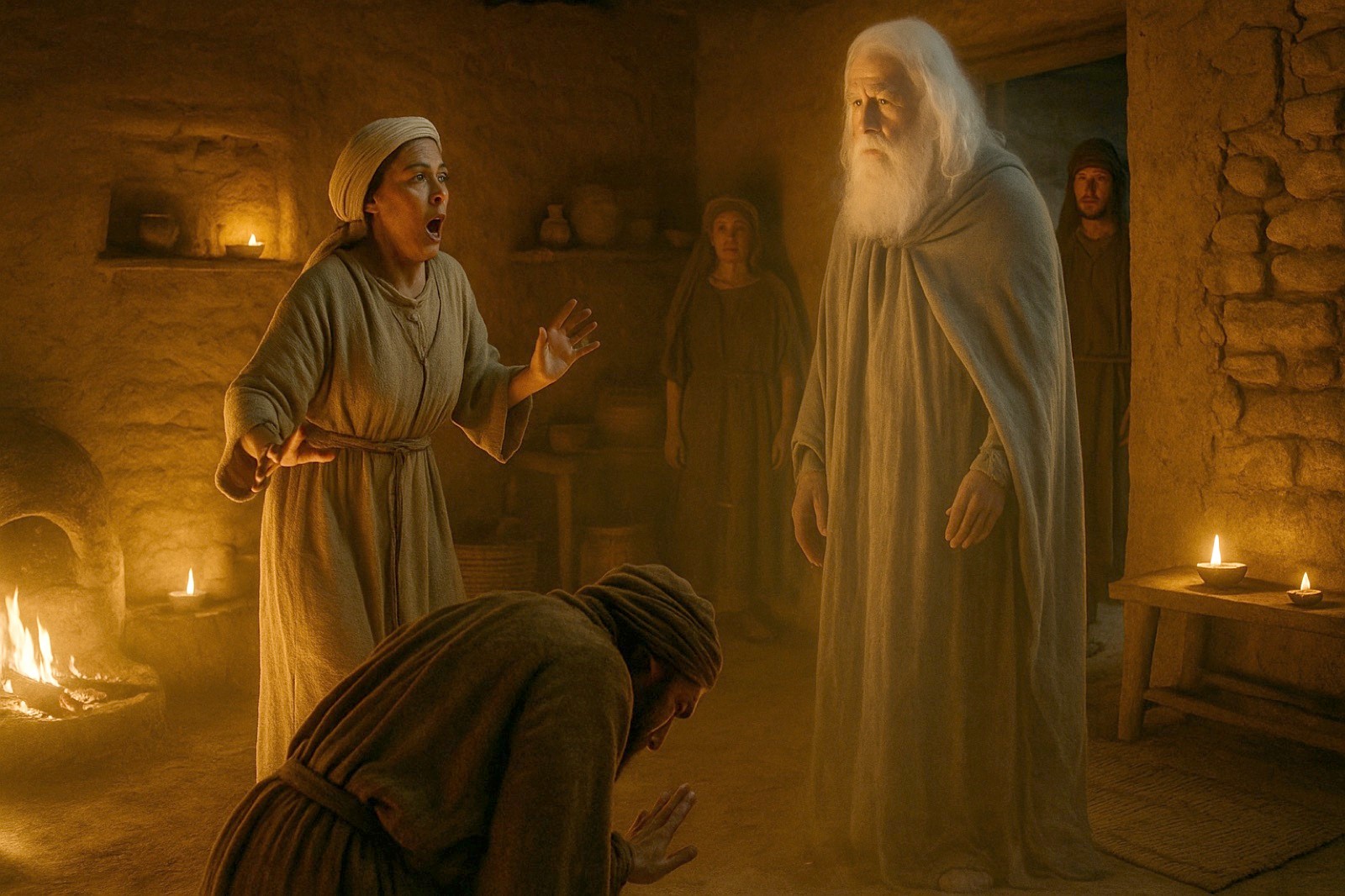
“And when the woman saw Samuel, she cried with a loud voice: and the woman spake to Saul, saying, Why hast thou deceived me? for thou art Saul.” (1 Samuel 28:12)
You’ll often hear that she screamed because nothing like this had ever really happened to her before, as if all her other sessions had been tricks. That’s a popular idea, and it might be right. But the Bible doesn’t actually say it. The only reason the verse gives comes in the same breath: she suddenly knew who her visitor was. The man who had outlawed people like her was standing in her house.
She told Saul she saw “gods ascending out of the earth” (1 Samuel 28:13). Then: “An old man cometh up; and he is covered with a mantle” (1 Samuel 28:14). Saul knew it was Samuel, and he bowed with his face to the ground.
Was it really Samuel? Was it a spirit pretending to be him? People who love the Bible have argued about that for many centuries, and nobody has settled it. (It’s the same kind of question that comes up when the disciples thought Jesus was a ghost.) What the text itself says is plain: “the woman saw Samuel,” and what Samuel said came true.
And here is the part that should stop us. What did Saul get for all that risk?
Nothing new. Samuel repeated what he had told Saul years before: “the LORD hath rent the kingdom out of thine hand, and given it to thy neighbour, even to David” (1 Samuel 28:17). Then he added the worst news of all: “to morrow shalt thou and thy sons be with me” (1 Samuel 28:19).
Saul went through the back door looking for a different answer. The back door gave him the same answer God had already given him.
The Meal Almost Nobody Remembers
This is where most people stop reading. But the chapter doesn’t end with the ghost. It ends in the kitchen.
“Then Saul fell straightway all along on the earth, and was sore afraid, because of the words of Samuel: and there was no strength in him; for he had eaten no bread all the day, nor all the night.” (1 Samuel 28:20)
The king was lying flat on her floor. He hadn’t eaten for a whole day and night. And the woman, the one he had tricked, the one whose way of life he had outlawed, came over to him.
“Now therefore, I pray thee, hearken thou also unto the voice of thine handmaid, and let me set a morsel of bread before thee; and eat, that thou mayest have strength, when thou goest on thy way.” (1 Samuel 28:22)
Saul said no. She and his servants kept urging him until he got up off the ground and sat on the bed. Then she did something much bigger than a morsel of bread:
“And the woman had a fat calf in the house; and she hasted, and killed it, and took flour, and kneaded it, and did bake unleavened bread thereof:” (1 Samuel 28:24)
In the ancient world, a fattened calf was not everyday food for most households. It was usually kept for a special occasion. She gave it to a ruined man who had just been told he was going to die. The bread was unleavened, which fits a woman with no time to let dough rise. The text says she hurried.
If you know your Bible, you may hear an echo. When three strangers came to Abraham’s tent, he “fetcht a calf tender and good” and “hasted to dress it” (Genesis 18:7). And when the lost son came home in Jesus’ parable, the father said, “bring hither the fatted calf, and kill it” (Luke 15:23). The Bible never tells us to link these stories. But the picture is the same: a calf, made ready in a hurry, for someone who arrived with nothing.
“Then they rose up, and went away that night” (1 Samuel 28:25). Three chapters later, Saul died in battle along with his sons. As far as the Bible records, that meal at Endor was the last one he ever ate.
Did Saul Ask God or Not?
There’s one more clue, and it’s in a different book. When 1 Chronicles looks back on Saul’s death, it says he died partly “for asking counsel of one that had a familiar spirit” and because he “enquired not of the LORD” (1 Chronicles 10:13-14).
Wait. 1 Samuel 28:6 said he did ask God. So which is it?
The answer is in the Hebrew. In 1 Samuel 28:6, the word for Saul’s asking is sha’al. It means to ask or to consult. In 1 Chronicles 10:14, the word is darash. It means to seek, to search after, to keep looking. Saul asked. He did not seek.
There’s a small, sad wordplay hiding in his name, too. Saul’s name in Hebrew is Sha’ul, from that same verb sha’al. His name means “asked for.” The man whose name meant asking was the man who asked once and never went on to seek.
What the Witch of Endor Story Means When God Feels Silent
If you’ve ever gone through a long, quiet season with God, this story can feel frightening. Is that me? Has God stopped answering me too?
Look closely at Saul’s silence. It didn’t come out of nowhere. It came after years of hearing a clear word and choosing not to obey it. And when the silence came, Saul didn’t keep seeking. He asked, got nothing, and went looking for a shortcut. Even his words to Samuel were about the war and “what I shall do” (1 Samuel 28:15). He wanted a plan. He never asked to have God back.
That’s the difference the Bible draws. Asking wants an answer. Seeking wants God. You can ask a horoscope, an app, or a stranger at night. (We looked more closely at what the Bible shows about reading your horoscope, if that’s been on your mind.) But you can only seek someone you want to be close to.
The prophet Isaiah put it like this: “should not a people seek unto their God? for the living to the dead?” (Isaiah 8:19). A quiet season is not the moment to find another voice. It’s the moment to keep seeking the God you already know, even when it feels like nobody is there. Habakkuk did exactly that, and it’s worth reading what Habakkuk did when God stayed silent.
And if you’re afraid that God’s silence means God has rejected you, notice this. The very fact that you care whether God is near is not what Saul looked like that night. Scripture makes a promise to exactly that kind of heart:
“The LORD is nigh unto them that are of a broken heart; and saveth such as be of a contrite spirit.” (Psalm 34:18)
There’s one more thing to carry out of that house. The kindest person in 1 Samuel 28 is the one we’d least expect: a woman with no name, living outside the law, who fed a broken man who had hurt people like her. God’s world is full of mercy in strange places. Sometimes the bread we need comes from someone we never would have picked. And sometimes we get to be that someone.
Actions to Take
- Name your back door. Think of the one place you reach for when prayer feels quiet: an app, a feed, a friend who always tells you what you want to hear. Just name it honestly. You don’t have to delete anything yet.
- Swap “ask” for “seek” for five minutes. Read Psalm 34:18 slowly. Then set a timer for five minutes and, instead of asking God what happens next, simply tell God you want to be close, whether or not an answer comes.
- Be the woman at Endor for someone. Think of one person having a terrible week, even someone who hasn’t been kind to you. Today, give them something practical: food, a message, a cup of tea, a hand with a chore. No lecture attached.
Journaling Prompts
- When God has felt quiet in your life, what have you reached for instead, and what were you really hoping it would tell you?
- Is there something God has already made clear to you that you keep hoping to hear differently?
- Who showed you kindness when you least expected it, and what did it change in you?
A Prayer for When Heaven Feels Quiet
God, I’ll be honest. Some nights it feels like my prayers hit the ceiling and stop. I don’t want to go looking for answers in places that can’t love me. I don’t just want to know what happens next. I want you. Keep me seeking even when I hear nothing, and make me kind to the people lying on the floor of their own hard night. Amen.
Discussion Question
Why do you think the story of the Witch of Endor ends with a meal instead of ending with Samuel’s warning? Share your thoughts in the comments below. We’d love to hear what you see.
If you’d like help noticing God in the ordinary, quiet moments, the free video guide and PDF are here for you.
Share This
- “Saul asked God. He didn’t seek God. The Bible uses two different Hebrew words, and the difference changed everything. (1 Samuel 28:6, 1 Chronicles 10:14)”
- “I always thought the Witch of Endor story ended with a ghost. It ends with a woman baking bread for a broken king who had outlawed people like her. Mercy shows up in the strangest places.”
- “When God feels silent, the temptation is to find another voice. Saul did. The other voice told him exactly what God already had.”
Questions People Ask About the Witch of Endor
Who was the Witch of Endor in the Bible?
The Witch of Endor was a medium living in Endor in ancient Israel, described in 1 Samuel 28. The King James Version calls her “a woman that hath a familiar spirit” and never gives her name. King Saul visited her in disguise at night before a battle with the Philistines and asked her to call up the dead prophet Samuel.
Did the Witch of Endor really bring Samuel back from the dead?
1 Samuel 28:12 says “the woman saw Samuel,” and the message given to Saul in that scene came true when Saul and his sons died in battle. Bible readers have debated for centuries whether the figure was truly Samuel, a spirit imitating him, or a deception, and the question has never been settled. The text presents the appearance as real and the words as accurate.
Why did the Witch of Endor scream when she saw Samuel?
In 1 Samuel 28:12 the medium of Endor “cried with a loud voice” when she saw Samuel, and in the same sentence she said to her visitor, “Why hast thou deceived me? for thou art Saul.” The verse links her cry to realizing that the disguised stranger was King Saul, who had banned mediums from Israel. A popular idea says she was shocked because her rituals had never truly worked before, but the Bible does not state that.
What did the Witch of Endor do after Saul heard Samuel’s message?
After King Saul collapsed from fear and hunger, the medium of Endor persuaded him to eat. According to 1 Samuel 28:24, she killed a fattened calf and quickly baked unleavened bread for Saul and his servants. This is the last meal the Bible records Saul eating before he died in battle against the Philistines.
Why was it wrong for Saul to consult a medium?
The law in Deuteronomy 18:10-11 forbade anyone to be “a witch,” “a consulter with familiar spirits,” or “a necromancer.” King Saul had enforced that law himself by removing mediums from Israel, according to 1 Samuel 28:3. 1 Chronicles 10:13-14 says Saul died partly for “asking counsel of one that had a familiar spirit” and because he “enquired not of the LORD.”