 0
0
 0
0
Think about the last time you cut your finger, twisted an ankle, or woke up with a sore throat.
The spot went red. It felt warm. It puffed up a little, and it hurt. That is inflammation, and most of the time it is your body doing exactly the right thing. It rushes help to the problem, fights off whatever got in, and starts the repair.
Then, a few days later, it stops. The redness fades. The pain goes. You forget it ever happened.
Except sometimes it doesn’t stop. And scientists have now found a natural off switch for inflammation, in real people rather than in mice. The most interesting part of their study is not the switch itself. It is what they saw when they flipped it: the pain cleared faster, but from the outside, nothing looked different.
What scientists found: an off switch for inflammation
The study was led by researchers at University College London (UCL), working with teams at King’s College London, the University of Oxford, Queen Mary University of London and the US National Institute of Environmental Health Sciences. It was published in the journal Nature Communications in January 2026, and it has been getting a fresh round of attention this month.
The off switch they studied is a group of tiny molecules made from fats. Their name is a mouthful, epoxy-oxylipins, so let’s just call them the brake.
Here is what the brake does. When inflammation starts, a type of white blood cell called a monocyte floods into the area. Some of those monocytes change into an in-between form that scientists call intermediate monocytes. A few of those are useful. Too many of them keep the inflammation going long after it should have finished.
The brake stops that from happening. One of these fat molecules, called 12,13-EpOME, shuts down a signal inside the cell (a protein called p38 MAPK) that pushes monocytes to change. Less change means fewer of the cells that keep the fire burning.
There is also an enzyme in the body, called soluble epoxide hydrolase, that breaks the brake molecules down. So the researchers asked a simple question: what happens if you block that enzyme and let the brake last longer?
The study’s first author, Dr Olivia Bracken, put the result simply: “Our findings reveal a natural pathway that limits harmful immune cell expansion and helps calm inflammation more quickly.”
If something in your own life has a way of flaring up again at night, so you lie awake while your mind keeps running, there is a free guide just below on why the mind won’t slow down, and the simple order of steps that helps it settle.
How they tested it on real people
Most research like this is done on cells in a dish or on mice. This one was not. As the study’s senior author, Professor Derek Gilroy, said: “This was an entirely human-based study with direct relevance to autoimmune diseases.”
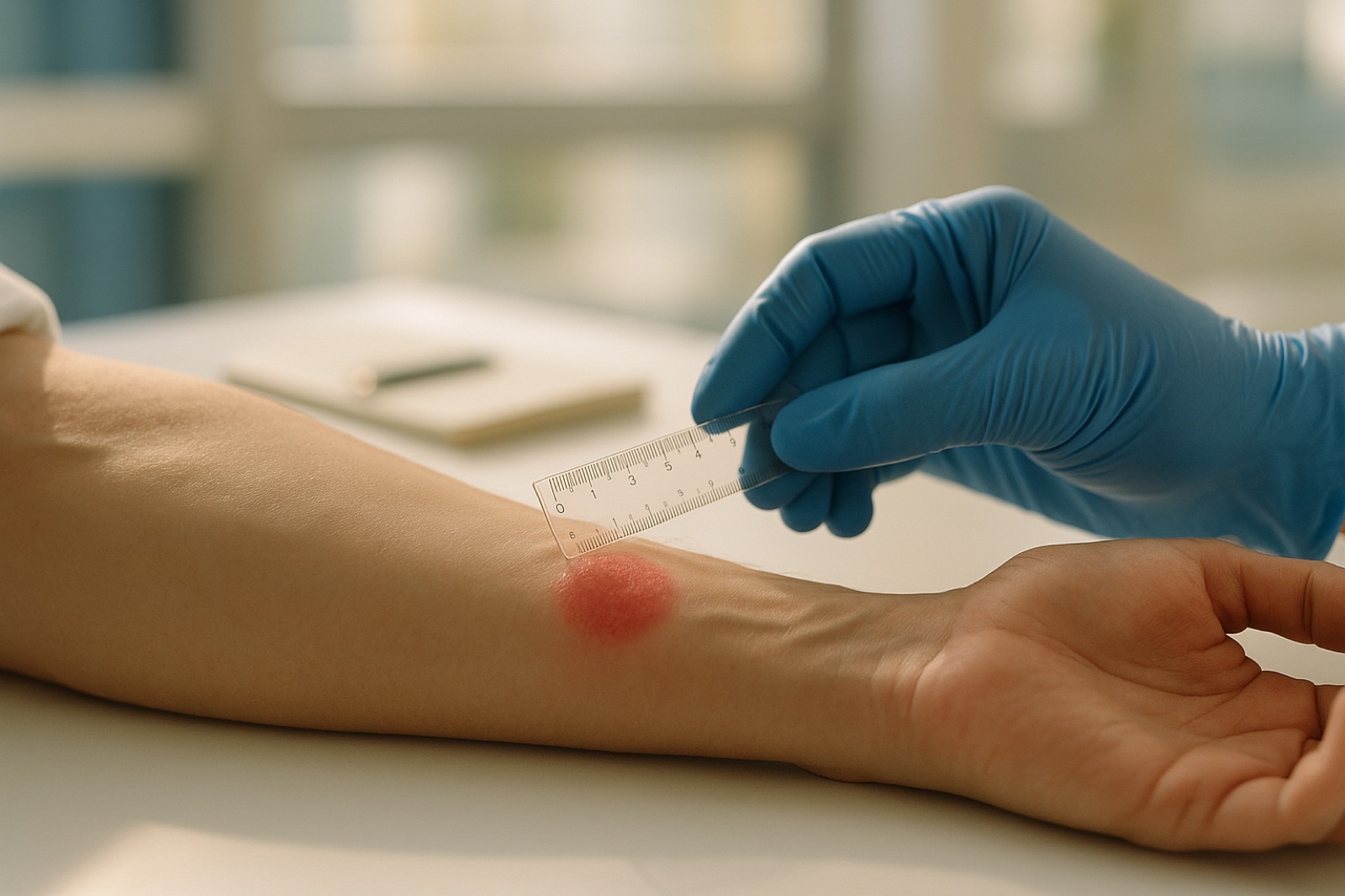
Healthy volunteers were given a tiny injection in the forearm of E. coli bacteria that had already been killed with ultraviolet light. Dead bacteria can’t make you ill, but your body doesn’t know that at first. It reacts as if they were alive, and a small, short-lived patch of inflammation appears on the skin. That gave the researchers a safe way to watch inflammation start, peak and end.
The volunteers were split into two groups of about two dozen people each:
- The “before” group took a single dose of an experimental drug that blocks the enzyme, two hours before the injection.
- The “after” group took the same dose four hours after the injection, once the inflammation had already begun.
In each group, about half got the real drug and half got a dummy pill.
The surprising part: the pain eased, the redness didn’t change
Blocking the enzyme did what the team hoped. The brake molecules went up. The number of intermediate monocytes dropped sharply, both in the blood and in the inflamed skin. And the pain went away faster: by about 24 hours in the “before” group, and between 24 and 48 hours in the “after” group.
But here is the detail most of the coverage skipped. The drug did not make the arm look any better. The paper reports that it did not affect the swelling, which the team measured by the fluid in a small blister over the spot, and it did not clearly change the redness either.
Think about what that means. If you had only looked at the arm, you would have said the drug did nothing. Underneath, the cells that keep inflammation going were already clearing out, and the person could feel it. The outside was simply the last part to catch up.
That is worth remembering the next time you judge how you are healing by how things look.
Why inflammation sometimes won’t switch off
Short bursts of inflammation keep us alive. The trouble starts when the ending goes wrong and inflammation becomes a background state that never quite finishes. Doctors call this chronic inflammation.
The intermediate monocytes at the centre of this study are one clue to how that happens. The paper notes that people with a range of long-term conditions tend to have more of them, including rheumatoid arthritis, lupus, Graves’ disease, obesity and heart disease, as well as infections such as tuberculosis and HIV.
That is why the researchers are hopeful. Most anti-inflammatory medicines work by pushing the immune system down. Boosting a natural brake could, in theory, help the inflammation finish without weakening the body’s defences. “Targeting this mechanism could lead to safer treatments that restore immune balance without suppressing overall immunity,” Bracken said.
What this study does not show
It is easy to get carried away with a headline like “off switch for inflammation,” so here is the honest fine print.
- It was small. About 50 volunteers in total.
- Everyone in it was a healthy man, aged 18 to 50. We don’t yet know if women, older people, or people who are already ill respond the same way.
- The inflammation was short and made on purpose. A patch on the forearm from dead bacteria is not the same as years of arthritis.
- The drug is experimental. It is not something you can buy, and this study does not tell anyone to change what they eat or take. The next step is proper clinical trials in people with inflammatory diseases.
What it does show is something scientists who study inflammation have been saying for years, now seen clearly in people: inflammation does not just fade away on its own. Ending it is a job the body actively does. And when that job is not done, the fire keeps burning.
A fire that was built to go out
There is something quietly hopeful in that idea.
The redness, the heat and the pain are not the enemy. They are a response, and a good one. The body needs them. It just doesn’t need them forever. The problem is not that the fire starts. It is when nothing tells it to stop.
People work the same way, especially when it comes to anger. Anger is a kind of inflammation of the heart. Something hurts us, and everything rushes to the spot. That is not wrong. It is often a sign that something really was wrong. But anger that never gets switched off turns into something else: a background state we carry into every room. Researchers have spent years looking at what that costs the body, and the findings on holding a grudge are hard to ignore.
One of the oldest pieces of advice about anger, written in a letter to a young church nearly two thousand years ago, understood this surprisingly well. It does not say “never get angry.” It says, in effect, be angry, but do not let the sun go down on it. It doesn’t ban the fire. It gives the fire an ending, a brake that comes around every single evening, so that what flared up today doesn’t become who you are.
That is the kind of healing God seems to have built into us, in our cells and in our hearts: not a life with no fire, but a fire that knows how to go out.
If you’re not sure whether your own anger tends to switch off or keep smouldering, this free How Well Do I Handle Anger? test takes a few minutes and gives you an honest picture.
What to take from the off switch for inflammation
- Inflammation is not the enemy. A short burst is your body protecting you. It is the kind that never ends that causes harm.
- Don’t judge healing only by how it looks. In this study, real change was happening underneath before the outside showed it.
- Be careful with “cure” headlines. This is early, small, and done in healthy men. It is a promising step, not a treatment.
- Watch for the fires that don’t go out, in your body and in your life. If pain or swelling keeps coming back or never settles, that is worth raising with a doctor or nurse. If it is a hurt from a person, it may be worth asking what it would take to let it end before tonight. Sometimes a hurt that won’t settle in the body lingers long after the cause is gone, and the same can be true of the heart.
Questions & Answers
What is the natural off switch for inflammation that scientists found?
A study led by University College London and published in Nature Communications in January 2026 found that small fat-derived molecules called epoxy-oxylipins act as a natural brake on inflammation in humans. One of them, 12,13-EpOME, blocks a signal inside immune cells called p38 MAPK. This stops white blood cells called monocytes from turning into “intermediate monocytes,” a form that can keep inflammation going. The enzyme soluble epoxide hydrolase breaks these brake molecules down, so blocking that enzyme lets the brake last longer.
Did blocking the enzyme make inflammation go away faster?
Partly. In the UCL-led study of healthy male volunteers given a small forearm injection of UV-killed E. coli bacteria, an experimental drug that blocks soluble epoxide hydrolase made pain resolve faster and sharply reduced intermediate monocytes in the blood and skin. However, the drug did not affect swelling and did not clearly change redness. The inner immune process was calming down even though the outward signs looked much the same.
Why does inflammation become chronic?
Acute inflammation is a normal, protective response that is supposed to end once an injury or infection is dealt with. Researchers now understand that ending inflammation is an active process in the body, not a passive fading. When that process fails, inflammation can continue as a long-term state. People with conditions such as rheumatoid arthritis, lupus, obesity and heart disease tend to have higher levels of intermediate monocytes, one of the immune cell types linked to inflammation that does not switch off.
Is there a treatment based on the inflammation off switch yet?
No. The 2026 UCL-led study used an experimental drug in about 50 healthy men aged 18 to 50, with inflammation deliberately triggered in a small patch of forearm skin. It was not tested in people with inflammatory diseases, women, or older adults. The researchers say the next step is clinical trials exploring whether boosting these natural brake molecules could help conditions such as rheumatoid arthritis and cardiovascular disease.
What does “don’t let the sun go down on your anger” mean?
The saying comes from an early Christian letter written nearly two thousand years ago. It does not tell people never to feel angry. It accepts that anger happens but sets a limit on it, urging people to deal with anger before the day ends rather than carrying it overnight and letting it settle into bitterness. Many people find it a practical daily rule for keeping a passing hurt from becoming a permanent grudge.
A question worth sitting with
In this study, the pain eased while the arm still looked just as red. Have you ever been healing from something, in your body or in your life, long before anyone else could see it? Or do you think we’re right to trust what we can see? Tell me in the comments; I read them.
If this was worth reading, pass it on
- Scientists found a natural off switch for inflammation. The strangest part: the pain cleared faster, but the redness and swelling looked exactly the same. The healing was happening where nobody could see it.
- Inflammation isn’t the enemy. It’s supposed to stop. A new study shows the body has to actively switch it off, and when that fails, it turns chronic. Worth knowing.
- Old advice about anger never said “don’t get angry.” It said don’t let the sun go down on it. After reading about the body’s off switch for inflammation, that makes a lot more sense.
The next time something flares up, in your skin or in your temper, it might help to remember that the fire is not the failure. Your body already knows how to put it out. Sometimes it is working on it before you can see a thing.