 0
0
 0
0
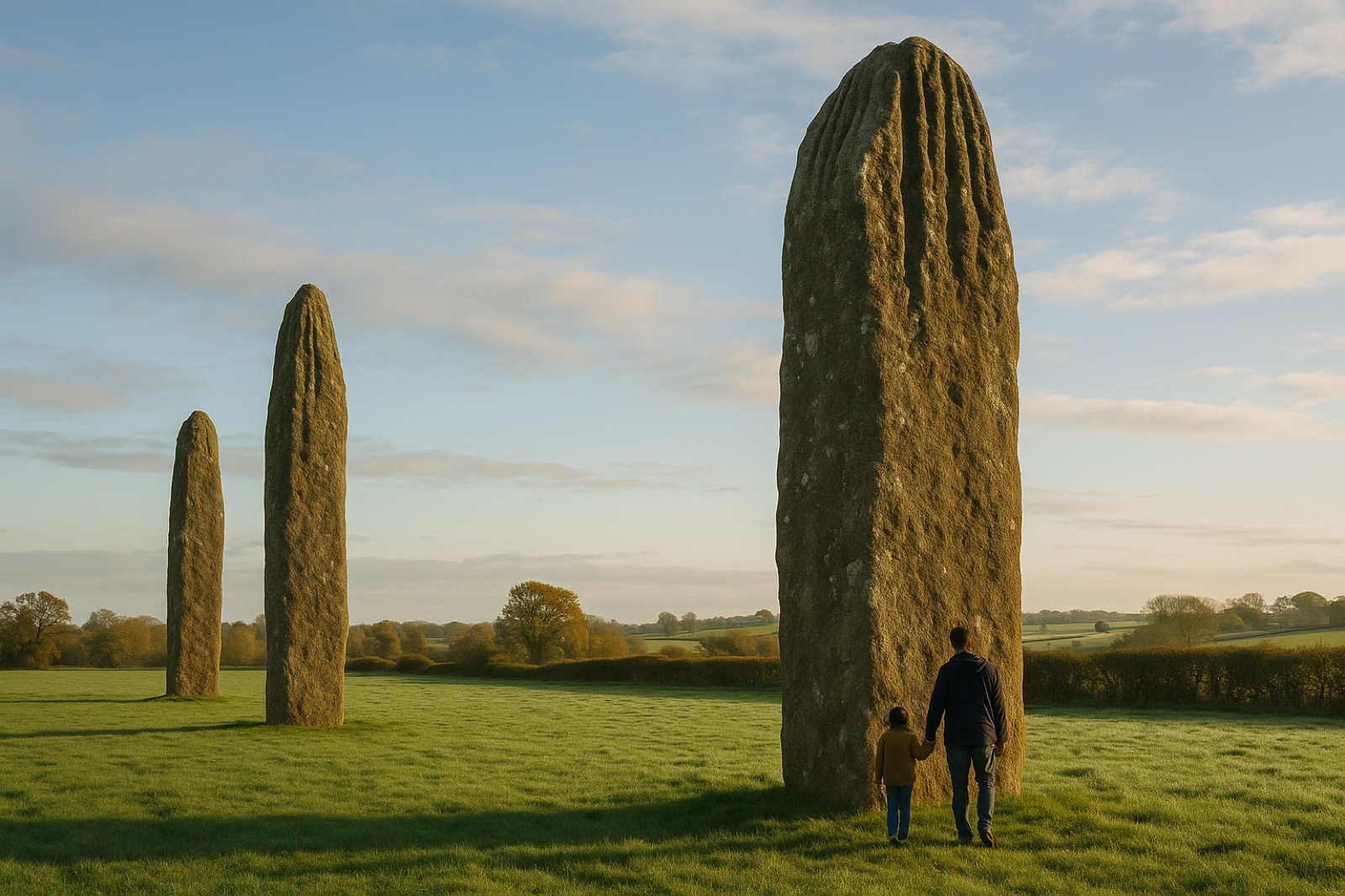
Three stones stand in a field in North Yorkshire, beside a busy road, a short walk from the small town of Boroughbridge.
You notice them the way you notice a lighthouse. They are simply too tall. The biggest is close to seven metres high. Each one weighs more than 25 tonnes. Their tops are cut into deep vertical grooves, like candle wax that has run, and nobody carved those grooves. Thousands of years of rain did.
They are called the Devil’s Arrows. They are the tallest prehistoric stone row still standing in Britain. And in September 2026, scientists finally worked out where they came from.
What the scientists could not tell us is why anyone went to the trouble. That turns out to be the most interesting part of the story.
Where the Devil’s Arrows actually came from
For a long time the answer seemed obvious. There is an outcrop of the same kind of rock, a coarse sandstone called Millstone Grit, at a place called Plumpton Rocks, not far away. England’s official heritage listing for the monument named it as the likely source. It was the sensible guess. If you have to drag a 25-tonne stone somewhere, you take it from the nearest place you can.
The guess was wrong.
A team led by Dr Anthony Clarke of Curtin University, working with Dr Jim Leary of the University of York, published new results in the journal Proceedings of the Royal Society A. They traced the Devil’s Arrows to Brimham Rocks, a cluster of strangely weathered gritstone towers on higher ground about 18 kilometres (11 miles) to the west.
That is not the nearest source. It is the harder one: further away, and up in rough country.
“Our research shows these stones weren’t simply taken from the nearest available source – they were deliberately chosen from a challenging landscape 18 km away,” Clarke said.
The team also ruled out the easy explanation that ice did the moving. The glaciers in this region flowed south, not east, so an ice sheet could not have carried giant blocks from Brimham down to Boroughbridge. People did it.
How do you fingerprint a stone you are not allowed to damage?
Here is the detail most of the coverage skipped, and it is lovely.
The Devil’s Arrows are a protected ancient monument. You cannot drill a core out of them. So the team used a low-impact method instead: they pressed adhesive tape against the stones to lift off tiny mineral grains.
Sticky tape, on a monument roughly 4,000 years old.
Some of those grains are crystals called zircon and apatite, and they work like tiny clocks. When each crystal formed, it locked in a trace of uranium, which slowly turns into lead at a known rate. Measure the two, and you know how old the crystal is. A sandstone is made of grains worn off many older rocks, so it holds a mix of crystals of very different ages, and that particular mix acts like a fingerprint for where the rock came from.
The grains on the Devil’s Arrows matched Brimham Rocks.
It is the same careful spirit as the researchers who recently read a 4,000-year-old sealed letter without ever opening it. We are getting very good at learning from old things without breaking them.
How old are the Devil’s Arrows, and how many were there?
The honest answer on age is: roughly. The stones are thought to have gone up in the Late Neolithic or Early Bronze Age, possibly around 2000 BC. But the site has not been excavated with modern methods, so the precise date is still unknown.
There were more of them once. Today three stones stand in a line about 174 metres long. The tallest is the second-tallest standing stone in Britain, beaten only by the Rudston Monolith in East Yorkshire. Old accounts describe at least one more stone, pulled down centuries ago by people who hoped to find treasure buried under it. They found nothing, and the stone was broken up and reused.
The row also sits inside a much wider ancient landscape. There are other monuments nearby, including the great earthwork rings known as the Thornborough Henges. This corner of Yorkshire was clearly a place that mattered to people a very long time ago.
Why were the Devil’s Arrows built? Nobody knows
This is where the science reaches the edge of what it can say.
We now know where the stones came from, and roughly when they were raised. People have suggested the row lines up with a particular moonrise, but nobody has proved it. What the stones were for is simply not known.
Clarke’s own reading of the new evidence is careful, and it is worth hearing in full. “This tells us prehistoric people placed real importance on the landscape itself,” he said. “It wasn’t just about convenience — the location the stones came from likely held meaning for them.”
In other words, the builders may not only have been making something at Boroughbridge. They may have been bringing a place with them. Brimham Rocks meant something to someone, enough to spend an enormous amount of shared effort carrying three or more pieces of it 18 kilometres east.
But what that meaning was, nobody wrote down. Nobody could. There was no writing in Britain yet. The people who knew grew old and died, and then their children did, and then their children’s children, until the stones were still standing and the reason was gone.
If you read our piece on Stonehenge’s Altar Stone, which travelled about 700 kilometres from Scotland, you will recognise the pattern. Science can measure the journey. The why stays out of reach.
What happens when a monument outlives its meaning
This is the part of the story I cannot stop thinking about.
A monument without its meaning does not stay empty for long. People fill the gap.
At some point, long after the builders were gone, people began calling these stones the Devil’s Arrows. The story that was eventually written down goes like this. The Devil stood on a nearby hill, furious with the old Roman town of Aldborough just down the road, and hurled the stones at it. He missed. They landed near Boroughbridge instead, and there they have stood ever since.
It is a good story. It is also, now that we have the science, almost exactly backwards.
In the legend, the stones came flying in anger, thrown at a place someone wanted to destroy. In the evidence, they were dragged slowly and deliberately, by a huge shared effort, from a place someone valued.
The truth was patience and care. The story people told once they had forgotten the truth was rage.
That seems to be what happens. Stone lasts. Memory does not. And when the memory goes, the explanation that rushes in to replace it is usually darker than what was really there.
The oldest fix for a forgotten meaning
There is a very old account, far older than most of the history we know, of a people who crossed a river and hauled stones up out of the riverbed to set them up on the other side. What makes the story stand out is not the stones. It is the instruction that came with them.
They were told, more or less: one day your children will ask you what these stones mean. When they do, tell them what happened here.
The stones were never expected to carry the meaning on their own. Whoever first passed down that instruction seems to have understood exactly what a field in Yorkshire shows us now: a stone can outlast a whole civilisation, but it cannot explain itself. God, it seems, never trusted rock to do the remembering. That job was handed to people. To a parent at a kitchen table, answering a child’s question.
Your own standing stones
Most of us will never raise a 25-tonne pillar. But all of us leave stones behind.
A ring in a drawer. A chipped mug nobody is allowed to throw away. A photograph of people standing outside a house that is no longer there. A recipe card in handwriting that is getting harder to read.
Every one of those things will almost certainly outlast the story that makes it matter, unless someone tells the story.
So here is one small thing worth doing this week. Pick one object in your home that means something to you, and tell someone why. A child, a friend, a neighbour. Or write one sentence on the back of the photo, or on a slip of paper folded into the drawer beside the ring. It takes a minute and costs nothing.
A long time from now, nobody may remember your name. But it would be good if, when someone picks up the thing you left behind, they do not have to invent a story to explain it. Better that the real one is already there, waiting for them.
A Question Worth Discussing
If a monument’s original meaning is lost for good, does it still mean something — or does it only mean whatever we decide it means now? Where do you land? Tell us in the comments. We read every one.
Share This
- Scientists just traced the Devil’s Arrows in Yorkshire to rocks 18 km away. People dragged 25-tonne stones past a closer source on purpose, about 4,000 years ago. Nobody knows why. The legend says the Devil threw them. The truth was far more patient.
- The part I keep thinking about: when people forgot why the stones were there, the story they made up was darker than the truth. Stone outlasts memory. Tell your stories while you still can.
- They sampled a protected 4,000-year-old monument with sticky tape. A few tiny crystals lifted off the surface were enough to prove where the Devil’s Arrows came from.
Questions People Ask
What are the Devil’s Arrows?
The Devil’s Arrows are three giant prehistoric standing stones in a line near Boroughbridge in North Yorkshire, England. They form the tallest prehistoric stone row still standing in Britain. The tallest stone is close to seven metres high and each weighs more than 25 tonnes. Their tops are deeply grooved by thousands of years of rainfall. Historical accounts show that at least one more stone once stood in the row before it was pulled down by treasure hunters.
Where did the Devil’s Arrows stones come from?
A study published in 2026 in Proceedings of the Royal Society A, led by Anthony Clarke of Curtin University with Jim Leary of the University of York, traced the Devil’s Arrows to Brimham Rocks, a Millstone Grit outcrop about 18 kilometres (11 miles) west of Boroughbridge. The researchers lifted tiny zircon and apatite grains from the stones with adhesive tape and matched their age fingerprints to Brimham. The nearer outcrop at Plumpton Rocks, long assumed to be the source, was ruled out, and so was transport by glacial ice.
How old are the Devil’s Arrows?
The Devil’s Arrows are thought to have been raised in the Late Neolithic or Early Bronze Age, possibly around 2000 BC, which would make them roughly 4,000 years old. The date is an estimate. The site has not been excavated with modern methods, so the precise date of construction is still unknown.
Why are they called the Devil’s Arrows?
The name comes from a local legend, not from the people who built the stones. In the story, the Devil stood on a nearby hill and threw the stones at the old Roman town of Aldborough, missed, and the stones landed near Boroughbridge. The legend appeared long after the builders were gone. Scientific evidence now shows the stones were deliberately carried about 18 kilometres from Brimham Rocks by people, which is close to the opposite of the legend.
Why were the Devil’s Arrows built?
Nobody knows why the Devil’s Arrows were built. There are no written records from the time, because Britain had no writing when they were raised. Some people have suggested an alignment with a particular moonrise, but it has not been proved. The 2026 study found that the builders passed over a closer stone source to fetch the stones from Brimham Rocks, and the lead researcher suggested that the place the stones came from likely held meaning for the people who moved them.