 0
0
 0
0
Nobody knows how many kinds of insect there are. The working estimate researchers use is somewhere between 14 and 30 million species. Most of them have never been named, described, or written down anywhere at all.
More than 80% of them live in the tropics. Almost none of the science does.
That gap finally has a name attached to it. Researchers call it parachute science: specialists from wealthy countries fly in, collect what they came for, fly out, and publish it somewhere the people who live there will probably never read. A paper published this week in the journal BioScience, led by Dr Shawan Chowdhury of the Global Change Ecology Lab at Monash University alongside collaborators in Bangladesh, Uganda, Brazil, India, Hong Kong, Italy and the Czech Republic, puts it without much padding: scientists and communities in tropical countries are treated “mainly as sources of data rather than equal partners.”
Why parachute science matters more for insects than for almost anything else
Insects are easy to walk past. They are small, they are not cuddly, and no one runs a fundraising campaign with a beetle on the poster.
But the numbers in the paper are hard to shrug off. Insects pollinate more than 80% of wild plant species. Around 60% of bird species eat them. Pull that thread and a great deal of what we casually call “nature” comes apart — and so does a great deal of what we call lunch.
We are also still discovering how sophisticated these animals actually are. Researchers have traced the brain circuit that decides which job a honeybee takes on as it ages — which is a level of detail we simply do not have for the overwhelming majority of insect species, because the overwhelming majority of insect species have never been looked at by anyone.
A quarter of the world’s insect records come from one rainy island
Here is the figure that reframes everything else. According to the paper, 26% of all insect distribution data held by the Global Biodiversity Information Facility — the main global clearing house for this kind of record — comes from the United Kingdom alone.
One country. Cool, temperate, comparatively insect-poor. A quarter of the world’s records.
That is not a map of where insects are. It is a map of where people with recording equipment, funding and a long amateur natural-history tradition happen to live. The tropics hold most of the life; the temperate north holds most of the paperwork.
Which means when a conservation body somewhere decides what is endangered and what is fine, it is reading a document written almost entirely by people who were nowhere near the animals in question.
The part nobody expected: the knowledge already existed
This is where the study stops being a familiar complaint about funding and becomes something stranger.
The team looked closely at Bangladesh. They found 111 relevant studies on the country’s butterflies. Only 34 of them had been published in international journals. The rest existed — in regional publications, in local languages, in places the global databases simply do not look.
Then they checked social media. Of 169 butterfly species considered threatened in Bangladesh, 167 had records on Facebook. Somebody had seen them, photographed them, and posted them. The observations were sitting there, publicly, the whole time.
Meanwhile, of 226 butterfly species assessed in the country, exactly one had adequate representation inside existing protected areas.
So the shortage was never really a shortage of knowing. It was a shortage of listening — and specifically, a shortage of listening in languages, formats and places that don’t look like a journal.
Chowdhury’s own summary of the fix is the line worth keeping: “The answer isn’t simply to collect more data. We need to become much better at finding, connecting and using the knowledge that already exists.”
What the framework actually asks for
The paper is a framework rather than an experiment, so it argues a case rather than proving a result. That case rests on four barriers the authors say are holding tropical insect conservation back: existing research that is invisible globally, genuine gaps in the data, weak scientific infrastructure, and too little action once something is known.
Their proposed remedies are unglamorous and specific. Count regional and non-English publications as real evidence. Use museum collections that already exist. Fund taxonomists in the countries doing the work. Take citizen science and social media observations seriously as data. Build long-term monitoring that outlasts a single grant. Make partnerships equal ones. Get the findings in front of the people who actually write policy.
None of that is exciting. All of it is the difference between a species being saved and a species quietly ending while its file sits in the wrong language.
It is worth saying that conservation science can do remarkable things when it does turn up properly — two bandicoot populations separated for over 10,000 years were recently reunited genetically. The capability is not in question. The distribution of it is.
Counted is not the same as known
There is something underneath this that is bigger than insects, and most of us have felt it from the other side.
Almost everyone has been in a room where they were treated as a source of information rather than a person — where what you had was wanted and who you were was not. You can tell instantly. It is a specific kind of loneliness, and it does not depend on anyone being unkind. You can be perfectly politely extracted from.
The Bangladesh finding lands right on that nerve. The information was never missing. The people holding it were simply never considered colleagues. Being counted and being known turn out to be two completely different things, and only one of them changes what happens next.
There is a very old idea, far older than any database, that runs quietly under all of this — that the thing which made the world did not study it from a safe distance and take the findings home. It came down into it, stayed, learned the place from the inside, and learned it by name rather than by number. Whatever else that is, it is the precise opposite of parachuting in.
Which is, more or less, what a group of entomologists just spent a paper asking their own field to do.
What this means the next time you see something small
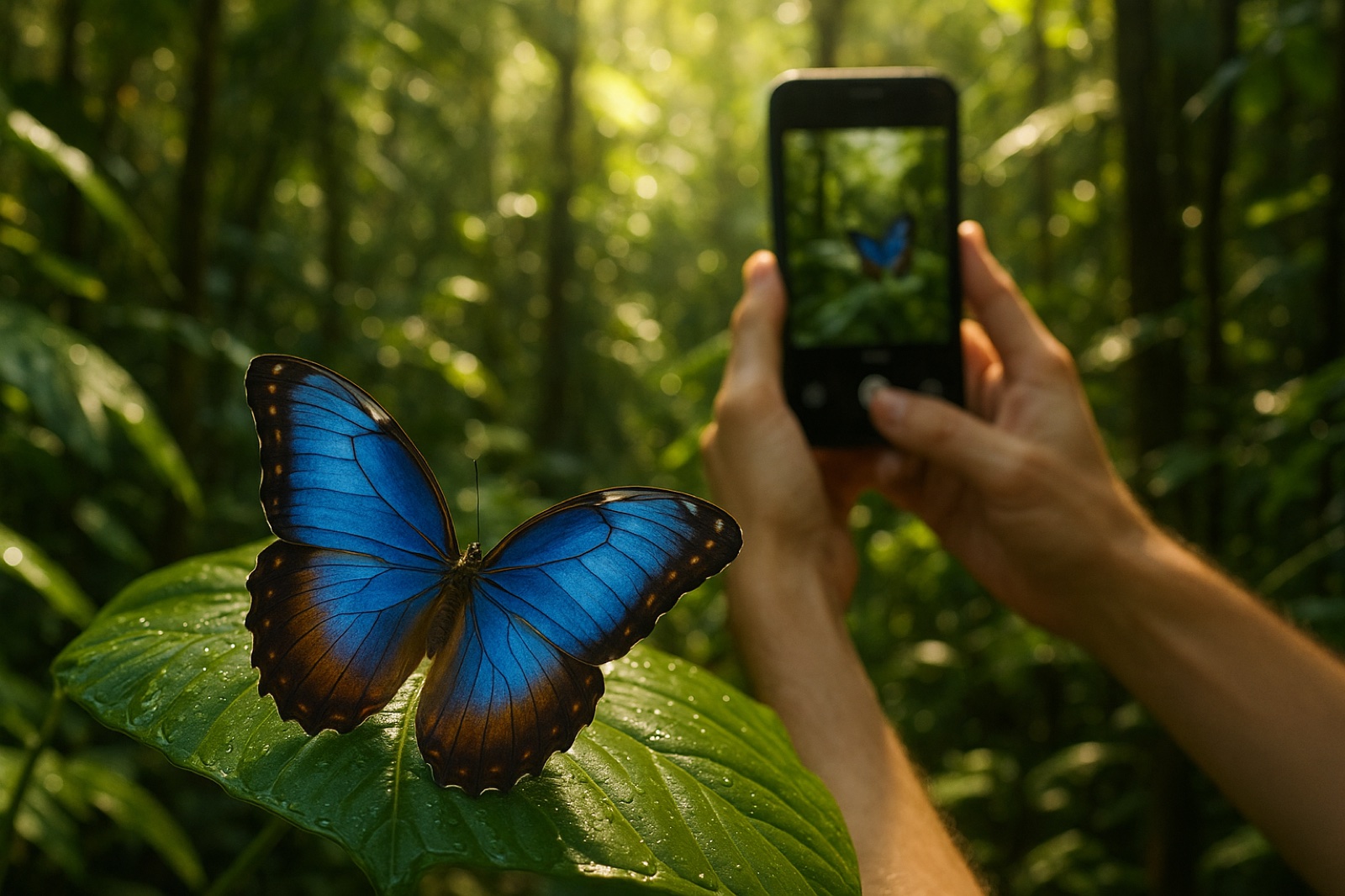
The most useful thing in this study is also the most ordinary. The records that mattered in Bangladesh were not gathered by an expedition. They were photographs, taken by people who lived there, posted where their friends would see them.
That is a genuinely low bar to clear. A phone, a leaf, a few seconds of paying attention.
And it suggests something about attention generally: the things that go missing are rarely the things nobody saw. They are the things nobody wrote down, because nobody thought their noticing counted.
Three things worth doing
- Photograph what you see where you live. A dated photo of an insect on a plant, posted publicly or uploaded to a citizen-science app, is a real record. Researchers are now explicitly asking for these.
- Name one thing. Look up what one insect in your own street or garden is actually called. Knowing a name changes how you treat what carries it — that is true of animals and it is true of people.
- Be careful about help that flies in. Even well-meant intervention can misfire when it ignores local conditions, as anyone who has followed the debate over garden bird feeders and disease spread will recognise.
Questions people are asking about parachute science
What is parachute science?
Parachute science is a term for research in which scientists from wealthier countries travel to another country, collect data, and leave, without involving local researchers or communities as equal partners. The 2026 BioScience paper on tropical insect conservation describes it as treating scientists and communities in tropical countries “mainly as sources of data rather than equal partners.” The criticism is not that outside researchers work abroad, but that the knowledge, credit and capacity leave with them.
What percentage of insect species live in the tropics?
More than 80% of the world’s insect species occur in tropical regions, according to the 2026 BioScience study led by Dr Shawan Chowdhury of Monash University. Roughly 20% of global insect diversity is found in temperate regions. Total global insect diversity is estimated at somewhere between 14 and 30 million species, most of which have never been formally described.
Why is insect conservation data so unevenly distributed?
Because records reflect where recording happens, not where species live. The 2026 BioScience study reports that 26% of the insect distribution data held by the Global Biodiversity Information Facility comes from the United Kingdom alone. Wealthier temperate countries have longer natural-history traditions, more funding, more taxonomists and more digitised collections, so their comparatively small insect faunas are far better documented than the tropics where most insect species actually live.
Can social media posts be used as scientific data?
Yes, and researchers are increasingly arguing that they should be. In Bangladesh, the 2026 BioScience study found that 167 of 169 threatened butterfly species had records on Facebook. Photographs posted publicly by members of the public can establish that a species was present at a particular place and time, which is exactly the information conservation planning needs and often lacks.
Why do insects matter to people who don’t like insects?
Because of what depends on them. The same study notes that insects pollinate more than 80% of wild plant species and that around 60% of bird species feed on them. Insect decline therefore affects food production, plant communities and bird populations, regardless of how anyone feels about insects themselves.
A question worth arguing about
If a threatened species is photographed by a hundred ordinary people on their phones but never appears in a scientific journal, has it been recorded or not? Put differently: who gets to decide what counts as knowledge? Tell us where you land in the comments — this one splits people.
Worth sharing
- 26% of the world’s insect records come from the UK. 80% of insect species live in the tropics. That’s not a map of nature — it’s a map of who owns the clipboard. https://bgodinspired.com/index.php/nature-and-creation/parachute-science-tropical-insects/
- Researchers looking for missing butterfly data in Bangladesh found records for 167 of 169 threatened species — on Facebook. The knowledge wasn’t missing. Nobody was looking there. https://bgodinspired.com/index.php/nature-and-creation/parachute-science-tropical-insects/
- “Parachute science”: fly in, take the data, fly out, publish somewhere the locals will never read it. A new paper says it’s quietly failing most of the insects on Earth — and that the fix is listening, not collecting. https://bgodinspired.com/index.php/nature-and-creation/parachute-science-tropical-insects/
Source: Chowdhury et al., BioScience (2026), via Monash University.