 0
0
 0
0
You wake up in one room. You travel to another room. Hours later you make the same trip in reverse. And somewhere on the way back you notice a feeling that is hard to name: there is nowhere else you are expected to be.
Not nowhere you could go. Nowhere you are expected — nowhere that would notice if you did not turn up.
Most people file that under loneliness. There is a narrower name for it. What is a third place, and why does not having one make adult life feel like commuting between two rooms?
What Is a Third Place?
Ray Oldenburg, an American sociologist, published a book in 1989 called The Great Good Place. In it he sorted ordinary life into three settings.
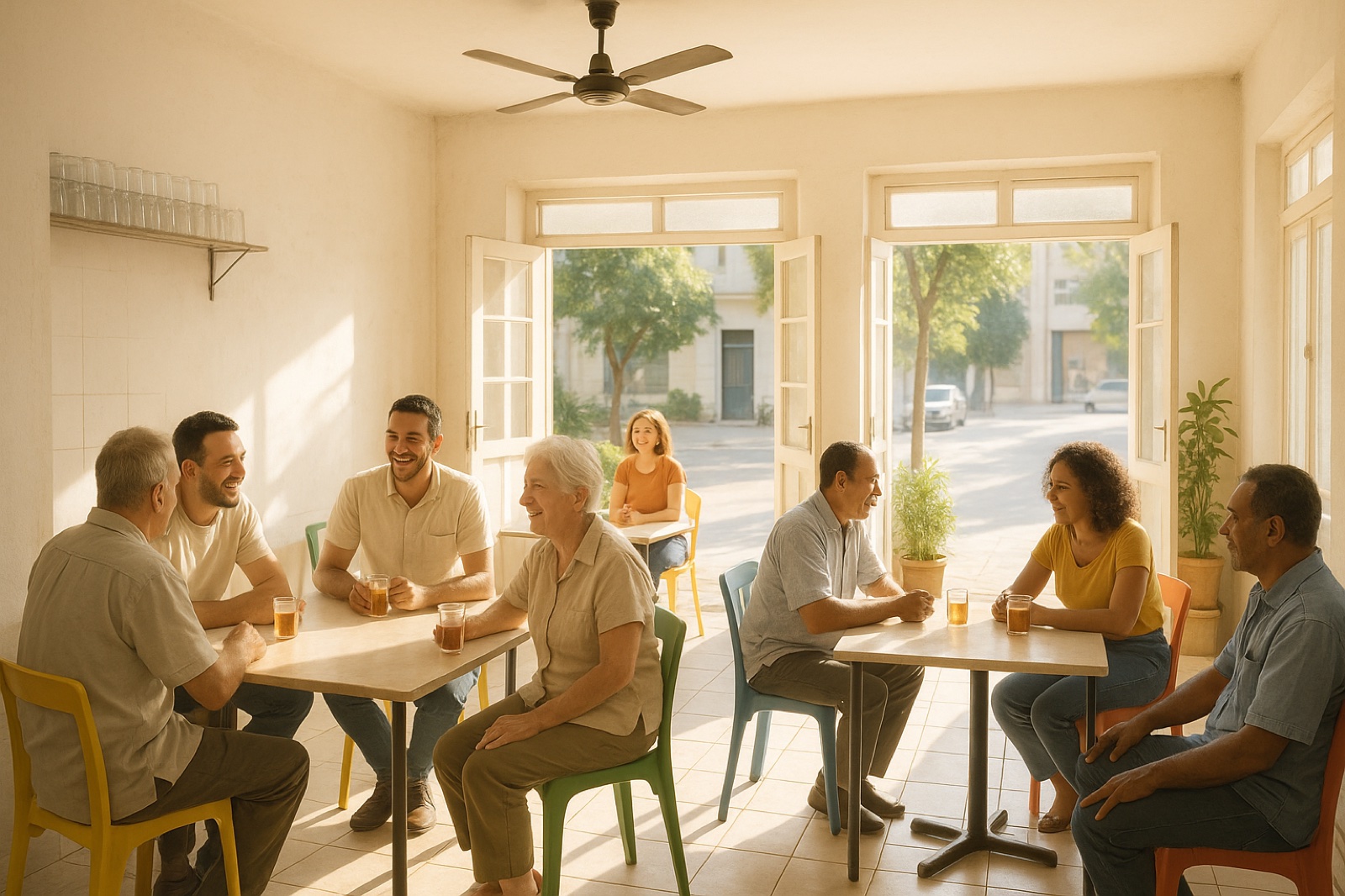
The first place is home. The second place is work. The third place is everything else — the tea shop, the barber’s chair, the market stall, the park bench, the gym, the corner shop, the front step where people sit in the evening.
His own definition is worth reading slowly, because the useful part sits in the middle of it. A third place, he wrote, is “a generic designation for a great variety of public places that host the regular, voluntary, informal, and happily anticipated gatherings of individuals beyond the realms of home and work.”
Regular. Voluntary. Informal. Happily anticipated.
Now think back over your last month. Almost nothing in an adult week is all four of those at once. Which is why the loneliness is so confusing to people who are not, on paper, short of friends. You have friends. You message them. You see them, occasionally, with enough planning.
The Part Almost Everyone Reads Past
Oldenburg did not stop at a definition. He listed what these places have in common, and the list is oddly specific. A third place is neutral ground. It is a leveller — nobody in it outranks anybody else. Conversation is the main activity. It is close enough to visit often. It is unpretentious and inexpensive. It has regulars. The mood is playful. It feels like a second home.
Most people skim that list and land on the warm-sounding items. The load-bearing one is the first: neutral ground.
Neutral ground means nobody is the host. Nobody invited you. Nobody has to clear up after you. Nobody is responsible for whether you enjoyed yourself. You can arrive and leave without explaining either one.
Which is exactly why the obvious fix does not work.
When you invite people to your home, you have not made a third place. You have made a first place with guests in it. Somebody has to tidy. Somebody is on duty. Somebody will be quietly judged on the food. And when you and a friend arrange to meet somewhere, you have made a small second place — an appointment, with a start time, that either of you can cancel.
Home is where you are responsible. Work is where you are ranked. A third place is the only setting where you are neither. That is the thing missing from a two-room week. Not company. Unearned company.
Why Near and Cheap Beat Good
The second overlooked item on the list is that a third place has to be close to you and it has to be inexpensive.
That reads like a footnote. It is the whole engine.
A third place runs on repetition. It is not built by one good evening; it is built by being recognised, and being recognised takes more visits than anyone expects. So the arithmetic is unforgiving. A wonderful place forty minutes away loses to a dull place five minutes away, every single time — because you will only visit the wonderful one when you have planned for it, and planning is the one ingredient a third place cannot contain.
Money works the same way. If each visit costs something that matters, you will ration the visits, and rationed visits never turn into regulars.
That is also the good news, and it is worth saying plainly for anyone reading this with no spare money at all: the requirements are near, cheap and repeatable. A bench. A stairwell. A stretch of pavement where people sit out. The same market on the same morning. A public library. A courtyard. Nothing on Oldenburg’s list asks you to buy anything.
Nobody Can Tell You How Many Have Been Lost
It is tempting to put a number here — some measure of how many third places have vanished. There does not appear to be an agreed figure, and inventing one would be worse than leaving the gap where it is.
The pressures are easier to describe. Third places are, almost by definition, the cheap low-margin ones, so they are the first to feel a rise in rent. A great deal of casual contact has moved onto screens, which are very good at messages and very bad at the accidental. And the second place has been thinning as well — our look at hybrid work and loneliness found the risk does not appear at one or two days at home, but climbs once most of the week is spent there.
Put those together and you get the two-room life. Not a tragedy. Just a shape that quietly removes the one setting where you were nobody’s guest and nobody’s subordinate. It also explains something a lot of people carry into the office itself: feeling invisible at work is far harder to shake when work is one of only two rooms you are ever in.
An Old Version of the Same Idea
There is something old underneath all this, older than the word for it.
Long before anyone sorted life into first, second and third places, the earliest communities that formed around God did not describe themselves by a building. The word they used for themselves — ekklesia — did not mean a hall or a temple. It meant, plainly, the gathering. The people, assembled.
And the oldest descriptions of what they actually did are almost boringly domestic. They met daily. In one another’s houses. And they ate together. No venue, no programme, no invitation needed — just the same people, often, on purpose, with food. Whoever kept those records seems to have thought the eating was the part worth writing down.
Which is a description of a third place, set down by people who had no word for it and did not need one.
What Actually Works
None of this needs a plan. It needs a lower bar.
- Pick near over good. Choose the closest thing to your door that has chairs and other people in it. It does not have to be nice. It has to be walkable.
- Go at the same time. Same morning, same hour. Being recognised is the entire mechanism, and it runs on pattern, not personality.
- Go alone. Somewhere you only ever visit with a friend is a meeting. Turning up by yourself is what leaves room for anyone else to speak to you.
- Give it many more visits than feels reasonable before you judge it. Nobody is a regular on the first visit, and almost nothing happens on the second.
If you are living far from the people who already know you — working abroad, away from family — this is usually the first thing to go missing, and the first thing worth rebuilding, because it is the one kind of belonging that does not require anybody to love you yet.
You do not need a community. You need somewhere to be, near your house, that costs nothing, where after a while somebody nods at you.
It is a low bar. It was always meant to be.
One Question
Do you think third places are genuinely disappearing, or just changing shape into something we have not learned to recognise yet? Tell us what you think in the comments — we read every one.
Share This
- Home is where you are responsible. Work is where you are ranked. A “third place” is the only setting where you are neither — and most adults no longer have one.
- Learned something today: inviting friends over does not solve the third-place problem. You have not made a third place, you have made a first place with guests in it. Somebody is still the host.
- A third place only works if it is near and cheap. A wonderful place forty minutes away loses to a dull one five minutes away every time, because the whole thing runs on repetition, not quality.
Questions People Ask
What is a third place?
A third place is a setting that is neither home nor work — a tea shop, a barber’s, a park bench, a market, a library, a gym, a front step. The term was coined by the American sociologist Ray Oldenburg in his 1989 book The Great Good Place, where he defined it as “a generic designation for a great variety of public places that host the regular, voluntary, informal, and happily anticipated gatherings of individuals beyond the realms of home and work.”
What are the characteristics of a third place?
Ray Oldenburg described a third place as neutral ground where nobody plays host; a leveller, where no one’s rank carries over; somewhere conversation is the main activity; close enough to visit often; unpretentious and inexpensive; populated by regulars; light-hearted in mood; and comfortable enough to feel like a second home. Neutral ground and low cost are the two that decide whether the others can happen at all.
Is a café or a gym a third place?
Only if it meets the conditions. A café visited once a month, forty minutes away, on a planned outing is not functioning as a third place — it is an appointment. The same café becomes one when it is close enough to drop into without deciding to, cheap enough to visit often, and visited regularly enough that the staff and the other customers start to recognise a face. The building does not make a third place; the frequency does.
Why does inviting friends to my home not have the same effect?
Because a home is a first place, and hosting reintroduces the two things a third place removes: responsibility and obligation. The host is on duty, the guests were invited rather than simply present, and both sides are aware the evening has to go well. A third place works precisely because nobody owns the room, nobody is being entertained, and anyone can leave without it meaning anything.
How do you find a third place if you don’t have one and have no money?
Start with proximity rather than quality. Pick the nearest free or near-free spot with seating and other people — a park, a public library, a market on a fixed morning, a courtyard, a stretch of pavement where neighbours sit out — and go at the same time each week, alone, for far longer than feels productive. Recognition is the mechanism, and recognition is built by repetition rather than by spending.