 0
0
 0
0
In a national park in western Thailand there is a flower you could stand directly on top of and never see.
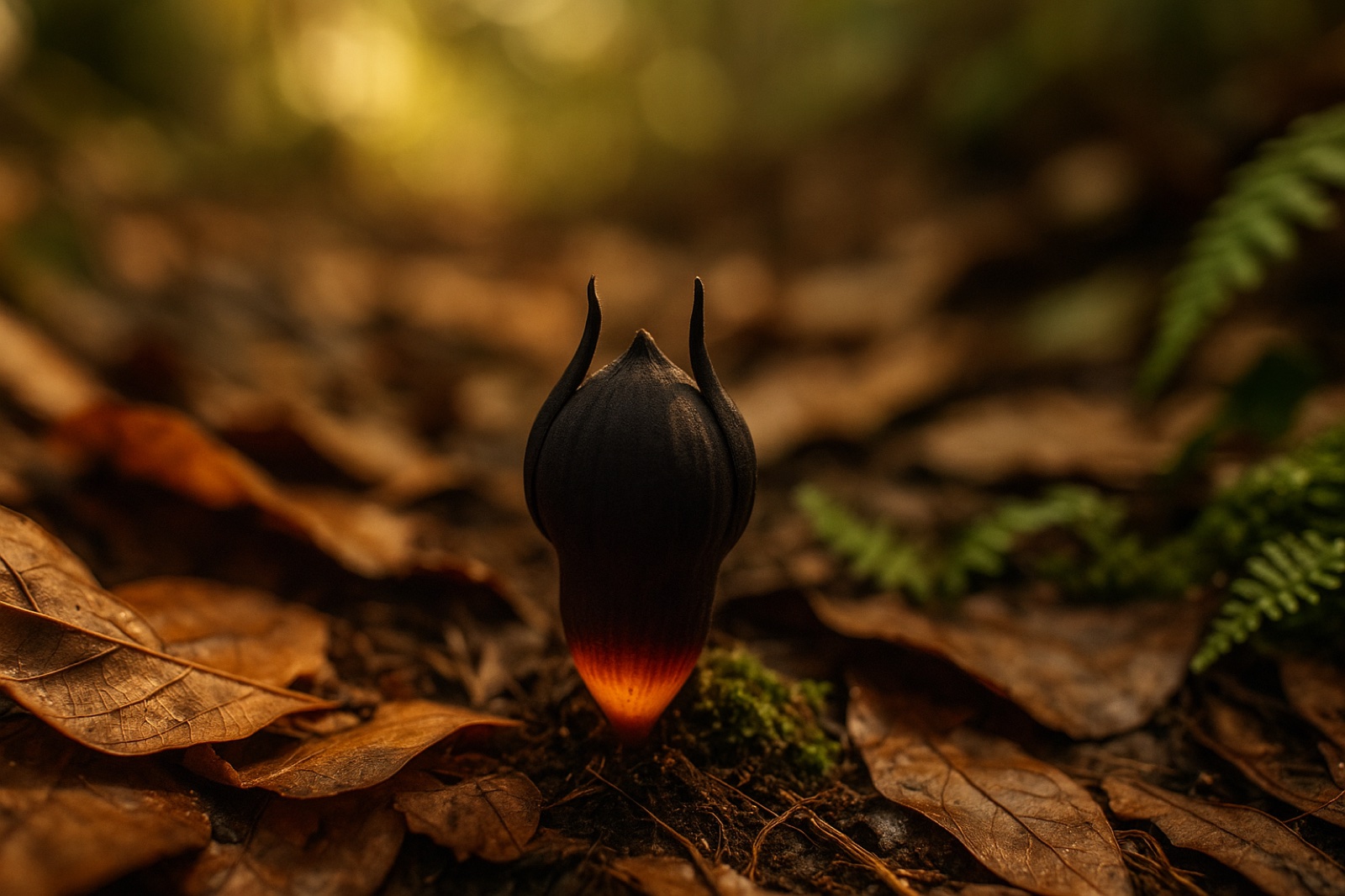
It is small. It is black. It has what look like horns. And it spends nearly its whole life beneath the leaf litter, below the point where anybody thinks to look. Botanists have just given it a name: Thismia daemona — already better known as the devil flower.
The strange part is not the horns. It is that almost nothing about how this plant lives is what a plant is supposed to do.
What the Devil Flower Actually Is
The devil flower belongs to a genus called Thismia, a group of tiny plants sometimes nicknamed “fairy lanterns” for the little lamp-shaped blooms they push up through the soil.
It was described by a team of botanists from Chulalongkorn University and Prince of Songkla University, working in Thong Pha Phum National Park in western Thailand. Their paper was published in September 2026 in the open-access journal PhytoKeys. With it, the number of Thismia species recorded in Thailand rises to sixteen.
The flower itself is mostly black, with slender horn-like points standing over a dome-shaped cap, and patches of vivid reddish orange low down near the base. That combination is where the name came from. One of the researchers, Dr Sahut Chantanaorrapint of Prince of Songkla University, put it this way: “Combined with its hidden, subterranean and mysterious lifestyle on the forest floor, our team unanimously agreed that naming it Thismia daemona perfectly captured its enigmatic and devil-like essence.”
A name for how it looks and where it hides, in other words. Not a claim about what it is.
A Plant That Gave Up the One Thing Plants Do
Here is the genuinely odd part.
The devil flower is not green, because it has no chlorophyll at all. No chlorophyll means no photosynthesis. No photosynthesis means it cannot turn sunlight into food — which is, more or less, the whole job description of being a plant.
So it doesn’t. It draws its nutrients from fungi in the soil instead. Botanists call plants that live this way mycoheterotrophs, and there are not many of them. This one has taken the arrangement about as far as it goes: no green tissue, no sun, and nearly its entire life spent under a layer of dead leaves.
Which sounds like a plant that has failed at being a plant. It is closer to the opposite. It is a plant that opted out of the visible economy of the forest and into the hidden one underneath it — the same buried fungal infrastructure that scientists only recently managed to map at global scale, and which has been quietly feeding forests the entire time.
It Was Hiding in the Wrong Place — Which Is Why Nobody Found It
This is the detail that got least attention, and it is the most interesting thing in the paper.
Thismia species are typically found in perennially humid lowland rainforest. Wet, low, warm, year-round. That is where you would go looking, and that is where botanists have generally looked.
This one turned up at nearly 1,000 metres — around 3,300 feet — in seasonal montane evergreen forest. Higher up, and dry for part of the year. Not just a new species, then, but a new species living somewhere the group was not expected to manage at all.
It is worth sitting with what that means. The flower was not missed because it was too rare to be found. It was missed because the map everyone was using said there would be nothing here worth stopping for.
Found and Nearly Lost in the Same Paper
The team located fewer than 50 individual plants, in a single population, in an area smaller than a football pitch.
On that basis the species has been provisionally assessed as Critically Endangered — partly because that small patch of forest sits close to where visitors go.
So the entire known population of this species on earth would fit comfortably inside a small field. And we learned that it exists and that it is in serious trouble in the same document. There was no gap between the two.
What Grows Where Nobody Is Looking
Take the whole thing in at once.
A flower that makes no food of its own. That lives below the surface. That was found in the last place anyone would have thought to search. That has presumably been doing this in that forest for a very long time — and no human being had ever written it down until this year.
Nothing about it was arranged for us. Whatever the horns and the dark cap and the ember-coloured base are for, we were not the audience; we only just arrived. And it is still one of the more remarkable things standing in that forest.
There is an old idea, much older than botany, that the unseen parts of a life are not the leftovers of it. That what happens where nobody is watching is not somehow less real for going unrecorded, and that God is not up in the sky waiting to be shown the highlights, but already down at the level of the leaf litter, where most of the actual work of the world gets done. Every forest turns out to be built exactly that way. The green part everybody photographs is standing on top of an enormous hidden economy that never once gets the credit.
Most of a Life Happens Under the Leaf Litter
Most of what you have done was not seen either.
The shift nobody thanked you for. The night you sat up with someone who does not remember it. The temper you kept. The thing you quietly did not do, that nobody will ever know you did not do. The years of showing up to something ordinary while it looked, from the outside, like nothing much was happening — the same way a field can look like a failed field for eleven years and be becoming a meadow the whole time.
None of that is filed anywhere. There is no paper on it.
The devil flower spent an unknown number of years being extraordinary in a place with nobody in it. Then somebody finally looked in the wrong place, and there it was — horns, ember-coloured base and all, exactly as it had been.
If you are in one of those stretches where it is hard to say what any of it is adding up to, our free What Is My Purpose? assessment is a low-pressure place to start putting words to it.
A Question Worth Arguing About
This species was named and listed as Critically Endangered in the same paper, with its location described. Some people argue that publishing exactly where a fifty-plant population lives is an invitation to collectors and curious visitors. Others argue that a species nobody knows about cannot be protected at all. Which risk would you rather take? Tell us where you land in the comments.
Share This
Botanists in Thailand just named a black flower that has no chlorophyll, cannot feed itself from sunlight, and spends nearly its whole life under the leaf litter. Fewer than 50 of them are known to exist. https://bgodinspired.com/index.php/nature-and-creation/devil-flower-thailand-underground/
My favourite detail about the new “devil flower”: it wasn’t missed because it was too rare to find. It was missed because it was growing somewhere nobody thought to look. https://bgodinspired.com/index.php/nature-and-creation/devil-flower-thailand-underground/
A plant that gave up photosynthesis, lives off fungi, blooms under dead leaves, and was completely unknown to science until this year. Nature is not short on strange. https://bgodinspired.com/index.php/nature-and-creation/devil-flower-thailand-underground/
Questions People Ask
What is the devil flower?
The devil flower is Thismia daemona, a plant species described in 2026 from Thong Pha Phum National Park in western Thailand by botanists from Chulalongkorn University and Prince of Songkla University, in the open-access journal PhytoKeys. It is a small, mostly black flower with slender horn-like points above a dome-shaped cap and vivid reddish-orange patches near its base. It belongs to the genus Thismia, a group of tiny plants nicknamed “fairy lanterns,” and it spends nearly all of its life underground beneath forest leaf litter.
Why is the devil flower black instead of green?
It has no chlorophyll, the pigment that makes plants green and allows them to photosynthesise. Because Thismia daemona cannot make its own food from sunlight, it takes nutrients from fungi in the soil instead. Plants that feed this way are called mycoheterotrophs. Living off fungi rather than sunlight is also why the plant can survive almost entirely below the surface, where no light reaches.
Where was Thismia daemona found?
It was found in Thong Pha Phum National Park in western Thailand, at close to 1,000 metres — roughly 3,300 feet — in seasonal montane evergreen forest. That setting is notable because Thismia species are typically recorded in perennially humid lowland rainforest, which is drier and lower than where this one was growing. The discovery brings the number of Thismia species recorded in Thailand to sixteen.
How rare is the devil flower?
Very. The researchers found fewer than 50 individual plants, in a single population, occupying an area smaller than a football pitch. On that basis the species has been provisionally assessed as Critically Endangered, in part because the site lies close to areas used by visitors. No other population is currently known anywhere in the world.
Why is it called the devil flower?
The name comes from the plant’s appearance and its habits, not from any belief about it. It is mostly black, carries horn-like appendages over a dome-shaped cap, and has bright reddish-orange patches at the base that some popular write-ups have compared to glowing eyes. Dr Sahut Chantanaorrapint of Prince of Songkla University said the team also had its hidden, subterranean lifestyle in mind, and unanimously agreed the name Thismia daemona captured its enigmatic and devil-like essence.