 0
0
 0
0
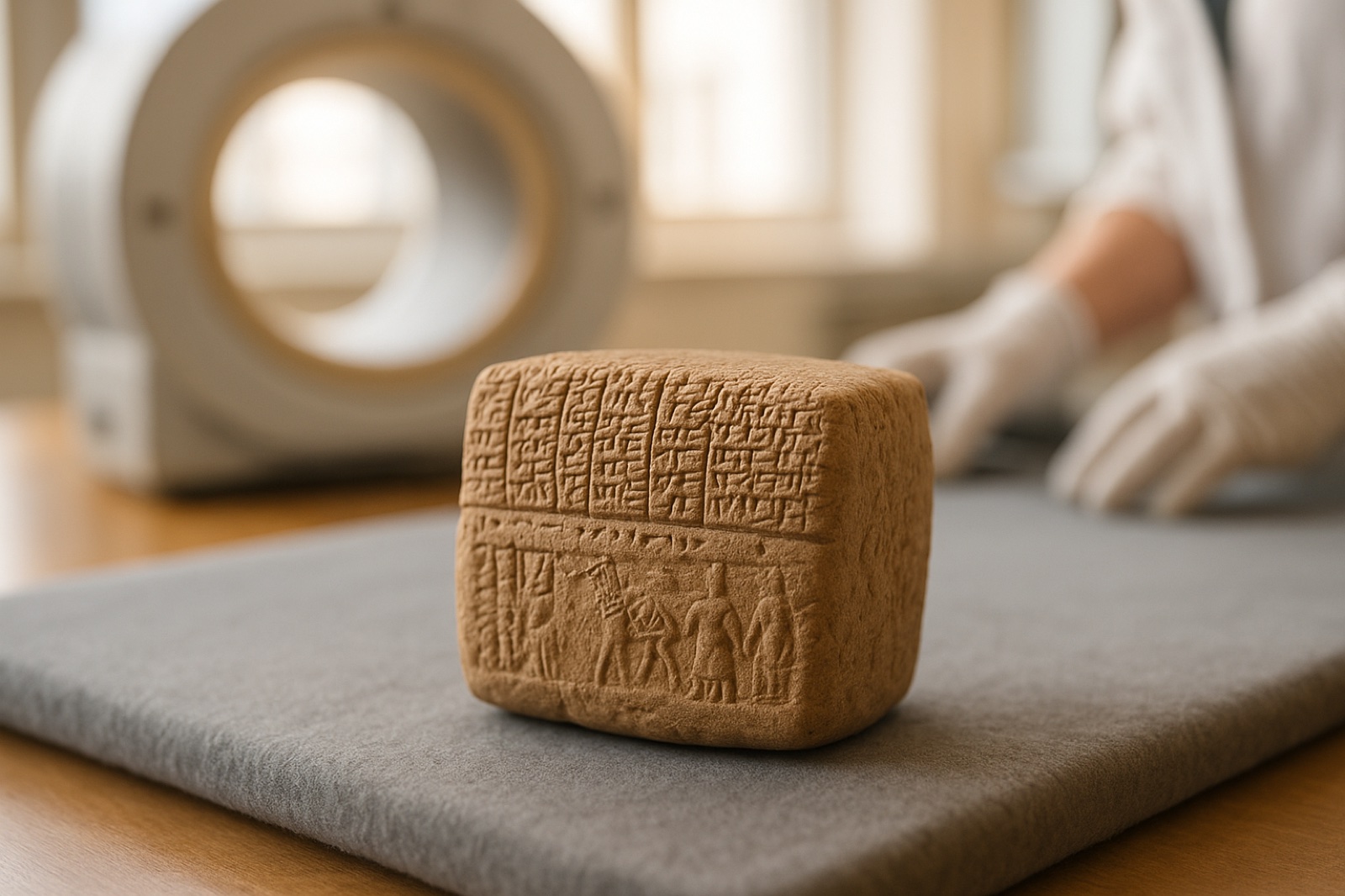
There is a lump of dried clay in a museum in Ankara, roughly the size of a bar of soap, with writing pressed into every face of it. The writing on the outside is an address and a set of seal marks. The writing on the inside is a letter, and until recently nobody had read it for close to four thousand years.
For most of the time archaeologists have known about objects like this, reading a 4,000-year-old sealed letter meant smashing the clay case around it. You could keep the envelope, or you could have the message. Not both.
In September 2024, a team carried a machine into the Museum of Anatolian Civilisations and read one without touching the seal.
How a 4,000-Year-Old Sealed Letter Was Read Without Opening It
The machine is called ENCI, short for Extracting Non-destructively Cuneiform Inscriptions. It is an X-ray computed tomography scanner — the same basic idea as a hospital CT scan, pointed at clay instead of at a person. It builds a 3D model of everything inside, layer by layer, so the wedge marks on the hidden tablet can be lifted out and read on a screen.
The clever part is not the physics. It is the luggage.
Tablets like these do not travel well, and museums are understandably reluctant to post 4,000-year-old clay to a laboratory in another country. So the team built a scanner that travels instead. The whole rig weighs about 420 kilograms and comes apart into eight pieces, which means it can be driven to a museum, carried up the stairs, and reassembled in a room next to the collection. Once it is set up, a sealed tablet takes minutes.
It was built by a group led by the Assyriologist Cécile Michel and the X-ray physicist Christian G. Schroer, with specialists from the University of Hamburg and DESY, the German particle physics laboratory. They tested it first at the Louvre in Paris, then took it to Ankara for a three-week campaign, where they recorded 64 scans of 48 tablets and other objects. The results were published this year in npj Heritage Science.
Why Anyone Sealed a Letter in Clay
The objects come from Kültepe, in central Türkiye — the ancient city of Kanesh. Nearly four thousand years ago, in what we now call the nineteenth and eighteenth centuries BC, merchants from the city of Assur ran a long-distance trading network out of a neighbourhood there. Their business was conducted by caravan, across hundreds of kilometres, and it ran on letters.
A letter written on a damp clay tablet is not private. Anyone who picks it up can read it. So the tablet was wrapped in a second, thinner layer of clay — an envelope — and the outside was inscribed with the name of the person it was for. Seals were then rolled across the surface, leaving a picture that identified the sender. Once the envelope dried, the only way to read the letter was to break the clay, which meant the recipient could see at a glance whether anyone had got there first.
It was a mail system, a signature and a tamper seal, all made out of mud.
It also worked far better than anyone intended. More than 23,000 tablets have come out of Kültepe, and some of them are still sitting inside envelopes that nobody ever broke — letters that arrived, or perhaps never arrived, and simply stopped. That unopened stack is the whole reason a machine like ENCI exists.
We are strangely good at this, as a species — leaving durable traces of ordinary business without meaning to. It is the same accident that let divers recover the recipe ancient shipbuilders used to waterproof a hull, and the same one that left the outlines of Anglo-Saxon bodies in sand long after the bones had dissolved. Almost nothing survives on purpose. What survives is whatever happened to be hard enough.
The Woman Who Was Told to Come Back With Her Husband
One of the letters read in Ankara was written by a woman named Anna-anna, to her husband Ennum-Aššur, a merchant who was away.
Someone owed him silver. In his absence, she went after it.
She did not get it. The debtor did not deny the debt. He simply would not settle it with her — he would pay, he said, when her husband came back. So she was left holding a claim she could not collect, waiting for a man who was somewhere else, and the letter carries her frustration about exactly that.
Sit with that for a moment, because it is a very specific kind of unheard. She was not ignored because she was wrong. She was standing right there, in possession of the facts, doing the work — and she was told her word was not the one that counted. The answer would have to wait for someone else to arrive.
Then the letter was sealed. And whatever she hoped would happen next, this is what actually happened: for close to four thousand years, not one person read that sentence.
There is a detail here that is easy to walk past. Cécile Michel, the scholar who led the team that scanned these envelopes, has spent much of her career on precisely these women — she published a whole volume of the letters written by the women of Assur and Kanesh, who ran households, produced textiles, handled money, and wrote about all of it. The archive kept their words. History mostly did not bother to look. The person who built a machine capable of reading a sealed letter is the same person who has spent decades arguing that the women’s half of the archive is worth reading at all.
What Waited Four Thousand Years to Be Read
It is a small letter about a small debt, and it should not land as hard as it does. But most of us know the shape of it. You say the true thing. You say it to the person who could act on it. And nothing moves — not because you were wrong, but because you were not the one they were waiting to hear from.
There is an idea about as old as the clay itself, running quietly under the oldest writing anyone has found, that a word does not need an audience to have landed. That the sentence said into an empty room, or written down by someone whose word nobody would honour, was already heard — by God, at the moment it was said, and not four thousand years later by a stranger with a scanner. You do not have to believe it to feel the pull of it while looking at a sealed envelope. It is simply the oldest answer anyone has offered to the fear sitting underneath Anna-anna’s letter: the fear that saying something and being heard are two different events.
The tablet is still in Ankara. The debt was never our business, the husband came home or he did not, and the city that both of them lived in is a mound of earth now with a car park beside it.
And a woman’s complaint about being made to wait outlasted every single one of those things — the debt, the marriage, the trade route, the language, the empire. Somebody carved letters into wet clay about an ordinary bad afternoon, and it is the part that survived. It is worth noticing what else that has happened to: not the monuments, but a bird the size of a thumbnail, carved by someone who was cold and hungry 40,000 years ago. The small things people bothered to make keep turning out to be the durable ones.
There are more envelopes on the shelf, still shut. The machine comes apart into eight pieces and fits in a van.
Questions About the Kültepe Sealed Letters
How were 4,000-year-old sealed cuneiform letters read without opening them?
A portable X-ray computed tomography scanner called ENCI (Extracting Non-destructively Cuneiform Inscriptions) was used to scan clay tablets while they were still inside their sealed clay envelopes. The scan produces a high-resolution 3D model of the object, allowing researchers to read the wedge-shaped cuneiform signs on the hidden inner tablet on a screen without breaking the outer clay. The results were published in the journal npj Heritage Science in 2026.
What is the ENCI scanner and who built it?
ENCI is a mobile X-ray computed tomography scanner designed specifically to read sealed cuneiform tablets. It weighs roughly 420 kilograms and disassembles into eight components so it can be transported to a museum rather than requiring fragile artefacts to be shipped to a laboratory. It was developed by an interdisciplinary team led by the Assyriologist Cécile Michel and the X-ray physicist Christian G. Schroer, with specialists from the University of Hamburg and DESY in Germany, and was first tested at the Louvre in Paris before a three-week campaign at the Museum of Anatolian Civilisations in Ankara, where 64 scans of 48 objects were recorded.
Where do the sealed cuneiform tablets come from?
Many of the scanned objects come from Kültepe in central Türkiye, the site of the ancient city of Kanesh, where merchants from the Assyrian city of Assur ran a long-distance trading colony during the nineteenth and eighteenth centuries BC. More than 23,000 cuneiform tablets have been excavated there, including business records, contracts and private letters found in the merchants’ own houses.
Why were ancient letters sealed inside clay envelopes?
A cuneiform tablet is readable by anyone who picks it up, so a letter intended to stay private was wrapped in a thin outer layer of clay. The envelope was inscribed with the recipient’s name and impressed with seals identifying the sender, which meant the message stayed private in transit and the recipient could tell whether anyone had opened it first. Envelopes were also used for legal and financial documents such as loans of silver.
What did Anna-anna’s letter say?
Anna-anna wrote to her husband Ennum-Aššur, a merchant who was away from home, about silver he was owed. She had tried to collect the debt herself, and the debtor refused to repay her directly, insisting he would settle only when her husband returned. The letter records her frustration at being left waiting. It was sealed inside its clay envelope and remained unread until it was scanned.
A Question Worth Sitting With
If one ordinary thing you wrote this year survived for four thousand years — not your best work, just whatever happened to be written on the most durable surface — what do you think it would be? A note on a fridge? A message you sent when you were annoyed? Tell us in the comments what you think future archaeologists would end up with, and whether that is a fair record of you.
Share This
- A woman wrote a letter about a debt nobody would settle with her because she wasn’t her husband. It stayed sealed in clay for 4,000 years. A scanner just read it without breaking the seal. https://bgodinspired.com/index.php/bible-resources/bible-history/4000-year-old-sealed-letter-read-without-opening/
- Reading a sealed 4,000-year-old letter used to mean smashing the envelope. Researchers built a CT scanner light enough to carry into the museum instead — and the first thing it read was an ordinary woman’s very bad afternoon. https://bgodinspired.com/index.php/bible-resources/bible-history/4000-year-old-sealed-letter-read-without-opening/
- Not the monuments. Not the kings. What survived from a whole trading city is a woman’s complaint about being told to come back when her husband was home. https://bgodinspired.com/index.php/bible-resources/bible-history/4000-year-old-sealed-letter-read-without-opening/