 0
0
 0
0
Here is something most people never hear about a stroke: the damaged part of the brain does not simply scar over. It empties out.
When blood stops reaching a piece of brain tissue, that tissue dies in an unusual way. It softens, breaks down into liquid, and is slowly cleared away, leaving a fluid-filled cavity where working brain used to be. Doctors have a name for the end stage of that process — cystic encephalomalacia. Left alone, the cavity can sit there, unchanged, for the rest of a person’s life.
That is the quiet reason stroke brain repair is so hard. The problem is not only that the brain will not rebuild. It is that in that exact spot there is nothing left to rebuild along — no structure, no framework, no surface for a new cell to take hold of. Just space.
A research team at Duke University decided to put a structure into the space on purpose. What grew into it was not quite what anyone expected.
One thing to be clear about before going further: this work was done in mice. There is no clinical trial, no available treatment, and nothing a person recovering from a stroke can ask a doctor for today. The researchers use the word “preclinical” themselves. Read what follows as a finding about how healing works — not as news about a cure.
Why Stroke Brain Repair Stalls in the First Place
Most of the body heals by building on what is still there. A cut closes because the edges have something to grip. Bone knits because there is bone on both sides of the break. Even a torn muscle has a mesh of connective tissue running through it, and the new fibres follow that mesh the way a climbing plant follows a trellis.
A stroke cavity has none of that. The trellis is gone. Cells at the rim may be perfectly willing to migrate into the gap, but there is nothing in the gap to migrate on.
There is a second problem, and it has a worse reputation than the first. After a stroke, immune cells flood the injured area. One type in particular — the neutrophil, the body’s fast, blunt first responder — has spent decades in the research literature as a villain of early stroke injury, associated with inflammation that makes the damage worse rather than better. Hold onto that, because it matters later.
A Structure You Can Inject
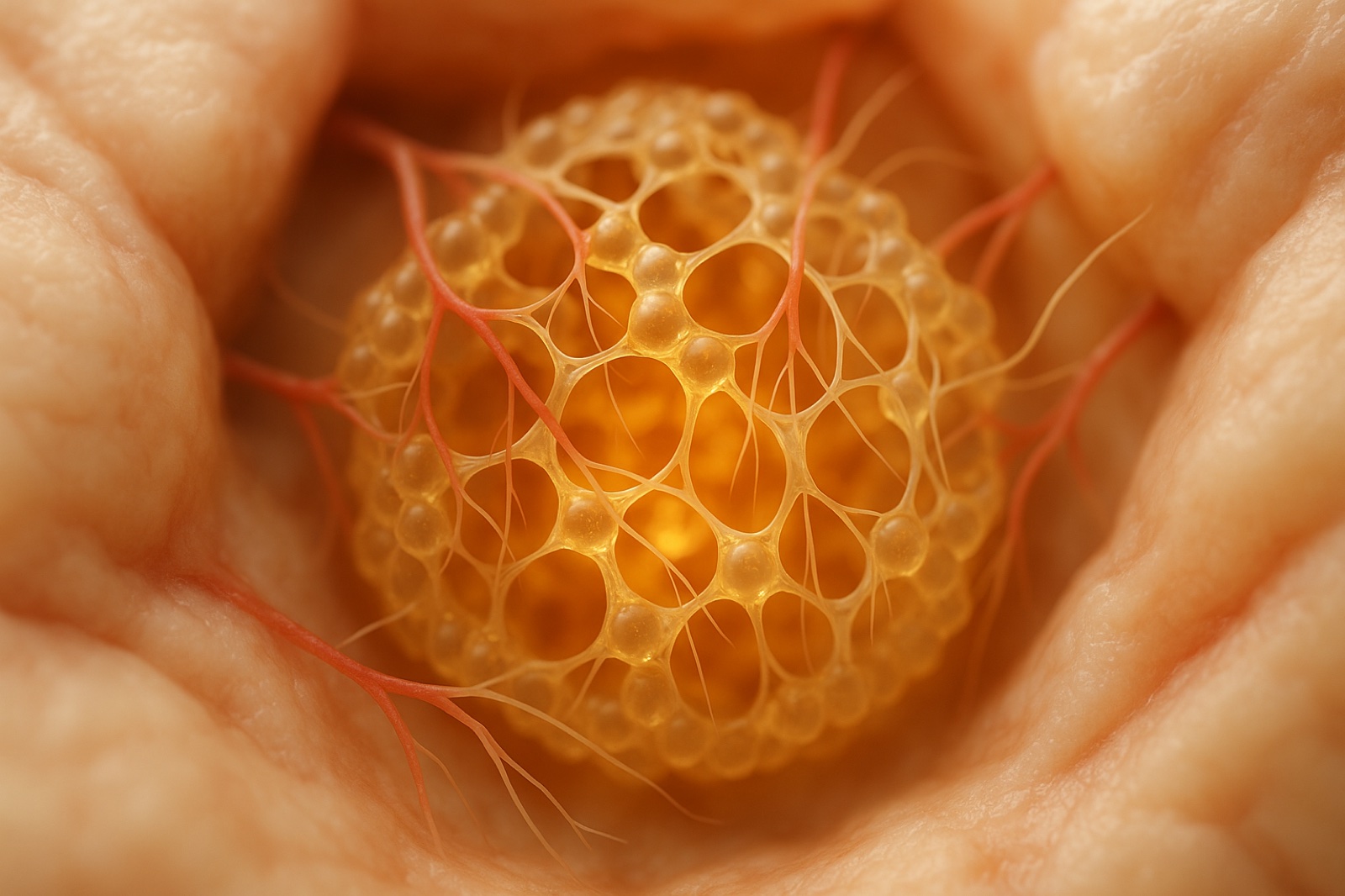
The Duke approach, published in July 2026 in the journal Cell Biomaterials, uses something called a microporous annealed particle scaffold, or MAPS. The idea is simple enough to picture. Tiny hydrogel microparticles are injected as a slurry, and once in place they link to each other and set into a porous three-dimensional network.
The pores are the whole point. The gaps between the particles are big enough for living cells to crawl into. So rather than a solid plug that cells would have to chew through, the cavity gets something closer to open scaffolding — a structure with room to work inside it.
Onto the surfaces of those particles the team anchored extracellular vesicles harvested from astrocytes, the brain’s support cells. Extracellular vesicles are small packets that cells release to send materials and instructions to other cells. These particular ones came from astrocytes that had been activated with two signalling molecules, IL-4 and C1q, chosen to call immune cells in.
So: a structure to grow along, plus a chemical invitation to come and grow.
What happened in the treated mice was that new blood vessels formed throughout the cavity. Axonal fibres — the long wiring that nerve cells send out to reach one another — increased in and around the damaged regions. And the animals got better at walking.
That last part was measured with a grid-walking test: a mouse crosses a wire grid, and a paw slipping through a gap counts as an error. Treated mice improved steadily until, by week eight, they were performing similarly to healthy mice that had never had a stroke at all. The improvement held for the rest of the study.
The Cells Blamed for the Damage Turned Up as the Repair Crew
Inside the scaffold, the researchers found a population of neutrophils — the villains from earlier — that showed up and then, unusually, stayed.
This is where the study does the thing that separates an interesting observation from an actual finding. It would have been easy to note the neutrophils and move on. Instead the team removed them. If the neutrophils were incidental passengers, depleting them should have changed very little.
It changed a lot. With the neutrophils reduced, blood vessel formation declined substantially and the scaffold underwent noticeably less remodelling. The cells with the bad reputation were not bystanders in the repair. They were holding it up.
Shangjing Xin, the postdoctoral fellow who led the work, described the situation this way: their role “appears to depend on when they arrive, where they are located and the signals they receive.”
That is a modest sentence with a great deal packed into it. It says the cell is not the problem. A neutrophil is not good or bad by nature. What it becomes depends on the conditions it lands in.
The Control Test That Changes the Story
There is an obvious question hiding in all of this, and to their credit the researchers went and answered it: was the healing caused by the vesicles, or by the scaffold?
They delivered the vesicles on their own, without the scaffold. The result did not come close — vesicles alone failed to produce comparable blood vessel repair.
This is the part that is easiest to read past and hardest to forget once you have noticed it. The active ingredient was not sufficient by itself. The signal needed somewhere to be concentrated, and the cells answering it needed somewhere to go. The structure was not the packaging around the treatment. The structure was half the treatment.
Put plainly: the medicine was not enough. The medicine plus a place to work was enough.
What This Does Not Mean Yet
It is worth being careful here, because health headlines routinely outrun the studies underneath them — something we have looked at closely before with another mouse study that travelled a long way from what its authors actually claimed.
So, the limits, stated by the researchers themselves. The findings are preclinical. The scaffold was injected directly into damaged sites. Safety has not been evaluated. Larger animal models still need to be tested, and vesicles from human astrocytes are listed as future work rather than completed work. Plenty of things that repair a mouse brain never repair a human one.
What is genuinely new is not a treatment. It is a better description of what was missing. Set alongside other recent work on how the adult brain repairs itself, the picture that keeps emerging is that the capacity to heal was mostly there all along, waiting on conditions rather than on permission.
If you are reading this because someone you love had a stroke, that distinction is probably not much comfort today, and the caregiving is the harder part anyway. If that is where you are, our free Am I Burned Out From Caregiving? check takes a couple of minutes and is worth being honest with.
Healing That Does Not Erase
There is a picture of healing most of us carry without examining it: the damage undone, the gap filled in, everything returned to how it was before. Erasure. As if the goal were to make the injury never have happened.
This study describes something else entirely. Nothing was erased. The cavity was not reversed. What changed was that a structure was placed inside the emptiness so the body’s own cells finally had something to work along — and the very thing that had done the harm was reassigned rather than removed.
It is an old idea, considerably older than any laboratory, that restoration works this way: that the damage is not pretended away, and that nothing gets discarded — not even the part of the story that caused the wreckage. It gets given a different job. People who have carried something heavy for a long time tend to recognise that description before they can explain it. In that older telling, God is not in the business of erasing. The work is redemption, which is a stranger and better thing.
The Shape of the Finding
For now this remains a mouse, a hydrogel, and a grid of wires in a laboratory in North Carolina. It would be a disservice to anyone waiting on real news to call it more than that.
But the shape of it is easy enough to carry around. Healing needed somewhere to happen before it could happen at all. And the cells everyone had written off as the cause of the damage turned out to be the ones doing the rebuilding, once the conditions around them changed.
Both of those seem worth remembering the next time something looks past repair.
A Question Worth Sitting With
Which half of this lands harder for you — that healing needed a structure before it could begin at all, or that the cells blamed for the damage turned out to be necessary for the repair? There is no right answer, and people split fairly evenly on it. Tell us which one you picked, and why, in the comments.
If You Want to Share This
- A stroke leaves an actual cavity in the brain — and nothing for new cells to grow along. Duke put porous scaffolding into the gap and blood vessels grew into it. Mice, not people, but still one of the more hopeful things I have read this year. https://bgodinspired.com/index.php/health-and-wellness/stroke-brain-repair-scaffolding/
- The strange part of this stroke study: the immune cells famous for making stroke damage worse turned out to be necessary for the repair. Researchers removed them and the healing slowed right down. https://bgodinspired.com/index.php/health-and-wellness/stroke-brain-repair-scaffolding/
- The treatment on its own did almost nothing. The treatment plus a structure to work inside changed everything. I suspect that applies to more than brains. https://bgodinspired.com/index.php/health-and-wellness/stroke-brain-repair-scaffolding/
Questions People Are Asking
Can the brain repair itself after a stroke?
The adult brain has a limited ability to repair itself after a stroke, and one of the obstacles is physical rather than biological. A severe stroke leaves a fluid-filled cavity where brain tissue used to be, and that cavity contains no structure for new cells to grow along. In a 2026 Duke University study published in the journal Cell Biomaterials, researchers injected a porous hydrogel scaffold into stroke cavities in mice, and new blood vessels and nerve fibres grew into it. The work is preclinical, and no equivalent treatment exists for people.
What is a MAPS scaffold?
MAPS stands for microporous annealed particle scaffold. It is built from tiny hydrogel microparticles that are injected as a slurry and then link together in place, forming a porous three-dimensional network. The gaps between the particles are large enough for living cells to migrate into, which is what distinguishes a MAPS scaffold from a solid gel implant that cells would have to break down before entering.
Are neutrophils harmful or helpful after a stroke?
Neutrophils are usually described as harmful in the early stages of a stroke, where they contribute to inflammation and worsen tissue damage. Research published in Cell Biomaterials in 2026 found that inside an implanted porous scaffold, neutrophils instead supported repair: when researchers depleted the neutrophil population, blood vessel formation declined substantially and the scaffold underwent less remodelling. The finding suggests neutrophil behaviour depends on timing, location and surrounding signals rather than on the cell type alone.
Has the Duke stroke scaffold been tested in humans?
No. As of September 2026, the Duke stroke scaffold has been tested only in mice. The researchers describe the findings as preclinical and state that further studies are required to evaluate safety and to test the approach in larger animal models before any clinical use could be considered. No human clinical trial has been announced.
What did the treated mice actually recover?
Motor function. Recovery was measured using a grid-walking test, in which an animal crosses a wire grid and a paw slipping through a gap counts as an error. By eight weeks after treatment, mice that received the scaffold loaded with astrocyte-derived extracellular vesicles performed similarly to healthy mice that had never had a stroke, and that improvement was sustained for the remainder of the study.
Source: Duke University Pratt School of Engineering.