 0
0
 0
0
Someone will quote it to you at the funeral. Two words, the shortest verse in the Bible, offered gently while you are holding a cup of something you are not going to drink. Jesus wept.
And it helps, a little. It is meant to. It says God is not embarrassed by your crying. It says the tears are allowed.
Then you go home, and the house is the wrong kind of quiet, and somewhere in the second or third week something shows up that those two words do not seem to cover. It is not sadness. It has an edge on it. You are angry. At the delay. At the phone call that came too late. At the disease, at the road, at the ordinary morning that was allowed to keep going as if nothing had happened.
And because everyone told you grief is sadness, and this is clearly not sadness, you assume it is a fault in you. A crack in your faith. Something to take to God once you have calmed down enough to be presentable.
It is not a fault. And the evidence is sitting two verses above the one they quoted at you.
Why “Jesus Wept” Is Not the Whole Sentence
Almost nobody reads John 11:35 with what comes before it. We have made those two words into a standalone comfort card. In the chapter itself they are the middle of a scene, and the scene starts somewhere much stranger.
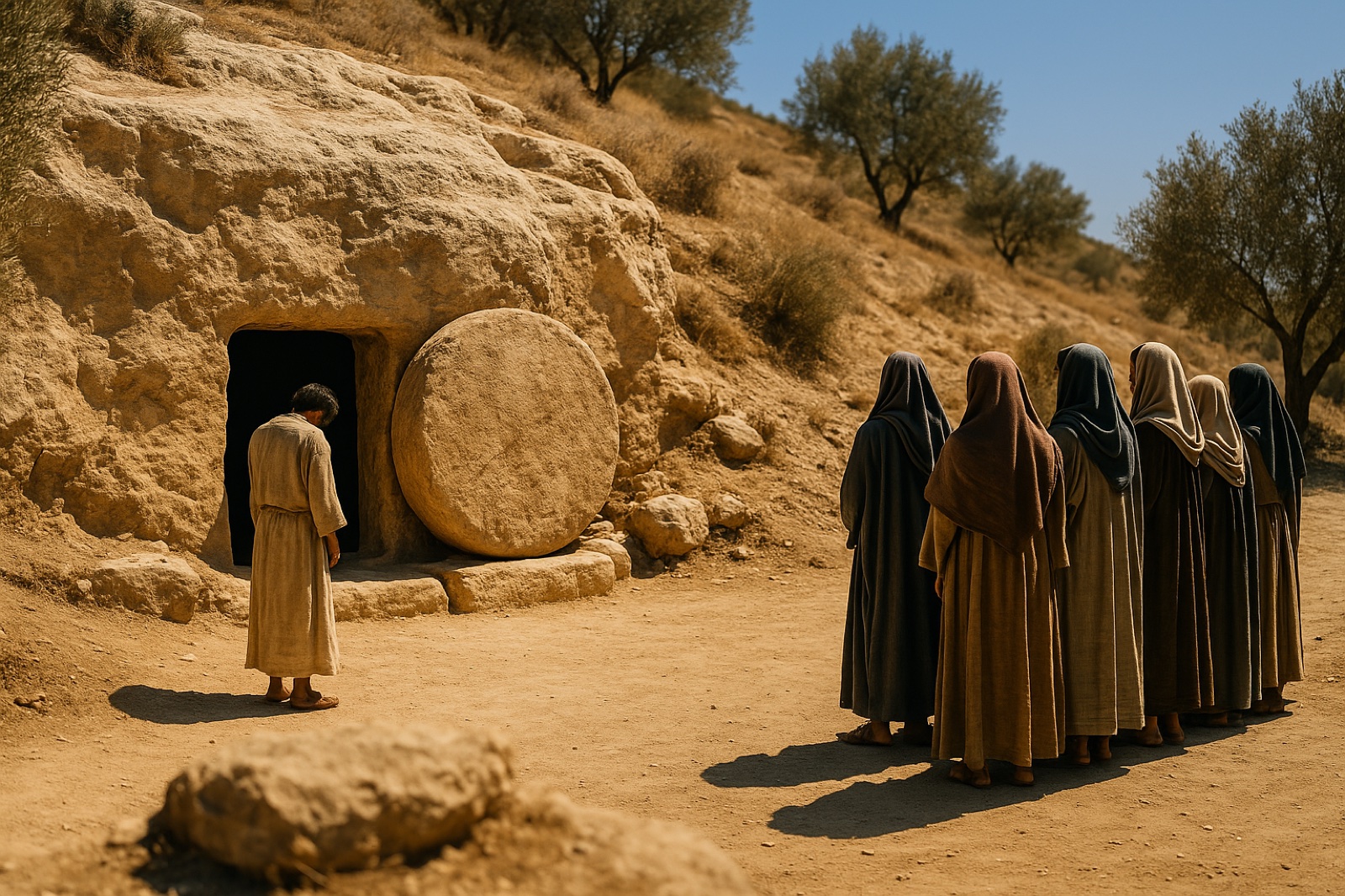
Lazarus is dead four days. Martha has already said her line. Mary comes out of the house and falls at Jesus’s feet and says the same thing her sister said — if you had been here, my brother had not died. Behind her comes a crowd of mourners, and they are not being quiet about it.
Here is what John records next, in the King James:
“When Jesus therefore saw her weeping, and the Jews also weeping which came with her, he groaned in the spirit, and was troubled,” — John 11:33, KJV
Groaned. Not wept. Not sighed. The tears are still two verses away.
Most of us skate straight over that verse on the way to the famous one. But it is the load-bearing verse in the passage, and the Greek underneath it is not soft.
The Word for Jesus Is Not the Word for the Crowd
John is using different vocabulary for different people standing in the same place, and once you see it you cannot unsee it.
The crowd is klaiō (Strong’s G2799). It means loud lamentation — audible, public, communal grief. It is the word used a few verses earlier for Mary going out to the grave to weep. If you have been to a funeral where the wailing carries down the street and the neighbours come out, you already know exactly what this word sounds like. This is not restrained sorrow. This is a whole village making noise at death.
Jesus is embrimaomai (Strong’s G1690), and that is a completely different animal. Literally, it is built from a verb for snorting — the sound a war horse makes. Strong’s gives it as “to have indignation on.” Thayer’s gives “to be very angry, to be moved with indignation.”
It appears five times in the whole New Testament. Twice it is here, at this tomb. The other three times, it is doing exactly what you would expect a word like that to do: twice it describes Jesus giving a stern, almost fierce warning to somebody He has just healed, and once it describes a crowd scolding a woman for pouring out expensive perfume. It is a hard word. It has teeth.
Here is the honest part, and it matters. Translators have never been fully comfortable with that word sitting in this verse. The King James softened it to “groaned in the spirit.” Many modern versions go with “deeply moved in spirit,” which is a legitimate reading — deep agitation rather than anger specifically. Scholars still disagree about exactly how much heat John intended.
But notice what nobody argues. Nobody argues that it means gentle. Whatever is happening in Jesus at that graveside, John chose a word from the vocabulary of snorting and indignation to describe it — and he had softer words available, because he uses them in the very same sentence for everybody else.
And Then He Troubled Himself
There is a second detail in that verse that almost every English translation quietly loses.
“And was troubled” sounds passive. It sounds like something washed over Him. In the Greek it is not passive at all. The verb is active and it carries a reflexive pronoun: etaraxen heauton — he troubled himself.
Jesus was not overcome at that tomb. He stirred Himself up. He looked at what death had done to a family He loved, and He deliberately let it move Him, rather than holding it at the professional distance you might expect from someone who already knew how the next ten minutes were going to end.
Because He did know. That is the part that makes this scene almost unbearable to read slowly. He is minutes away from calling Lazarus out of the cave. He knows the ending is good. And He still stands there and lets Himself be furious about it first.
“Jesus Wept” Is the Only Time This Word Appears in the Bible
Then, two verses later, the vocabulary changes again.
“Jesus wept.” — John 11:35, KJV
The word here is dakruō (Strong’s G1145), and it means to shed tears — the quiet flow, not the wailing. It is not the crowd’s word. It is not a public performance of grief.
And it appears exactly once in the entire New Testament. Not once in this chapter. Once, full stop. Of all the weeping in all twenty-seven books, this verb is used one time, for one person, at one graveside.
The shortest verse in the Bible also contains its rarest tear.
Jesus is not only sad about death. He is against it.
And He is not finished. Five verses on, walking up to the cave itself, John reaches for the snorting word a second time — Jesus “groaning in himself” comes to the grave. The indignation was not a passing mood that the tears resolved. It came first, and it was still there at the stone.
What This Changes About the Grief You Are Carrying
We have built a whole culture of comfort on the idea that Jesus at that tomb is tender. He is. But tenderness alone is a strangely thin comfort, because a God who is only sad with you is a God standing in the same helpless place you are.
The order John gives us is different, and it is better. Anger, then tears. Indignation first, then the crying, then the stone rolled away.
Which means the thing you have been apologising for — the hot, unspiritual, unpresentable anger that shows up at week three and makes you feel like a bad believer — is not a failure of faith. It is the first thing Jesus felt.
You are not angry at God when you are angry at death. You are, for one honest moment, angry about exactly what God is angry about. Death was never in the original plan and it is not part of the final one. It is the intruder. Something in you knows that, and refuses to make peace with it, and that refusal is not rebellion. It is agreement.
This is also why the Christian answer to a graveside has never been “don’t be sad.” It has been that death is a defeated enemy, not an accepted feature. Jesus did not stand there and explain death. He snorted at it, cried about it, and then undid it.
If the harder question underneath all of this is why a God who is that opposed to death allows it at all, that is worth facing directly rather than tidying away — we sat with it honestly in Why Does God Allow Suffering? What the Bible Actually Says. And if the part you keep apologising for is the crying rather than the anger — the tears that arrive in a shop or a car park with no warning — you are in good company, and Why Do I Cry So Easily? What Jesus’s Tears Reveal is the one to read next.
What to Do Today
- Say the angry sentence out loud, once, without editing it. Name the actual thing — the delay, the diagnosis, the driver, the four days. Do not turn it into a prayer request first. You are not confessing something; you are saying out loud what Jesus said with a snort at a cave in Bethany.
- Read John 11:33 and John 11:35 in that order, slowly. Thirty seconds. The groaning first, the tears second — the order almost nobody has ever heard them in. Most of us have only ever been handed verse 35 on its own.
- Send one message to somebody grieving something older than a month. No advice, no scripture, no “at least.” Just their person’s name and the words “I still think about them.” The crowd at that tomb was making noise together; nobody there was expected to do this quietly or alone.
Two Journaling Prompts
- When the anger arrives, where do you send it? Track where it actually lands — on yourself, on someone still living, on God, or nowhere at all. The destination tells you more than the feeling does.
- If your anger at this death is something Jesus shares rather than something to repent of, what would you say to God this week that you have been holding back?
And if you get to the end of a day like this one and cannot find any words at all for where you have landed, our free Bible Verse for How I Feel tool will hand you one in about thirty seconds.
A Prayer for When Grief Turns Into Anger
God, I am angry, and I have been trying to hide that from You as if You had not already seen it. I keep being told to accept this, and something in me will not do it. If Jesus stood at that grave and burned about death before He cried about it, then maybe this heat in me is not the thing that is wrong with me. Meet me here, in the honest version, and not in the calm one I keep trying to become first. Amen.
One Question
Why do you think “Jesus wept” became the verse everyone quotes at funerals, while the verse two lines above it — the one where He is indignant — almost never gets read out loud? Tell me your take in the comments. I read every one.
Share This
- “Jesus wept” is the shortest verse in the Bible. Two verses earlier, John uses a word that means to snort like an angry horse. Jesus is not only sad about death. He is against it.
- Nobody told me the Greek in John 11:33 has teeth in it. I spent years apologising for being angry at a grave that Jesus was angry at first.
- The word behind “Jesus wept” appears exactly once in the whole New Testament. One verb, one person, one graveside. The shortest verse in the Bible also holds its rarest tear.
Questions People Ask About “Jesus Wept”
Was Jesus angry at Lazarus’s tomb?
John 11:33 says Jesus “groaned in the spirit, and was troubled” in the King James Version. The Greek verb behind “groaned” is embrimaomai (Strong’s G1690), built from a root meaning to snort, and the standard lexicons define it as being moved with indignation or being very angry. It appears five times in the New Testament — twice at this tomb, and elsewhere of stern warnings and of a crowd scolding someone. Many modern translations render it “deeply moved in spirit,” and scholars still differ over how much anger John intended. What is not in dispute is that it is a forceful word, and that John deliberately used a different, gentler word for everyone else weeping in the same verse.
What is the shortest verse in the Bible?
In English, “Jesus wept” — John 11:35 — is the shortest verse in the Bible at two words. In the original Greek it is three words: edakrusen ho Iēsous. It sits inside the account of Lazarus’s death in John 11, after Jesus has spoken with Martha and Mary and before He calls Lazarus out of the tomb.
What does the Greek word for “wept” in John 11:35 mean?
The verb is dakruō (Strong’s G1145) and it means to shed tears quietly, as distinct from loud wailing. It is used exactly once in the entire New Testament — in John 11:35. The crowd’s weeping in the surrounding verses uses a different verb, klaiō (Strong’s G2799), which describes audible lamentation. John chose the quieter word for Jesus and the louder one for the mourners around Him.
Why did Jesus cry if He knew He would raise Lazarus?
The text does not give a reason, so any answer is a reading rather than a statement of fact. What John does record is the order of events: Jesus is indignant first (John 11:33), then weeps (John 11:35), then is indignant again as He reaches the tomb (John 11:38), and only then raises Lazarus. He is not reacting to an outcome He does not know. He knows the ending and grieves anyway, which suggests the grief is aimed at death itself rather than at the loss of information about what happens next.
Is it a sin to be angry after someone dies?
Scripture does not treat grief-anger as a sin in itself. The Bible contains long stretches of lament in which people address God with raw complaint, and John 11 shows Jesus responding to a death with a word the lexicons define as indignation before He responds with tears. Anger becomes a problem when it is turned into contempt or violence toward other people, not when it is honestly named. Saying it out loud to God is closer to what scripture models than waiting to feel calm before praying.