 0
0
 0
0
The Boss Who Kept Changing the Deal
You did the work. You hit the number. And somewhere between the agreement and the payday, the agreement moved.
Maybe the hours. Maybe the rate. Maybe nobody said a word — the target just slid quietly further out.
A man in Genesis would recognise your week instantly. His name is Jacob, and the strangest passage in his whole story is about exactly this. It is the passage with Jacob’s peeled rods — sticks with the bark stripped off, stood up in a water trough — and it is one of the least preached scenes in the Bible, because at first glance it reads like a superstition that somehow paid off.
It is not that. But you have to read one chapter further to find out, and most of us never do.
What Jacob’s Peeled Rods Actually Were
Here is the setup. Jacob has been working for his uncle Laban for a long time. Fourteen of those years were the price of marrying Laban’s two daughters — a household story with its own long ache to it, which you can read more about in Leah’s side of that same house.
Then Jacob asks to go home. Laban does not want him to go, and he says why:
“And Laban said unto him, I pray thee, if I have found favour in thine eyes, tarry: for I have learned by experience that the LORD hath blessed me for thy sake.” (Genesis 30:27)
Hold on to that verse. We are coming back to it.
So they strike a deal. Jacob will keep the odd-coloured animals — the streaked, the speckled, the spotted — and Laban keeps the plain ones. It sounds generous to Laban. Off-coloured sheep and goats were the minority.
And then Jacob does the strange thing:
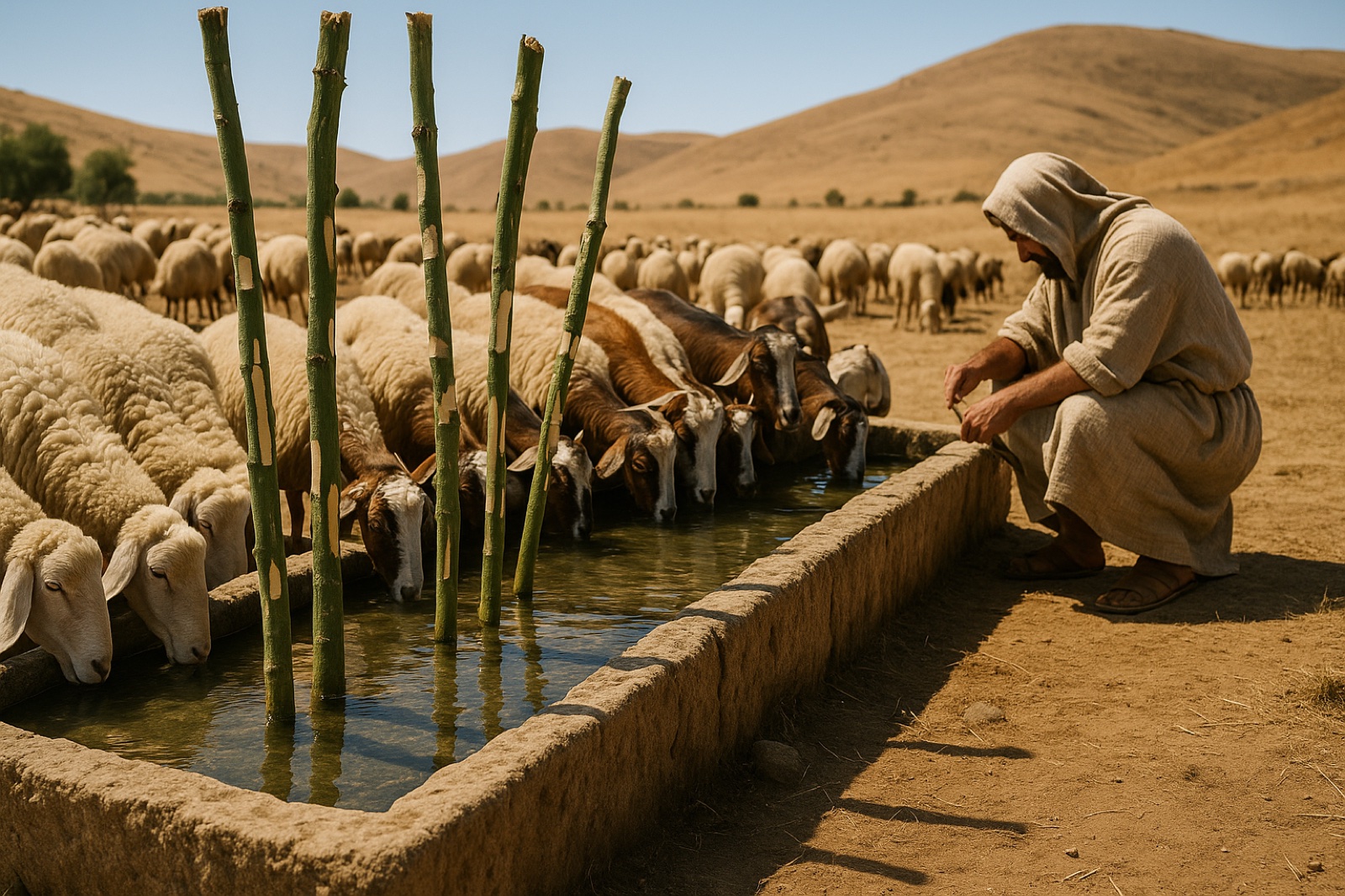
“And Jacob took him rods of green poplar, and of the hazel and chesnut tree; and pilled white strakes in them, and made the white appear which was in the rods.
And he set the rods which he had pilled before the flocks in the gutters in the watering troughs when the flocks came to drink, that they should conceive when they came to drink.
And the flocks conceived before the rods, and brought forth cattle ringstraked, speckled, and spotted.” (Genesis 30:37-39)
He peels stripes into green branches. He stands them in the drinking water. The animals drink, and the lambs and kids come out streaked and spotted — the exact ones that belong to him.
The chapter also tells us he was selective about it. He used the rods when the strong animals were breeding and left them out when the weak ones were, so the strong stock ended up his and the feeble stock ended up Laban’s. Then verse 43: “And the man increased exceedingly, and had much cattle, and maidservants, and menservants, and camels, and asses.”
Six years of this. It worked.
What the Text Does Not Say
Let us be honest about the part people skip.
Striped sticks in a water trough do not change the colouring of an animal’s offspring. Whatever an animal looks at while drinking has no effect on what it gives birth to. That is not a modern objection to an ancient book — it is simply not how any of it works.
And here is the thing worth noticing: Genesis never claims it does.
Read chapter 30 again slowly. It reports what Jacob did. It reports what the flocks produced. It never once tells you the rods were the cause. We supply that. We read two events side by side and assume the first one produced the second, because that is what our minds do with a sequence.
The narrator is not explaining a technique. The narrator is describing a man scrambling.
Laban Already Knew
Now go back to that verse from earlier, because it is doing more work than it looks like.
Before the deal. Before the rods. Before any of it — Laban says he has learned by experience that God has been blessing him because of Jacob.
Sit with that a moment. The man exploiting Jacob had already worked out where the increase in his own house was coming from. He had watched it happen for years and drawn the correct conclusion. He knew the source was God, and he knew the source was attached to Jacob.
And knowing that, he kept moving the wages anyway.
That detail changes the whole scene. Jacob is standing at a water trough with an armful of stripped branches, trying to out-manoeuvre a man who has already publicly admitted that the thing making him rich is not something either of them controls.
Jacob was working hard at a method. God was already working the outcome.
One Chapter Later, Jacob Tells It Differently
Twenty years in, Jacob calls his wives out to the field to tell them it is time to leave. And in that conversation he finally explains what those six years were really about.
“And your father hath deceived me, and changed my wages ten times; but God suffered him not to hurt me.” (Genesis 31:7)
Ten times. The deal moved ten times.
Then this:
“Thus God hath taken away the cattle of your father, and given them to me.” (Genesis 31:9)
Not the rods. God.
And then Jacob describes something that is not in chapter 30 at all:
“And it came to pass at the time that the cattle conceived, that I lifted up mine eyes, and saw in a dream, and, behold, the rams which leaped upon the cattle were ringstraked, speckled, and grisled.
And the angel of God spake unto me in a dream, saying, Jacob: And I said, Here am I.
And he said, Lift up now thine eyes, and see, all the rams which leap upon the cattle are ringstraked, speckled, and grisled: for I have seen all that Laban doeth unto thee.” (Genesis 31:10-12)
There was a dream. During breeding season, God showed Jacob what was actually happening in that flock.
And look at the reason given. Not because you were clever. Not because you found the right method. The reason is one line long:
“for I have seen all that Laban doeth unto thee.”
God had been watching the wage games the entire time.
The Part That Actually Lands
Here is what makes this passage worth your afternoon.
Chapter 30 does not mention the dream. You read the whole strange scene — the branches, the trough, the growing flock — with no idea that anything else was going on. The reader is left with the sticks, because the sticks are all Jacob had to show anyone at the time.
We only learn the truth when Jacob himself tells it. Twenty years later. Looking backward.
That is the honest shape of most people’s experience of being provided for. Almost nobody recognises it while it is happening. In the middle of it, you are not having a moment of faith — you are peeling sticks. You are doing the one thing you can think of, in a situation you cannot control, for a person who keeps changing the terms.
And you find out afterward what was actually holding you up.
This is not a formula, and it must not be turned into one. Jacob did not get a technique. God is not a system you can operate correctly to produce increase, and anyone selling that is selling something the Bible does not contain. Jacob’s story is not do this and prosper. It is much quieter than that, and much better: God was working in a season he could not read while he was inside it.
God Saw the Labour, Not Just the Affliction
There is one more line, and for anyone who is currently underpaid it may be the most important sentence in the whole account.
Jacob, finally saying out loud what those twenty years cost him:
“Thus have I been twenty years in thy house; I served thee fourteen years for thy two daughters, and six years for thy cattle: and thou hast changed my wages ten times.
Except the God of my father, the God of Abraham, and the fear of Isaac, had been with me, surely thou hadst sent me away now empty. God hath seen mine affliction and the labour of my hands, and rebuked thee yesternight.” (Genesis 31:41-42)
Read that last part again. “God hath seen mine affliction and the labour of my hands.”
Two things were seen. Not one.
Most of us can just about believe God notices when we are suffering. That is the easier half. What Jacob says here is that God also saw the labour of his hands — the actual work. The early mornings. The animals kept alive. The six years of effort that never once got paid what it was worth.
The work was seen. Not just the pain of it. The work itself.
If you are pouring effort into something and nobody has said thank you and the numbers keep moving, that line is for you. Whatever else is true about your situation, the labour of your hands is not going unseen.
Jacob’s household was, by any measure, a difficult and complicated one — and God built a nation out of it anyway. The provision was never waiting on his circumstances being tidy first.
Actions to Take Today
Name your sticks. Take one minute and finish this sentence honestly: the thing I am doing right now because I cannot think of anything else to do is ______. No judgement on it. Jacob’s answer was branches in a trough. Just name it.
Write down one thing that has worked out that you cannot fully explain. Something from the last two years. A door that opened, a bill that got covered, a person who turned up. Put it in your phone’s notes app. That is your Genesis 31 — the retrospective view Jacob only got twenty years in.
Say the labour line out loud over your own week. “God has seen the labour of my hands.” If you are working somewhere that never acknowledges it, this is a two-second thing you can do at the end of a shift, and it is true whether or not anyone else says it.
If work itself is the thing wearing you down, it may be worth taking ten minutes with our free Am I Burned Out at Work? assessment — it is not a faith quiz, just an honest look at where you actually are right now.
Journal Prompts
- Where am I currently working hard at a method because I cannot control the outcome?
- Laban knew where his blessing was coming from and exploited it anyway. Is there a place in my life where I have recognised God’s hand and then carried on as though it were mine to manage?
- Jacob only understood the six years afterward. What season am I still too close to read — and what would it look like to leave that one unresolved for now?
A Prayer for the Season You Cannot Read
God, I do not know what you are doing right now, and I am tired of pretending I do. I have been working hard at something I am not sure is even the right thing, for people who keep changing what they want from me. I am not asking you to make me clever. I am asking you to be at work in this the way you were at work in that flock, whether or not I can see it from where I am standing. And thank you that the labour of my hands has not gone unnoticed, even when it has gone unpaid. Amen.
One Question
Why do you think the writer of Genesis left the dream out of chapter 30 and only let Jacob reveal it in chapter 31? Was that a storytelling choice, or is it saying something about how provision actually gets recognised? Leave a comment — I would genuinely like to hear how you read it.
Share This
Jacob peeled sticks and stood them in a water trough for six years, and everyone reads it as folk magic. One chapter later he says a dream showed him God was the one building that flock. He didn’t know while it was happening. Neither do we.
“God hath seen mine affliction and the labour of my hands.” Two things. Not one. If you’re working somewhere that never says thank you — the work itself is seen, not just the hurt.
Laban admitted out loud that God was the reason his house was prospering. Then he changed Jacob’s wages ten times anyway. People can know exactly where the good is coming from and still try to keep it.
Q&A: Jacob’s Peeled Rods in Genesis 30
What were Jacob’s peeled rods in Genesis 30?
In Genesis 30:37-38, Jacob took branches of green poplar, hazel and chesnut, stripped white stripes into the bark, and stood them in the watering troughs where his uncle Laban’s flocks came to drink. The flocks then produced streaked, speckled and spotted young — which, under the wage agreement Jacob had made with Laban, belonged to Jacob rather than to Laban.
Did the peeled rods actually cause the animals to be born speckled?
Striped branches placed in drinking water have no effect on the colouring of an animal’s offspring. It is worth noting that the book of Genesis never states that the rods caused the result — chapter 30 reports what Jacob did and then reports what the flocks produced, without linking the two as cause and effect. The causal claim is something readers add.
Why does Jacob credit God instead of the rods in Genesis 31?
In Genesis 31:9 Jacob says, “Thus God hath taken away the cattle of your father, and given them to me.” He then describes a dream, recorded in Genesis 31:10-12, in which an angel of God pointed out the streaked and speckled rams and gave the reason: “for I have seen all that Laban doeth unto thee.” The dream is not mentioned anywhere in Genesis 30, so a reader encounters the strange rod scene with no knowledge of it — the explanation arrives only when Jacob recounts it himself, twenty years later.
What does “changed my wages ten times” mean in Genesis 31:41?
Genesis 31:41 has Jacob telling Laban, “Thus have I been twenty years in thy house; I served thee fourteen years for thy two daughters, and six years for thy cattle: and thou hast changed my wages ten times.” Fourteen years were served as the price of marrying Laban’s daughters and six years were worked for livestock. During that final period the terms of payment were repeatedly altered — the ancient equivalent of an employer moving the goalposts on an agreed rate.
Is Genesis 30 teaching a method for becoming wealthy?
No. The passage records a specific event in one man’s life, not a repeatable technique, and Jacob’s own account in Genesis 31 attributes the outcome to God rather than to anything he did with the branches. Reading the chapter as a formula for increase reverses its point: Jacob did not understand what was happening while it was happening, and only recognised the provision looking backward.
Back to Your Own Trough
Jacob’s peeled rods were never the reason. They were what a cornered man did with his hands while something else entirely was going on around him.
You may be in a season like that right now — doing the only thing you can think of, for people who keep changing the terms, with no way to tell whether any of it matters.
Jacob could not tell either. He worked it out twenty years later, in a field, explaining it to his wives.
The provision was running the whole time. He just could not read it from inside it.