 0
0
 0
0
On a low ridge in Suffolk, on the eastern coast of England, a team of archaeologists spent months lifting the shapes of people out of the ground.
Not bones. Shapes.
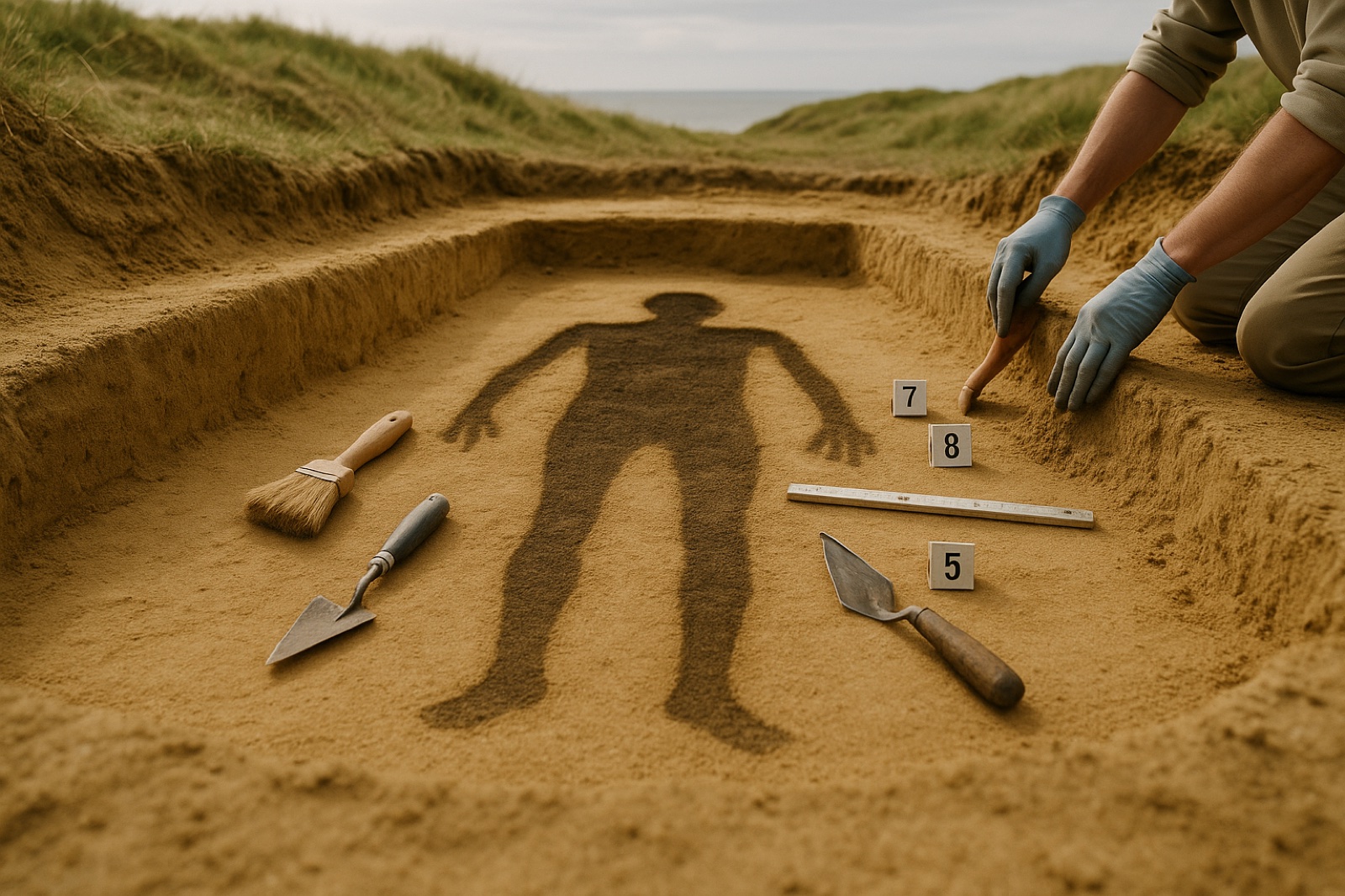
The soil there is sandy and acidic, and acid is patient. Over roughly fourteen centuries it worked through the skeletons in that cemetery until there was essentially nothing solid left of them. What stayed behind was a change in the sand itself — a darker, firmer outline exactly where a body used to be. Archaeologists call these Anglo-Saxon sand silhouettes. You can make out a shoulder. The curve of a skull. The angle of a leg folded at the knee.
And inside the shape, there is sand.
What the Diggers Actually Found at Sizewell
The cemetery turned up ahead of construction work at Sizewell C, a nuclear power station being built on the Suffolk coast near the village of Theberton. Oxford Cotswold Archaeology ran the excavation on behalf of the project, and the scale of the search was unusual: by the project’s own account, around 200 archaeologists examined roughly two million square metres across about 70 separate sites before the ground was handed over to the builders.
What they found on that ridge dates to the 6th and 7th centuries. At least 11 burial mounds, plus cremation burials and full-body burials, laid out deliberately across a raised piece of land where anyone approaching would have seen them on the skyline. Many of the graves held weapons, jewellery, and vessels.
One grave stood apart. It held two people and a horse — a fully harnessed horse, buried alongside weapons and personal belongings. Len Middleton, project officer at Oxford Cotswold Archaeology, called it a “princely” grave and placed it in what he described as “the same elite tradition seen at Sutton Hoo, Snape and Prittlewell.” The find was significant enough to be filmed for the BBC Two programme Digging for Britain, which aired in January 2026.
None of which is the strangest part.
Why the Anglo-Saxon Sand Silhouettes Survived When the Bones Did Not
Bone is mostly mineral, and mineral does not do well in acid. In free-draining sandy soil with low pH, water moves through constantly, and over centuries it dissolves the mineral structure of a skeleton the way rain slowly dissolves chalk. Wood goes the same way. Iron and some metals hold on longer, which is why weapons and fittings tend to survive in these graves while the person who owned them does not.
But a decomposing body does something to the sand around it. It leaves organic residue, chemical traces, a slight staining and hardening of the grains along the boundary where flesh met soil. That boundary is fragile — it is not a fossil, it is a stain — and it can be destroyed by a single careless trowel stroke. Excavating one is closer to peeling than digging. You take the sand away from the outside of a shape, and the shape stays.
So what gets recorded is not a person. It is the precise outline of where a person is no longer.
The Grave That Was Packed for a Journey
Now put those two facts next to each other, because together they are the whole story of that ridge.
The people burying their dead there had no way of knowing the soil would erase the bodies. But they buried them as though the bodies mattered enormously — and as though something other than the body was going somewhere.
Think about what a harnessed horse cost a community in the 7th century. A horse was transport, labour, status, and food security all at once. Harnessing it and putting it in the ground was not a gesture. It was the deliberate destruction of an enormous amount of wealth, by people who were not wealthy in any sense we would recognise, and who did not have a spare one.
Nobody does that for a corpse. You do that for a traveller.
Humans keep doing this, and it keeps not making economic sense. Ice Age people who were cold and hungry stopped to carve tiny birds out of ivory. Someone in Roman Egypt tucked a fragment of Homer’s poetry into the wrappings of a mummy, and we still do not know exactly why. The pattern is old and it is everywhere: when people are at their most practical about death, they behave impractically.
The Other Sand Bodies, Further Down the Same Coast
Here is the part that does not usually get told alongside the Sizewell find, and it is the part that complicates it.
Sutton Hoo sits on the same stretch of Suffolk coast, in the same kind of hungry sandy soil. It is famous for a ship burial and a helmet. It is less famous for what a later round of digging turned up nearby.
Starting in 1983, a team led by the archaeologist Martin Carver found more of these sand shapes around the edges of the site. The National Trust’s own account of Sutton Hoo records thirty-nine individuals found in total, and states that all of them died violently. They were not laid out. They were in twisted, awkward positions — the postures of people who had been executed and dropped into the ground, not carried into it.
Same soil. Same chemistry. Same eerie preservation of a shape with nothing inside it. Completely opposite human story.
And one more detail from Sutton Hoo, which is quietly the most interesting thing in any of this. When the great ship burial was excavated, no human remains were found in the burial chamber at all — not even a stain. For a long time that raised a real question: was anyone ever actually buried in it, or was the whole magnificent thing a memorial to someone whose body lay somewhere else? The answer came from chemistry rather than from digging. During excavations in the 1960s and early 1970s, analysis of the sand beneath the chamber showed high phosphate levels — and that, as the National Trust puts it, established that a body had decomposed there.
Read that again. There was nothing to see. Nothing to lift, nothing to photograph, nothing to put in a case. The only evidence that a person had ever existed in that spot was a chemical change they had made in the ground around them.
What an Outline Is Evidence Of
That is a strange kind of proof, and it is worth sitting with for a second.
Every one of those graves is an argument, made with hands rather than words, by people who could not write it down. The argument is this: the person and the remains are not the same thing. You do not harness a horse for a body. You do not send anyone anywhere unless you believe there is somewhere to go and someone to arrive.
They may have been wrong. People have been wrong about a great deal. But the instinct is remarkably stubborn and remarkably universal, and it turns up in nearly every culture that has ever put a person in the ground — long before those cultures had any contact with each other, and long before any of them had a theology to defend.
Some people read that instinct as a story we tell ourselves because we cannot bear the alternative. Others read it as a memory — the deep, inherited suspicion that we were made by God to be kept, and that the keeping was never going to depend on whether the sand held on to us.
What the Sand Actually Recorded
Here is what strikes me most about a sand silhouette, though.
It is not a picture of a person. It is a record of the difference a person made to what was around them. The sand shifted because someone was there. Fourteen hundred years later, with every bit of the actual body gone, the shift is still legible.
That is not a bad description of a life, honestly. Most of what any of us leave is not an object. It is the shape we pressed into the people near us — the way a friend still hears a phrase in someone’s voice years after that person died, the small habits we picked up from a grandparent and never noticed we were carrying.
Those people on the ridge did not know the sand would keep them. They chose what to send anyway. If you have ever wondered what you would actually want sent along — what you would say defines you if you had to pick a handful of things — there is a free two-minute Core Values assessment on this site that asks that question from a completely different direction.
They are still there in the ground in Suffolk, or they were until recently: perfect human outlines, held in sand, with nothing at all inside them. Which is either the emptiest thing you could dig up, or the clearest proof that whatever made them a person was never in the ground to begin with.
A Question Worth Sitting With
Why do you think almost every culture in history has buried its dead with objects, even when those objects were desperately needed by the living? Is it grief, hope, habit, or something else entirely? I would genuinely like to hear how you read it — leave a comment below.
If You Want to Share This
- Archaeologists in Suffolk excavated Anglo-Saxon graves where the acidic soil had dissolved the bodies completely. What they lifted out was the outline — a perfect human shape held in sand, with nothing inside it. https://bgodinspired.com/index.php/bible-resources/bible-history/anglo-saxon-sand-silhouettes/
- A 7th-century community buried two people with a fully harnessed horse — an enormous amount of wealth deliberately put in the ground. Nobody does that for a corpse. You do that for a traveller. https://bgodinspired.com/index.php/bible-resources/bible-history/anglo-saxon-sand-silhouettes/
- At Sutton Hoo, the great ship burial contained no body at all — not even a stain. The only proof anyone had ever been there was a chemical trace in the sand beneath the chamber. Read the whole strange story: https://bgodinspired.com/index.php/bible-resources/bible-history/anglo-saxon-sand-silhouettes/
Questions People Ask About Anglo-Saxon Sand Silhouettes
What is an Anglo-Saxon sand silhouette?
A sand silhouette is the outline of a buried body preserved in soil after the bones themselves have completely dissolved. In free-draining, acidic, sandy ground, water gradually destroys the mineral structure of a skeleton over centuries. As the body decomposes it leaves organic residue and chemical traces that slightly stain and harden the surrounding sand, creating a firmer, darker shape along the boundary where the body once was. Archaeologists excavate the loose sand away from the outside of that boundary, leaving a body-shaped form that is entirely hollow.
What was found at the Sizewell C site in Suffolk?
Excavations ahead of construction at the Sizewell C nuclear power station near Theberton, Suffolk, uncovered an early Anglo-Saxon barrow cemetery dating to the 6th and 7th centuries. The site included at least 11 burial mounds along with cremation and full-body burials, many furnished with weapons, jewellery and vessels. The most notable grave held two individuals buried alongside a fully harnessed horse. The excavation was carried out by Oxford Cotswold Archaeology and the discovery was announced in January 2026.
Why did Anglo-Saxons bury horses with people?
Horse burials in early Anglo-Saxon England are rare and are strongly associated with high-status individuals. A horse represented transport, labour, status and food security to a 7th-century community, so burying one — fully harnessed and unused — destroyed a significant amount of that community’s wealth. Archaeologists generally interpret such burials as signalling elite rank and as reflecting beliefs about the dead person continuing on in some form, though the precise beliefs of the people who dug those graves were never written down and cannot be recovered with certainty.
Was there a body in the Sutton Hoo ship burial?
No human remains were recovered from the burial chamber of the great ship burial at Sutton Hoo, which led to genuine debate over whether the ship was a memorial for someone buried elsewhere. Chemical analysis of the sand beneath the chamber, carried out during excavations in the 1960s and early 1970s, found high phosphate levels. According to the National Trust, which cares for the site, this established that a body had decomposed there.
Are sand silhouettes the same as the bodies found at Pompeii?
No. The famous body shapes at Pompeii are plaster casts: archaeologists poured plaster into cavities left in hardened volcanic ash after the bodies inside decayed, then removed the surrounding ash to reveal the cast. A sand silhouette is not a cast and nothing is poured into it. It is the naturally stained and compacted sand along the edge of where a body decomposed, excavated in place, and it is extremely fragile.
Sources: the Sizewell C announcement of the burial ground and the National Trust’s history of archaeology at Sutton Hoo.