 0
0
 0
0
There is a name you did not choose.
Maybe a parent gave it to you during the hardest year of their life. Maybe it came from a teacher, or a village, or a season that went badly and never quite let go. The difficult one. The expensive one. The one who arrived when everything was already falling apart.
You can carry a name like that for decades without ever saying it out loud. And you can build an entire life around quietly trying to prove it wrong.
There is a man in the Bible who was given exactly that kind of name. Most people have heard his prayer. Very few know what his name actually meant — or what he was really asking for.
Who Was Jabez in the Bible?
Jabez was a man from the tribe of Judah, and almost everything Scripture tells us about him fits into two verses.
To find him, you have to go somewhere most readers skip. The first nine chapters of 1 Chronicles are one long list of names — fathers, sons, clans, families, page after page of them. It reads like a register, because that is what it is. Then, with no warning, the list stops for two sentences:
“And Jabez was more honourable than his brethren: and his mother called his name Jabez, saying, Because I bare him with sorrow. And Jabez called on the God of Israel, saying, Oh that thou wouldest bless me indeed, and enlarge my coast, and that thine hand might be with me, and that thou wouldest keep me from evil, that it may not grieve me! And God granted him that which he requested.”
— 1 Chronicles 4:9-10, KJV
Then the list picks up again, as though nothing happened.
That is the whole record. No age. No death. No children of his own listed. In a chapter built entirely out of fathers and sons, his father is never named — the one person the text gives him is his mother, and the only words she gets are the reason she called him what she called him.
What the Name Jabez Actually Means
Here is the detail that changes the whole story.
In Hebrew, his name — Ya’bets — is built from the same letters as ‘otseb, the word for pain and sorrow, simply rearranged. The text does not leave you to work this out. It says it plainly: she called him that “because I bare him with sorrow.”
So the name was not poetry. It was a description of the day he arrived. Something went badly at his birth — the text never says what, and it would be dishonest to guess — and she named him after it.
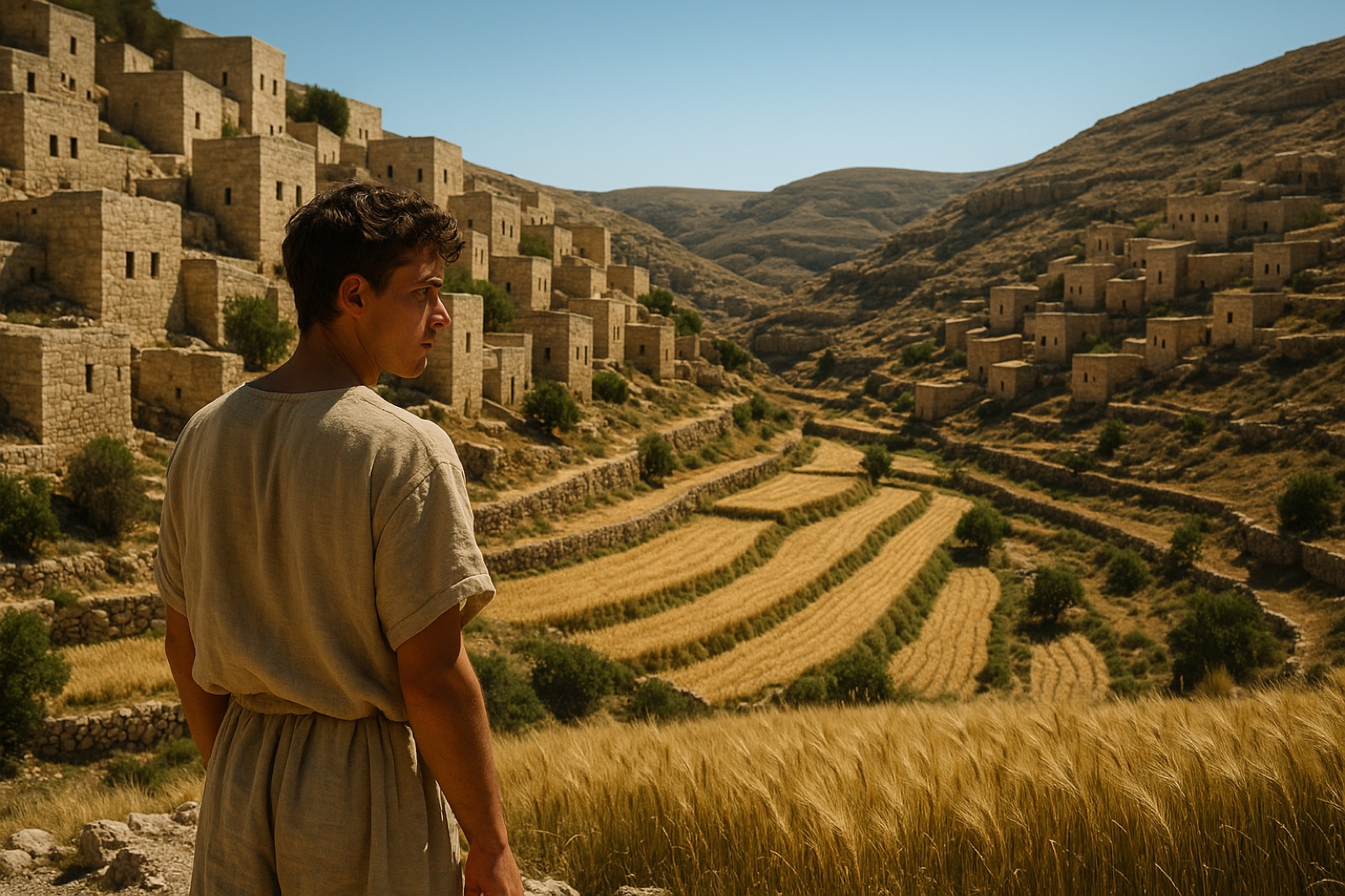
Which means that every time someone in that village called him in for a meal, or shouted to him across a field, or greeted him at the well, they said the word “pain” out loud. His neighbours. His brothers. His own mother. For his entire life.
The Prayer of Jabez Everyone Quotes
In 2000, a short book by Bruce Wilkinson called The Prayer of Jabez turned these two verses into one of the best-known prayers in modern Christianity. A generation of readers learned the phrase “enlarge my coast” — rendered in newer translations as “enlarge my territory.” You will find that reading all over the internet, including in our own earlier piece on what it means to ask God to enlarge your territory.
And that is usually where the prayer gets flattened.
Read as a formula, it sounds like a script for getting more: more land, more influence, more success. Say the words, watch the borders move. That reading has been sold hard, and it is worth naming plainly — it is not what the passage says. God is not a transaction, and faith is not a technique.
Two details in the text itself push back on the formula reading.
The first is the order. The verse tells us Jabez was “more honourable than his brethren” before it tells us he prayed. His honour is stated first. The text never presents the prayer as the thing that earned it.
The second is that word “coast.” The Hebrew behind it means a border or boundary — the edge of the land a family worked. In that world, land was not luxury. Land was how you fed people. Asking for a wider border sat much closer to asking for the capacity to provide than to asking for a bigger house.
The Line Nobody Quotes
Now look at how the prayer ends.
“…and that thou wouldest keep me from evil, that it may not grieve me!”
That word — grieve — comes from the same root as his name.
After asking for blessing, after asking for wider borders, after asking for God’s hand to stay on him, Jabez circles all the way back to the word he was called. It is the last thing he says.
He is not asking for a bigger life. He is asking not to become the thing he was named.
Read that way, the whole prayer changes shape. It stops being a man reaching for more and becomes a man asking God to break a sentence handed to him before he could speak. Keep me from causing what I was named for. Let it stop here. Let it stop with me.
And the record says: “And God granted him that which he requested.”
What This Means for the Name You Were Given
Most of us are carrying something we did not choose.
A temper we grew up watching. A habit of going quiet when things get hard. Something with money, or with anger, or with leaving. A word someone said about us once that we have been living inside ever since.
And the honest fear underneath it is rarely “I want more.” It is usually smaller and much heavier: I am afraid I will do to someone else what was done to me.
That fear already has a prayer in the Bible. This is it. It has been sitting quietly in the middle of a genealogy for thousands of years, dressed up in recent decades as a prayer about ambition, when it was always a prayer about not repeating the pain. Jabez had the nerve to ask God boldly for the one thing he was most afraid of losing.
Notice what he does not do. He does not change his name. He does not deny it, or argue with his mother, or pretend the day he was born went some other way. He takes the name straight to God and asks for a different ending than the one it predicts. If you want to sit longer with the courage in that, our reflection on the transformative prayer of Jabez walks through the same two verses from another angle.
One more detail is worth sitting with. Earlier in the same book, a town called Jabez appears — “the families of the scribes which dwelt at Jabez” (1 Chronicles 2:55). Scripture never says whether that place was named for this man, so we cannot claim it was. But it is a striking thing to find in the record: the name that meant pain, attached to a town full of people whose work was writing things down.
Actions to Take Today
- Write the name down. One line, no explaining. The word or phrase you have been quietly carrying — what you were called, or what you are afraid you already are. Seeing it in your own handwriting takes some of the power out of it.
- Turn it into one sentence. Say it out loud, filling in the blank: “God, keep me from ______, so that it stops with me.” That is the prayer of Jabez in your own words, and it takes about ten seconds.
- Tell one person that sentence. Not the whole story — just the sentence. Something said out loud to another human being is much harder to keep living inside.
Journaling Prompts
- What would actually change in an ordinary week if you believed the name you were given was a description of one day, and not a prediction of your life?
- Who is most likely to receive whatever you never deal with? Write their name down, and leave it on the page.
A Prayer You Can Pray Right Now
God, You know what I was called, and You know how much of it I still believe. I am tired of waiting to find out whether it is true. Keep me from the thing I am most afraid of becoming — the one thing I would hate to hand to anybody else. Put Your hand on me, and let it stop here. And thank You that You have never once called me by that name.
Discussion Question
Do you think the Prayer of Jabez became so popular because of what it actually says, or because of what people wanted it to say? Share your thoughts in the comments — we read every one.
Share This
- Turns out the Prayer of Jabez was never about getting more. His name meant pain — and the last line asks God to keep him from causing it. He wasn’t chasing a bigger life. He was asking not to become his name.
- Two verses inside nine chapters of genealogy. That is all we get about Jabez. And the one prayer he prayed ends on the same word his mother named him after.
- I always heard “enlarge my territory.” I never noticed the line right after it: keep me from evil, that it may not grieve me. That is not ambition. That is a man asking for the cycle to stop with him.
Questions About Jabez, Answered
Who was Jabez in the Bible?
Jabez was a man of the tribe of Judah who appears in only two verses of Scripture, 1 Chronicles 4:9-10, inside a long genealogy. The Bible describes him as more honourable than his brothers, records that his mother named him Jabez because she bore him in sorrow, and preserves a short prayer asking God for blessing, for wider borders, for God’s hand to remain on him, and for protection from evil. The text says God granted the request.
What does the name Jabez mean?
In Hebrew, Jabez (Ya’bets) is formed from the same consonants as ‘otseb, the word for pain or sorrow, in a different order. 1 Chronicles 4:9 gives the reason directly: his mother named him this “because I bare him with sorrow.” The name refers to the circumstances of his birth. Scripture does not say what specifically went wrong.
Where is the Prayer of Jabez in the Bible?
The Prayer of Jabez is found in 1 Chronicles 4:10, in the Old Testament. It sits inside the genealogy of the tribe of Judah in the opening chapters of 1 Chronicles, and it is one of the very few narrative interruptions in nine chapters that otherwise consist almost entirely of lists of names.
Is the Prayer of Jabez a formula for wealth or success?
No. The prayer does ask for blessing and for enlarged borders, but it also asks that God’s hand remain on him and that he be kept from evil so that it would not grieve him. That closing phrase uses the same Hebrew root as his own name. Read as a whole, the prayer is a request not to cause the pain he was named after, rather than a technique for obtaining wealth. The passage also states that Jabez was more honourable than his brothers before it records the prayer at all.
Was Jabez a real person?
The Bible presents Jabez as a real man within the genealogy of Judah. Outside of 1 Chronicles 4:9-10 he is never mentioned again, and there is no other biblical or archaeological record of him. A place called Jabez appears in 1 Chronicles 2:55, but Scripture does not state whether it was named after this man.