 0
0
 0
0
You said yes again. Not because you had room for it, but because you are the one who always has room for it. You are the person people call. The one who quietly holds the whole thing together. And somewhere around Wednesday, you noticed your arms were shaking.
There is a story in Exodus about a man whose arms gave out in the middle of the most important moment of his life. Most people know the outline of it. Almost nobody notices the thing that actually saved him — two men named Aaron and Hur, standing on either side of him, holding up what he could not hold up himself.
When the Strong One Runs Out of Strength
There is a specific kind of tired that does not come from doing too much. It comes from being the one everyone assumes is fine.
You are the backup plan for six different people, and you do not have one. When something slips, it lands on you. When something needs doing at 11pm, it is your name on it. And the hardest part is not the work — it is the quiet belief underneath it that needing help would mean you were never really strong to begin with. If that describes your house more than your job, you are not imagining it; there is a name for that pattern, and it is exhausting in a way that is hard to explain to anyone who has not lived it. We wrote about what happens when you are the one the whole household runs through, and the loneliness that comes with it.
Here is what makes Exodus 17 worth sitting with: the man in the story had the exact same problem. And the Bible does not treat it as his failure.
What Actually Happened on That Hill
Israel had just walked out of Egypt. They were free for the first time in four hundred years, camped at a place called Rephidim, still learning how to eat and drink in a wilderness. And then Amalek showed up and attacked them.
It was the first real battle of their freedom. Moses sent Joshua down into the valley to fight, and Moses himself climbed a hill with the rod of God in his hand. Then something strange started happening.
“And it came to pass, when Moses held up his hand, that Israel prevailed: and when he let down his hand, Amalek prevailed.” — Exodus 17:11
Read that again slowly, because it is genuinely odd. The battle in the valley was rising and falling based on the position of one man’s arms on a hill. Not his strategy. Not his sword. His arms.
Which means the whole thing depended on a person doing something no person can do for very long. Try it right now — hold both arms straight up over your head. Two minutes in, your shoulders start to burn. Ten minutes in, you cannot think about anything else. Moses was not a young man, and this went on all day.
The Detail Everyone Skips: Aaron and Hur
This is where almost every retelling of the story speeds up. But the next verse is the entire point.
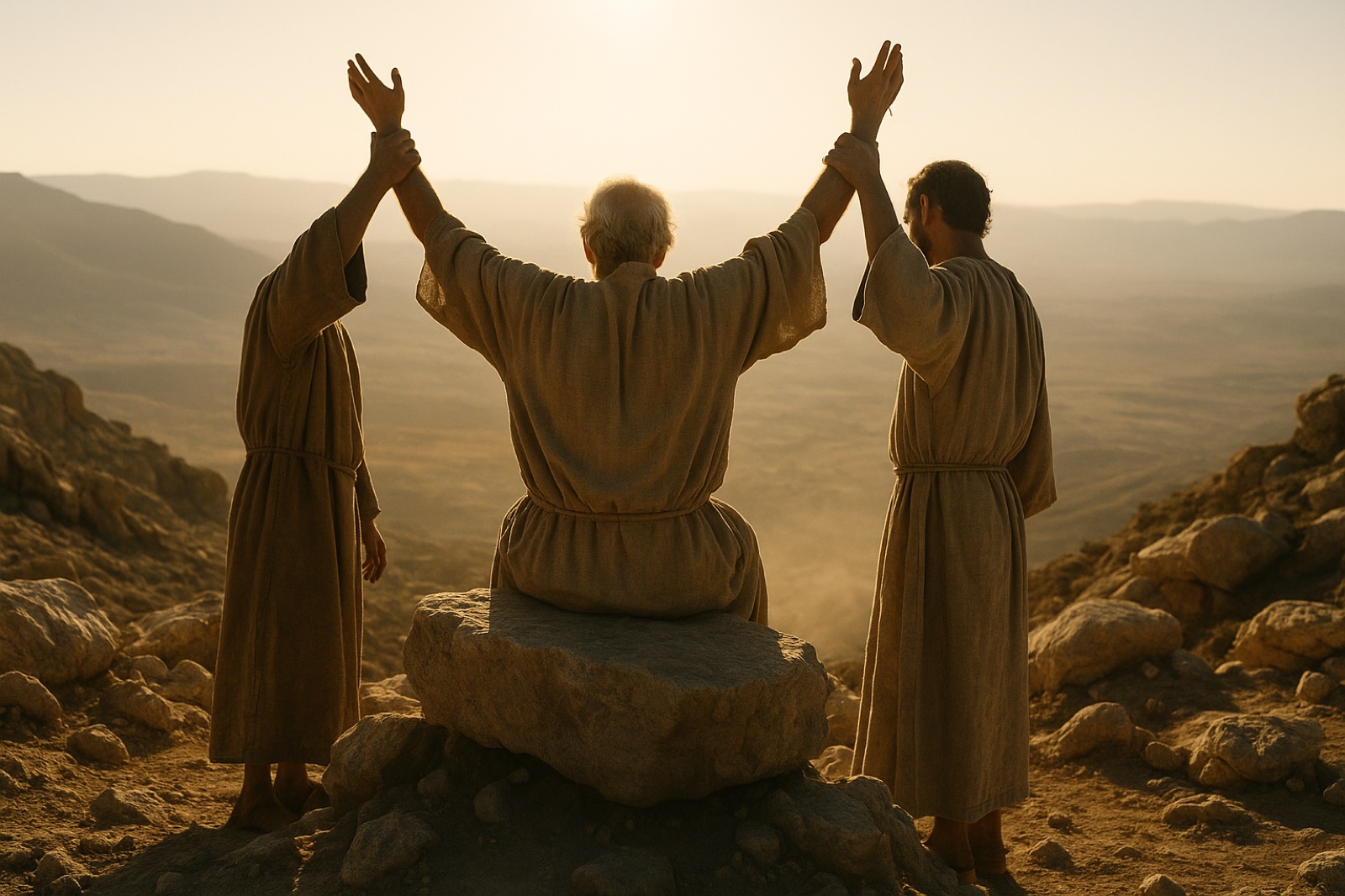
“But Moses’ hands were heavy; and they took a stone, and put it under him, and he sat thereon; and Aaron and Hur stayed up his hands, the one on the one side, and the other on the other side; and his hands were steady until the going down of the sun.” — Exodus 17:12
Three things happen in that one verse, and every one of them is worth noticing.
- His hands were heavy. Scripture says it plainly, with no apology and no shame attached. The leader ran out. That is simply reported as a fact, the way you would report the weather.
- They gave him a stone to sit on. Nobody told him to push through it. Somebody found him a place to sit down in the middle of a battle.
- Aaron and Hur held his arms up — one on each side. Not one helper. Two. One man could not have done it either, because you cannot hold two arms up from one side.
And then the line that quietly rearranges everything: “his hands were steady.” Not strong. Steady. The text does not say Moses found a second wind. It says the arms stayed up, and it tells you exactly who was underneath them.
Here is the part that gets me every time. This story could have been written without those names. It would have been easy to say “and Israel prevailed” and move on. Instead, in a book that skips whole decades in a sentence, two men are named for nothing except holding somebody else’s arms up. Scripture keeps the names of the people who did the unglamorous holding.
You Were Never Asked to Hold Your Own Arms Up
Most of us were handed this story as a lesson about persistence. Keep praying. Do not give up. Hold on a little longer.
But that is not the mechanism in the text. Moses did give up — his hands came down, more than once, and the valley felt it. The victory did not come from Moses digging deeper. It came from Moses letting two people get close enough to carry what he could not.
Think about how easily this could have gone another way. If God had wanted a story about a self-sufficient hero, the arms could have simply stayed up. That would have been the smaller miracle. Instead God arranged a victory that was impossible unless the leader admitted, in front of witnesses, that he could not hold his own arms up. The help did not arrive as lightning. It arrived with two names and a rock.
Moses’ hands got heavy. That was never the failure. That was the design.
Which means the thing you have been treating as proof that you are falling apart may be the exact place God has been trying to send someone. You have been reading your heavy arms as a character flaw. The text reads them as an invitation.
And it cuts both directions. Some days you are Moses on the rock. Some days you are Hur, and the most important work available to you is standing quietly beside someone who is close to done. If you have never really considered what you are built to carry for other people, our free Spiritual Gifts Assessment takes a few minutes and is a surprisingly clarifying place to start.
What to Do With Tired Arms Today
None of this helps unless something changes before you go to bed tonight. Start here, easiest first.
- Write the heaviest thing in one sentence. Not a list — one sentence, on paper or in your notes app. “I am the only one who knows the medication schedule.” “I have not had a day off in five weeks.” Vague weight cannot be handed to anyone. A sentence can.
- Send one specific ask to one person. Not “I’m struggling” — people freeze at that, because they do not know where to put their hands. Try “Could you take the Thursday pickup?” or “Can I call you for ten minutes tonight?” Aaron and Hur knew exactly which arm to grab. Give somebody that.
- Find your stone. Look at the next seven days and take one thing off. Move it, cancel it, or hand it over. Moses did not sit down after the battle was won; he sat down in the middle of it. You are allowed to do that too — and you do not have to finish everything first to deserve it, which is something Jesus made remarkably clear to His own exhausted friends.
Journaling Prompts
- When did you first learn that needing help was not safe? Who taught you that — and were they right?
- Who is already standing close enough to hold one of your arms, if you let them? What has kept you from asking?
- Whose arms have you been holding up lately without saying anything about it? What did that cost you, and would you do it again?
A Prayer for When Your Arms Are Heavy
God, I am tired in a way I have not said out loud to anyone. I have been holding things up for so long that I stopped noticing my arms were shaking. I do not want to be the person who collapses, but I am starting to think I do not have to be the person who never needs anyone either. Show me who my Aaron and Hur are, and give me the courage to actually ask. Thank you that heavy hands were never the thing that disqualified me.
Discussion Question
Why do you think we treat asking for help as weakness, when the Bible clearly does not? Share what you think in the comments — someone reading this today is holding both arms up alone and needs to hear it.
Share This
- Exodus 17: Moses’ arms gave out mid-battle. God’s answer was not “try harder.” It was two guys, one on each side. Still thinking about that.
- Just realized the famous story about Moses holding up his arms is not actually a story about persistence. It is a story about a leader who let two people carry what he could not — and the Bible bothered to write down their names.
- Your heavy arms are not proof you are failing. In Exodus 17 they were the exact reason help showed up.
Common Questions
What happened when Aaron and Hur held up Moses’ arms?
In Exodus 17, Israel fought Amalek at Rephidim while Moses stood on a hill above the valley. Whenever Moses held his hand up, Israel was winning; whenever he lowered it, Amalek gained ground. When Moses’ hands grew heavy, Aaron and Hur put a stone under him so he could sit, then stood on either side and held his arms up until sunset — and Joshua won the battle in the valley below.
Who was Hur in the Bible?
Hur appears only a handful of times in Scripture. He is with Moses and Aaron on the hill in Exodus 17, and later he is left in charge alongside Aaron while Moses goes up Mount Sinai. Jewish tradition connects him to Miriam’s family, though the Bible itself does not spell that out. What Scripture does record about him is that he was one of the two people holding up the arms of a leader who had run out of strength.
What does Exodus 17:12 mean for us today?
It reframes what strength looks like. The verse states plainly that Moses’ hands were heavy, and it treats that as a normal limit rather than a moral failure. The victory came through shared weight — a place to sit and two people on either side. For anyone carrying more than they can hold, the practical takeaway is that receiving help is not a fallback plan; in this passage it is the plan itself.
Why did Moses need to keep his hands raised at all?
The text never explains the mechanism, and that silence is intentional. Moses was holding the rod of God — the same rod tied to the plagues and the parted sea — so the raised hands functioned as a visible sign that the outcome belonged to God, not to Israel’s military skill. What the passage emphasizes is not why the raised hands worked, but what happened when one man could no longer keep them raised alone.
Is it wrong for a Christian to admit they cannot handle something?
No. Scripture is remarkably unembarrassed about human limits. Moses ran out of strength mid-battle, Elijah asked to die under a tree, and Jesus Himself asked three friends to stay awake with Him in Gethsemane. In each case the limit is reported honestly, and in each case help is offered rather than a rebuke. Admitting you cannot carry something alone puts you in fairly good company.