 0
0
 0
0
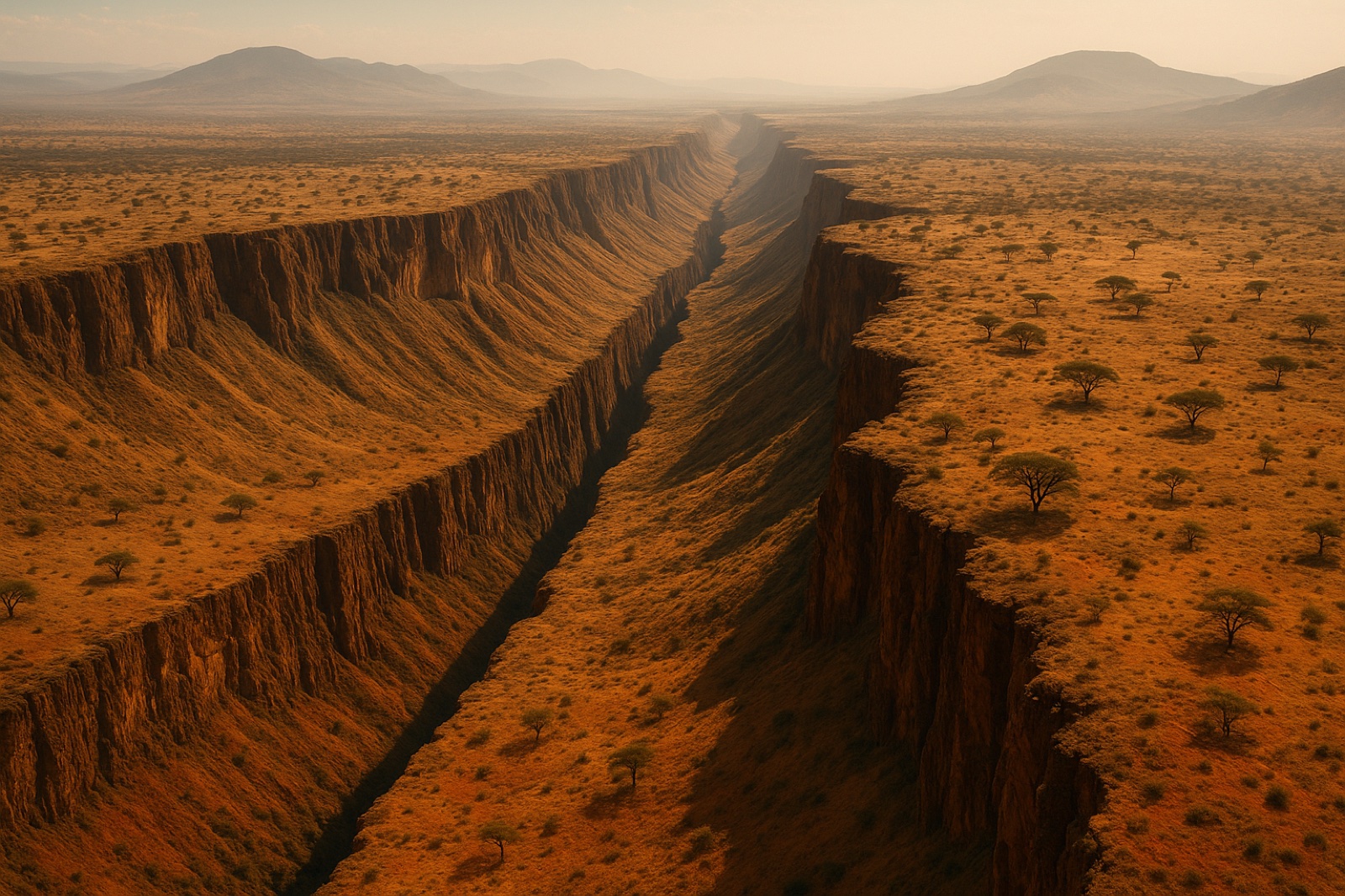
Look at a map of Africa and it looks finished. Solid. Permanent — the kind of landmass that’s clearly been sitting there since the beginning and isn’t going anywhere. But underneath the Turkana region, where Kenya and Ethiopia meet, geologists just caught the exact moment that isn’t true anymore.
New research on the Turkana Rift Zone, covered by ScienceDaily this July, describes the area as caught mid-“necking” — a real geological term, and it means almost exactly what it sounds like if you picture pulling a piece of warm taffy apart. Right before it snaps, there’s a thin, stretched, narrowed section in the middle holding everything together by a thread. That’s necking. And right now, Turkana is that section — for an entire continent.
The Turkana Rift Is Caught Mid-“Necking”
“Necking” isn’t a term geologists invented for headlines. It comes from structural engineering, where a metal rod pulled to its breaking point visibly thins — “necks down” — at the exact spot where it’s about to fail. Apply enough tension to the Earth’s crust for long enough, and continental lithosphere does the same thing: it stretches, thins, and narrows at a specific point long before it ever fully separates.
The Turkana Rift, part of the larger East African Rift System, is that narrowing point right now. Researchers studying the region found the crust there measurably thinner than the land on either side of it — not a sudden crack, but a slow, ongoing squeeze that’s been building for millions of years and is still very much in progress.
How Continents Actually Tear Apart
Nothing about this happens the way a earthquake movie would have you picture it. There’s no single moment where the ground splits open in front of a crowd of screaming extras. Continental rifting is closer to a bone healing in reverse — imperceptibly slow, measured in millimeters a year, invisible to anyone standing on top of it.
The process runs in stages: first the crust stretches and thins (that’s the necking happening at Turkana right now), then it fractures at depth while still holding together on the surface, then magma rises to fill the widening gap, and — eventually, over millions of years — ocean water floods in to fill what used to be solid ground. Geologists have already watched an earlier stage of this exact process next door: the Afar region of Ethiopia, just north of Turkana, is already stretched thin enough that parts of it sit below sea level, a preview of where this stretch of Africa is headed.
It’s not the only place on the solar system’s radar doing this, either. Researchers recently found Venus quietly tearing itself apart from the inside, its rift valleys younger and more active than anyone assumed from a planet that looks completely dead from orbit. And back on Earth, the Indian Plate is doing something similar beneath the Himalayas, splitting internally in a way that looked, from the surface, like nothing more than a very tall, very solid mountain range.
Why This Particular Stretch of Africa Matters
The East African Rift System runs roughly 3,700 miles, from the Red Sea down through Ethiopia, Kenya, and Tanzania. Scientists have known for decades that the Somali plate is slowly pulling away from the much larger Nubian plate that makes up most of the rest of the continent. What Turkana adds is a close-up look at the exact mechanics of the moment in between — not “has it split” or “will it split,” but the specific, ongoing physics of a landmass in the act of coming apart, measured in real time with modern instruments.
Given enough time — and geologists are talking in the range of 5 to 10 million years, not anything on a human timescale — the rift is expected to widen enough for the ocean to pour in. A new coastline would eventually run down the middle of what’s currently East Africa, and the Horn of Africa would become its own separate landmass entirely.
The Part That Doesn’t Show on the Surface
Here’s what stayed with me after reading through the research. Every satellite image of the Turkana region shows solid, dry ground. Herds moving across the plain. Acacia trees. Dust. Nothing about the surface tells you a continent is quietly coming apart underneath it. The transformation is real, it’s measurable, and it is completely invisible to anyone standing on top of it, living their ordinary day.
Ancient wisdom has always described creation this way — not as a finished project sitting still since the beginning, but as something still being formed, still being shaped, long after it looks complete. There’s something worth sitting with in that: the ground doesn’t have to visibly move for something real to be happening underneath it. Something bigger than what you can see is still very much at work, on a timeline that isn’t yours to see all at once.
It’s a strange kind of comfort, honestly — the idea that “nothing is happening” and “everything is happening” can both be true of the exact same ground at the exact same time.
What This Means If You’re in a Slow Season
You don’t have to be tracking tectonic plates for this to land somewhere familiar. Most of us have stood on ground like that at some point — a season that looked, from the outside, like absolutely nothing was changing. No visible progress. No dramatic before-and-after. Just the same flat, quiet stretch of days, over and over.
If you’ve ever wondered whether a slow season means you’re stuck, or worse, forgotten, that question shows up more than people admit — it’s the same question behind feeling behind in life when everyone else’s timeline seems to be moving and yours isn’t. Turkana is a reminder that a lot of the most important structural work in the world happens below whatever surface anyone else can see.
Turkana won’t visibly split apart in your lifetime, or your grandchildren’s. But it’s splitting right now, today, in a way instruments can measure even though your eyes never could. Maybe the season you’re standing in — the slow one, the “nothing’s happening” one — is doing more work than it looks like from the surface too.
What Do You Think?
Do you think the seasons that feel like nothing is happening are actually where the biggest changes are quietly taking shape? Tell us in the comments below.
Share This
- Africa is quietly splitting into two continents. Geologists just caught the exact geological moment mid-process, at a spot called the Turkana Rift — and it looks completely solid from the surface. https://bgodinspired.com/turkana-rift-africa-splitting-in-two
- The ground can look totally still while something massive is happening underneath it. Africa’s Turkana Rift is proof — and it might be the best metaphor for a slow season I’ve read all year. https://bgodinspired.com/turkana-rift-africa-splitting-in-two
- “Necking” is the real geological term for the exact moment before a continent snaps in two. Africa’s doing it right now at the Turkana Rift. Wild that you’d never know just by looking at it. https://bgodinspired.com/turkana-rift-africa-splitting-in-two
Quick Questions About the Turkana Rift
What is the Turkana Rift?
The Turkana Rift is a section of the East African Rift System, located where Kenya and Ethiopia meet, where new research shows the continental crust is measurably thinning — the specific stage geologists call “necking,” the point right before a landmass fully separates.
What does “necking” mean in geology?
Necking is a term borrowed from structural engineering, describing the thin, stretched section that forms in a material right before it breaks under tension. In geology, it describes continental crust thinning and narrowing at a specific point during rifting, long before an actual split occurs.
Is Africa really splitting into two continents?
Yes, over a very long geological timescale. The Somali plate is slowly separating from the larger Nubian plate along the East African Rift System, and scientists estimate it could take another 5 to 10 million years before the ocean fully floods in to create a new coastline and a separate landmass.
Will this affect anyone living in East Africa today?
No noticeable effect on a human timescale. The process is measured in millimeters of movement per year and unfolds over millions of years, so it has no impact on daily life in the region today, though the area does experience related seismic and volcanic activity typical of active rift zones.
Where else has this kind of rifting been found?
Similar processes have recently been documented on Venus, where rift valleys once thought ancient and inactive turned out to be much younger and still actively forming, and beneath the Himalayas, where the Indian Plate has been found splitting internally at depth.