 0
0
 0
0
Planting a tree feels like the most hopeful thing a person can do. You dig a hole, you put in something small and green, and you picture the forest it will become.
So here is a finding that sounds almost rude. A big new study of the Amazon says that if you want to save wildlife and keep carbon out of the air, planting new forest is the most expensive tool you have. And on its own, it does the least.
The cheaper, stronger move? Protecting forests that are still standing. Not just from the chainsaw, but from something most of us never think about.
What the Amazon Study Found About Protecting Forests
The study was published in the journal Science on 17 September 2026. It was led by Dr Leonardo Miranda of Lancaster University in the UK, with Professor Jos Barlow as senior author, and a team of researchers from the UK, Brazil, Sweden and Australia.
They looked at about 3.2 million hectares of land around two places in the Brazilian state of Pará: Santarém and Paragominas. That is an area roughly the size of a small country. They followed what happened there from 2010 to 2020.
This was not a quick look from space. The team combined detailed satellite images with years of work on the ground: 381 survey routes across 38 river catchments, and 499 rural properties. They built models for 160 kinds of birds and 426 kinds of trees.
Then they asked a simple question. Over those ten years, which kind of effort would have done the most good?
- Stopping deforestation — keeping forest from being cleared completely.
- Stopping disturbance — keeping standing forest from being burned by wildfire or damaged by logging.
- Restoration — letting forest grow back, or planting it back, on land that had already been cleared.
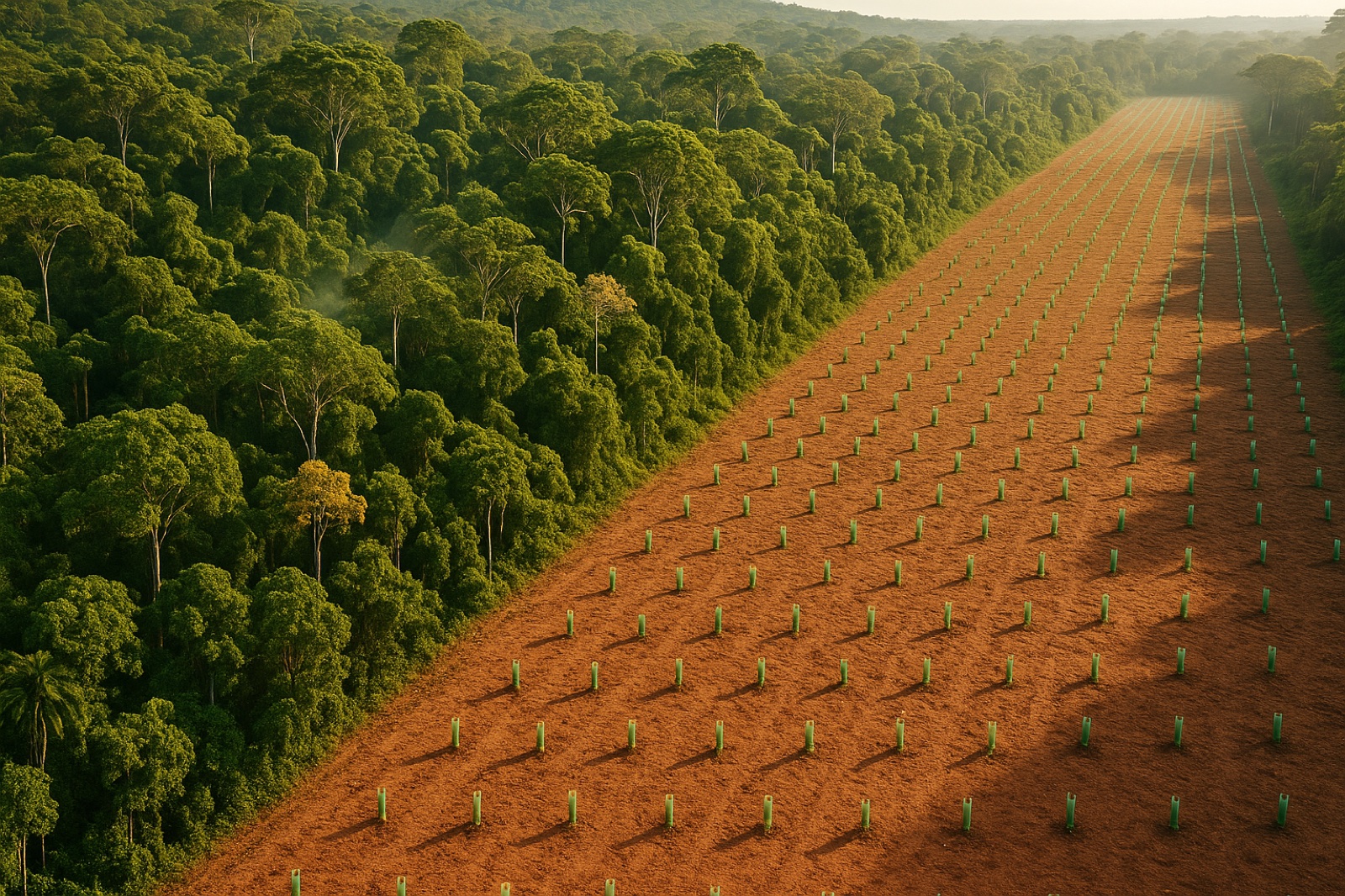
The answer was clear. Stopping fire and logging damage in forests that were still standing gave the biggest benefit for wildlife. For carbon, it came very close to stopping clearing altogether. Restoration was the most expensive of the three, and the weakest when used by itself.
Dr Miranda put the lesson plainly: “we should begin by prioritizing the forests we have left.”
A Forest Can Still Be Standing and Still Be Losing
This is the part of the study that is easy to read past, and it may be the most important part.
When most people hear “save the rainforest,” they picture bulldozers and bare ground. That is deforestation, and it is the number that usually makes the news. But this study says that is only half the danger.
A forest can burn along the ground and keep its tall trees for a while. It can have its biggest, oldest trees quietly taken out by loggers while the rest stays green. From far above, it can still look like forest. It still has a roof of leaves. It may not count as “deforestation” at all.
But inside, it is not the same place. Birds that need deep, old, shady forest can start to disappear. The big trees that held the most carbon may already be gone. It is standing, but it is losing.
That is why Dr Miranda said that protecting existing forests “must go beyond avoiding deforestation.” Keeping a forest from being cut down is not the same as keeping it well.
Why Replanting Costs More and Gives Back Less
None of this means planting trees is useless. It means a young forest and an old forest are not the same thing, even if they cover the same patch of ground.
An old rainforest took a very long time to become what it is. Its tallest trees, its tangled layers, the soil under it and the creatures that depend on all of it were built slowly. A young forest on cleared land starts almost from nothing. It has to be paid for, looked after and protected for many years before it gives back even part of what the old one held.
So the math is simple, even if it is not what we want to hear. Guarding what is still alive costs less and saves more than rebuilding what we let go.
If you have been following the Amazon, you may remember the news that Brazil’s deforestation fell to a 10-year low. That was real progress. This new study adds a quiet warning to it: fewer trees being cleared is good, but it is not the whole job.
The Honest Catch: No Single Fix Was Enough
It would be easy to turn this study into a slogan. The researchers themselves did not.
Across the whole study area, none of the three efforts on its own was able to reverse the overall loss of wildlife and carbon. Real gains only showed up when both kinds of protection were used together — stopping clearing and stopping fire and logging damage. Adding restoration on top of those gave even bigger gains.
And restoration still matters a great deal in places where most of the forest is already gone. You cannot protect a forest that no longer exists. There, growing it back is the only road left.
The study also looked at two parts of the Amazon, not the whole world. The authors say their findings may apply to other tropical places where forest is being lost, but that is a “may,” not a promise. Stories like the effort to save species once given up for dead show that bringing things back is possible. It is just slower and harder than keeping them.
What We Still Have Is Worth Guarding
Read the study again and it starts to sound like more than a report about trees.
Most of us spend a lot of energy on rebuilding. We make big plans to fix the friendship after it has already gone quiet for years. We promise ourselves we will rest once we are already burned out. We try to replant what we let burn.
But the forest says something different. The best time to care for a thing is while it is still alive. And the danger is not always the loud, obvious one. Sometimes a friendship, a family, a hope or a faith is still standing — it still looks fine from far away — while something small is slowly burning along the ground.
There is a very old piece of wisdom that tells people to guard their heart more carefully than anything else they keep, because the whole of a life flows out from there. It was written long before anyone had satellites. But it knew what this study found: the thing that looks fine from above can be losing on the inside, and it is worth watching over while it is still green. Some people have found that God is part of that guarding — the one who notices what is still alive in us before we do.
You do not have to plant a whole new life to start. You can begin with what you already have.
Three Small Ways to Protect What You Still Have
- Name one thing that is still alive. A friendship, a habit, a hope. Write it down. It is easier to guard something you have noticed.
- Look for the quiet fire. Ask what is slowly wearing it down — not the big crisis, but the small thing that happens every week. A missed call. A promise put off.
- Do one small guarding act this week. Send the message. Keep the walk. Show up once. It costs almost nothing, and it is far cheaper than rebuilding later. If a friendship is the thing on your mind, these thoughts on what real friendship looks like may help.
A Question Worth Talking About
The study says protecting old forest beats planting new forest — but only when protection goes beyond stopping the bulldozers. Do you think people are more drawn to rebuilding than to protecting? Why do you think “starting fresh” feels more exciting than guarding what is already there?
We would really like to hear what you think. Tell us in the comments.
Share This
- “A 10-year study of 3 million hectares of the Amazon found protecting the forest you still have beats replanting the one you lost. Turns out that is true of a lot more than forests.” https://bgodinspired.com/index.php/nature-and-creation/protecting-forests-beats-replanting-amazon-study/
- “A forest can still be standing and still be losing. Fire and logging hollow it out while it looks green from space. Worth thinking about what else in life works that way.” https://bgodinspired.com/index.php/nature-and-creation/protecting-forests-beats-replanting-amazon-study/
- “Planting trees is good. Guarding old forest is better, cheaper and does more for wildlife, says a new study in Science. This one changed how I think about fixing things.”
Questions People Are Asking
Is protecting existing forests better than planting new trees?
A 2026 study in the journal Science, led by Lancaster University, found that in two regions of the Brazilian Amazon, protecting standing forest from fire and logging gave the biggest benefits for wildlife and nearly matched stopping deforestation for carbon. Restoration, meaning regrowing or replanting forest, was the most expensive option and the least effective when used on its own. Restoration is still important where most forest has already been cleared.
What is forest disturbance, and how is it different from deforestation?
Deforestation means forest is cleared completely and the land is turned to other uses. Forest disturbance means the forest is still standing but has been damaged, for example by wildfires burning through it or by logging that removes some of its trees. A disturbed forest can still look like forest from above while losing much of its wildlife and stored carbon.
Where was the Amazon forest protection study done?
The study covered about 3.2 million hectares around Santarém and Paragominas in the state of Pará, Brazil, from 2010 to 2020. Researchers used satellite images together with field surveys along 381 transects in 38 catchments and on 499 rural properties, and modelled 160 bird species and 426 tree species.
Can forest restoration alone reverse biodiversity loss in the Amazon?
According to the Lancaster University-led study published in Science in September 2026, no single approach on its own reversed the overall loss of biodiversity and carbon in the regions studied. Net gains came only when both stopping deforestation and stopping fire and logging damage were used together, and adding restoration on top of those produced even larger gains.