 0
0
 0
0
You have more to watch, read, play and scroll through than any human being in history. Thousands of hours of it. In your pocket. Free. Right now.
And you are bored.
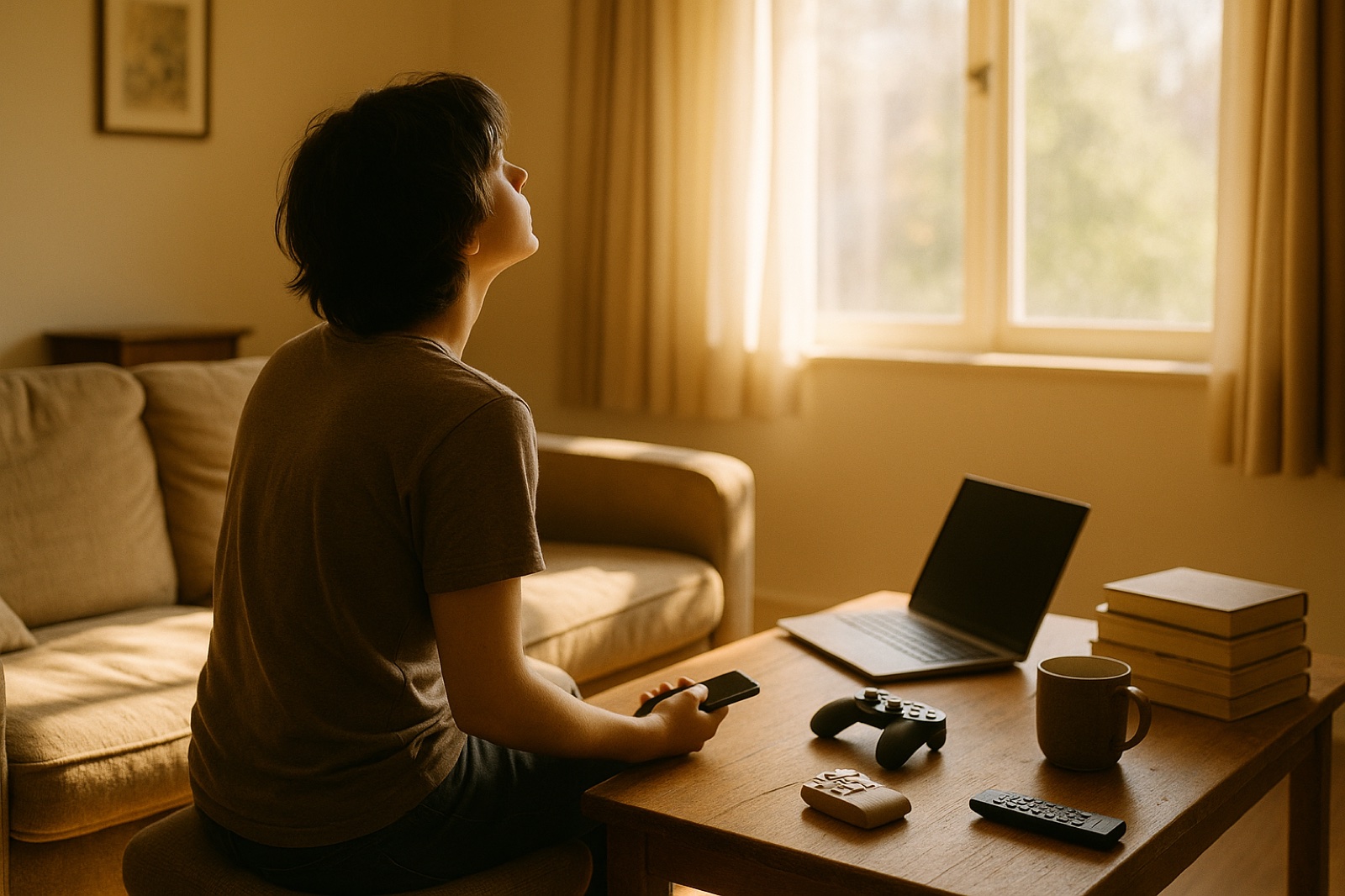
Not tired. Not sad. Bored — that flat, itchy, restless feeling where nothing sounds good and everything sounds like too much effort. You open an app. You close it. You open a different one. You put the phone down and pick it back up ninety seconds later.
If you have ever typed why am I so bored all the time into a search bar late at night, you already know what comes back. Find a hobby. Try something new. Go outside. Learn an instrument. Rearrange your room.
You have tried some of those. They did not work, or they worked for about four days.
There is a reason for that, and it is not a lack of willpower. Two very different groups of people worked out what is actually going on here. One group is made up of psychologists publishing in the last ten years. The other is a group of monks who lived in the Egyptian desert about sixteen hundred years ago. They reached almost the same diagnosis — and the ancient one was more specific.
Why am I so bored all the time when there is so much to do?
In 2018, two psychologists at the University of Virginia, Erin Westgate and Timothy Wilson, published a model of boredom in the journal Psychological Review. They called it the MAC model, short for meaning and attentional components.
Their argument is simple and it changes everything. Boredom is not one problem. It is two, and either one on its own is enough to produce it.
The first is attention. You get bored when what you are doing does not match the mental capacity you have available. And here is the part almost nobody expects: that mismatch runs in both directions. Too easy, and you are understimulated — bored. Too much, too fast, too demanding, and you are overstimulated — also bored. Being flooded is boring. It does not feel like boredom while it is happening. It feels like being busy. But it produces the same flat result.
The second is meaning. You get bored when what you are doing is not connected to anything you actually care about — or when you do not currently have anything you care about. This one works entirely on its own. No amount of stimulation fixes it.
Now look at your evening again. Content engineered to require nothing from you, delivered in a volume that floods you, attached to nothing you care about. That is all three failure modes at once. You are not bored because there is nothing to do. You are bored because of what you are doing.
Which is oddly good news, because it means the problem is not you.
It is worth knowing how hard the alternative is, too. In an earlier set of studies published in Science in 2014, Wilson and colleagues left people alone in a room for six to fifteen minutes with nothing to do but think. Many disliked it so much that they gave themselves a mild electric shock rather than sit there — sixty-seven percent of the men and twenty-five percent of the women — even though every one of them had said beforehand that they would pay money to avoid that shock.
So: sitting still with your own mind is genuinely difficult. Nobody is weak for finding it hard. But that difficulty is the whole subject, and a group of men in the desert built their entire way of life around it.
The desert monks had a name for this, and it was not boredom
Evagrius Ponticus was a Greek monk who spent the last years of his life in the Egyptian desert in the late 300s. In a short book called the Praktikos he catalogued the thoughts that troubled monks living alone. One of them he singled out as the worst of the lot.
He called it acedia. And he gave it a nickname: the noonday demon, a phrase borrowed from an ancient Hebrew poem about a danger that arrives in the middle of the day.
His description is uncomfortably recognisable. Acedia arrives, he wrote, around the fourth hour and stays until the eighth — roughly mid-morning to mid-afternoon, the hottest and longest stretch of the day. Under it, the monk keeps checking the sun to see how slowly it is moving. He goes to the door and looks out to see whether anyone is coming to visit. He develops a sudden dislike of the place he lives in, and of the work in front of him, and of the people around him. And then he starts thinking about somewhere else — a different place, where the work would suit him better and he would finally amount to something.
Read that list again, and notice what is missing from it.
It is not laziness. The monk under acedia is not sleepy. He is full of energy, plans and ideas. It is not sadness either. He is not grieving. He is restless, and he is completely certain that the answer to his life is located somewhere he currently is not.
That certainty is the disease. Not the flatness — the certainty.
If that has ever hit you as a specific ache for a place you cannot name, you are in very old company; we looked at that particular feeling separately in why you can feel homesick for a place that does not exist.
The detail everyone reads past
Here is the part that is easy to miss, and it may be the most useful thing in this whole article.
They knew what time it came.
Acedia had a schedule. It was not a mystery and it was not a verdict on a man’s character. It was a thing that showed up at a predictable hour, did what it always did, and left. Everyone in the community knew it. Everyone expected it. Nobody concluded from it that they had chosen the wrong life.
Modern boredom feels random and deeply personal — evidence that something is wrong with you specifically, that you are broken in a way other people are not. Theirs was punctual. And a thing that arrives on time is survivable in a way that a personal defect never is.
Their cure was the exact opposite of every list you have read
Everything on page one of the search results tells you to change something. New hobby. New routine. New place. Acedia’s own voice, essentially, in a helpful font.
The desert answer was the reverse. There is a famous line in the collected sayings of these monks, from Abba Moses, given to a younger brother who came asking for advice: “Go, sit in your cell, and your cell will teach you everything.”
Stay. That is the whole instruction.
But if you stop there you have only got half of it, and the missing half is the half that works.
John Cassian, who learned from Evagrius and later carried these ideas into Europe, wrote the longest treatment of acedia that survives from that period. His remedy was not stillness. It was work. Plain, small, physical, unglamorous work, done in the same place you were already sitting. A monk who is working, he argued, is troubled by one demon; an idle one is torn apart by countless.
So the prescription has two parts, and they only function together. Stay put. And do the small real thing in front of you.
Which is, remarkably, exactly what the modern research would predict. Staying answers the meaning half — a goal you keep returning to slowly becomes a goal you actually have, while a goal you abandon every four days never gets the chance. Doing real work answers the attention half — an activity with genuine friction, one you could plausibly do badly, holds your mind in a way that a feed designed to require nothing from you never will.
Sixteen hundred years apart, with no shared vocabulary, both groups landed on the same two levers.
Why everything goes flat right after you quit something
The most common version of this question comes from people who have just stopped something. Drinking. Vaping. Smoking. A phone habit. A relationship that was going nowhere.
They expected to feel better. Instead everything went grey.
The MAC model explains this plainly, and gently. The thing you removed was doing the attention work on your behalf. It was loud enough to occupy you without ever needing to mean anything. Take it away and you do not get relief — you get an accurate reading of how much of your life had no meaning in it. That reading is unpleasant. It is also the first honest measurement you have had in a long time.
The monks would say the flatness is not the problem. The flatness is the diagnosis arriving, on schedule, right on time. And if you have ever had a completely free evening and still could not settle into it, that same machinery is at work in why you cannot relax even when you have free time.
What the restlessness was thought to be for
This is where the ancient diagnosis goes somewhere ours does not.
They did not think acedia was a mood to be managed. They thought it was a signal, and a fairly precise one. The restlessness was telling you that you were trying to satisfy a hunger for meaning with a change of scenery — and that it would keep coming back, patiently, for as long as you kept doing that, because a change of scenery had never once worked for anybody.
What they believed sat underneath the hunger was God. It is an old idea: that a person is built pointing at something, and feels the pull of it as a low, nameless ache whenever they are pointed somewhere else. They were not remotely surprised that endless activity failed to touch it. They would not be surprised that endless entertainment fails to touch it either.
You do not have to agree with them to notice the shape of the thing. The feeling never actually asks for more input. It asks what any of it is for.
What to try this week
None of this needs money, equipment, spare time you do not have, or anyone’s permission.
- Stop switching for one hour. Pick anything. Do the whole hour. The switching is not a symptom of the boredom — it is a large part of what makes it.
- Choose something with friction. Something you could genuinely do badly: cooking a real meal, mending something, walking a route you do not know, writing by hand. Effortless things cannot hold you.
- Do the same thing again tomorrow. Repetition is not the boring part. Repetition is the part that turns an activity into something that means anything at all.
- Name your hour. Track when the flat feeling shows up for a few days. Most people have one. Knowing the time it arrives takes most of its authority away.
- Do not move this week. Do not quit the job, leave the city, or end the relationship while the feeling is loud. Acedia is extremely persuasive and its advice is always relocation.
And if the honest problem underneath is that you genuinely do not know what you are pointed at any more, that is worth ten quiet minutes rather than another evening of scrolling. Our free What Is My Purpose? assessment is a decent place to start putting words to it.
The monks were not offering a life hack. They were making a claim: that the room you are already sitting in has more in it than you think, and that the reason you cannot see it is that you have spent years being trained to look at the door.
You could look around instead. It costs an hour.
What do you think?
The desert monks said the answer to restlessness is to stay exactly where you are and do something small. Modern advice says to shake things up and try something new. Which one do you think is actually right for most people today — and has one of them ever worked for you? Leave a comment; genuinely curious what people find.
Share this
- Turns out “I’m bored” is not a modern problem. Monks in the Egyptian desert named it 1,600 years ago, called it the noonday demon, and knew what hour it arrived. https://bgodinspired.com/index.php/personal-growth-and-life-skills/why-am-i-so-bored-all-the-time/
- Boredom is not caused by having nothing to do. Psychologists say it comes from a mismatch of attention or meaning — which means being flooded with options makes it worse, not better. This explains my whole week: https://bgodinspired.com/index.php/personal-growth-and-life-skills/why-am-i-so-bored-all-the-time/
- Every article about boredom tells you to try something new. The oldest advice on record says the opposite: stay exactly where you are, and do the small unglamorous thing in front of you. https://bgodinspired.com/index.php/personal-growth-and-life-skills/why-am-i-so-bored-all-the-time/
Questions people ask
Why am I so bored all the time even though I have endless entertainment?
Boredom is not caused by an absence of things to do. According to the MAC model of boredom, published by psychologists Erin Westgate and Timothy Wilson in Psychological Review in 2018, boredom comes from two separate sources: a mismatch between an activity and a person’s available attention, and a mismatch between an activity and anything the person values. The attention mismatch runs both ways, so being overstimulated causes boredom just as reliably as being understimulated does. Endless entertainment tends to trigger both routes at once: it demands almost nothing, it arrives in overwhelming volume, and it usually connects to nothing the viewer actually cares about.
What is acedia?
Acedia is a term used by early Christian monks in the Egyptian desert for a specific state of restless listlessness. The monk Evagrius Ponticus described it in the late 300s in his book the Praktikos, nicknaming it “the noonday demon” because it typically struck in the middle of the day. Its symptoms were a sudden dislike of one’s surroundings and daily work, constant checking of the time, watching the door for visitors, and a strong conviction that life would be better in a different place. It is distinct from both laziness and sadness, because the person experiencing it is restless and energetic rather than tired or grieving.
Why does everything feel boring after quitting drinking, vaping or smoking?
Removing a habit that provided constant stimulation often reveals how little of the remaining routine is connected to anything meaningful. In terms of the MAC model of boredom, the habit was supplying the attentional component — occupying the mind without requiring it to engage with anything valued. Once it is gone, the meaning component is exposed on its own, and a meaning deficit produces boredom regardless of how much stimulation is available. The flatness is usually a temporary and informative stage rather than a sign the decision to quit was wrong.
What did the desert monks recommend as a cure for acedia?
Two things together: staying in place, and working. The saying attributed to Abba Moses in the collected Sayings of the Desert Fathers is “Go, sit in your cell, and your cell will teach you everything.” John Cassian, who studied under Evagrius Ponticus and later brought these ideas to Europe, wrote the longest surviving early treatment of acedia and prescribed ordinary manual labour, arguing that a working monk faces one demon while an idle one faces countless. The remedy was never stillness alone; it was remaining in one place and doing small, real, unremarkable work there.
Is boredom a sign of depression?
Boredom and depression are different states, though they can occur together. Boredom is typically restless and energetic — the person wants to engage with something and cannot find anything that fits. Depression more often involves persistently low mood, loss of pleasure in activities that were previously enjoyable, changes in sleep and appetite, and low energy lasting for weeks. If low mood, hopelessness or loss of interest have continued for more than two weeks, or if there are thoughts of self-harm, that is a medical matter and worth raising with a doctor or a local health service rather than treating as boredom.