 0
0
 0
0
Somewhere past the halfway mark of Interstellar, a scientist stands in the hold of a spaceship and argues that love is a real thing. Observable. Powerful. Maybe an artifact of a dimension we cannot perceive. She wants to fly toward it.
The man across from her looks at her the way most of the audience did. Then he overrules her.
That decision kills two people, burns decades, and nearly ends the species. And she was right.
If you have been hunting for an Interstellar ending explained that does more than diagram the black hole, start here. Christopher Nolan’s 2014 film is far more careful than its reputation suggests. The line everyone mocks and the scene everyone loves are the same idea. The film makes the argument twice: once out loud, where it sounds embarrassing, and once in physics, where it sounds like genius.
What Interstellar Is Actually Arguing
Interstellar is a 2014 film directed by Christopher Nolan, written by Nolan and his brother Jonathan. The premise did not start with either of them. It came from the theoretical physicist Kip Thorne and the producer Lynda Obst. Thorne stayed on as an executive producer and science adviser, and he wrote a companion book called The Science of Interstellar.
In that book he sets out the two rules he worked under. Nothing in the film would violate firmly established physical law. And the wilder speculation had to spring from real science, from ideas that at least some respectable scientists consider possible. Nolan agreed to work inside those limits.
That matters more than it sounds. It means the film is not allowed to cheat. Which makes what it does at the end much stranger than its fans or its critics usually admit.
The setup is a dying Earth. A blight is taking the crops and the dust is taking everything else. Cooper, a widowed former NASA pilot now farming corn, lives with his father-in-law Donald, his son Tom, and his ten-year-old daughter Murph. Murph is certain there is a ghost in her bedroom, knocking books off the shelf. Cooper works out that the dust on her floor is settling in a gravity pattern, reads it as binary, and pulls a set of map coordinates out of it. The coordinates lead to what is left of NASA.
Then he leaves. The film never once lets him off the hook for it.
The Argument on the Endurance
This is where the film quietly sets its trap.
Miller’s planet goes badly. Knee-deep water in every direction, a wave the size of a mountain range, Doyle dead on the surface. And every hour down there costs seven years at home. The crew gets back to the Endurance to find twenty-three years gone. Romilly has lived through all of them, alone, waiting. Cooper sits down and watches two decades of video messages from his children in one go.
If that is the scene that stayed with you, Frieren: Beyond Journey’s End spends an entire series on the same wound from the opposite side, and we also built a small how many days have I been alive counter for anyone who wants to feel that number for themselves.
Now they have fuel for one more planet. Mann’s or Edmunds’. One shot.
Mann has been sending back data, and the data is good. Amelia Brand wants Edmunds, and she cannot pretend she has a reason beyond the fact that she loves him. She admits it openly. Then she makes the speech, the one about love being observable, powerful, possibly the one thing we can perceive that reaches across time and space.
Cooper picks the data. They go to Mann’s planet.
Mann falsified all of it. He was alone and dying and he wanted someone to come. His planet is ice over frozen cloud, uninhabitable. He tries to kill Cooper. A booby trap he rigged kills Romilly. He destroys himself and most of the Endurance trying to force a docking.
Brand’s hunch, the one she conceded had no evidence behind it whatsoever, was correct. Edmunds’ planet is where the colony actually gets built. The film leaves her standing on it.
So Interstellar builds a clean experiment. Two hypotheses, one shot, no do-over. It runs the experiment. The evidence loses to the feeling.
It would be easy to read that as the film going soft on its own science, and it is not. Look at why the data loses. Not because data is weak. Because data has an author. Mann’s numbers could be forged, because a frightened man made them. Brand’s attachment to Edmunds could not be forged by anyone, including her. She could not talk herself out of it, which is precisely what made Cooper distrust it. The film slips in a genuinely sharp point here: the thing we discard for being unverifiable is also the only thing in the room nobody can counterfeit.
And notice what the film costs her for being right. She is right about the planet and wrong about everything she wanted from it. By the time she arrives, Edmunds is dead, and she buries him. Her instinct was a good compass and a bad promise. The film is not sentimental about this at all, which is the part most summaries get wrong.
Interstellar Ending Explained: What the Tesseract Actually Does
Cooper and the robot TARS drop themselves into the black hole Gargantua so the Endurance has the mass to reach Edmunds. Past the horizon, Cooper lands inside a tesseract, a structure built by far-future humans in which time is laid out as a physical dimension you can move along.
And what is inside this miracle of engineering? One room. Murph’s bedroom, repeated endlessly, every moment of it available at once.
Here is the thing almost nobody notices on a first watch. The tesseract is an enormous gift and a completely useless one. It hands Cooper access to every instant of that room and gives him no way whatsoever to choose between them. An infinite library with no catalogue. He can reach any moment and has no reason to reach for one.
What gets him an address is that he loves one specific person and knows exactly which moment of her life he needs. The future beings built the machine. They could not supply the coordinate. The thing that made their machine work was not in the machine.
That is Brand’s cargo-hold speech, restated in the only language Cooper respects. He dismissed it on the ship and he survives on it inside a black hole. Those two scenes are one scene, split in half and parked an hour apart, and the film is much better once you watch them that way.
Watch what he actually sends, too, because the film is precise about it in a way that is easy to miss. He pushes dust into binary and gives his younger self the coordinates to NASA. Machine code, the message that starts the mission. Then he taps the second hand of Murph’s wristwatch in Morse and gives the grown Murph the quantum data from inside Gargantua. A hand-code, invented by people for people, and the message that saves everyone.
In between those two, he tries to send a third. He finds the morning he drove away and shoves the books off the shelf to spell out STAY.
It fails. It was always going to fail, because he remembers leaving. The father in the room cannot keep himself home. Only the father who already went can send back the thing that was needed. Interstellar puts its most desperate message and its only failed message in the same place, and that is not an accident of plotting. It is the film telling you what kind of story this is.
Where the Film Does Not Quite Earn It
It should be said plainly, because this film gets oversold by the people who love it most. Brand claims love is quantifiable, and Interstellar never quantifies it. Not once. There is no unit, no equation, no fifth force added to the four. Gravity does every bit of physical work in the entire film. Love does none of it.
Love here is only ever the user of the machine, never the machine. When Cooper says the connection with his daughter is quantifiable, he does not produce a quantity. He produces a decision.
So the film does not prove its thesis. It assumes it and then behaves consistently, which is a different and smaller achievement. Worth admitting.
But the failure is the interesting part, because of where it comes from. Brand reaches for physics because physics is the only authority her world still recognises. Her civilisation is starving under dust. Its last functioning institution is a hidden NASA facility. If she wants to say this matters, and it points somewhere, she has exactly one vocabulary available to her, and it is the wrong department. She tries to file love as a force because force is the only filing cabinet left standing.
The older account of the same instinct never made love a force, and never needed to. It made love prior.
Not a property of the universe, measurable from inside it. The reason there is a universe to measure. In that telling love is not a fifth thing acting on matter alongside gravity. It is the reason there is matter for anything to act on, and the reason the whole arrangement was ever aimed at anybody in particular. The oldest line on the subject runs backwards from the way we usually say it: we love because God loved first (1 John 4:19). Love as the starting condition, not the discovery.
Which is the exact shape of Cooper’s problem. He is standing in a structure with infinite access and no index, and what saves him is not something he measures in there. It is something that was already true before he climbed in. A bond he did not build inside the tesseract and could not possibly have assembled there. He did not find the coordinate. He brought it with him.
Brand had the direction right and the category wrong. The thing she was pointing at does not sit inside physics waiting to be weighed. It is upstream of the weighing.
A Man in a Child’s Bedroom
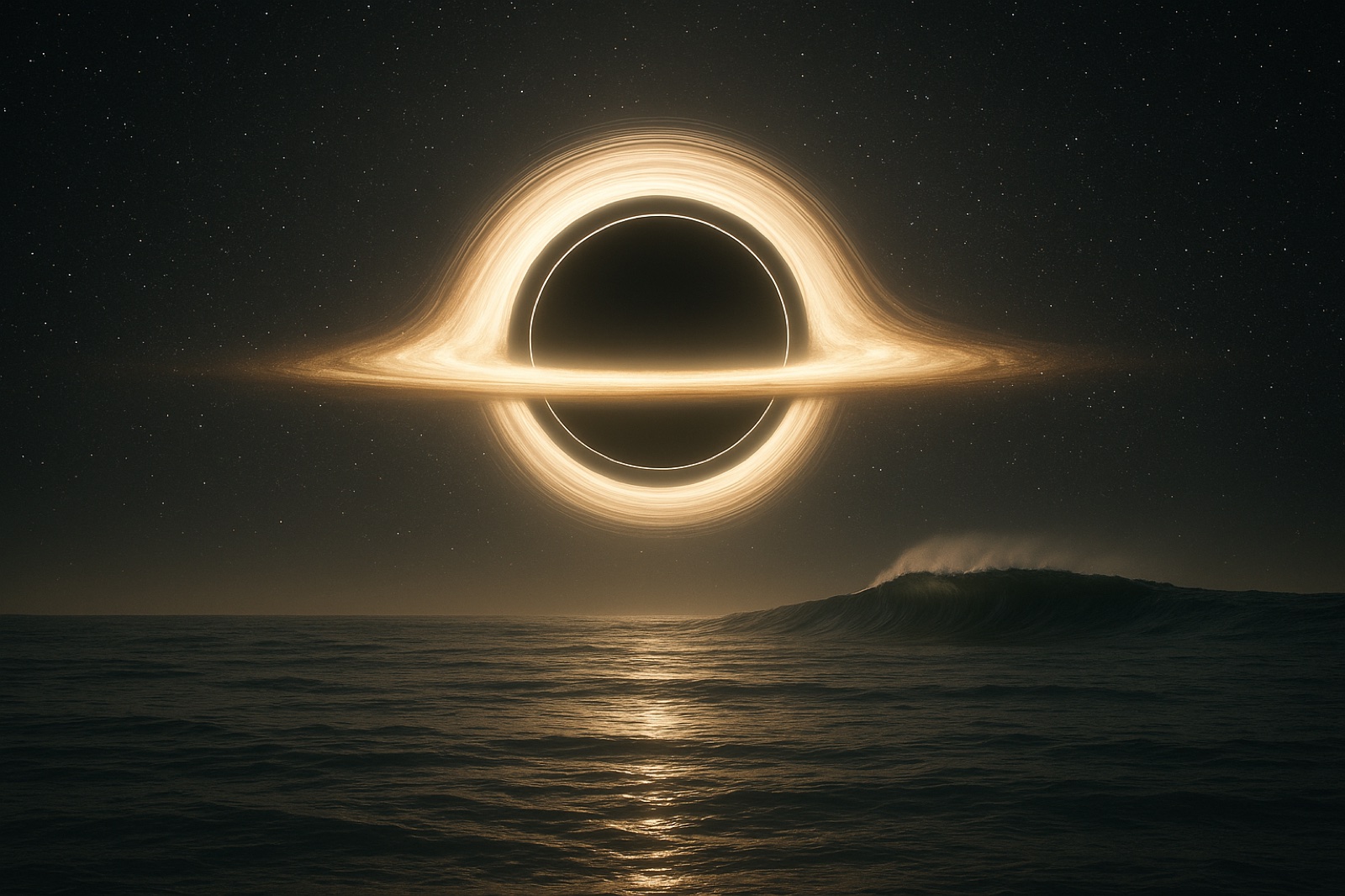
It is worth noticing what Interstellar picks for its climax. The film has a wormhole, a hundred-foot wave, a planet of frozen clouds, and one of the most carefully rendered black holes ever put on a screen.
And the scene it builds all of that toward is a man kneeling in a child’s bedroom, pushing at a bookshelf.
All that engineering, all of Thorne’s physics, and the centre of the film is a small room with corn outside the window and a wristwatch on the shelf. If you like stories that decide the ordinary object is the thing worth saving, Station Eleven makes its own version of that argument out of a homemade comic book.
Cooper spends the whole film trying to get back to that room. He gets there in the only way left to him, far too late, and from the wrong side of the shelf. And the message he manages to send is not the one he wanted to send. He wanted to say stay. What he got to say was go, here are the numbers, finish it.
Most of us only ever get to send one of those two.
Your Turn
Did Cooper make the right call choosing Mann’s planet over Edmunds’, given only what he knew at the time? He had hard data on one side and an openly admitted bias on the other, and the film punishes him for making the defensible choice. Tell us in the comments whether you would have voted with Cooper or with Brand.
Questions About Interstellar
What does the ending of Interstellar mean?
The ending of Interstellar means the loop closes on itself. Cooper falls into the black hole Gargantua, lands inside a tesseract built by far-future humans, and discovers that the “ghost” haunting his daughter’s bedroom at the start of the film was always him. He sends the quantum data to the grown Murph through the second hand of her wristwatch in Morse code, she solves the gravity equation, and humanity survives. The film’s point is not time travel. It is that the tesseract gives Cooper access to every moment of one room and no way to choose between them, and the only thing that supplies him an address is his bond with one specific person.
What does the tesseract mean in Interstellar?
The tesseract in Interstellar is a four-dimensional structure inside the black hole Gargantua, built by far-future humans, in which time is laid out as a physical dimension Cooper can move along. It contains endless copies of Murph’s bedroom at every moment of its existence. Its meaning in the film is a limit rather than a power: it hands Cooper infinite access and no instructions. The builders could construct the machine but could not tell him which moment mattered, so the film makes a human attachment the thing that selects the coordinate.
Was Amelia Brand’s love speech in Interstellar meant seriously?
The structure of Interstellar treats Amelia Brand’s love speech as correct, whatever viewers made of it. She argues for travelling to Edmunds’ planet while admitting her only reason is that she loves Edmunds. Cooper overrules her and chooses Mann’s planet on the strength of Mann’s data, which turns out to be falsified. Brand’s evidence-free hunch was right, and Edmunds’ planet is where the human colony is established at the end of the film. The speech is the film stating its thesis out loud before the tesseract sequence restates it in physics.
Why did Dr. Mann lie in Interstellar?
Dr. Mann lied in Interstellar because he was alone on an uninhabitable ice planet and wanted to be rescued. He transmitted falsified survey data so a crew would come for him, knowing the planet could not support human life. When the Endurance crew arrives and he realises he cannot return to Earth, he tries to kill Cooper, leaves a booby trap that kills Romilly, and destroys himself and much of the Endurance attempting to dock. His lie is what makes the film’s argument work: data can be forged by a frightened person, which is the weakness Cooper never accounted for.
How much time did Cooper lose on Miller’s planet in Interstellar?
On Miller’s planet in Interstellar, one hour on the surface equals roughly seven years elsewhere, because the planet orbits very close to the black hole Gargantua. The landing goes wrong, a vast tidal wave kills Doyle and floods the lander’s engines, and by the time Cooper and Brand return to the Endurance, twenty-three years have passed. Romilly waited through all of them alone, and Cooper watches more than two decades of saved video messages from his children in a single sitting.
Share This
- Everyone mocks the love speech in Interstellar. Nobody notices that Brand was right about the planet and Cooper, who trusted the data, was catastrophically wrong. The film ran the experiment.
- The tesseract in Interstellar gives Cooper every moment of one bedroom at once and no way to choose between them. Infinite library, no catalogue. What hands him the address is that he loves one specific person. Same argument as the speech he laughed at.
- In the tesseract Cooper sends coordinates in binary, sends the data in Morse, and tries to push the books into the word STAY. That third message is the only one that fails. Interstellar knew exactly what it was doing.