 0
0
 0
0
There is a kind of work that leaves no record.
The neighbour who sits with someone’s mother so the daughter can finally sleep. The night worker who keeps a building warm and clean while the city is dreaming. The one who cooks again, for people who will not remember the meal. Nobody writes any of it down. There is no receipt, no title, no announcement. And on the tired days a quiet question arrives with the tiredness: does this actually count?
Exodus 1 answers that question, and most of us read straight past the answer. Two women named Shiphrah and Puah refuse a direct order from the most powerful man in their world. The Bible writes down their names. It never writes down his.
Who Were Shiphrah and Puah?
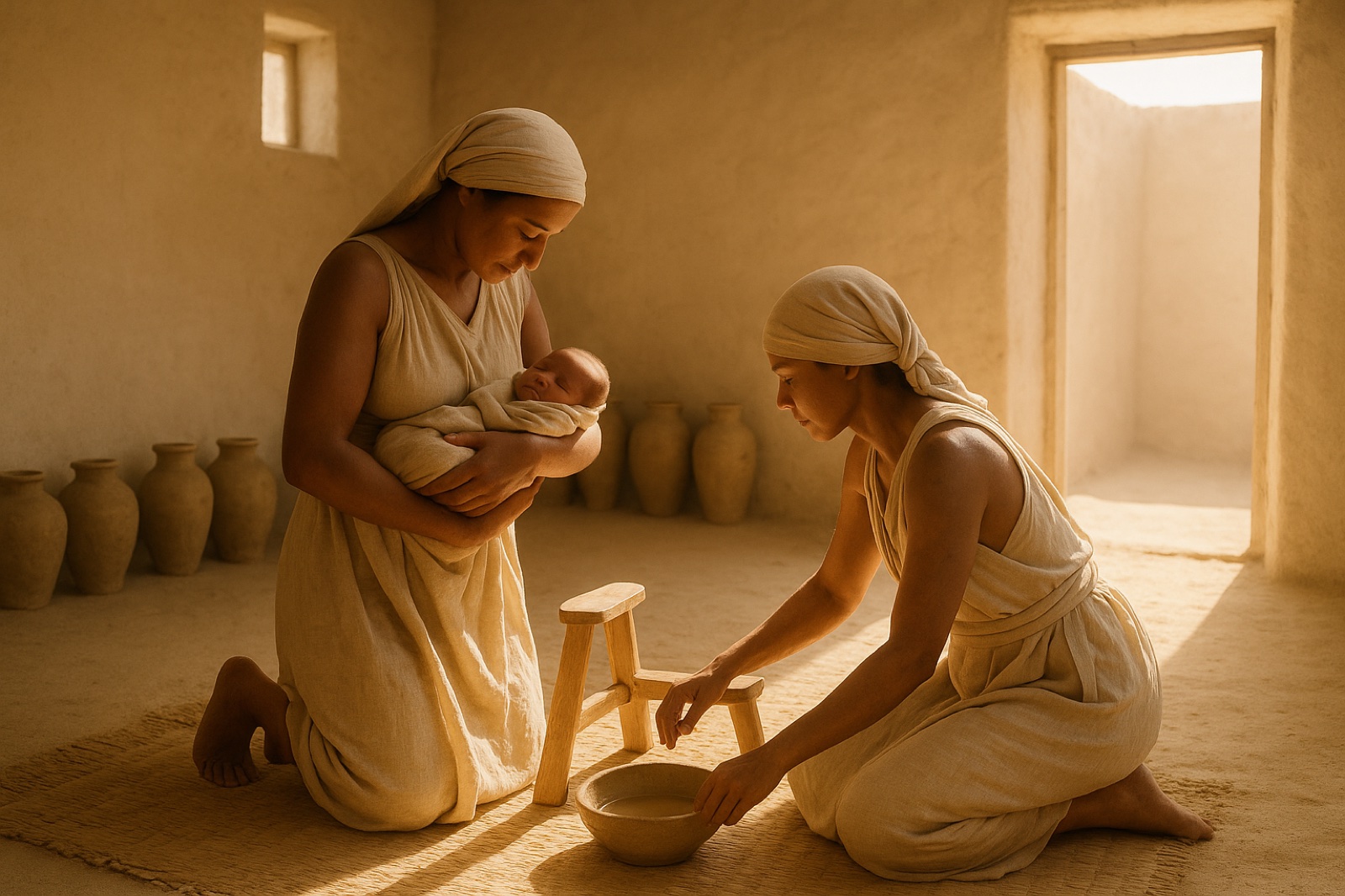
They were midwives in Egypt, at the beginning of the story that becomes the Exodus. A new king had come to power who did not remember Joseph. The Hebrew families kept growing. The king grew afraid of them, put them under hard labour, and when that did not slow the growth, he tried something quieter.
He went to the midwives.
“And the king of Egypt spake to the Hebrew midwives, of which the name of the one was Shiphrah, and the name of the other Puah: And he said, When ye do the office of a midwife to the Hebrew women, and see them upon the stools; if it be a son, then ye shall kill him: but if it be a daughter, then she shall live.” — Exodus 1:15-16, KJV
Read that first line again slowly. The king of Egypt is “the king of Egypt.” The midwives are Shiphrah and Puah.
The Order, and the Quietest Refusal in the Bible
What happens next takes one sentence.
“But the midwives feared God, and did not as the king of Egypt commanded them, but saved the men children alive.” — Exodus 1:17, KJV
There is no speech. No confrontation. No moment where they stand up in a throne room and denounce anybody. They simply went to work and kept going to work, and the babies kept living. The refusal was the work. Day after day, in rooms nobody important ever entered.
Eventually the king notices the numbers and calls them in to explain themselves. They answer that the Hebrew women deliver too quickly, before the midwives can arrive. Whether that was true, partly true, or a shield held up in front of a king who could have killed them on the spot, the text does not say. It says what happened next: “Therefore God dealt well with the midwives: and the people multiplied, and waxed very mighty” (Exodus 1:20, KJV).
Two ordinary working women slowed down a genocide by continuing to do their job properly. That is the whole strategy. It is not a small thing to notice that the Bible treats it as enough.
Nobody Is Actually Sure Who These Women Were
Here is where the story gets more interesting than it first looks, and honesty is better than tidiness.
The Hebrew phrase in Exodus 1:15 can be read two different ways, and it has been read both ways for a very long time. The vowel-pointed Hebrew text reads “the Hebrew midwives” — making them Hebrew women themselves. But the Septuagint, the ancient Greek translation, appears to reflect a different reading: “midwives of the Hebrew women,” which leaves their own background unstated. Josephus, the first-century historian, said plainly that they were Egyptian, reasoning that a king would never trust Hebrew women with an order to kill Hebrew babies. Rabbinic tradition went the opposite direction and identified them with Jochebed and Miriam, Moses’ own mother and sister. (The textual debate is laid out in detail here.)
So which was it? Nobody knows. The names themselves lean Semitic rather than Egyptian, which is a point in favour of the traditional reading, but it is a lean and not a proof. There is even an Egyptian document — a list of household servants from roughly the eighteenth century BC — that includes a name scholars assume is the same name as Shiphrah. That is a genuinely interesting detail and also not evidence that it is the same woman. It only tells us the name was real and in use.
Sit with what that means. We are not certain what nation these two women belonged to. We are not certain whether they were saving their own people or somebody else’s children. And their names came down to us anyway, across roughly three and a half thousand years, attached to nothing except what they did.
The Bible Knows Perfectly Well How to Name a Pharaoh
This is the part that changed how I read the chapter.
It would be easy to assume the Bible simply does not deal in Egyptian royal names. It does. Shishak is named in 1 Kings 14. Later scripture names Necho and Hophra and Tirhakah and So. When the biblical writers want to hand you a pharaoh’s name, they hand it to you.
Now, honesty matters more than a good line here, so here is the counterweight: historians point out that naming pharaohs only shows up in the biblical record from around the tenth century BC onward, and that in the earlier period referring to a ruler by his title alone was simply normal practice. So we cannot claim with confidence that the writer of Exodus 1 was deliberately withholding a name as an insult. We do not know that, and saying we do would be overreaching.
But here is what is not in dispute. Whatever the reason — deliberate choice, ordinary convention, or both — the page we ended up holding names two midwives and does not name the king. That is the record. That is what survived. Somebody’s crown did not make the list. Somebody’s day job did.
Two midwives are named. The king who gave the order is not.
“He Made Them Houses”
The chapter closes their part of the story with an odd phrase.
“And it came to pass, because the midwives feared God, that he made them houses.” — Exodus 1:21, KJV
Houses. The Hebrew word can mean a building, but it far more often means a household — a family, a line of descendants, people who come after you. Most commentators read it that way here: these two women, who spent their working lives helping other people’s families begin, were given families of their own. One old Jewish reading, from Rashbam, goes another way entirely and takes the houses as buildings Pharaoh put up to keep the midwives under watch. Even that reading is worth knowing, because it stops us flattening the verse into something simple.
And it is worth saying clearly what this verse is not. It is not a formula. Shiphrah and Puah did not obey God in order to receive something, and this is not a promise that quiet faithfulness pays out in the currency you would choose. They acted because they feared God more than they feared a king, with no idea anything at all was coming. What the verse tells us is the character of the God they were dealing with — not a transaction they figured out how to trigger.
What This Means for Work Nobody Sees
Most of us carry a quiet assumption that the record of our life is being kept by the people who can see us. Employers. Family. Whoever is counting.
By that record, Shiphrah and Puah should have vanished completely. They had no rank. They left no monument. They did their work in the least public room in the world, and the one powerful person who knew their names wanted them to do the opposite of what they did.
They are still here.
That is the turn, and it is worth slowing down for. God was not keeping the same record everyone else was keeping. Not a bigger version of it — a different one. On the world’s record, the king is the story and the midwives are staff. On the record we actually have, the midwives are the story and the king is scenery.
This is not an isolated case, either. It is a habit. Shamgar gets one verse in the entire Bible and saved a nation with a farm tool. Aaron and Hur held up the arms of a man everyone else was watching, and scripture stopped to write down who was doing the holding. The pattern keeps repeating because it is not an accident. It is how God sees.
Which means the tired question — does any of this count? — has already been answered, and it was answered a long time before you asked it. Not with a promise that someone will finally notice. With the plain evidence that God was already writing down the part nobody was watching.
If the deeper question underneath your tiredness is not really about the work but about what your life is actually for, that is a worthwhile thing to sit with honestly — our free What Is My Purpose? assessment is a straightforward place to start.
3 Things You Can Do Today
- Say one name out loud. Think of the person whose unrecorded work is holding your life up right now, and say their name aloud. It takes five seconds and it changes what you notice for the rest of the day.
- Send that person one specific message. Not “thanks for everything” — that is easy to write and easy to forget. Name the exact thing: the meal, the lift, the phone call at the bad hour. Specific gratitude lands like being seen, because it is.
- Write your own list. On any scrap of paper, write down three things you did this week that nobody will ever know about. Look at the list. That is not a list of wasted effort. That is the part being recorded.
Questions Worth Sitting With
- Which part of your week would quietly disappear from the record if you simply stopped doing it — and who would be the first to feel it?
- When you imagine that God already knows your name, what do you assume God thinks of the life attached to it? Where did that assumption actually come from?
- Shiphrah and Puah had no idea they were being written down. What would change about today if you took seriously that the unseen part is the part being kept?
A Prayer for Work Nobody Sees
God, I am tired of doing things that leave no trace. Some days I am not sure the work counts at all, and I am saying that plainly because You already know it. Thank You that the record You kept has two midwives in it and leaves a king out — that tells me what You are actually paying attention to. Help me do the next unnoticed thing well, not because someone might finally see it, but because You already have. Amen.
One Question for the Comments
Do you think Exodus leaves the king unnamed on purpose, or is that simply how writers of that era referred to rulers? There is a real case on both sides. Tell us which way you lean — we read every comment.
Share This
- Exodus 1 names two midwives, Shiphrah and Puah. It never names the king who gave them the order. Whatever the reason, the record we ended up holding says something.
- Read Exodus 1 again today. The powerful man is just “the king of Egypt.” The two women who quietly refused him have names.
- Shiphrah and Puah had no rank, no monument, and no audience. They did their job properly in a room nobody important entered, and three and a half thousand years later we still have their names. If your work goes unrecorded, that chapter is worth your evening.
Questions People Ask About Shiphrah and Puah
Who were Shiphrah and Puah in the Bible?
Shiphrah and Puah were two midwives named in Exodus chapter 1. The king of Egypt ordered them to kill every Hebrew baby boy at birth. They refused, kept delivering the babies alive, and the Hebrew population continued to grow. Exodus 1:17 says the midwives feared God and did not do as the king commanded.
Were Shiphrah and Puah Hebrew or Egyptian?
This is genuinely unresolved. The vowel-pointed Hebrew text of Exodus 1:15 reads “the Hebrew midwives,” suggesting they were Hebrew women. The ancient Greek Septuagint appears to reflect a reading of “midwives of the Hebrew women,” which leaves their background open, and the first-century historian Josephus stated they were Egyptian. Rabbinic tradition identified them with Jochebed and Miriam. Their names lean Semitic rather than Egyptian, but scholars have not settled the question.
Why does the Bible not name the Pharaoh in Exodus?
The ruler in Exodus is called only “the king of Egypt” or “Pharaoh,” never by a personal name. Historians note that in that earlier period it was normal practice to refer to a ruler by title alone, and that named pharaohs appear in the biblical record from roughly the tenth century BC onward — Shishak, Necho, Hophra, Tirhakah and So are all named in later scripture. So the omission cannot be confidently claimed as a deliberate insult. What is certain is the result: the text preserves the midwives’ names and not the king’s.
What does “he made them houses” mean in Exodus 1:21?
Exodus 1:21 in the King James Version reads, “And it came to pass, because the midwives feared God, that he made them houses.” The Hebrew word translated “houses” usually means a household — a family or line of descendants — rather than a physical building, and most commentators read the verse as meaning the midwives were given families of their own. A minority Jewish reading, from Rashbam, takes the houses literally as buildings put up to keep the midwives under guard. The verse describes God’s character, not a formula for earning a reward.
What is the lesson of Shiphrah and Puah?
Shiphrah and Puah had no rank, no public platform, and no audience for their work, yet Exodus records their names while leaving the most powerful man in the story unnamed. The lesson is that the record God keeps is not the same record the world keeps. Faithful, ordinary, unseen work — done in rooms nobody watches — is treated in scripture as significant, whether or not anyone alive notices it at the time.