 0
0
 0
0
Read Time:7 Minute, 30 Second
Quick Answer
The Hebrew word for wisdom is chokmah (חָכְמָה), pronounced *khok-MAH*, Strong’s H2451. But in the Hebrew Bible, chokmah rarely means “knowing a lot of facts.” It’s closer to *skill* — the mastery a craftsman has over their materials, applied to the art of living well. That single shift changes how almost every verse about wisdom in Scripture should be read.Word Study: Where It Comes From
Chokmah comes from the root *chakam* (חָכַם), “to be wise.” So far, that sounds like exactly what you’d expect. But look at where the Hebrew Bible actually uses this word family, and a different picture emerges. In Exodus 31, God fills a craftsman named Bezalel with chokmah so he can build the tabernacle — carving wood, setting gemstones, weaving fabric. In Exodus 35, the same word describes the women who spin goat’s hair into thread for the tabernacle curtains. In Ezekiel 27:8-9, it describes sailors and shipbuilders who know how to keep a vessel afloat. None of that is abstract intellectual knowledge. It’s hands-on competence — the kind that shows up in calloused hands and finished work, not just a well-stocked mind. That’s the root idea chokmah carries into every other place it appears: *skill applied to a task.* When the word shifts from carving wood to living a life, the task changes but the meaning doesn’t. Chokmah is the skill of living — knowing not just what is true, but how to act rightly, wisely, and well, in the actual textured circumstances of a day. It’s the difference between owning a cookbook and being able to cook. Solomon didn’t just accumulate facts about the world; he had the craftsman’s ability to apply what he knew, rightly, to the situation in front of him — which is exactly what 1 Kings shows him doing when two women both claim the same baby. This is also why Proverbs personifies Wisdom as a skilled builder rather than a lecturer. In Proverbs 8:30, Wisdom describes standing beside God at creation “as one brought up with him” — some translators render the underlying word as “master craftsman.” Whether or not that specific rendering holds, the picture it sits inside is consistent: wisdom in the Hebrew imagination is something closer to God’s own craftsmanship, on loan to human hands.Where This Word Appears in the Bible
| Reference | KJV Text | |—|—| | Proverbs 9:10 | “The fear of the LORD is the beginning of wisdom: and the knowledge of the holy is understanding.” | | Proverbs 1:7 | “The fear of the LORD is the beginning of knowledge: but fools despise wisdom and instruction.” | | Exodus 31:3 | “And I have filled him with the spirit of God, in wisdom, and in understanding, and in knowledge, and in all manner of workmanship,” | | 1 Kings 4:29 | “And God gave Solomon wisdom and understanding exceeding much, and largeness of heart, even as the sand that is on the sea shore.” | | Proverbs 3:19 | “The LORD by wisdom hath founded the earth; by understanding hath he established the heavens.” |Verse Deep Dive: Proverbs 8:22-31
This is the passage where chokmah stops being a trait people have and becomes a voice of its own. Wisdom speaks in the first person, and what she says is startling: > “The LORD possessed me in the beginning of his way, before his works of old. I was set up from everlasting, from the beginning, or ever the earth was.” (Proverbs 8:22-23) And later: > “Then I was by him, as one brought up with him: and I was daily his delight, rejoicing always before him; Rejoicing in the habitable part of his earth; and my delight was with the sons of men.” (Proverbs 8:30-31) Read this next to Exodus 31, and the pattern comes into focus. The same word that describes a craftsman’s hands filling a tabernacle with carved cherubim and woven curtains is here describing something present *at* creation — delighting in the work, delighting in the world, delighting in people. Wisdom isn’t a rulebook God consulted before making the world. She’s pictured as intimately involved in the making, the way a skilled builder is involved in every joint and seam of what they build. That’s why the passage ends the way it does — not with an argument for why you should be smarter, but an invitation: “whoso findeth me findeth life” (Proverbs 8:35). Chokmah isn’t a subject to master. In Proverbs 8, it’s closer to a person to walk with.Why the Original Word Changes the Meaning
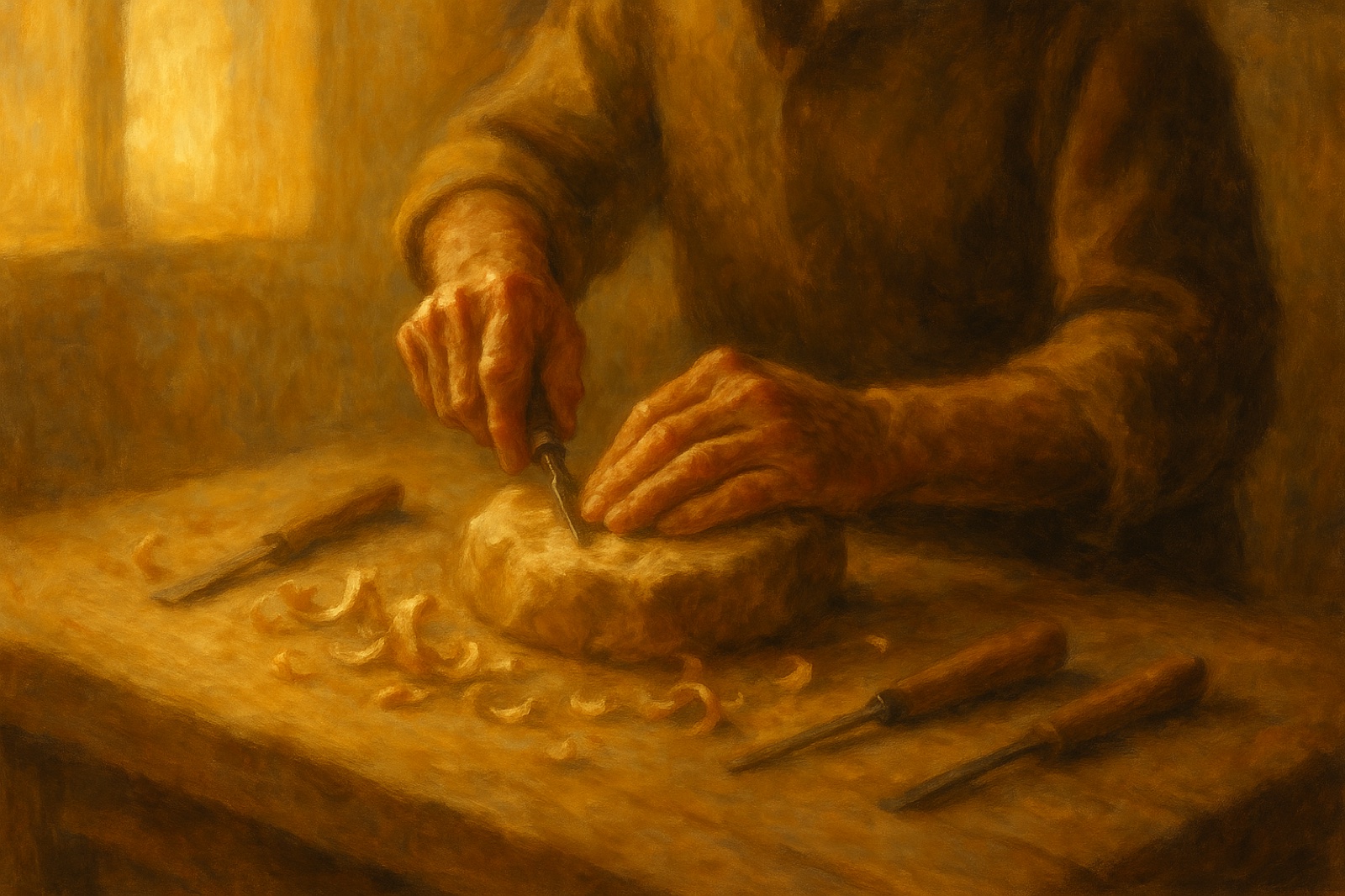
If wisdom just means “knowing things,” then the goal is to read more, study more, accumulate more correct information. That’s not nothing — but it quietly lets you off the hook. You can know the whole Bible cover to cover and still make foolish, careless, self-destructive choices, because knowing was never the actual assignment. Chokmah says the goal was never information. It was skill — the God-given ability to take what you know and do something faithful with it, in the actual, specific, sometimes messy situation you’re standing in today. A craftsman doesn’t stop at knowing what wood does under a chisel. They pick up the chisel. Wisdom, in the Hebrew sense, is what happens when belief becomes a practiced skill instead of a stored fact.Living It Out
Think of one place this week where you already know the right thing to do — you don’t need more information, more research, or another sermon on the topic. You just haven’t picked up the chisel yet. That’s the chokmah gap: not a knowledge gap, a practice gap. Ask God today for the craftsman’s skill to actually do the thing you already know, in the specific, textured circumstances you’re in — not someday, in general, but this week, in particular.Journal Prompts
1. Where in your life right now do you have knowledge but not yet skill — you know what’s right, but haven’t practiced doing it? What would it look like to “pick up the chisel” this week? 2. Proverbs 8 pictures Wisdom delighting in the world and in people, not standing over them with a checklist. Does your image of “being wise” feel more like that, or more like passing a test? What would change if it felt like delight instead? 3. Read Proverbs 9:10 again. Why do you think fear of the LORD is described as the *beginning* of wisdom rather than the end goal? What comes after that beginning, in your own walk?Prayer
Lord, You are the craftsman who built the world with wisdom and delighted in the work. I don’t want to just know more about You — I want the chokmah to actually live what I know. Where I’ve been collecting information instead of practicing faithfulness, give me the skill to pick up what’s in front of me and do it well, for You. Let me delight in the work the way Wisdom delighted in Yours. Amen.Share This
1. Chokmah, the Hebrew word for wisdom, doesn’t mean “knowing a lot.” It means skill — the kind a craftsman has. Wisdom isn’t what you know. It’s what you do with it. [Post URL] 2. In Proverbs 8, Wisdom stands beside God at creation “as one brought up with him” — the same word used of the craftsmen who built the tabernacle. Wisdom was never just information. [Post URL]FAQ
Is chokmah the same as intelligence? No. Intelligence is about capacity to understand; chokmah is about skillful application. A person can be highly intelligent and still lack chokmah if they don’t act rightly on what they know — and a person with modest formal intelligence can carry real chokmah if their life reflects skillful, faithful judgment. Why is Wisdom described as a woman in Proverbs? Chokmah is a feminine noun in Hebrew, and Proverbs leans into that grammatical fact by personifying Wisdom as a woman who calls out in the streets (Proverbs 1:20-21, 8:1-3), inviting people to walk with her. It’s a literary device meant to make wisdom feel like a relationship to pursue, not a subject to memorize. Does chokmah ever describe a bad kind of wisdom? The word itself is neutral enough to appear in verses about cunning advisors (2 Samuel 13:3) and even Egypt’s court magicians (Exodus 7:11), so chokmah alone doesn’t guarantee godliness — context decides whether the skill is aimed well. That’s part of why Proverbs 9:10 ties true wisdom to the fear of the LORD: the skill needs a right foundation, or it can be put to shrewd but hollow use. How is chokmah different from understanding or knowledge? Hebrew often pairs chokmah with binah (understanding, discernment) and da’ath (knowledge), as in Proverbs 2:6 and Exodus 31:3. Knowledge is what you’ve learned; understanding is grasping how it fits together; chokmah is the skilled follow-through — actually living it out.

Happy
0 %

Sad
0 %

Excited
0 %

Sleepy
0 %

Angry
0 %

Surprise
0 %