 0
0
 0
0
You know the feeling. You prayed. You asked for the breakthrough — the diagnosis to come back clear, the relationship to fully mend, the fog in your head to lift. And something happened. Things got better. Just… not all the way better. You can see more than you could before. You just can’t see clearly yet.
Maybe it’s a season of sobriety that’s real but still shaky. A grief that’s lighter but not gone. A calling you can feel but can’t quite name. You’re not where you started. You’re just not where you’re going, either.
There’s a story in the Gospel of Mark about a man who lived in that exact space — physically, literally — for a few minutes. And the strange part isn’t that Jesus healed him. It’s that Jesus let the in-between stand, in front of witnesses, before finishing the job.
The Miracle That Took Two Tries
Mark 8:22-26 tells it plainly:
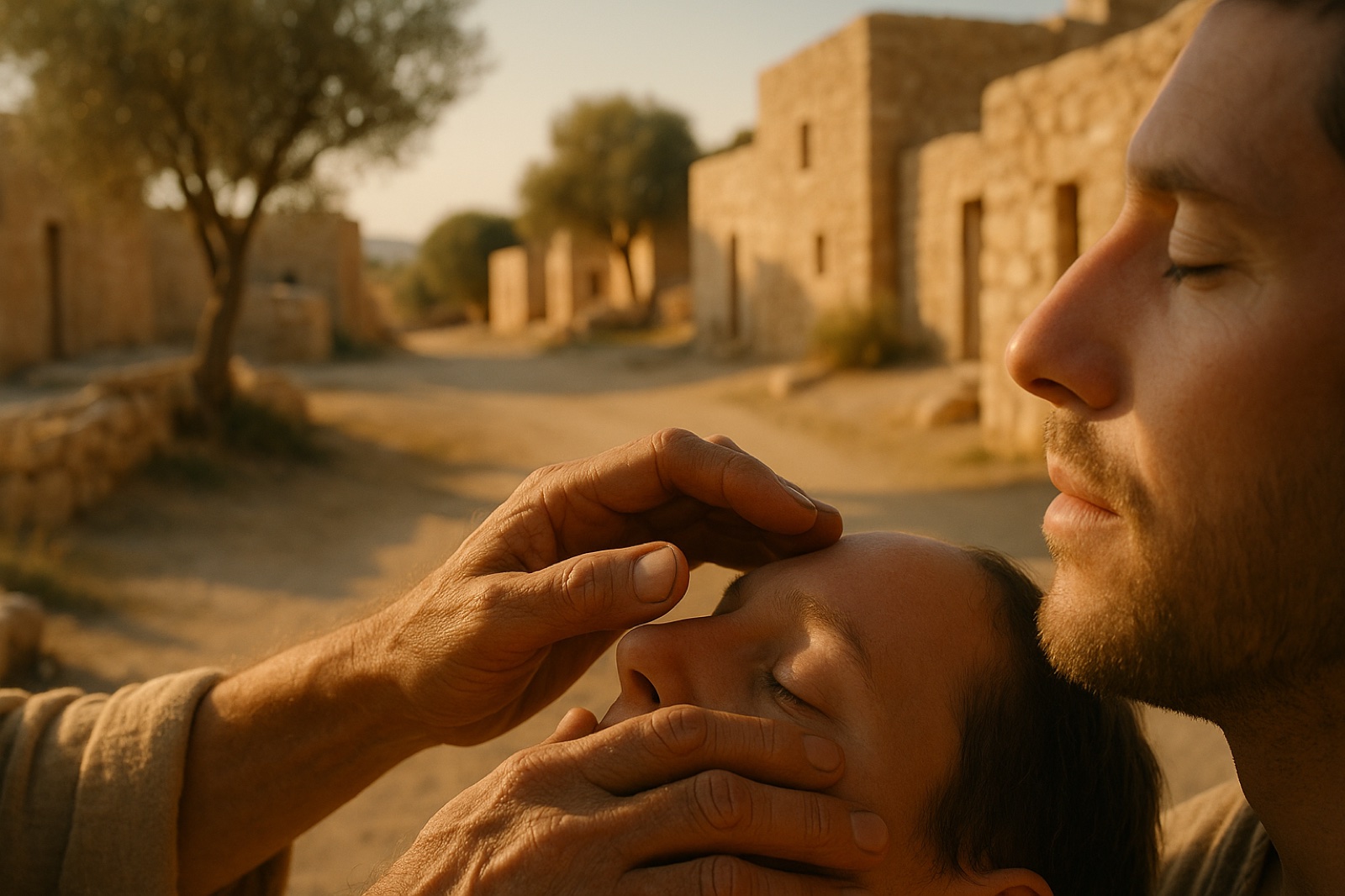
“And he cometh to Bethsaida; and they bring a blind man unto him, and besought him to touch him. And he took the blind man by the hand, and led him out of the town; and when he had spit on his eyes, and put his hands upon him, he asked him if he saw ought. And he looked up, and said, I see men as trees, walking. After that he put his hands again upon his eyes, and made him look up: and he was restored, and saw every man clearly.” (Mark 8:23-25, KJV)
Read that again slowly, because it’s easy to skim past what actually happened. Jesus touches the man’s eyes. Asks him what he sees. And the man says — out loud, in front of the people who carried him there — “I see men as trees, walking.” Shapes. Movement. Not nothing. Not everything.
Then Jesus touches him a second time, and only then does he see “every man clearly.”
In every other healing story in the Gospels, the result is instant and complete. The woman with the issue of blood touches His robe and is healed immediately. Bartimaeus cries out and receives his sight on the spot. Even the man born blind in John 9 sees clearly the first time Jesus applies mud to his eyes. Mark 8:22-26 is the only recorded miracle where Jesus healed someone in stages — where the first attempt produced a real but incomplete result, and everyone in the room knew it.
Why Bethsaida, and Why This Way?
Bethsaida wasn’t a random stop. It was one of the towns Jesus had already named specifically for its unbelief — a place that had seen “mighty works” and still hadn’t turned (Matthew 11:21). It’s worth sitting with that for a second: this two-stage healing happens in the one town Jesus had already called out for spiritual blindness of a different kind. The physical miracle and the spiritual backdrop are talking to each other.
Notice the small details too. Jesus doesn’t heal the man in the middle of the crowd — He takes him by the hand and leads him outside the village first. This wasn’t a performance. It was personal. And the method — spit, then touch — isn’t unique to this story; Jesus uses something similar in John 9. In the ancient world, saliva was widely believed to carry a physical, even medicinal, quality. Jesus meets the man in a way that would have felt familiar, not foreign — ordinary elements, used by an extraordinary hand.
But the detail that actually matters isn’t the method. It’s the pause. Jesus asks a direct question — “seest thou ought?” — and waits for a real, honest answer before doing anything else. He doesn’t assume the first touch worked. He checks. And when the answer is “sort of, but not really,” He doesn’t treat that as a failure to hide. He goes again.
The Turn: God Isn’t Threatened By Your Unfinished Middle
Here’s what nobody talks about with this passage: Jesus let a real crowd of witnesses see a real, incomplete miracle. He could have sent everyone away first. He could have kept working in private until it was flawless and only then let anyone see the “after.” Instead, the blurry middle happened in public, out loud, on the record — men like trees, walking — before the story was finished.
That’s not a flaw in the story. That’s the whole point of the story.
If you’ve ever felt like your faith, your healing, your calling, or your breakthrough is somehow disqualified because it isn’t finished yet — because you can see progress but not clarity — this passage says otherwise. God let an incomplete healing stand in broad daylight, with an audience, without shame, without rushing to cover it up. If Jesus wasn’t embarrassed by the blurry middle of a real miracle, your blurry middle isn’t disqualifying either.
The mistake most of us make is treating “I see men as trees, walking” as the failure point instead of the honest report. It wasn’t a setback. It was real progress, spoken out loud, on the way to something more.
What This Looks Like on a Monday
So what do you actually do with this? Not “have more faith” in the abstract. Something you can do today.
Think of one specific area of your life right now that’s better than it was — but not yet what you’re praying for. A relationship that’s talking again but hasn’t fully healed. A habit you’ve broken most days but not every day. A career move that’s in motion but not landed. Don’t wait until it’s “men seen clearly” to talk about it. Name the “trees, walking” version out loud — to God, and to one other person — today, while it’s still unfinished. That’s exactly what happened in Bethsaida, and it wasn’t the failure. It was the middle of the miracle.
Actions to Take This Week
- Name your “trees, walking” moment. Right now, in your Notes app or on paper, write one sentence describing something in your life that’s genuinely better but not yet fully clear. Don’t minimize it and don’t inflate it — just describe what you actually see.
- Say it out loud to one person today. Text or tell someone you trust: “I’m in the blurry middle of ___.” Practice letting the unfinished stand in front of a witness instead of hiding it until it’s resolved — the same way the man in Bethsaida did.
- Thank God for the partial sight before asking for the rest. Before your next prayer request, spend one minute specifically thanking God for the clarity you already have — even if it’s just shapes and movement. Then ask for the second touch.
A Prayer for the Blurry Middle
God, I’ll be honest — I’m tired of feeling like I’m not there yet. Some days I can see You moving and some days it’s just shapes and shadows, and I don’t always know which kind of day I’m in. Thank You for the ground I have gained, even the parts that still feel unfinished. I’m not asking You to rush the process — I’m asking You to stay with me in it, the way You stayed with that man in Bethsaida until he saw clearly. Touch it again. Amen.
A Question Worth Sitting With
Do you think it’s harder to keep trusting God in a season that’s completely unanswered, or in a season like this one — where you’ve already seen something real, but it’s still blurry? Tell us what you think in the comments.
Share This
- “Jesus healed a blind man in two tries. Not because He couldn’t do it in one — because sometimes the blurry middle is allowed to stand.” #TreesWalking
- “I used to think an unfinished answer meant God wasn’t done with me yet. Then I read Mark 8. Turns out the blurry middle was never the failure.”
- “There’s exactly one miracle in the Gospels that took two tries. Jesus let the crowd see it unfinished. That’s the part nobody talks about — Mark 8:22-26.”
Questions People Ask About Mark 8:22-26
Why did Jesus need two tries to heal the blind man in Mark 8?
Scripture doesn’t say Jesus lacked the power to heal instantly — He does exactly that in every other Gospel healing. Mark 8:22-26 is best read as intentional: Jesus asked the man directly what he saw, got an honest “not yet” answer, and touched him again. The two stages let the healing unfold as a real, witnessed process rather than an instant, unquestioned event.
Is this the only two-stage miracle in the Bible?
Among the recorded healing miracles of Jesus in the four Gospels, yes — this is the only one described in two distinct stages with a real, partial result in between. Every other healing, from Bartimaeus to the man born blind in John 9, happens in a single moment.
Why did Jesus use spit to heal the man’s eyes?
In the ancient world, saliva was commonly believed to have physical, even medicinal properties. Jesus uses the same method in John 9:6 with the man born blind. It wasn’t a magic ingredient — it was a familiar, human gesture that met the man in a way that would have made sense to him.
What does “I see men as trees, walking” mean?
It’s the man’s honest description of partial sight — he could make out shapes and movement, tall figures he identified as people, but without the sharp detail of full vision. It’s not confusion or exaggeration; it’s an accurate report of real, incomplete healing.
Why did Jesus tell the healed man not to go into the village?
Jesus gave similar instructions after several miracles, often to avoid stirring up premature, misdirected excitement about His identity before the right time. In this case, He’d also led the man outside Bethsaida specifically, away from the crowd, which fits the same pattern of a more private, personal healing rather than a public spectacle.
If this passage stirred something in you, you might also want to read about the man born blind in John 9, a different kind of healing story with its own layers, or dig into the name Jehovah Rapha — the moment God first called Himself “the LORD who heals.” And if you’re in a season where you’re doing everything right but still waiting, this piece on Mark 6:31 is worth your time too.
Curious what other surprising details are hiding in plain sight throughout Scripture? Our free Bible Fun Facts AI assistant (it opens in ChatGPT, and a free account works) is built to surface exactly this kind of thing.