 0
0
 0
0
Watch someone with Parkinson’s disease try to hold a cup of coffee still, and you’re watching a body that has lost its rhythm. The hand shakes when it should be steady. The steps shorten when they should stride. For decades, doctors could describe what Parkinson’s does — but not exactly why one treatment, deep brain stimulation, works so well for some patients and barely helps others. That gap just got a lot smaller.
A team of researchers spanning three countries just pinpointed something remarkably specific: a brain rhythm, oscillating at 20 to 35 times per second, that appears to be the actual reason deep brain stimulation calms the chaos of Parkinson’s. Not a vague “it helps somehow.” A signal. A frequency. A rhythm hiding inside a disease that looks, from the outside, like the total absence of one.
The “Storm” Doctors Already Knew Was There
Deep brain stimulation, or DBS, has been used for Parkinson’s since the late 1990s. Surgeons implant tiny electrodes deep in the brain — usually in a walnut-sized structure called the subthalamic nucleus — and those electrodes send a constant, gentle pulse of electricity. For many patients, the tremor eases. The stiffness loosens. People who could barely rise from a chair get up and walk.
But DBS has always had an uncomfortable asterisk attached to it: it works beautifully for some patients and only partially for others, and until now, nobody could fully explain the difference. Doctors knew Parkinson’s involves abnormal electrical “noise” in the brain — you’ll sometimes hear it called a beta-frequency storm — but they didn’t have a precise map of which connections actually mattered for treatment to succeed. (Parkinson’s itself is far from uniform, either — recent research has even found it shows up differently in men and women, which is part of why a one-size-fits-all approach to treatment has never quite worked.)
The Study That Found the Brain Rhythm Underneath the Chaos
Researchers from University Hospitals Cologne and Düsseldorf, Harvard Medical School, and Charité Berlin set out to answer that question directly. They studied 50 Parkinson’s patients — 100 brain hemispheres in total — who already had DBS electrodes implanted. Then they did something that hadn’t been done quite this way before: they recorded electrical activity from those implanted electrodes at the exact same time they scanned each patient’s brain with magnetoencephalography, a technology that maps brain activity from outside the skull with extraordinary timing precision.
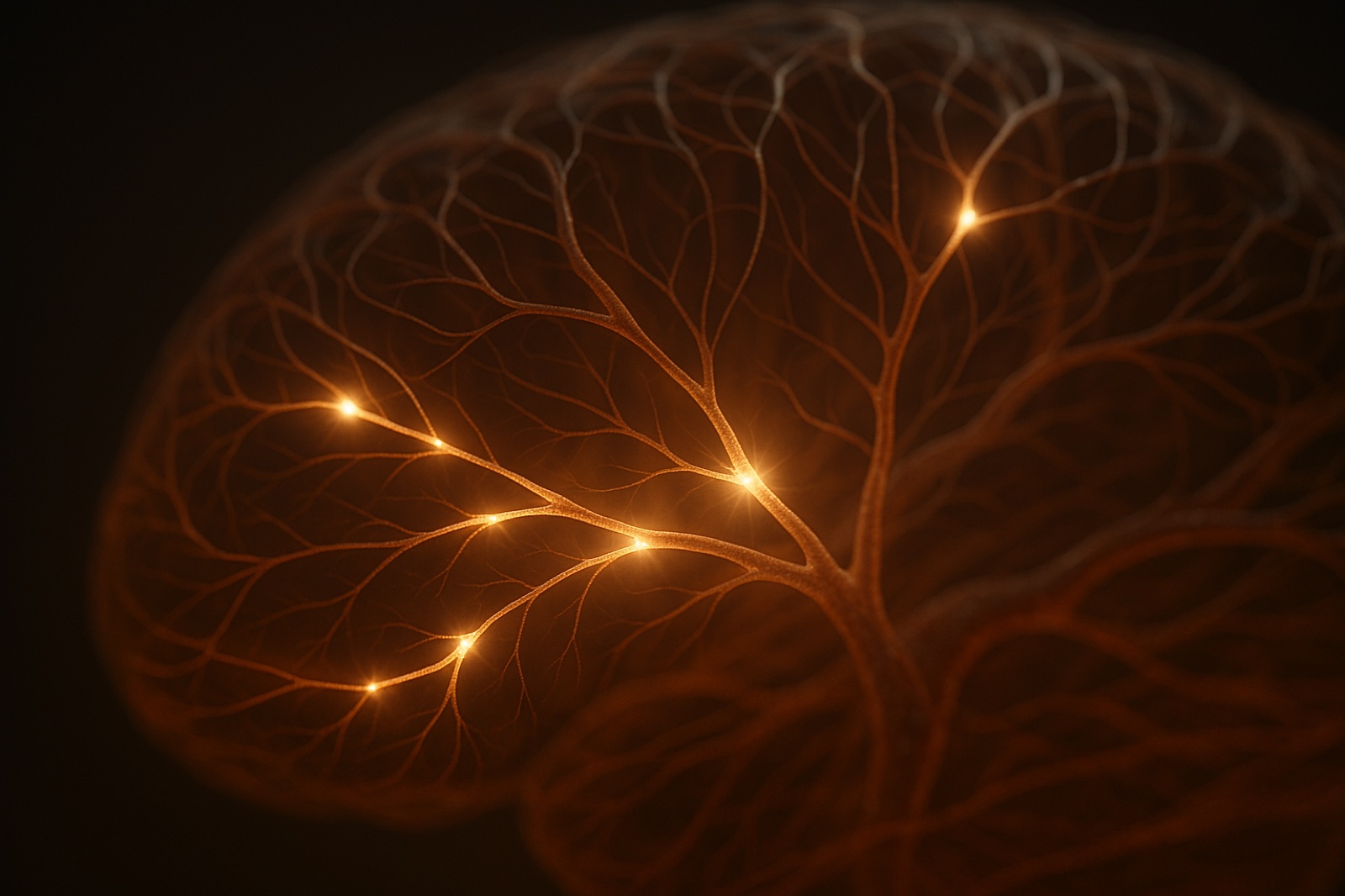
Combining those two data streams — the deep signal from inside the brain and the wide-angle picture from outside it — let the team trace something no one had mapped this clearly before: a specific network connecting the subthalamic nucleus to regions of the frontal cortex, communicating through a high beta rhythm in that narrow 20-to-35Hz band. And the strength of that network’s connection lined up, patient by patient, with how much their motor symptoms actually improved.
“This network operates synchronized within a specific frequency band, and offers an explanation for how well patients respond to deep brain stimulation,” said Professor Andreas Horn, one of the researchers behind the study. In other words: the rhythm isn’t a side effect of the treatment working. The rhythm may be why the treatment works at all.
It’s a small, quiet reminder of something researchers keep rediscovering in different forms — that even inside conditions that look like pure disorder, the brain is still built along precise, findable lines. It’s the same kind of hidden structure that showed up when scientists traced the exact brain circuit that makes loneliness feel unbearable — a specific signal, in a specific place, doing a specific job, waiting for someone to go looking.
Why This Actually Changes Treatment
Right now, adjusting a patient’s DBS settings after surgery is part science, part trial and error. A neurologist nudges the stimulation, watches how the patient responds, and adjusts again. It works, but it’s slow, and some patients spend months dialing in a setting that never quite gets them all the way there.
This discovery gives doctors a target instead of a guess. Dr. Bahne Bahners, who worked on the study, put it plainly: “By stimulating regions that are connected to the identified network, we will probably be able to adjust DBS settings more precisely in the future, especially in patients who have not yet benefited optimally from deep brain stimulation.” Instead of testing broadly, clinicians may eventually be able to aim directly at the network doing the actual work — turning months of trial and error into something closer to a fitting.
It’s also the first study to combine live electrical recordings and brain imaging this way — at the same time, in the same patients — which is part of why the picture is so much sharper than what researchers had before. Where earlier work could describe the storm, this study drew the exact coordinates of the eye at its center.
The Order Inside What Feels Like Chaos
There’s something worth sitting with here, whether or not you or anyone you love has ever heard the word Parkinson’s. A disease that looks, from the outside, like total breakdown — a body that can’t hold still, can’t keep time with itself — turns out to still be running on precise, locatable, findable order. Not random misfiring. A specific rhythm, in a specific place, doing a specific thing.
Ancient writers who never once looked through a microscope still landed on the idea that the human body was made with an almost unsettling level of intention — “fearfully and wonderfully made,” in the old language, long before anyone could explain what that actually meant at the level of a neuron or a network. It’s a strange thing to find that specificity confirmed, piece by piece, thousands of years later, in a lab studying the disease that seems most like proof the design has failed. It hasn’t. It’s just harder to see from inside the storm.
That’s not a claim that suffering has a tidy purpose, or that anyone’s diagnosis is some kind of hidden lesson — that would cheapen something real. It’s smaller and, maybe, sturdier than that: even where the body is fighting itself, the architecture underneath hasn’t stopped being precise. Something built that specifically doesn’t read like an accident. It’s the same quiet pattern that turned up when a 30-year study of 147,000 people found the exact amount of movement that adds years to a life — modern data, quietly landing on something ancient wisdom had already pointed toward.
If Parkinson’s Is Part of Your Story
If this is close to home — for you, or for someone you’re caring for — a few things worth knowing:
- DBS isn’t right for every stage of Parkinson’s, but if symptoms are getting harder to manage with medication alone, it’s worth asking a movement disorder specialist directly whether you’re a candidate — not just a general neurologist.
- If you already have a DBS implant and feel like your settings have never quite gotten you all the way there, this research is new enough that it’s reasonable to ask your care team whether their approach to programming has evolved.
- Movement disorder centers at academic medical centers tend to have the most current access to research like this — a second opinion at one is rarely wasted effort.
And if you’re just the friend or family member watching from the outside, feeling helpless — presence still matters more than having the right words. Showing up steadily is its own kind of medicine.
A quiet prayer, for anyone this touches: God, for every hand that shakes when it wants to be still, for every family watching someone they love fight to stay steady — be near. Give the researchers wisdom, give the caregivers strength, and give the ones in the middle of the storm some evidence, today, that the order hasn’t left them. Amen.
Whatever specific chaos you’re standing in right now — a diagnosis, a body that won’t cooperate, a season that feels like static — it’s worth remembering that “chaos” is often just order we haven’t found the frequency for yet. Scientists just proved that, literally, for one of the hardest diagnoses there is. It’s a good rhythm to hold onto.
What Do You Think?
If scientists can find a specific, locatable rhythm holding order inside something as disruptive as Parkinson’s, what other parts of the body — or life — do you think are more “designed” than they look from the outside? Drop your thoughts in the comments — we’d love to hear where you land.
Share This
- Scientists just found the *exact* brain rhythm that makes deep brain stimulation work for Parkinson’s — a 20-35Hz signal hiding inside a disease that looks like total chaos. Wild.
- Turns out even a disease that looks like pure disorder is still running on precise, findable rhythm underneath. Researchers just mapped it for the first time.
- “The order hasn’t left, it’s just hard to see from inside the storm.” New Parkinson’s research found the exact brain network that makes treatment work — and it’s a good reminder for more than just Parkinson’s.
Common Questions About This Research
What brain rhythm did scientists find for Parkinson’s treatment?
Researchers identified a high beta-frequency brain rhythm, oscillating between 20 and 35 times per second (20-35Hz), running through a network that connects the subthalamic nucleus to regions of the frontal cortex. The strength of this network’s connectivity correlated with how much a patient’s motor symptoms improved with deep brain stimulation.
Who conducted the Parkinson’s brain rhythm study?
The research came from a multicenter team including University Hospitals Cologne and Düsseldorf, Harvard Medical School, and Charité Berlin. The study involved 50 Parkinson’s patients and analyzed data across 100 brain hemispheres.
How does this change deep brain stimulation treatment for Parkinson’s?
Currently, doctors adjust DBS settings through trial and error after surgery. This discovery gives clinicians a specific network to target directly, which researchers say should make it possible to fine-tune stimulation settings more precisely — especially for patients who haven’t responded fully to DBS in the past.
Why did this study need both brain implants and brain scans?
The researchers recorded electrical activity from patients’ implanted DBS electrodes at the same time they performed magnetoencephalography (MEG) brain scans. Combining a signal from deep inside the brain with a wide external map let them trace the exact network and rhythm involved — something neither method could do fully on its own.
Does this mean Parkinson’s disease can be cured?
No — this research doesn’t cure Parkinson’s, but it meaningfully improves how precisely deep brain stimulation, an existing and already-effective treatment, can be targeted and adjusted for individual patients going forward.