 0
0
 0
0
You know the feeling. You’re walking into your day with a plan — errands, a meeting, dinner with your family — and then something grabs you. A phone call you didn’t want. A responsibility nobody asked if you were free for. A crisis that isn’t yours, that becomes yours anyway, the second you happen to be standing there.
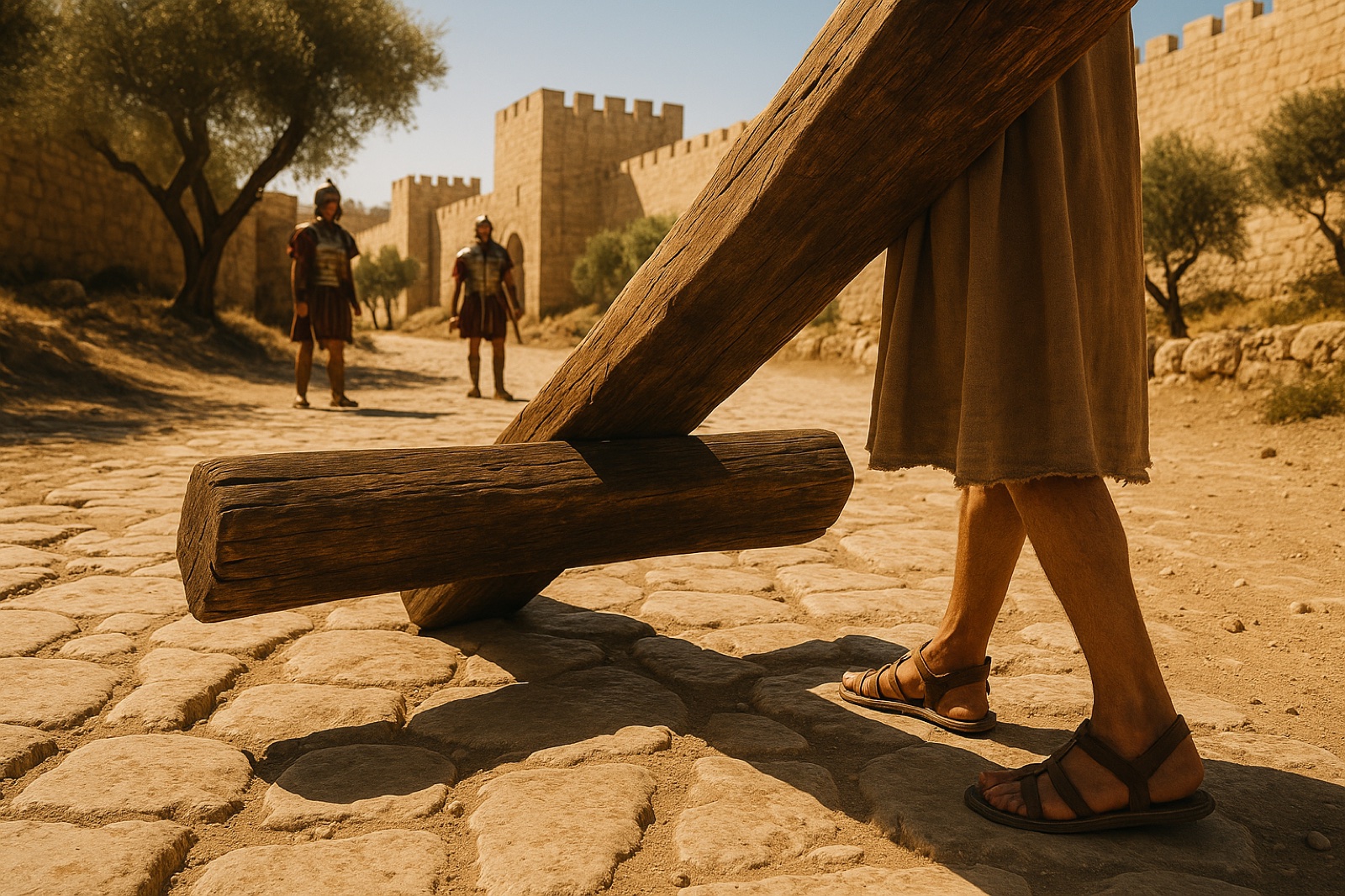
That’s exactly how Simon of Cyrene’s day started. He wasn’t part of the crowd that had gathered to watch. He wasn’t looking for Jesus at all. Scripture says he was simply “coming out of the country” — walking in from the fields, likely heading into Jerusalem for the last of the Passover preparations — when Roman soldiers grabbed him off the road and forced him into something he never signed up for.
He carried a cross that wasn’t his. For a man he’d never met. Toward a hill he never wanted to see.
And then — almost nothing. Scripture barely mentions him again. No sermon from him. No recorded reaction. Just one verse, and then silence.
That silence isn’t the Bible forgetting about him. Read closely, and it says everything.
Who Was Simon of Cyrene, Really?
Cyrene was a city in North Africa, in what’s now Libya — home to a sizable Jewish community that regularly made the long trip to Jerusalem for the major feasts (you can see other Cyrenians mentioned throughout Acts, in chapters 2, 6, 11, and 13). Simon was almost certainly one of those pilgrims — a man who had traveled a long way to celebrate Passover, not to become part of the most significant execution in human history.
Mark’s gospel gives us the anchor verse for his whole story:
“And they compel one Simon a Cyrenian, who passed by, coming out of the country, the father of Alexander and Rufus, to bear his cross.” (Mark 15:21, KJV)
Notice what that verse doesn’t say. It doesn’t say Simon offered. It doesn’t say he pushed through the crowd out of compassion, or that he’d heard about Jesus and wanted to help. The word Mark uses is “compel” — and that word is doing more work than it looks like at first glance.
The Roman Law Behind One Word: “Compelled”
The Greek word behind “compel” here is angareuo. It described a specific legal right under Roman occupation: any Roman soldier could seize any civilian and force them to carry a burden for up to one mile, no explanation required, no refusal allowed. It’s the same word Jesus Himself used years earlier, in the Sermon on the Mount: “And whosoever shall compel thee to go a mile, go with him twain” (Matthew 5:41). Jesus had literally taught about this exact practice before it was ever done to someone on His behalf. Simon wasn’t asked to help. He was legally seized — the same way Jesus described people being seized every day under Roman rule.
Picture the scene physically. Jesus had already been scourged — a brutal Roman flogging that regularly left victims too weak to stand, let alone carry a heavy wooden beam through Jerusalem’s streets. The soldiers weren’t looking for a volunteer out of mercy. They needed the execution to keep moving, and Jesus’s body couldn’t carry the weight anymore. So they grabbed the nearest man who could.
That man happened to be Simon.
The Sons Named in a Verse That Doesn’t Explain Why
Here’s where the story gets quietly remarkable. Mark doesn’t just say “a man named Simon.” He says Simon was “the father of Alexander and Rufus” — naming two sons his original readers apparently already knew. Scholars have long noted that Mark’s gospel was likely written for the church in Rome, and there’s a striking connection a chapter away from where you’d expect it: in Paul’s letter to that same church, he writes, “Salute Rufus chosen in the Lord, and his mother and mine” (Romans 16:13).
Many scholars believe this is the same Rufus — Simon’s son, now a known and respected believer in the Roman church, close enough to Paul that Paul calls Rufus’s mother “his own” too. If that connection holds, it means the man forced off the road that day didn’t just carry a cross for one afternoon. His family carried faith for decades afterward, known by name in one of the New Testament’s most important letters.
Simon isn’t the only Bible figure whose one recorded scene turned out to matter far more than it looked like at the time. Ananias of Damascus gets three sentences in Acts 9 — and changes the entire trajectory of Christianity by obeying an assignment he was terrified to accept.
The Story That Isn’t Really About Simon — Which Is the Point
Simon of Cyrene wasn’t a disciple. He hadn’t been at the Last Supper. He didn’t apply for a role in the most important moment in human history, and nothing in the text suggests he wanted one. He simply happened to be walking down the wrong road at the right moment, and God’s sovereignty used exactly that.
That’s the Turn worth sitting with: the interruption you resent today — the call, the crisis, the responsibility dumped on you without warning — isn’t automatically a detour from your purpose. Sometimes it’s the assignment itself, arriving in the one form purpose never seems to come in: unplanned, unwanted, and not remotely convenient.
It’s the same quiet pattern behind Nicodemus, who shows up in only a handful of verses before disappearing into the background of the Gospels — until the very end, when his one hidden act says more about his faith than anything he ever said out loud. Scripture doesn’t always tell us a person’s significance the moment it happens. Sometimes, like with Simon, it tells us decades later, in someone else’s letter.
If you’ve ever wrestled with feeling like you don’t have a clear calling — like everyone else got a résumé for their purpose and you’re still waiting for yours — Jacob’s story shows the same thing from a different angle: sometimes the moment that defines your identity in God isn’t the one you planned for either. And if you want to go a step further and explore where God might already be using you in the ordinary things filling your week, BGodInspired’s free Spiritual Gifts GPT (opens in ChatGPT) is built for exactly that kind of exploring.
What This Looks Like for You This Week
Simon’s story doesn’t end with a feeling. It ends with an unplanned burden that quietly became a legacy. Here’s how to let that reshape the next interruption that finds you.
Actions to Take
- Today, before you react to the next unwanted interruption — the call, the errand, the favor you didn’t have time for — pause and pray one sentence: “God, if this is Yours, use it.” Takes ten seconds. Changes how you carry the next hour.
- Reach out to one person you’ve been “forced” to help lately — a family member, a coworker, a neighbor whose need landed on you without warning — and say one encouraging thing to them today. Let the burden become a door instead of just a weight.
- Write down one past interruption you resented at the time but can now see God actually used. One sentence is enough. Keep it somewhere you’ll see it the next time you’re tempted to resent the current one.
Journal It Out
- What’s an interruption in your life right now that you’ve been resenting instead of receiving?
- Whose “sons and daughters” — the people quietly watching how you respond — might remember this moment long after you’ve forgotten it?
- Where have you assumed you had no assignment, when really you were just standing on the wrong road at the right time?
A Prayer for the Interruption You Didn’t Choose
God, I didn’t plan for this. This isn’t the day I thought I’d be having, and honestly, part of me resents it. But Simon didn’t choose his either, and it turned out to matter more than he probably ever knew. So help me carry what’s in front of me right now without waiting to understand why. If this weight is actually an assignment, open my eyes to see it. And if it’s just a weight, carry it with me anyway. Amen.
One question to sit with: If Simon of Cyrene had known, in that moment, exactly who he was carrying that cross for — do you think it would have changed how he carried it? Tell us what you think in the comments.
Share This
- “Simon of Cyrene didn’t ask to carry that cross. Rome forced him. Decades later, his son gets named by name in the book of Romans. Some interruptions are actually assignments.”
- “I used to think God only used people who volunteered. Then I read about the guy randomly pulled out of a crowd to carry Jesus’s cross — and became part of the story forever.”
- “The Bible barely records a single word about how Simon of Cyrene felt carrying that cross. Maybe that’s the point. It was never about him.”
Simon of Cyrene: Your Questions Answered
Who was Simon of Cyrene in the Bible?
Simon of Cyrene was a man from North Africa, likely a Jewish pilgrim visiting Jerusalem for Passover, whom Roman soldiers forced to carry Jesus’s cross to Golgotha after Jesus — exhausted from being scourged — could no longer carry it Himself. His story appears in Mark 15:21, Matthew 27:32, and Luke 23:26.
Was Simon of Cyrene a disciple of Jesus?
Nothing in Scripture says so. He appears to have simply been walking into Jerusalem “out of the country” when Roman soldiers seized him under a legal practice called angareia — the right to force any civilian bystander into labor, no consent required.
Why does Mark mention Simon’s sons, Alexander and Rufus?
Mark names them (Mark 15:21) as though his original readers already knew who they were — a strong sign the family became known believers. Many scholars connect this Rufus to the Rufus Paul greets warmly in Romans 16:13, suggesting Simon’s forced moment on the road to Golgotha helped plant a faith that outlived him by decades.
What does “compelled” mean in Mark 15:21?
The Greek word, angareuo, described a legal right under Roman occupation: a soldier could force any civilian to carry a burden for up to one mile. It’s the same word Jesus uses in Matthew 5:41 (“whoever compels you to go one mile, go with him two”). Simon wasn’t asked — he was legally seized.
What can we learn from Simon of Cyrene today?
That God’s sovereignty can use interruptions we never chose and would never have volunteered for. Simon didn’t apply for a role in the most important moment in human history — he was pulled into it, and his family’s faith became part of the story for generations afterward. The unwanted assignment in front of you today might not be a distraction from your purpose. It might be it.