 0
0
 0
0
Venus has a reputation problem. For decades, planetary scientists filed it under “dead.” Not dead like the Moon, which never had much geologic life to lose — dead like a house that used to have people in it. Venus is roughly the same size as Earth, made of the same basic rock, sitting in the same neighborhood of the solar system. But every radar map, every orbital scan, every mission that’s peered through its thick yellow clouds has come back with the same story: a scarred, static surface that stopped changing hundreds of millions of years ago and has just been sitting there ever since, weathering into stillness under 900-degree heat.
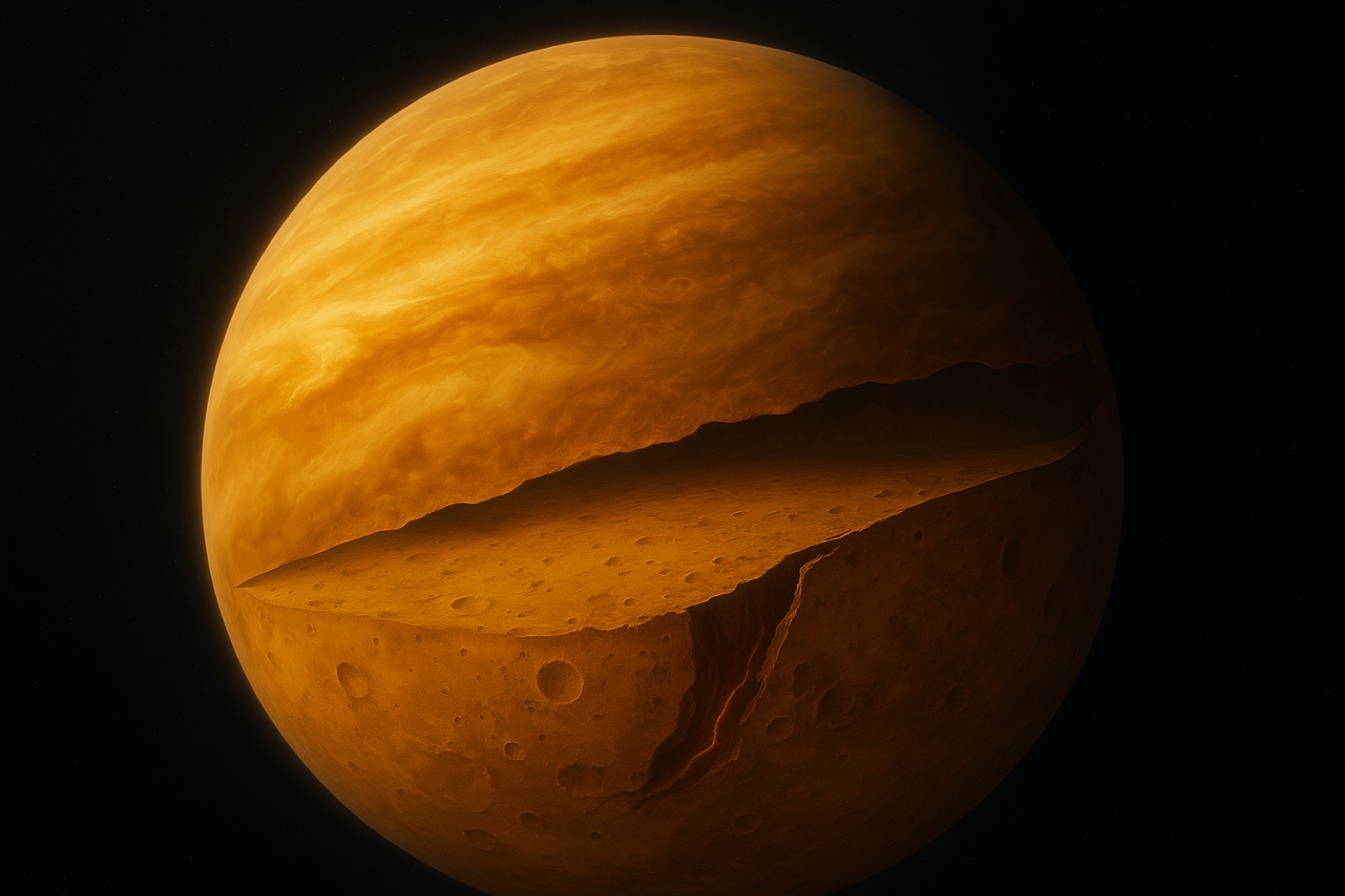
A new study out of ETH Zurich just rewrote that story. Venus isn’t finished. Some of its most massive rift valleys — canyons that stretch up to 10,000 kilometers across the planet’s surface — are far younger than anyone assumed, and they’re still growing. The planet everyone agreed was geologically dead is, underneath its ancient-looking surface, still tearing itself apart.
Why Everyone Thought Venus Had Stopped Moving
Earth’s crust is broken into plates that grind, collide, and slide past each other — that’s plate tectonics, and it’s the reason we have earthquakes, mountain ranges, and a planet that keeps recycling its own surface. Venus doesn’t have that. Its crust is one continuous shell, which is part of why scientists assumed its interior had gone quiet: no plates, no motion, no reason for the surface to keep changing.
Venus does have rift valleys, though — long, deep gashes in the crust that look a lot like the ones plate tectonics produces on Earth. But because Venus wasn’t supposed to have any tectonic activity left, researchers generally assumed these rifts were ancient. Fossils. Scars from something that happened over 100 million years ago and then simply stopped, the way a crack in a sidewalk doesn’t keep spreading once the concrete has fully set.
The trouble is, nobody had actually modeled how these rifts would behave in enough detail to know if that assumption held up. It wouldn’t be the first time Venus surprised the people studying it — scientists only recently confirmed an intact volcanic lava tube hidden beneath its surface, evidence that the planet’s underground story is a lot more active than its surface lets on.
The Venus Rift Valleys Are Still Expanding — and Faster Than Expected
Professor Taras Gerya, a geodynamicist at ETH Zurich, and Xi Yang, who led the research as part of his master’s studies, built something that hadn’t existed before: the first high-resolution, 3D computer simulations of how Venusian rift valleys actually form and evolve. Earlier models had flattened the problem into two dimensions, using simplified assumptions about how planetary rock behaves under stress. Gerya and Yang’s team let the physics play out in three dimensions instead, and the picture that came back looked nothing like a fossil.
Published in Nature Geoscience, the simulations reproduced a detail that shows up on the real Venusian surface: rift flanks, the broad raised ridges that form along the edges of a rift valley — but only while that rift is still young and actively pulling apart. Mature, long-dead rifts don’t have them. Venus’s rifts do. Which means, according to the model, some of these canyons aren’t ancient scars at all. They’re active. And they may be widening by roughly 3 to 10 centimeters a year — which happens to be about the same rate your fingernails grow.
“The results help us to better assess the tectonic activity on Venus,” Gerya said of the findings. It’s a modest way to describe a fairly major shift: a planet that textbooks have described as geologically inert for years may still have a moving, active interior, reshaping the surface in real time, just too slowly and too quietly for any single glance to catch it.
This doesn’t mean Venus is secretly Earth in disguise, and researchers are careful to say so. One study, however striking, isn’t the final word — Venus is still a hard planet to study up close, and future missions like NASA’s VERITAS and ESA’s EnVision, both designed to map the planet’s surface and interior in far more detail, will be what actually confirms how active it really is. But the door that this research opens is real: for the first time in a long time, “Venus is dead” is a claim scientists are having to defend rather than assume.
What a Motionless-Looking Planet Can Teach You About What’s Actually True
There’s something worth sitting with in the fact that every photograph of Venus — every single one ever taken — shows a planet that looks completely finished. Still. Locked in place. And it turns out that appearance was never proof of anything. The stillness in the picture was just the limit of what a photograph can show. Underneath it, something had been moving the entire time. Astronomers have run into this exact blind spot before — four stars sat in plain sight for years, missed entirely because they were standing next to something brighter. What’s real and what’s visible keep turning out to be two different lists.
People carry a version of this same mistake around, usually without noticing. There’s an old idea, older than modern psychology, that the most important changes in a person happen on the inside first — quietly, slowly, long before there’s any outward sign of them. Not the kind of change you can catch in a single glance, or prove to someone else, or even always feel yourself. Just movement, underneath the surface, doing its work at its own pace. A life can look exactly the same from the outside for a long time while something real is genuinely shifting underneath it. Venus just happens to be a very large, very dramatic reminder that “looks unchanged” and “is unchanged” are not the same claim.
It’s a strange kind of comfort, if you let it be one — the idea that transformation doesn’t need an audience, or evidence, or even your own certainty, to be real. Sometimes it’s just moving, at three centimeters a year, waiting for the surface to catch up. It’s the same quiet question underneath why a person can feel completely disconnected from anything bigger than themselves even while something in them is still, unmistakably, moving.
Discussion Question
Do you think people put too much weight on what’s visible on the surface — of a planet, a situation, or a person — and not enough on what might be happening underneath it? What changed your mind, if anything ever has?
Share This
- “Venus was supposed to be geologically dead. Turns out it’s still tearing itself apart from the inside — just slowly enough that nobody noticed until now. Wild.”
- “TIL Venus’s rift valleys might be actively expanding at about the same rate your fingernails grow. A whole planet, quietly changing shape, and you’d never know from a photo.”
- “Every picture of Venus makes it look finished. It’s not. There’s a planet-sized lesson in that somewhere.”
Frequently Asked Questions
Is Venus geologically active?
New research from ETH Zurich, published in Nature Geoscience, suggests Venus may still be tectonically active. High-resolution 3D simulations found that some of the planet’s giant rift valleys show signs of being much younger than previously believed, and may still be expanding today.
How fast are Venus’s rift valleys growing?
According to the study’s simulations, some rift valleys on Venus may be widening by roughly 3 to 10 centimeters per year — a rate comparable to how fast human fingernails grow.
Who led the Venus rift valley study?
The research was led by Professor Taras Gerya, a geodynamicist at ETH Zurich, with Xi Yang as lead author, completed during his master’s studies. It was published in the journal Nature Geoscience in 2026.
Why did scientists think Venus was geologically dead?
Venus lacks the broken, moving crustal plates that drive plate tectonics on Earth, so scientists long assumed its interior had gone quiet and that its rift valleys were ancient, inactive scars rather than active features.
What are rift flanks, and why do they matter to this discovery?
Rift flanks are broad, raised ridges that form along the edges of a rift valley while it’s actively pulling apart — mature or long-dead rifts don’t have them. Finding rift flanks on Venus’s rift valleys in the 3D simulations is part of what suggests some of these features are geologically young and still active.