 0
0
 0
0
You check your phone again. Nothing. You prayed about the job, the diagnosis, the marriage, the kid who won’t call back — and you meant it, really meant it, and then you waited. A day. A week. Three years, maybe, if you’re honest about how long some of these prayers have been sitting open. And somewhere in that waiting, a question starts to form that feels almost too dangerous to say out loud: is God even listening?
A prophet named Habakkuk asked that exact question. Not politely, either — and what he did next, when God stayed silent for years, is one of the most oddly practical passages in the entire Bible.
A Prophet Who Complained to God’s Face
Habakkuk doesn’t open like most prophetic books. There’s no vision of angels, no burning bush, no thunder from a mountain. It opens with a man arguing with God.
“O LORD, how long shall I cry, and thou wilt not hear! even cry out unto thee of violence, and thou wilt not save!” (Habakkuk 1:2). That’s verse two. Not the closing lament after a long, patient buildup — the opening line. Habakkuk is watching his nation, Judah, rot from the inside: violence in the streets, courts twisting justice, the law “slacked” as he puts it, and God is doing nothing about it. So he says so. Directly. Repeatedly.
And here’s the detail worth sitting with: God doesn’t rebuke him for it. God answers him — just not with the answer Habakkuk wants. God tells him judgment is coming, but it’s coming through the Babylonians, a nation Habakkuk considers even more violent and godless than his own. Which prompts a second round of complaint. Habakkuk basically says: that’s your plan? Use the worse guys to punish the bad guys?
This is a man who does not fake being fine. He brings his real objections to God and expects, somehow, to still get a real answer.
What Habakkuk Actually Did With the Silence
After two rounds of complaint, Habakkuk doesn’t storm off. He doesn’t spiral into despair, and he doesn’t pretend everything’s suddenly resolved either. He does something much stranger and much more useful:
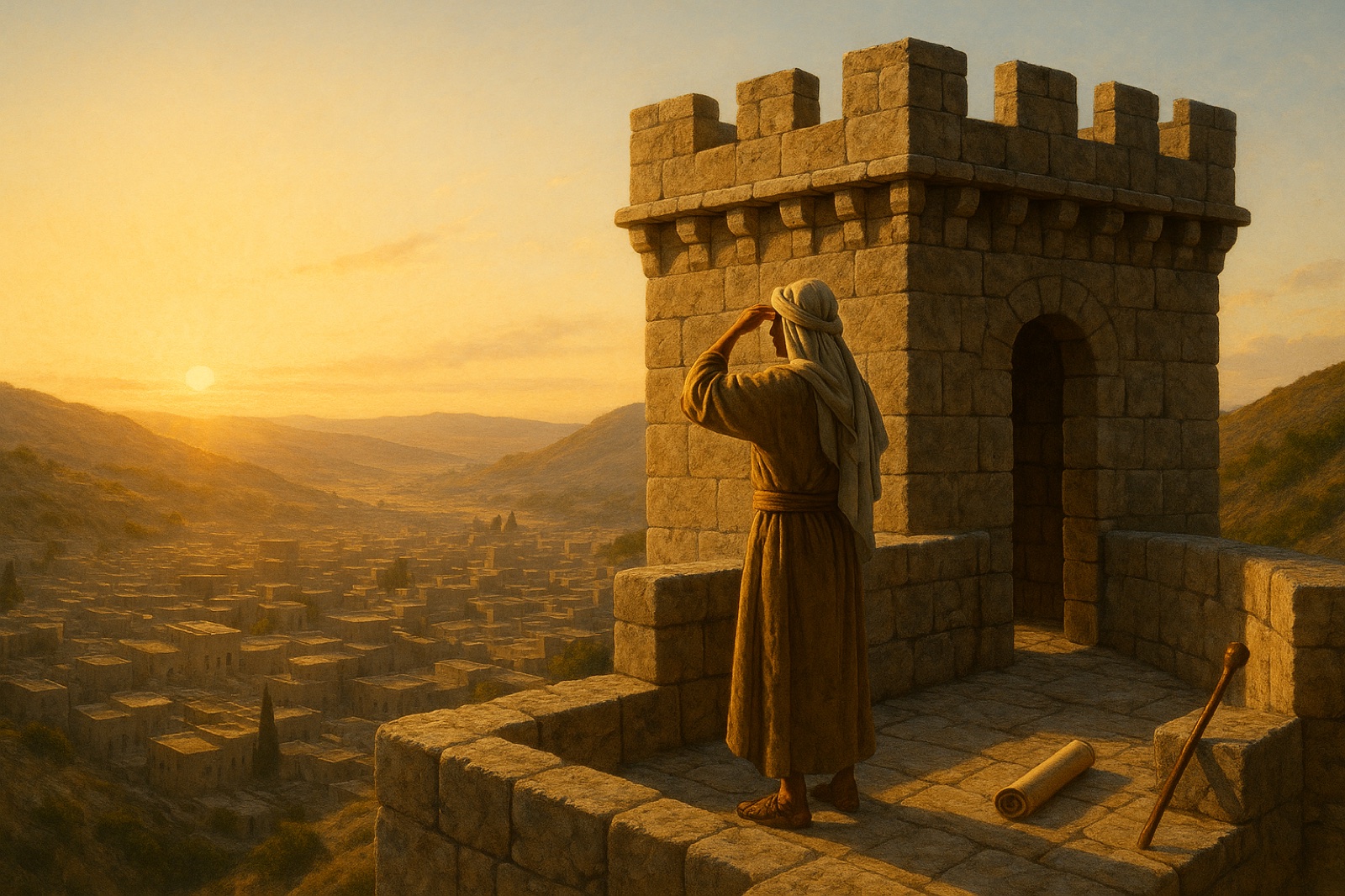
“I will stand upon my watch, and set me upon the tower, and will watch to see what he will say unto me, and what I shall answer when I am reproved” (Habakkuk 2:1).
Watchtowers in the ancient world were built for one job: a soldier stood up there because something was actually going to happen, eventually, and someone needed to be awake and looking when it did. It wasn’t a place you went to give up. It was a place you went because you still expected an answer — you just didn’t know when it was coming, so you positioned yourself where you could actually catch it.
That’s the whole move. Habakkuk doesn’t wait passively, scrolling through his despair on the ground. He climbs. He picks a vantage point. He commits to watching specifically for God’s response, instead of just marinating in the silence. Waiting, for him, is active. It has a posture. It has a direction he’s facing.
And God does answer — but the answer includes this line, one of the most quoted verses on delayed hope in the whole Bible: “For the vision is yet for an appointed time, but at the end it shall speak, and not lie: though it tarry, wait for it; because it will surely come, it will not tarry” (Habakkuk 2:3). Not if it comes. When. The delay was never proof the answer wasn’t coming — it was proof God’s timing wasn’t finished yet.
The Turn: Waiting Isn’t the Opposite of Faith
Here’s what changes when you actually sit with Habakkuk’s story instead of just knowing the “wait for it” verse as a quote on a mug: the waiting itself was never meant to be neutral. It wasn’t a gap between the real spiritual moments. The climbing, the watching, the positioning yourself to notice when the answer finally lands — that was the spiritual moment. That was Habakkuk being faithful.
Most of us treat silence from God like it’s a verdict. No answer yet must mean no, or not important enough, or maybe He’s not really there. That instinct is common, and worth examining on its own — but Habakkuk read the exact same silence completely differently: no answer yet just means the appointed time hasn’t arrived, and my job right now is to stay on the tower, still watching, instead of climbing down and walking away.
By the book’s final chapter, Habakkuk writes something that only makes sense if the watchtower actually worked on him: “Although the fig tree shall not blossom, neither shall fruit be in the vines, the labour of the olive shall fail, and the fields shall yield no meat… yet I will rejoice in the LORD, I will joy in the God of my salvation” (Habakkuk 3:17-18). He’s not celebrating because everything got fixed. Nothing’s fixed yet. He’s celebrating because three chapters of honest complaint and active waiting changed what he trusted — not what he was waiting for. (If you want to sit with a shorter, quieter side of this same book, Habakkuk 2:20 has its own reflection on what that silence can hold.)
What This Looks Like in Your Actual Week
You don’t need a literal tower. You need Habakkuk’s posture: bring the real complaint, then choose a specific, deliberate way to keep watching instead of just generally hoping something changes.
Maybe that’s picking one fixed time each day — not “whenever I remember,” but an actual time — where you stop and ask God directly about the thing you’re waiting on, the same way Habakkuk kept returning to the same rooftop. Maybe it’s writing the date you started waiting somewhere you’ll see it, the way a watchman would mark how many nights he’d stood there, so the waiting has a shape instead of just being a fog. Maybe it’s simply naming out loud, once a day, what you’re actually watching for — because Habakkuk’s waiting had a direction, and vague hoping doesn’t.
Actions to Take This Week
- Today: Write down, in one specific sentence, exactly what you’re waiting on God for. Not “help with work stuff” — the real, specific thing. Habakkuk’s complaint was specific; make yours specific too.
- This week: Pick one fixed time each day — coffee, a commute, right before bed — and use it as your “watchtower.” Show up at that same time and ask God directly about that one thing, out loud if you can.
- Ongoing: Start a single running note on your phone titled with what you’re waiting for. Each time you check in on it, add one line — even just “still watching.” Read back through it in a month. It turns invisible waiting into a record you can actually see.
A Prayer for the Waiting
God, I’m tired of not hearing anything back. I’ve been asking about this for a long time, and it’s starting to feel like You’ve gone quiet on purpose. Help me do what Habakkuk did — bring You the real complaint instead of a polite one, and then actually stay watching instead of walking away numb. I don’t need the whole answer today. I just need to believe You’re still standing at the other end of this silence. Amen.
Discussion Question
If you had to name one thing you’re still “on the watchtower” for right now — one prayer you haven’t stopped watching for, even after a long wait — what would it be? Tell us in the comments. Someone else reading this is probably watching for the same kind of thing.
Share This
- Habakkuk didn’t get an answer from God for years. What he did instead — climb a literal watchtower and keep watching — might be the most practical thing the Bible says about waiting.
- “Though it tarry, wait for it.” Turns out that famous verse comes right after a prophet yelling at God for chapters. Context changes everything. 🕊️
- Waiting on God isn’t the opposite of faith — it might actually be what faith looks like when nothing’s changed yet.
Quick Questions, Answered
What does Habakkuk 2:1 mean?
In Habakkuk 2:1, the prophet says he will stand on his watchtower to see how God answers his complaints. It reflects a posture of active, expectant waiting — Habakkuk positions himself to notice God’s response rather than passively hoping one shows up, after openly voicing his frustration with God’s apparent silence.
Why did Habakkuk complain to God?
Habakkuk complained because he saw violence, injustice, and a broken legal system in Judah and couldn’t understand why God allowed it to continue unpunished. When God answered that judgment would come through Babylon, Habakkuk complained again, questioning why God would use a nation he considered even more wicked to carry out that judgment.
What does “the vision is yet for an appointed time” mean?
Habakkuk 2:3 means that God’s promised response has a set, though currently unknown, time of fulfillment. The verse teaches that a delay isn’t evidence the promise is false — it’s evidence the appointed time hasn’t arrived yet, and it instructs the reader to keep waiting for it rather than giving up.
How do you deal with God feeling silent?
Habakkuk’s example suggests bringing your honest complaint to God rather than suppressing it, then choosing an active, specific way to keep watching for His answer — a set time, a set place, a specific thing you’re watching for — instead of passively waiting without direction or giving up on the silence entirely.
What is the main message of the Book of Habakkuk?
The Book of Habakkuk centers on a prophet’s honest dialogue with God about injustice and unanswered prayer, concluding that even when circumstances don’t improve, faith means choosing to trust and rejoice in God’s character rather than in immediate resolution — captured in Habakkuk’s closing declaration that he will rejoice in God even if everything visibly fails.