 0
0
 0
0
There’s a specific kind of stuck that has nothing to do with ability. You know how to make the call. You know how to walk into the room, send the email, start the hard conversation. What you don’t have is someone to go in with you — and until you do, you just… don’t move.
That’s not weakness. It’s how a lot of people are wired. And it’s exactly the situation a battle-hardened military commander named Barak found himself in, three thousand years before you did — standing across from a prophetess named Deborah, telling her flatly: I’m not going without you.
Who Was Deborah in the Bible?
Deborah shows up in Judges 4 with two titles stacked on top of each other, and both matter: she was a prophetess, and she was judging Israel at that time. In the period of the Judges — a chaotic stretch where “every man did that which was right in his own eyes” — Deborah was the one people walked to. Judges 4:5 says she sat under a palm tree between Ramah and Bethel in the hill country of Ephraim, “and the children of Israel came up to her for judgment.” Not because she campaigned for the role. Because she was trustworthy, and people brought her their hardest disputes.
She wasn’t a general. There’s no verse where Deborah picks up a sword or trains for combat. Her authority was spiritual and judicial — she heard from God, and Israel listened to her because her track record backed it up.
Twenty Years Under Sisera’s Chariots
To feel the weight of what happens next, you need the situation Israel was actually in. Judges 4:2-3 lays it out plainly: God had sold Israel into the hand of Jabin, king of Canaan, whose army was commanded by a man named Sisera. Sisera had nine hundred iron chariots — a devastating military technology for that era — and he “mightily oppressed the children of Israel” for twenty years.
Twenty years is not a bad season. It’s most of a generation. Children were born, grew up, and had children of their own under that oppression, never knowing anything else. When the cry for help finally reached Deborah, it wasn’t a fresh crisis. It was exhaustion that had calcified into something closer to despair.
“If You Will Go With Me, I Will Go”
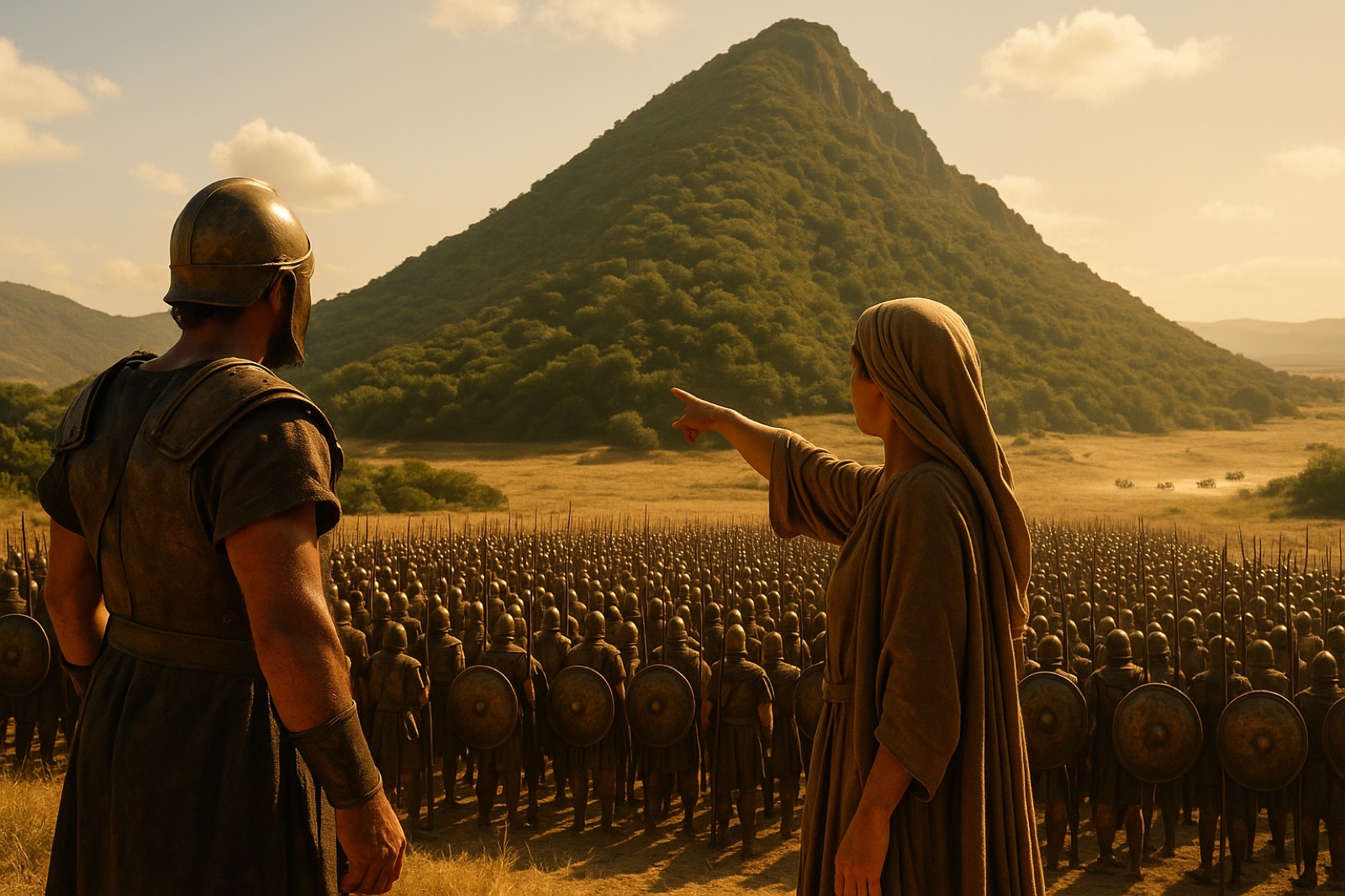
God’s instructions come through Deborah, not around her. She calls for Barak, son of Abinoam, and relays exactly what the Lord commanded: gather ten thousand men, march to Mount Tabor, and God would draw Sisera’s army — chariots and all — to the river Kishon and deliver them into Barak’s hand (Judges 4:6-7). This isn’t a vague pep talk. It’s a specific battle plan with a specific promised outcome, straight from God, delivered by someone Israel already trusted to hear from Him accurately.
Barak’s answer is the hinge the whole story turns on:
“And Barak said unto her, If thou wilt go with me, then I will go: but if thou wilt not go with me, then I will not go. And she said, I will surely go with thee: notwithstanding the journey that thou takest shall not be for thine honour; for the LORD shall sell Sisera into the hand of a woman. And Deborah arose, and went with Barak to Kedesh.” (Judges 4:8-9, KJV)
Sit with that for a second. A trained commander, given a direct word from God with a guaranteed outcome, still said: not without her. Not because he doubted God — he clearly believed enough to march at all — but because the presence of someone steady mattered more to him than going in alone with just a promise in his pocket.
Courage Was Never About Being Fearless
Here’s where the story usually gets flattened into a simple “strong woman, weak man” reading — and where it actually says something more useful than that. Deborah didn’t demand the field. She didn’t scheme her way into command. Barak asked her to come, and she went. The leadership shifted not because she seized it, but because he was only willing to move if someone he trusted moved with him — and she was willing to be that person.
God didn’t rebuke Barak for asking. He didn’t say “I told you to do this alone.” The plan proceeded exactly as promised, chariots and all, with Barak still leading the charge down from Tabor (Judges 4:14-16). The only consequence Deborah names is that the glory of the final kill would go to a woman, Jael, rather than to Barak — a detail about honor, not about disqualification. It’s the same pattern you see with Gideon hiding in a winepress when God called him a mighty warrior — God working with someone’s fear instead of demanding it disappear first.
And it’s worth knowing where Barak ends up: hundreds of years later, Hebrews 11 lists him by name among the great heroes of faith, alongside Gideon, Samson, and David (Hebrews 11:32). Not “Barak, who needed backup.” Just Barak — counted, remembered, credited with faith.
That’s the Turn. Courage, in this story, was never the absence of needing someone. It was showing up anyway, conditions and all, and doing the hard thing the moment the person you needed said yes. God didn’t need Barak to be fearless. He needed him willing — and willing was enough to work with.
What This Looks Like on a Tuesday
You probably aren’t marching ten thousand men toward iron chariots this week. But you likely have a version of Barak’s sentence sitting somewhere in your life right now: “I’ll do it, if…” I’ll apply for the job, if my friend proofreads it with me tonight. I’ll go to the doctor, if someone comes with me. I’ll have the conversation, if I can text my sister the second before I walk in.
That condition isn’t a character flaw to fix before you’re allowed to act. It’s information about how you’re built — and Barak’s story says God is willing to work with exactly that, not around it.
Three Things You Can Do in the Next 10 Minutes
- Name your Deborah. Think of the one hard thing you’ve been stalling on, and text one specific person right now: “Will you go with me on this — even just by checking in with me while I do it?” Send it before you talk yourself out of it.
- Do the next ten minutes of the thing, not the whole thing. Barak still had to march. Pick the smallest next physical action on your stalled task — dial the number, open the form, write the first line — and do just that piece today, backup or not yet in place.
- Write down who has already been your Barak or your Deborah. Name one person who showed up beside you for something hard in the last year. Send them a one-line thank you. Naming it out loud makes it easier to ask for again.
Questions Worth Sitting With
- Where in your life right now are you saying “I’ll go, but only if…” — and is that condition something you could actually name and ask for today?
- What’s one hard thing you’d attempt this week if you knew, for certain, someone steady would be right beside you the whole way?
- Who has shown up for you the way Deborah showed up for Barak — not to lead for you, just to go with you? Have you told them what that meant?
A Prayer for When You Need Someone to Go With You
God, I have a version of Barak’s sentence stuck in my chest right now — something I know I should do, but I keep waiting until I feel less alone in it. Thank You that You didn’t shame him for needing Deborah, and I don’t think You’re shaming me either. Give me the courage to ask for what I actually need instead of pretending I don’t need anything. And when nobody else can go with me, remind me that You already are. Amen.
One Question for You
Do you think Barak’s request for Deborah to come with him was a lack of faith, or wisdom in knowing his own limits? Drop your answer in the comments — I’d genuinely like to know where you land on it.
Share This
- “Barak wouldn’t go to war without Deborah beside him — and God didn’t rebuke him for it, He just worked through both of them. Maybe courage was never about doing it alone.”
- “I used to think ‘I’ll do it if someone comes with me’ was a weakness I needed to outgrow. Then I read Judges 4 and realized God worked with Barak’s condition instead of around it.”
- “Hebrews 11 remembers Barak as a hero of faith — not despite needing Deborah beside him, but with that need fully intact. That changes how I think about my own conditions.”
Questions People Ask About Deborah and Barak
Who was Deborah in the Bible?
Deborah was a prophetess and the only female judge mentioned in the Book of Judges. She held court under a palm tree between Ramah and Bethel, where the Israelites came to her to settle disputes, and it was through her that God gave Barak his battle instructions against Sisera’s army (Judges 4:4-7).
Why did Barak ask Deborah to go with him into battle?
Scripture doesn’t give an explicit reason, only his condition: “If thou wilt go with me, then I will go: but if thou wilt not go with me, then I will not go” (Judges 4:8). Many readers see it as Barak valuing Deborah’s proven closeness to God more than his own confidence as a commander.
What does “the journey shall not be for thine honour” mean in Judges 4:9?
Deborah told Barak that because of his condition, the final credit for defeating Sisera would go to a woman instead of to him — which was fulfilled when Jael, not Barak, killed Sisera (Judges 4:17-21). It was a statement about who would get the glory, not a punishment or a rejection of Barak’s request.
Was Barak considered a coward in the Bible?
No. Despite his condition, Barak still led ten thousand men into battle against a chariot army and won, exactly as God promised. Centuries later, Hebrews 11:32 lists him by name among the Bible’s heroes of faith, alongside Gideon, Samson, and David.
What can Deborah and Barak teach us about courage today?
That courage doesn’t require the absence of fear or need — it requires showing up and doing the hard thing anyway, even with conditions attached. God worked through both of their willingness rather than demanding either of them go it alone.
If you found encouragement here, you might also want to read A Leader’s Faith and the Call to Courage: Barak’s Challenge or Triumph at Dawn: The Rise of Divine Justice in Judges 5:31, which picks up the story right where this one leaves off.