 0
0
 0
0
You’re sitting in a waiting room, or maybe a parked car, or the back pew after everyone else has left. Your lips are moving. No sound is coming out. If someone walked in right now, they’d have no idea what to make of you — and it wouldn’t be a compliment.
That exact scene happened once before, three thousand years ago, to a woman named Hannah. Except the person who walked in on her wasn’t a stranger. It was the high priest. And he got it completely wrong.
Who Was Hannah in the Bible?
Hannah’s story opens the book of 1 Samuel. She was one of two wives married to a man named Elkanah. The other wife, Peninnah, had children. Hannah did not — and in that culture, in that era, that wasn’t just a private sorrow. It was a public one, repeated every single year.
Every year, Elkanah’s family made a trip to worship at Shiloh, where the tabernacle stood. And every year, Peninnah used the occasion to provoke Hannah about it — the text says she did it ‘year by year,’ deliberately, until Hannah wept and could not eat. This wasn’t a one-time wound. It was an anniversary of pain Hannah couldn’t skip and couldn’t escape.
The Prayer Eli Mistook for Drunkenness
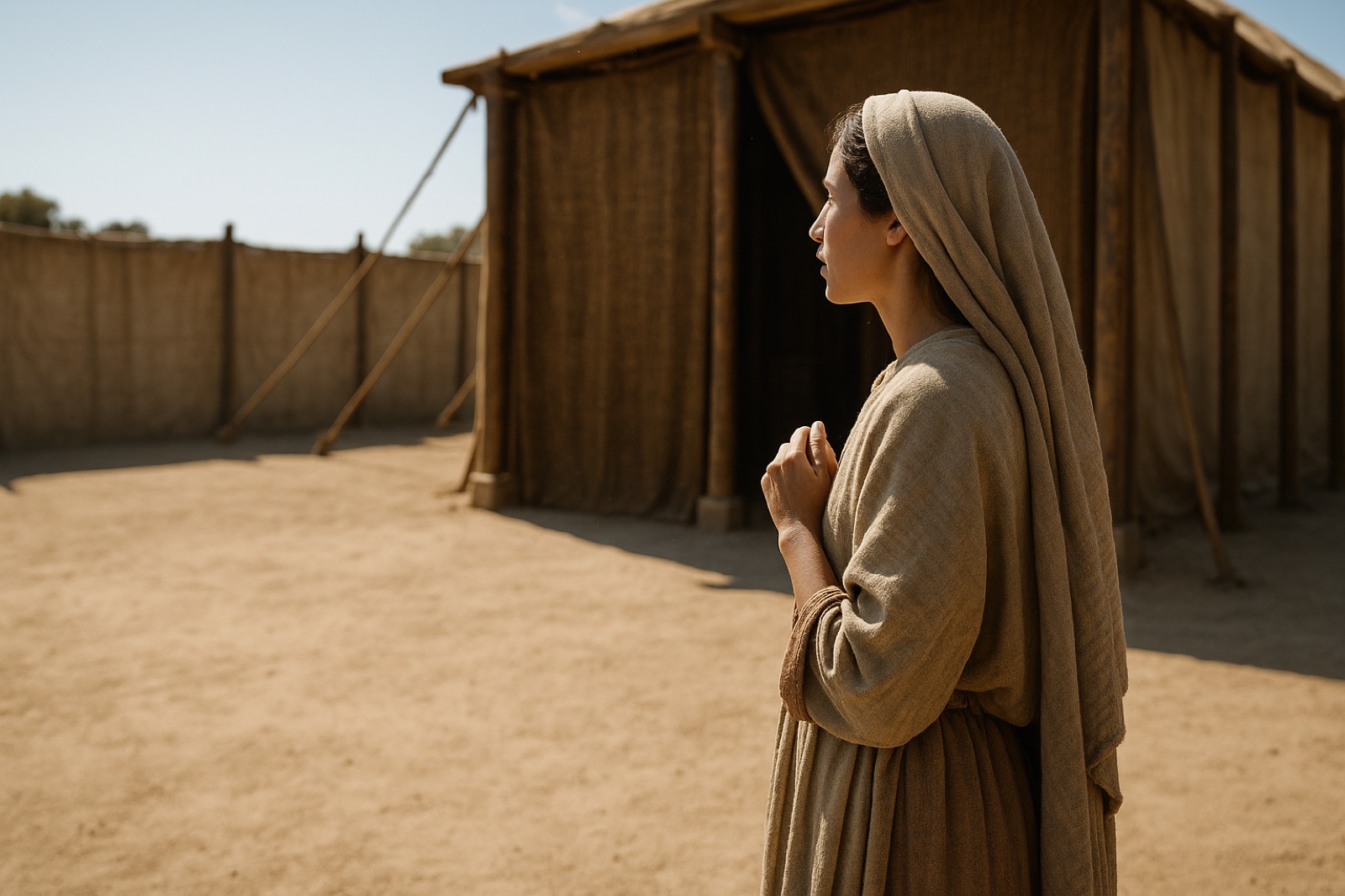
On one of these trips, after another meal she couldn’t finish, Hannah got up and went to the entrance of the tabernacle alone. She was, in her own words, in bitterness of soul. She prayed to the Lord and wept without restraint. She made a vow — that if God gave her a son, she would give him back, dedicated to the Lord for all his life.
Here’s the detail that makes this story unusual: Hannah didn’t say any of this out loud.
‘Now Hannah, she spake in her heart; only her lips moved, but her voice was not heard: therefore Eli thought she had been drunken.’ — 1 Samuel 1:13 (KJV)
Eli, the priest — the one man in Israel whose entire job was recognizing what real devotion to God looked like — watched her lips move with no words coming out and drew the only conclusion he had a category for. He told her to sober up and get rid of her wine.
Hannah’s response is the part worth sitting with:
‘And Hannah answered and said, No, my lord, I am a woman of a sorrowful spirit: I have drunk neither wine nor strong drink, but have poured out my soul before the LORD.’ — 1 Samuel 1:15 (KJV)
She wasn’t drunk. She was praying so honestly, from so deep a place, that it didn’t look like anything the priest had a name for.
What Hannah’s Silent Prayer Actually Reveals
Here’s what tends to get skipped when this story gets told: Eli was wrong about her — and the text never says God was confused for even a second. While the one person standing closest to Hannah completely misread what she was doing, nothing about her prayer failed to reach its destination. The silence, the moving lips, the lack of a single audible word — none of it was a barrier. It was just what real anguish looked like from the outside, and God was never on the outside.
That’s the part that quietly reframes a lot of modern prayer. Somewhere along the way, a lot of us picked up the idea that prayer has to sound like something — composed, articulate, a little formal — to actually count. Hannah’s story pushes back on that hard. If you’ve ever felt disconnected from God in the middle of a season that had no words for it, Hannah’s prayer says the disconnection was never on His end.
And if the silence itself has ever felt like the problem — like God went quiet right when you needed Him most — it’s worth reading what the Bible actually says about that kind of honest, unresolved prayer too.
There’s something freeing in that. You don’t need the right words. You don’t even need words at all. You need the honesty Hannah had — pouring out her soul rather than performing a prayer for an audience. That’s what reached God. Not the volume. Not the vocabulary. Just the truth of what she was carrying, however she carried it.
It also means you’re not doing your hardest seasons alone, even the ones where you can’t explain what’s wrong to a single other person. The nearness that met Hannah at the entrance of the tabernacle is the same nearness the Bible promises is available to anyone carrying something too heavy for words.
3 Things You Can Do Today
- Give your wordless prayer five minutes, on purpose. Set a timer, go somewhere private — your car, a closet, a bathroom — and let yourself pray without forming sentences. Let your breathing, your tears, or just your silence be the whole prayer, the way Hannah’s was.
- Name the thing you’ve been carrying silently, in writing. Hannah’s prayer became specific — she named exactly what she needed and made a vow around it. Write down, in one sentence, the ache you’ve been praying about without ever saying out loud. Put today’s date on it.
- Tell one person you trust that you’re carrying something, without over-explaining it. You don’t owe anyone the full story. Practice letting your prayer be witnessed by another person, even imperfectly, the way Hannah’s was witnessed — and misunderstood — by Eli.
Questions Worth Sitting With
- What’s something you’ve prayed about so many times you don’t say it out loud anymore — you just carry it?
- Has anyone ever misread your pain as something else entirely — distraction, coldness, irritability — when really you were just overwhelmed? What did that feel like?
- If God already knew the ache before Hannah spoke a single word, what does that change about how you show up in prayer today?
A Prayer for When You Don’t Have the Words
God, I don’t always have the words, and today might be one of those days. Some mornings all I can do is sit here and let You see what I can’t say out loud to anyone else. I don’t need the people around me to understand what I’m carrying right now — I just need You to. You heard Hannah before she ever finished a sentence. Hear me the same way, and give me the quiet confidence she walked out of that tabernacle with — that You were listening the whole time.
A Question Worth Answering
Do you think a wordless, silent prayer ‘counts’ the same as one spoken out loud — or does putting the words together actually matter? Tell us what you think in the comments.
Share This
- There’s a woman in the Bible who prayed so hard the priest thought she was drunk. She never said a word out loud. God heard her anyway.
- You don’t need the right words for God to hear you. Hannah proved that 3,000 years ago, and it still applies to whatever you’re carrying today.
- Ever had someone completely misread your pain as something else? Same thing happened to a woman in 1 Samuel 1 — and it didn’t stop God from answering her.
Common Questions About Hannah’s Prayer
Who was Hannah in the Bible?
Hannah was one of two wives of Elkanah in 1 Samuel 1. She was unable to have children for years and was repeatedly provoked about it by Elkanah’s other wife, Peninnah. Her story opens the book of 1 Samuel and leads directly into the birth of the prophet Samuel.
Why did the priest Eli think Hannah was drunk?
While praying silently at the entrance of the tabernacle in Shiloh, Hannah’s lips were moving but no sound came out. Eli, the priest, was watching her and assumed from her moving mouth and total silence that she was drunk, telling her to put away her wine.
What did Hannah say when Eli accused her of being drunk?
Hannah told Eli she had not been drinking at all. She explained that she was a woman of a sorrowful spirit who had been pouring out her soul before the Lord — not performing intoxication, but praying with total honesty.
What does Hannah’s prayer teach about how to pray?
Hannah’s story shows that prayer doesn’t need to be spoken aloud or eloquent to be real. She prayed silently, in visible anguish, and the text makes clear that God heard her fully even though the person standing closest to her completely misunderstood what she was doing.
What happened after Hannah’s prayer at Shiloh?
Hannah later gave birth to Samuel, who became one of Israel’s most significant prophets and judges — the text ties his birth directly to God remembering the vow Hannah made in her silent prayer that day.