 0
0
 0
0
Title: New Study Explores Life Potential on Moons of Rogue Planets: A Shift in Our Understanding of Habitability
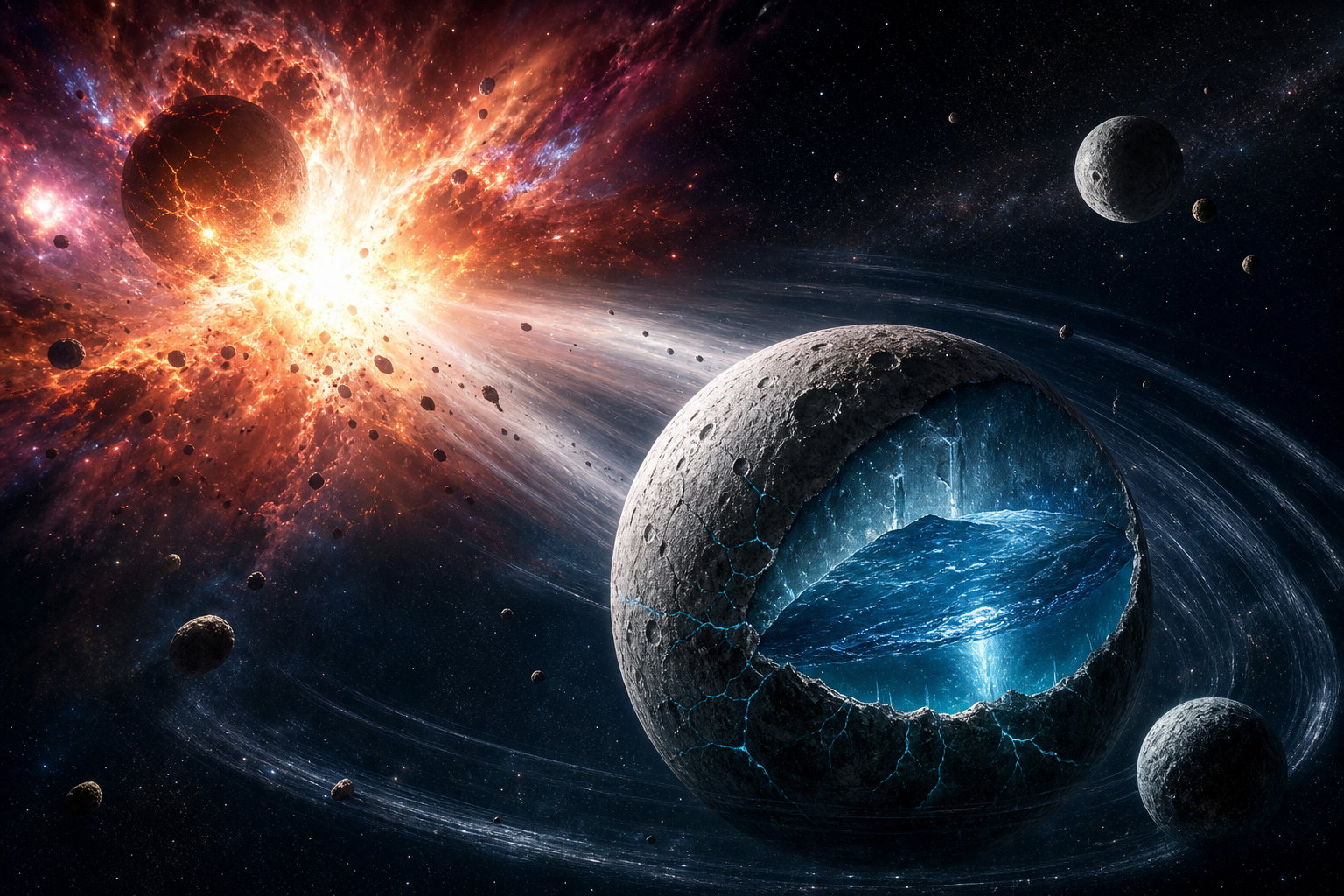
In an intriguing exploration of the cosmos, a recent study titled Life in the Dark: Potential Habitability of Moons of Rogue Planets presents a bold conjecture: moons orbiting planets adrift in deep space, far from stars, could potentially sustain conditions suitable for life. This groundbreaking research, conducted by Viktória Fröhlich and Zsolt Regály, invites us to question our preconceptions about what makes a celestial body habitable.
Traditionally, the narrative of life in the universe begins with a planet snugly orbiting a star, basking in its warm glow. Yet, this study encourages us to expand that view. Could moons cast away from their star systems, drifting alone in the dark, still harbor the right conditions for life? The hypothesis suggests that even in the absence of sunlight, subsurface oceans warmed by tidal heating—similar to those found on Europa and Enceladus—might thrive.
The Physics Behind Habitability
Rogue planets are those not gravitationally bound to any star, often ejected from their initial systems due to violent cosmic events like supernovae. Fröhlich and Regály’s simulations indicate that, following such disturbances, moons can remain in orbit around their rogue planets—an initial sign of hope. The pivotal question becomes: can these moons, devoid of the sun’s warmth, maintain liquid water?
Their findings show a conditional possibility: in approximately 12 to 15 percent of simulated cases, moons could generate sufficient tidal heating to preserve liquid water beneath icy crusts. This points to an astonishing reality: even without sunlight, certain moons could maintain life-supporting environments, raising the possibility that conditions conducive to life might exist in unexpected places.
A Deeper Spiritual Reflection
This exploration of rogue planets and their moons can draw a parallel to the resilience of life and hope despite overwhelming odds—a theme echoed in biblical teachings. The notion that life can emerge and thrive in seemingly inhospitable environments mirrors the biblical account of creation, where the Spirit of God brought order and life from chaos.
Just as God declared, “Let there be light” (Genesis 1:3), revealing potential even in darkness, so too does this study suggest that life’s possibilities persist beyond our conventional confines.
Looking Beyond the Stars
While the findings are theoretical, they provoke deeper questions about the limits of life and the universe’s mysteries. The research challenges the star-centric view of habitability, nudging us to ponder the resilience of existence. What kinds of worlds might still sustain life, even when they seem dark and lifeless?
The authors clarify that while they are proposing a plausible hypothesis, the challenge of identifying these rogue planets and their moons in the vastness of space remains formidable. However, their work extends an invitation to look beyond the familiar and discover what lies in the unseen—a notion that resonates with faith and hope.
Conclusion: Hope Beyond Darkness
As we navigate our own challenges in life—be they personal, social, or spiritual—this study urges us to consider the hidden potentials within our own “dark” spaces. Just as life may exist in unexpected realms of the universe, so too can hope and renewal arise within our own lives, regardless of present circumstances.
"Faith is the assurance of things hoped for, the conviction of things not seen" (Hebrews 11:1). Let this notion inspire you to reflect on the hidden possibilities around and within you. Even when the path seems dark, remember that resilience and life can flourish in the most unlikely places.
If you want to want to know more about this topic, check out BGodInspired.com or check out specific products/content we’ve created to answer the question at BGodInspired Solutions
If positive Biblical wisdom matters to you, I’d love your support of the mission
Q&A about
Could life really exist on moons far from their stars, and how does that fit with the Bible?
Life existing on moons heated by gravitational flexing instead of sunlight raises intriguing questions, but it aligns with God’s creativity and power. Scripture teaches that God created life in diverse environments, as seen in Genesis 1 when He brought life from the land and sea. It reminds us that God’s designs are beyond our full understanding, and His presence can sustain life in ways we might not anticipate.
Does the idea of moons surviving deep space support the idea of a Creator?
Yes, the concept of moons sustaining subsurface oceans for billions of years through gravitational interactions highlights the intricate design needed for life. It underscores the belief that a Creator, as expressed in Colossians 1:16, is responsible for everything in heaven and on earth, seen and unseen. This complexity reflects the wisdom of God, who formed all things intricately and purposefully.
How should Christians view the possibility of life existing in extreme conditions like deep space?
Christians can view the possibility of life in extreme environments as a testimony to God’s boundless creativity and greatness. Just as Jesus spoke about how God knows even the sparrows that fall (Matthew 10:29), it reminds us that every facet of creation is under His care. Our faith reassures us that God could allow life to thrive anywhere in the universe, showcasing His majesty.
What Scriptures can guide us in understanding life beyond Earth?
The Bible invites us to marvel at creation and God’s sovereignty over it. Psalm 19:1 affirms that the heavens declare the glory of God, suggesting that even distant moons and planets reflect His handiwork. This perspective can encourage us to be open-minded about the possibilities of life beyond our planet, promoting a sense of wonder about God’s infinite creations.