 0
0
 0
0
The fear usually arrives quietly.
It’s not dramatic. It’s more like a small wrongness — a name you’ve known for thirty years going blank mid-sentence. Walking into a room and standing there for a moment too long, waiting for the reason to come back. Reading the same paragraph twice and realizing nothing landed either time.
For most people, these are just the small fumbles of a busy life. But underneath them lives a different worry — quieter, more persistent: Is this how it starts?
In surveys conducted over the past decade, more adults say they fear Alzheimer’s than any other disease, including cancer. Not just the loss of memory, but the particular kind of loss it represents: the slow erosion of the self. The person still present in the body but becoming harder to reach.
Which is why a line of research quietly gaining momentum in neuroscience deserves more attention than it’s received outside academic circles. Because what these scientists are finding isn’t just about what goes wrong in an aging brain. It’s about what goes right in the ones that don’t.
The Question Everyone Missed
For decades, Alzheimer’s research focused almost entirely on the enemy: amyloid plaques, tau protein tangles, the inflammatory cascade that accelerates decline. The field was asking what goes wrong — and building interventions designed to stop it.
But a growing body of research has shifted to a different question: Why do some brains stay intact?
It’s a question with a strange answer.
There are people in their 80s and 90s — some in their hundreds — whose brains carry all the biological hallmarks of Alzheimer’s. The plaques are there. The protein tangles are there. The structural damage that typically produces dementia is present and measurable. But the person is still sharp. Still present. Still, in every meaningful sense, themselves.
How?
The answer, it turns out, may have less to do with avoiding damage and more to do with what happens to the brain’s most fragile cells in the middle of it.
The Cells Nobody Was Watching
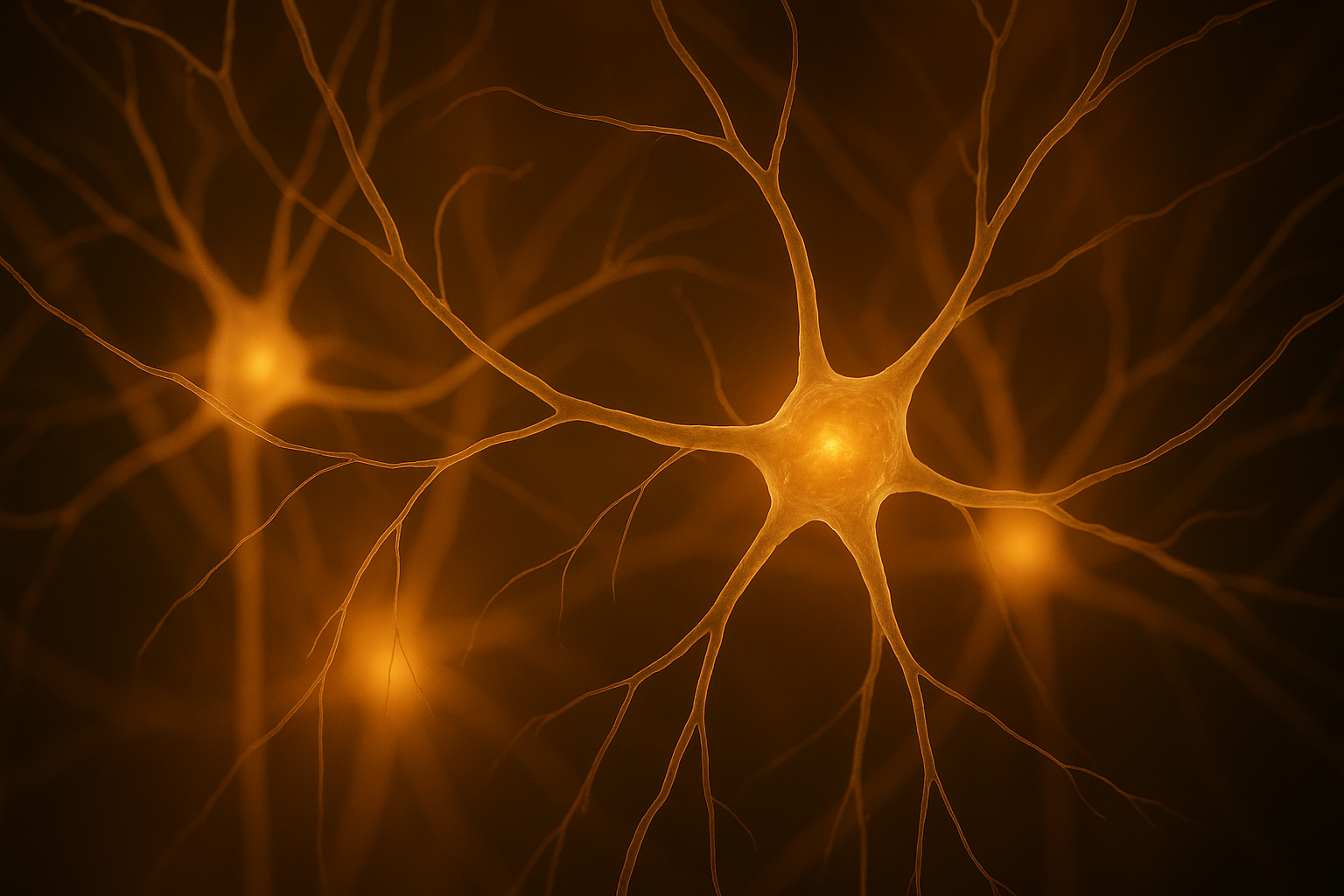
The brain is always making new neurons. Even in old age — even in a brain under significant stress — the hippocampus and other regions continue generating what are called immature neurons: brand-new cells that haven’t finished developing, haven’t built their connections yet, haven’t integrated into the brain’s larger networks.
These cells are fragile. They’re unfinished. Under normal conditions, many of them die before completing their development — that’s simply part of how the brain manages its own growth.
But Alzheimer’s is particularly hostile to them. The amyloid plaques, the inflammation, the toxic protein buildup — all of it creates conditions that immature neurons struggle to survive. In most brains affected by the disease, these cells die early and in large numbers, accelerating the decline.
In Alzheimer’s-resistant brains, something different happens.
Researchers studying these resilient brains found that they appear to actively nurture their immature neurons under stress. Rather than letting the most fragile, unfinished cells die in the hostile environment, these brains do something that looks, at the cellular level, almost like protection: they provide the support these vulnerable cells need to survive, to continue developing, to complete what they started.
The result is a sustained supply of new neurons that brains without this protection lose — and those neurons appear to matter enormously for the brain’s ability to adapt, reorganize, and maintain function even as damage accumulates around them.
Counterintuitive, but Consistent
The finding is counterintuitive in the best way. The assumption going in was that Alzheimer’s-resistant brains might be structurally tougher — thicker cortex, denser connections, some biological advantage that insulated them from the damage. A hardness in the architecture.
That’s not what the data shows.
The resilience isn’t primarily in the wall against what’s attacking from outside. It’s in what the brain does for what is most vulnerable on the inside — specifically, the cells that look least likely to survive. The immature ones. The unfinished ones. The ones that haven’t yet become what they’re supposed to become.
The brain that best resists cognitive decline is the brain that refuses to abandon the most fragile material inside it, even when the conditions surrounding that material are actively working against its survival.
This finding connects to other lines of research in brain health — including work on how deep sleep activates repair circuits and how certain nutrients protect aging neural tissue. The pattern across this research keeps pointing to the same thing: the brain that endures is the one that keeps tending what is at risk of being lost.
What the scientists are describing has a name in ancient Greek. And the person who used it was writing about something else entirely — or so it would appear.
A Word That Only Appears Twice
In the first century, a letter circulated among communities across the Mediterranean. Written by a man named Paul to a group of people in Rome, it contained a word that has been quoted in religious contexts for 2,000 years — but rarely examined for what it actually says.
The word is anakainōsis (pronounced ah-nah-kai-NO-sis).
It’s typically translated as “renewing” — as in, be transformed by the renewing of your mind. Most people, hearing that phrase, imagine something like replacement: out with the old, start fresh, wipe the slate. It sounds like a before-and-after. A decision that changes everything at once.
But that’s not what the word means.
Anakainōsis is built from two Greek roots: kainos, meaning new (not new in the sense of recent, but new in the sense of restored to its best form), and ana, meaning again, from within, upward. Together they describe something happening continuously, from the inside — not replacement, but the ongoing renovation of something already existing.
Scholars of ancient Greek note that the word appears only twice in the entire New Testament — and in both places, it describes not a single dramatic event but a continuous, active process. Not a transformation that happens once and is done. An ongoing renovation. The persistent tending of what is already there.
Paul chose this word carefully. He had others available. He could have used words for replacement, for newness in the sense of something entirely different, for exchange or substitution. He chose anakainōsis — the word that describes renovation from within, working with what’s already present, bringing to completion what is most fragile rather than discarding it.
The mechanism neuroscientists just mapped in Alzheimer’s-resistant brains — actively protecting the most immature, vulnerable cells rather than letting them die — is the same mechanism Paul was describing when he chose anakainōsis over every other option. Not replacement. Renovation. The persistent nurturing of what is unfinished, even in hostile conditions.
He wrote that word in a letter about the human mind two thousand years before neuroscience had a vocabulary for what those resistant brains are actually doing.
What to Do with This
The scientists studying Alzheimer’s-resistant brains weren’t looking for a spiritual principle. They were doing cellular biology — counting neurons, measuring protein levels, tracing the mechanisms of protection in brains that should have declined and didn’t.
But what they found keeps pointing back to something worth sitting with, whether you have a framework for it or not.
The mind that stays itself under pressure — that resists the slow erasure — isn’t necessarily the strongest or the most protected from outside threat. It’s the one that refuses to abandon what is most fragile inside it. The unfinished. The developing. The cells that look least likely to survive.
That’s not a metaphor the researchers constructed. It’s what the data showed. The brains that stay intact are the ones that keep tending what everyone else would let go.
There are a lot of ways to interpret that finding. One of them is 2,000 years old and uses a Greek word most people have heard without knowing what it means.
Whatever your framework — the science is striking enough on its own. A mind that survives doesn’t do it by becoming something new. It does it by refusing to stop caring for what’s still becoming.
If you’re interested in exploring what ancient wisdom says about the mind’s capacity for renewal — and what that looks like in practice — there’s more to discover here.
Discussion Question
The research suggests that Alzheimer’s-resistant brains are distinguished not by hardness, but by their willingness to tend what is most fragile and unfinished inside them — even under pressure. Where in your own experience have you seen something vulnerable prove more resilient than expected? What made the difference? Share your thoughts below.
Share This
“Turns out the brains that best resist Alzheimer’s aren’t the hardest ones — they’re the ones that refused to abandon what was most fragile inside. New science + a 2,000-year-old Greek word that describes the exact same thing: https://bgodinspired.com/index.php/bible-resources/bible-and-science/scientists-discovered-some-brains-resist-alzheimers-by-nurturing-their-most-vulnerable-cells-paul-called-that-process-by-name-2000-years-ago/”
“Scientists studying Alzheimer’s resistance found something nobody expected: it’s not about being tougher. It’s about protecting what’s most unfinished. A first-century letter used a specific Greek word for this. Fascinating: https://bgodinspired.com/index.php/bible-resources/bible-and-science/scientists-discovered-some-brains-resist-alzheimers-by-nurturing-their-most-vulnerable-cells-paul-called-that-process-by-name-2000-years-ago/”
Common Questions
What did researchers discover about Alzheimer’s-resistant brains?
Scientists found that some brains resist Alzheimer’s by actively protecting their most immature, vulnerable neurons when under stress — rather than letting these fragile, still-developing cells die in the hostile environment the disease creates. This sustained supply of new neurons appears to help the brain maintain function even as damage accumulates.
What is anakainōsis and why does it matter?
Anakainōsis is a Greek word used by Paul in a first-century letter to Rome. Usually translated as “renewing” (as in “renewing of the mind”), it doesn’t mean replacement or starting fresh — it means the ongoing renovation of something already existing, from the inside. The word appears only twice in New Testament writings, and in both places it describes a continuous process, not a one-time event.
Why do some brains resist Alzheimer’s while others don’t?
Research suggests Alzheimer’s-resistant brains have a specific protective behavior: they nurture their most fragile, immature neurons even in hostile conditions — amyloid plaques, tau tangles, inflammation. This protection keeps new neurons developing that other brains lose, and those neurons appear critical for the brain’s ongoing ability to adapt and maintain function.
Is the connection between Paul’s Greek word and neuroscience scientific?
The neuroscience is peer-reviewed. The linguistic observation — that Paul’s specific word for mind renewal describes the same protective-renovation mechanism Alzheimer’s-resistant brains perform — is an observation worth sitting with, not a scientific claim. Both describe the same pattern: renovation from within, working with what’s already there, protecting what is most fragile rather than discarding it.
What practical steps support brain health as we age?
Current research points to adequate deep sleep, regular physical activity, social engagement, and nutritional support for aging brain tissue. The Alzheimer’s-resistance research adds something less expected: the brain’s own capacity to protect its most vulnerable cells may be one of the most important factors — a process more about internal tending than external defense.