 0
0
 0
0
When life starts to tilt, it usually doesn’t look dramatic. It’s your phone lighting up at 1 a.m. with a message you didn’t expect. It’s the lab result that needs “additional testing,” the reorg at work, the slow fade of a relationship you thought would always be there. Your chest tightens, your thoughts sprint ahead, and suddenly you’re living five versions of the worst-case scenario. You tell yourself to calm down — but your body doesn’t listen. If you’re honest, “just relax” has never worked.
The real problem isn’t uncertainty itself. Life has always been uncertain. The problem is what our minds do with uncertainty. We mistake “I don’t know what will happen” for “I’m not safe,” and our brains go into full threat response. Adrenaline floods. Breath shortens. We catastrophize because it gives us the illusion of control — if we can predict the worst thing, maybe we can outsmart it. But fear doesn’t make us smarter; it makes our world smaller. We stop asking better questions and start bracing for impact.
Here’s the shift that changes everything: courage isn’t the absence of fear; it’s the presence of something steadier than fear. You don’t have to eliminate the storm to stop drowning in it. You need an anchor — something solid to hold you while the waves do what waves do.
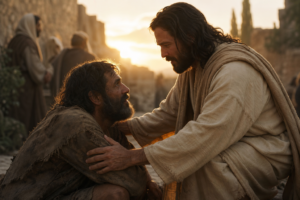
A friend once put it this way: “Take courage. You don’t have to pretend the storm isn’t real — just remember you’re not facing it alone.” He told me he first encountered the idea in Matthew 14:27 — but the concept doesn’t require a religious framework to be true. It’s just quietly profound wisdom that happens to have ancient roots.
If fear is a wave, then your practical job is learning to stand. Not perfectly. Not magically calm. Just steadily enough to choose what matters next. Here’s how to make that shift when the water’s in your lungs and your thoughts are sprinting.
— Bold lead-in paragraphs per instructions —
Bold lead-in: Name the storm out loud. Fear loves vagueness. It multiplies inside words like “always” and “never” and “everything is falling apart.” Put real language on it. Say it out loud or write it down: “I’m afraid I’ll lose my job and won’t be able to pay rent by September.” Specificity shrinks the monster. Your nervous system reads clarity as safety. Pair it with a 90-second reset: sit, plant your feet, and breathe in for four, out for six, slowly, for a minute and a half. Let your shoulders drop. The body tells the brain, “Danger isn’t immediate.” Once the volume is down, your thinking improves. You haven’t solved anything yet, but you’ve opened the door to sane choices.
Bold lead-in: Shrink the frame to the next right thing. Panic is time travel. It yanks you into a future you can’t control and dares you to rescue it. Refuse the dare. Ask, “What is the next right thing, within my control, in the next hour?” Not the next 90 days. The next hour. Send the email. Make the appointment. Outline the expense plan. You move from helplessness to agency, one brick at a time. Disasters win by getting you to play on their timeline. You win by insisting on your own.
Bold lead-in: Borrow a steadier voice. Anxiety distorts your inner narrator. So borrow one. Text a friend, “Can I get a 10-minute reality check?” Or write yourself a note from the calmest version of you: “You’ve handled worse. You do not need a perfect plan — only the first step. You’re allowed to move slowly.” Keep that note where you can see it. Research on self-distancing shows that speaking to yourself in the second or third person (“You can handle this,” or using your own name) reduces emotional intensity and improves problem-solving. It’s not cheesy; it’s a tool. Let your future self lend you their spine.
Bold lead-in: Turn fear into a task. Fear wants you to pause your life and negotiate with it forever. Don’t. Make the fear do work. If you’re scared of a conversation, draft a script and practice it once into your notes app. If you’re afraid of money uncertainty, open the account and list three exact numbers you need to understand by Friday. If you’re scared of being alone, schedule one connection this week: a walk, a call, a class. Exposure, gently and specifically, is what teaches your brain that the tiger is often a housecat in bad lighting. Action is the only language fear actually respects.
Bold lead-in: Build a ritual that marks “safe enough now.” Fear doesn’t vanish on its own; it fades with cues. Pick one small ritual that signals, “Right now, in this moment, I am safe enough.” Hand on chest, slow breath, feel the chair under you. Or a nightly routine: phone in the other room, tea, ten minutes of reading something that isn’t bad news. Or a physical anchor you carry — a smooth stone, a ring, a phrase on a lock screen. When the wave rises, touch the anchor and say the phrase. Rituals don’t fix everything; they stitch enough moments of calm together that you can think clearly and choose your next move.
Here’s the part people skip: courage isn’t a mood. It’s a direction. Some days it feels like confidence; other days it feels like nausea and a shaky hand. Both count. Courage is choosing to return to what matters — your values, your people, your responsibilities — even when the waves are loud. It’s a practice of remembering. Remembering that you are not your worst thought at 2 a.m. Remembering that feelings are weather, not climate. Remembering that small, steady steps change big outcomes.
You don’t need to become a different person to do this. You need a different sequence. First, steady the body so the brain can come back online. Then shrink the frame, borrow a steadier voice, turn fear into a task, and practice a ritual of return. Do it imperfectly. The goal isn’t to be fearless. The goal is to be honest about the fear and still move in the direction you care about.
One more thing: uncertainty has a way of isolating us. We think we’re the only ones awake at night scrolling for answers. We aren’t. The people you admire aren’t fearless; they’ve learned how to anchor themselves and reach for help before the wave crests. If you remember nothing else, remember this: you don’t have to outrun the storm. You just need to find enough ground under your feet to take the next step.
When the wave hits this week, what’s the one “next right thing” you’ll choose, and who’s the steady voice you’ll ask to walk you there?
If positive Biblical wisdom matters to you, I’d love your support of the mission
Q&A about Matthew 14:27
How does Matthew 14:27 help me deal with anxiety when life feels out of control?
In Matthew 14:27 Jesus says, “Take heart; it is I. Do not be afraid,” reminding you His presence is bigger than the waves. Turn that into a breath prayer and hand your worries to God, since Philippians 4:6-7 promises His peace will guard your heart and mind in Christ. When anxiety spikes, speak the verse aloud and remember Jesus brings peace, as He also does in John 14:27.
Does Jesus saying “It is I” in Matthew 14:27 mean He claims to be God?
“Yes, at least by strong implication.” The phrase echoes God’s “I AM” (ego eimi), which Jesus uses clearly in John 8:58, and His walking on the sea mirrors God’s power in Job 9:8; the disciples respond by worshiping Him in Matthew 14:33. Trusting Him as Lord means you can lean on His authority over chaos in your life.
How can I practically “take heart” like Jesus says in Matthew 14:27 when I’m facing a scary diagnosis?
Fix your gaze on Jesus as Peter learned to do in the same scene (Matthew 14:29-31), and keep bringing your fear to God in prayer. Ask your church to pray and anoint you per James 5:14-15, and cling to His promise, “I am with you always” in Matthew 28:20. Let that assurance guide one faithful step at a time today.
What’s the difference between fear and wisdom here—am I supposed to ignore real danger because of Matthew 14:27?
Jesus’ “Do not be afraid” isn’t a call to recklessness; it’s courage rooted in His presence (Matthew 14:27). Scripture still commends prudence—the prudent see danger and take refuge (Proverbs 22:3), and Paul combined faith with wise action in Acts 27:22-25,31. Ask the Spirit for power, love, and self-control (2 Timothy 1:7) and then take the next wise step.