 0
0
 0
0
You already sense something is wrong. Maybe you see it in the teenagers around you — the flat affect, the anxiety that won’t lift, the sadness that looks different from ordinary teenage sadness. Maybe you see it in your own house.
The numbers confirm the feeling. More than 40 percent of American high school students reported persistent feelings of sadness or hopelessness in a recent CDC survey. The U.S. Surgeon General has called it a prolonged crisis in child and adolescent mental health — one that predates social media, predates COVID, and has been building steadily for more than a decade. Therapists have waiting lists months long. Schools are overwhelmed. Parents are trying everything they know how to try.
But a psychologist at Weill Cornell Medicine just published research suggesting that the thing most families are missing isn’t a technique or a therapy modality or a new app.
It’s a person. Specifically — a grandparent.
The Study That Should Reshape How We Think About Family
Dr. Kenneth Barish has spent more than forty years as a child psychologist. He has sat with families through anxiety, depression, learning struggles, and all the ordinary crises of growing up. In his new book, The Art and Science of Parenting and Grandparenting (Routledge, 2026), he makes an argument that sounds almost too simple to take seriously.
Children need grandparents. And they always have.
But what Barish means is more precise than that. He argues that the erosion of extended family involvement isn’t a social inconvenience — it is a direct contributor to the mental health crisis that has medicine, schools, and parents all scrambling for answers.
Drawing on four decades of clinical work alongside findings from neuroscience and child development research, Barish makes the case that grandparents are not a nice-to-have. They are a structural component of healthy child development that modern family life has quietly removed — and the data is registering the loss.
“We did not evolve to raise children with as little extended family and community support as most American parents have now,” he writes. “Children need grandparents, and they always have.”
What Grandparents Actually Do That Nobody Else Can
The research Barish describes doesn’t portray grandparents as backup caregivers or a convenient source of free childcare. It describes them as something closer to essential infrastructure — a buffer built into the human developmental architecture that the nuclear family model stripped away.
The modern family shrank. Geographic mobility scattered grandparents across time zones. Busyness, the cult of independence, and a cultural emphasis on individual achievement all conspired to make extended family feel optional. We told ourselves children had everything they needed in a healthy two-parent home. The data is now suggesting otherwise.
What got lost in the process, Barish argues, is something he calls “molecules of emotional health” — small, repeated moments of listening, encouragement, and genuine understanding that collectively build what he describes as a child’s “emotional immune system.”
Not therapy sessions. Not parenting strategies. Just moments of someone paying real attention.
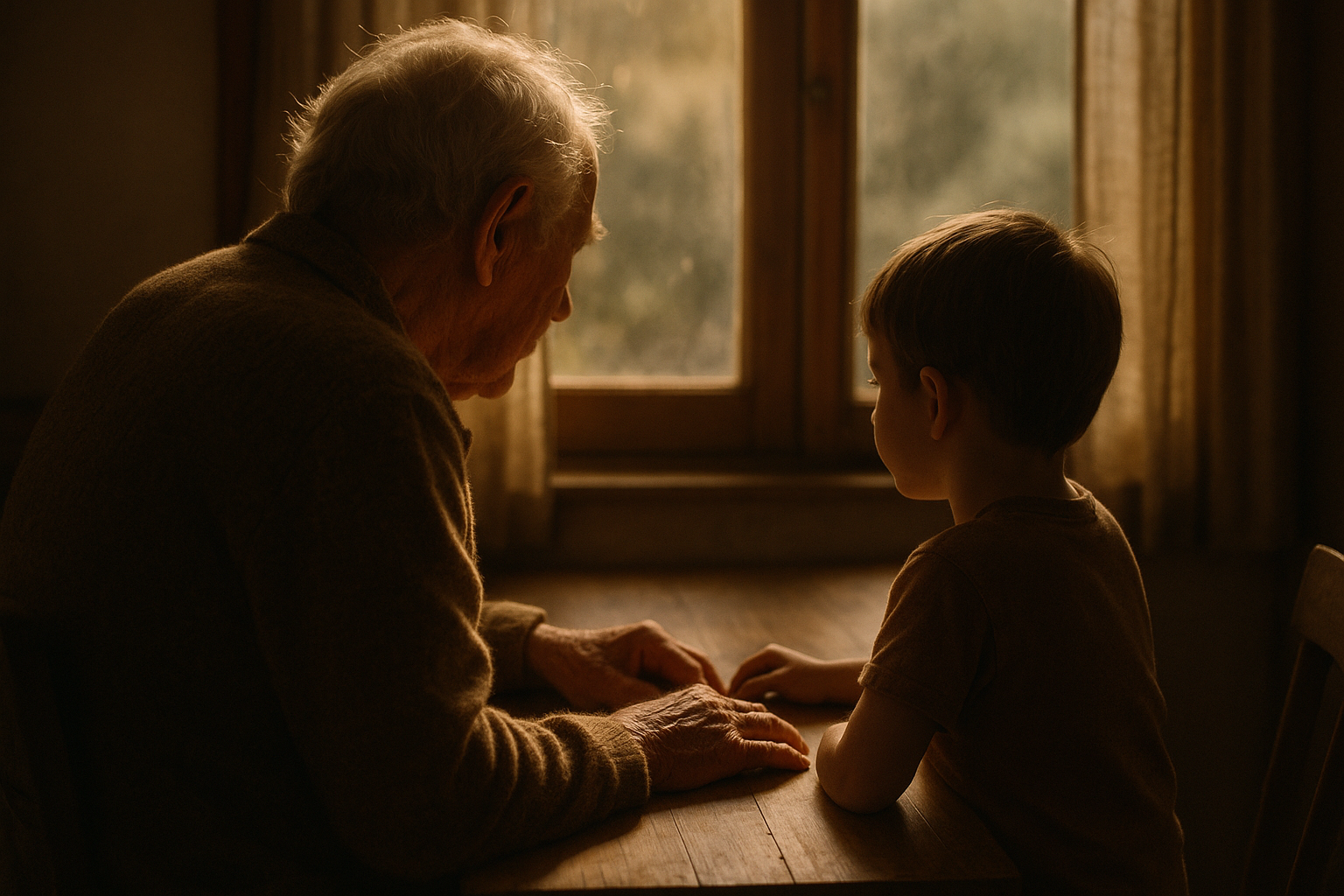
“More than anything else,” Barish writes, “children need someone in their life who listens, who helps them feel less alone, and who teaches them that problems can be solved, relationships can be repaired, and bad feelings do not last forever.”
Grandparents, he argues, are uniquely positioned to be that person. They have what busy parents often don’t have: time, perspective, and a calm that comes from having watched hard things resolve over decades. They’re not managing homework or discipline in the same urgent way. They can simply be present — and that presence, research increasingly confirms, is doing something that no program or platform can replicate.
“A child’s confident expectation that someone will listen and understand,” Barish says, “is the best protection against the emotional pathogens they will experience throughout their childhood.”
The Problem With Raising Children for Achievement
There’s another dimension to Barish’s research that deserves more attention than it’s getting. He connects the mental health crisis not just to the absence of grandparents, but to a culture that has organized childhood almost entirely around individual achievement.
The research is unambiguous: intense pressure for achievement is associated with elevated rates of anxiety, depression, and substance abuse — particularly in communities where success is visible and expected. The very families who are doing the most to secure their children’s futures may be contributing to their children’s distress in ways they don’t intend.
The antidote, Barish argues, isn’t less ambition. It’s a broader sense of purpose — one rooted in connection, contribution, and meaning rather than performance alone.
“Individual achievement alone is a fragile source of motivation and effort, with a high cost in anxiety and stress,” he writes. “Helping others promotes a greater balance in children’s emotional lives.”
Grandparents, by their nature, model a different kind of life. They represent the longer arc — what a life looks like after the career pressure eases, after the proving is done, after the question shifts from what did you achieve to what did you mean to people. That modeling matters. Children who grow up watching that arc develop a different understanding of what a good life looks like.
This connects to something researchers have found about the power of family storytelling. Children who know their family’s history — the struggles, the failures, the recoveries — show greater psychological resilience than children who grew up without it. Grandparents are, in many cases, the ones who carry and transmit that history. When they’re not present, the story gets shorter. And children raised on a short story have less to stand on when life gets hard.
If You’ve Been Told You’re Too Involved
There’s something worth sitting with if you’re a grandparent who has felt pushed to the margins — told you’re “too involved,” that your parenting instincts are outdated, that modern children need something different from what you can offer.
The data doesn’t support that. If anything, the data says the opposite.
The extended family wasn’t simply a convenience from an earlier era of human life. It was the architecture children were designed to grow up inside. The consistent presence of attentive grandparents — the listening, the stories, the unhurried attention — isn’t interference. It’s infrastructure that children need and aren’t getting enough of.
You’re not in the way. You may be exactly what’s missing.
And if the geographic distance between you and your grandchildren feels like the real obstacle, Barish’s research suggests the investment to close that distance — more visits, more calls, more deliberate presence — is one of the highest-return investments available in a child’s development.
What a 3,500-Year-Old Text Already Knew
Here’s what makes Barish’s findings more interesting than a typical psychology study: he isn’t discovering something new. He’s confirming something ancient.
The book of Deuteronomy contains one of the most architecturally explicit multigenerational transmission plans ever written. The central command in chapter 6 — what Jewish tradition calls the Shema — doesn’t just instruct parents to teach their children. It explicitly extends to grandchildren: teach them to your children and your children’s children. The grandparent is built into the design. The covenant requires a three-generation chain to transmit what a single generation cannot carry alone.
Psalm 78 goes even further. It describes the precise purpose of that chain: so that the next generation would know — not just believe, not just perform, but know at a lived level — that they are connected to something larger than themselves. That they are not alone. That problems can be solved and bad feelings don’t last forever.
What Barish calls the emotional immune system, that ancient text was calling covenant.
The nuclear family was never the original design. The multigenerational household — what the ancient Hebrews called the beth av, the house of the father — wasn’t a product of historical circumstance or limited mobility. It was an intentional structure. Grandparents, parents, and children living in proximity, each generation transmitting to the next not just faith but resilience, identity, and a sense of belonging to something that preceded them and would outlast them.
God, that text suggests, was not being nostalgic. He was engineering resilience. The science just took 3,500 years to catch up.
Where to Go From Here
None of this requires moving back to the same neighborhood, though it might make that feel worth reconsidering. What it does suggest is something simpler and more immediately actionable.
If you’re a grandparent, the research says your presence — consistent, listening, unhurried — is doing something that no program or platform can replicate. The small moments are the molecules. Show up for them. Call. Tell the story. Sit with the child and don’t try to fix anything. That act of listening is doing more than you know.
If you’re a parent, it might be worth asking honestly whether the distance between your children and their grandparents is logistical — or whether it’s something you’ve been willing to accept too easily. For more on how God designed family relationships to work from the very beginning, this piece on what Genesis 2 actually says about partnership and design is worth your time.
And if the anxiety about your kids’ wellbeing is the thing keeping you awake — the low-grade dread that you’re missing something, that you’re not doing enough — that’s a real thing worth addressing directly. The Night Peace Framework was built for exactly that kind of nighttime worry: the thoughts that surface when the day quiets and everything you’re carrying comes to the front.
The larger thing — the thing Barish’s research and that ancient text both seem to be pointing toward — is simpler than any framework.
Show up. Be present. Listen. Tell the story.
That has always been the design. The science just confirmed it.
A Prayer for the Family You’re Carrying
If You’re there — and reading this is making me think You might be — I want to ask for something simple. Help me show up for the people in front of me. Help me listen the way the research says matters. And if I’ve been told I’m not needed, help me trust that that isn’t the whole truth. Amen.
Three Things You Can Do This Week
- Make the call. If you haven’t talked to your grandchildren — or your own parents or grandparents — in more than two weeks, call today. Not to say anything important. Just to be present in their life for ten minutes.
- Tell one story. Find a moment to tell a child in your life about something hard you once went through and how it resolved. Not a lecture — a story. The resilience research says this matters more than you think.
- Reconsider one barrier. Identify one concrete thing (distance, schedule, old friction) that’s been keeping your family less connected than it should be. Ask whether it’s really as fixed as it feels.
Questions Worth Sitting With
- Who in your own childhood gave you the kind of unhurried attention Barish describes — the person who simply listened? What did that do for you?
- What is the story of your family that the children in your life don’t know yet — the struggle, the recovery, the thing that shows problems can be solved? Who is responsible for telling it?
- If the extended family design described in this article is actually right — that children need more than two parents — what would it cost you to move toward that? What would it cost you not to?
What Do You Think?
Do you think the shift toward nuclear families (and away from extended family involvement) has been mostly a positive development for modern children — or has something important been lost in the process? Drop your take in the comments.
Share This Article
- A Weill Cornell psychologist just said grandparents are the overlooked solution to the teen mental health crisis. “We did not evolve to raise children with as little extended family support as most parents have now.” Worth reading: https://bgodinspired.com/index.php/health-and-wellness/grandparents-children-mental-health-deuteronomy-6/
- This hit me differently — a child psychologist at Weill Cornell spent 40 years in practice and then wrote a book saying the thing most families are missing isn’t a technique. It’s a grandparent. He calls it “molecules of emotional health.” And apparently there’s an ancient text that laid out exactly this family architecture 3,500 years ago. Worth your time if you’ve been wrestling with what’s going on with kids today: https://bgodinspired.com/index.php/health-and-wellness/grandparents-children-mental-health-deuteronomy-6/
- Researchers now say grandparents are one of the most powerful buffers against the youth mental health crisis — and the nuclear family model may have been the wrong architecture all along. Found this article connecting the science to something much older. Really made me think. https://bgodinspired.com/index.php/health-and-wellness/grandparents-children-mental-health-deuteronomy-6/
Frequently Asked Questions
Why do grandparents matter so much for children’s mental health?
According to Dr. Kenneth Barish, a child psychologist at Weill Cornell Medicine, grandparents provide what he calls ‘molecules of emotional health’ — repeated moments of listening, encouragement, and genuine presence that build a child’s emotional immune system. Children who have consistent access to attentive grandparents show greater resilience, lower rates of anxiety and depression, and a stronger sense that problems can be solved and that they are not alone. Modern family life has increasingly separated children from extended family support, and research suggests this loss is a direct contributor to the current youth mental health crisis.
What does Deuteronomy 6 say about family and raising children?
Deuteronomy 6, known as the Shema, contains one of the oldest and most explicit multigenerational family design plans in human history. It doesn’t just instruct parents to teach their children — it extends the obligation to grandchildren (‘teach them to your children and your children’s children’). The grandparent is built into the design. Psalm 78 elaborates on this: the purpose of the multigenerational chain is so that children develop a deep, lived sense of belonging and connection — not just intellectual belief, but an experiential knowledge that they are part of something larger than themselves. Modern psychology is now confirming what that text described 3,500 years ago.
Is the nuclear family bad for children?
Research doesn’t say the nuclear family is harmful — it says it may be insufficient on its own. Dr. Kenneth Barish argues that human beings did not evolve to raise children with as little extended family support as most modern American parents have today. Children raised with consistent involvement from grandparents and extended family show better emotional resilience, lower rates of anxiety and depression, and a stronger sense of identity and meaning. The nuclear family structure, while not harmful in itself, may be missing the generational depth that child development research increasingly says children need.
What is the beth av in Hebrew family structure?
The beth av — literally ‘house of the father’ in Hebrew — was the multigenerational household structure of ancient Israel. It typically included grandparents, parents, and children living in close proximity. This was not simply a practical arrangement; it was a deliberate design for transmitting faith, resilience, identity, and a sense of belonging from one generation to the next. Modern child psychology is describing the same kind of extended family structure as essential to healthy child development — what ancient Hebrew society called the beth av, researchers today call the extended support network.
What can grandparents actually do to help with a grandchild’s mental health?
According to Dr. Kenneth Barish’s research, the most impactful thing grandparents can do is simply be present and listen without trying to fix or instruct. Small, consistent moments of genuine attention — what he calls ‘molecules of emotional health’ — build a child’s confidence that problems can be solved and that they are not alone. Beyond listening, grandparents can tell family stories (which research links to greater psychological resilience), model a life built around connection rather than achievement, and show genuine enthusiasm for a child’s interests. Grandparents don’t need to be therapists. They need to show up and pay attention.
God was not being nostalgic. He was engineering resilience.