 0
0
 0
0
Astronomers Discover a Stunning Supermassive Black Hole in the Early Universe
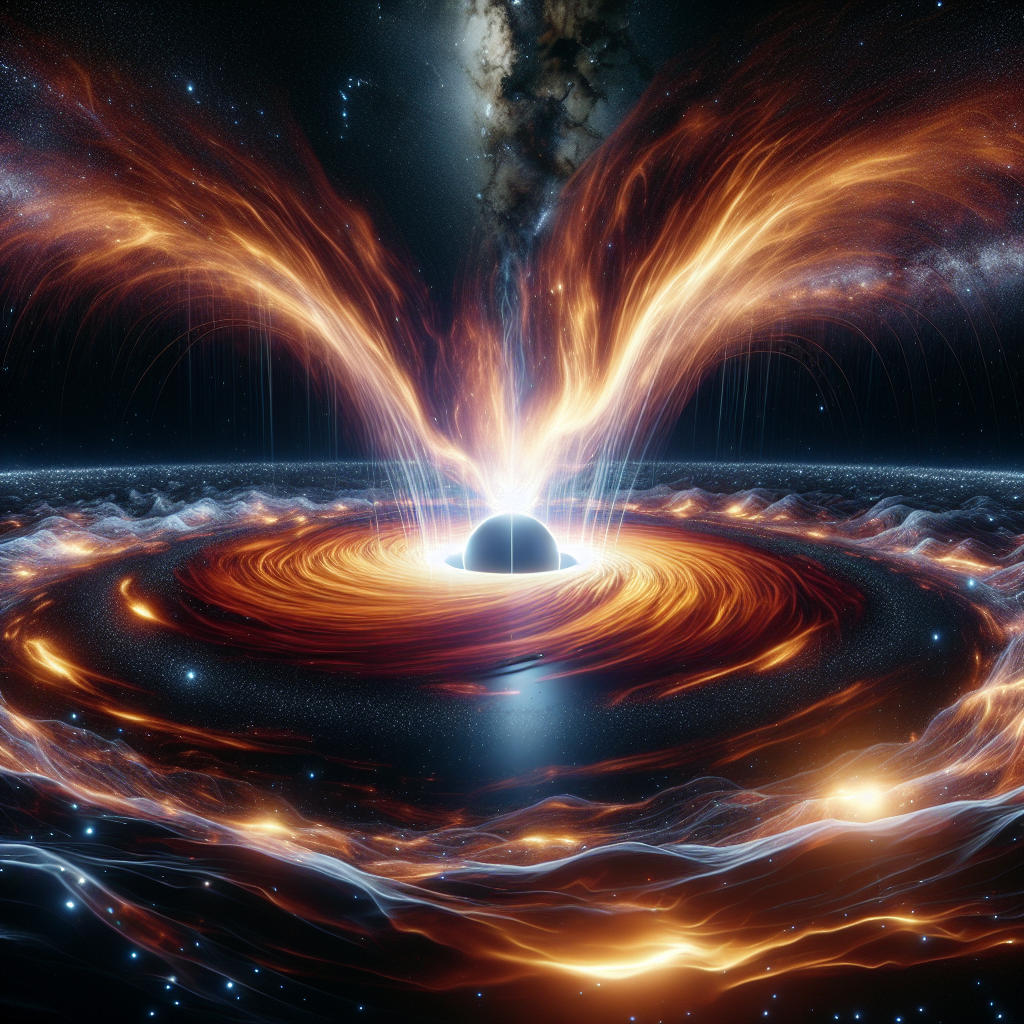
In an extraordinary find, astrophysicists have identified a supermassive black hole in the early Universe, ejecting powerful jets of plasma that stretch an astonishing 215,000 light-years—more than double the width of the Milky Way. This remarkable black hole, located within the quasar J1601+3102, was observed as it existed less than 1.2 billion years after the Big Bang. Such a discovery not only advances our understanding of cosmic formation but also ignites wonder about the incomprehensible scale of God’s creation.
Anniek Gloudemans, an astrophysicist at the National Science Foundation’s NOIRLab, shared insights on the research objectives: "We were searching for quasars with strong radio jets in the early Universe, which helps us understand how and when the first jets are formed and how they impact the evolution of galaxies." This exploration into quasars not only demonstrates scientific curiosity but mirrors the biblical principle of seeking wisdom as a means of understanding the world around us: "The fear of the Lord is the beginning of knowledge" (Proverbs 1:7).
Jets of Discovery
The jets emitted by supermassive black holes are particularly captivating phenomena. When sufficient material orbits a black hole, it forms a disk of matter. This swirling mass is drawn into the black hole by its extreme gravity, often manifesting as a quasar—an object radiating immense light. While some material spirals inward, a portion is accelerated along magnetic field lines and launched into space, forming these extraordinary jets.
The jets discovered in J1601+3102 challenge previous assumptions about supermassive black holes. Traditionally, it was believed that exceptionally massive black holes were necessary for generating such substantial jets. However, the findings indicate that even a black hole with a mass of approximately 450 million times that of the Sun can unleash powerful jets—suggesting a more varied landscape of quasar characteristics than previously thought.
A Broader Perspective
Through meticulous observation and collaboration among various telescopes—including the LOFAR array in Europe and the Gemini North telescope in Hawaii—researchers have peeled back layers of understanding about the black hole’s mass and activity. The discovery emphasizes the value of working together and the importance of community—a principle echoed in many faith traditions, including Christianity, which teaches that "where two or three gather in my name, there am I with them" (Matthew 18:20).
The research, revealed in The Astrophysical Journal Letters, opens a window into how early cosmic structures might have evolved while raising profound questions about the nature of creation itself. The vastness of the Universe, much like the depth of spiritual inquiry, invites reflection on our place within it and the Creator’s plan.
An Encouraging Takeaway
In contemplating this monumental discovery, we are reminded to embrace a spirit of curiosity and wonder. Each breakthrough in understanding the cosmos not only sheds light on our Universe but also beckons us to appreciate the depth of wisdom found in spiritual texts. As we ponder the magnificent scale and complexity of creation, let us remember the words of Psalm 147:5: “Great is our Lord, and mighty in power; His understanding is infinite.”
May we continue to seek knowledge and foster a sense of wonder about the world around us, reflecting on the divine intricacies woven into the fabric of the Universe.
Explore and dig up answers yourself with our BGodInspired Bible Tools! Be careful – each interaction is like a new treasure hunt… you can get lost for hours 🙂