 0
 0
Every working day in Perfect Days, Hirayama eats his lunch in the same place: a bench in the grounds of a shrine, in the shade, under trees.
And every day he looks up, lifts a small film camera, and photographs nothing. No person in the frame. No building. Just branches, leaves, and the light coming through them.
He does not check the shot. There is no screen to check. He will not see the picture for days, and when he does, most of it will be sky.
Anyone hunting for the Perfect Days meaning usually starts at the last shot, which is fair enough, because the last shot is devastating. But it only works because of the sandwich.
What Perfect Days is actually doing
Perfect Days is a 2023 Japanese-language film directed by Wim Wenders, who co-wrote it with Takuma Takasaki. Kōji Yakusho plays Hirayama, a man who cleans public toilets in Tokyo’s Shibuya district for The Tokyo Toilet project – seventeen real facilities, by real architects, which the film simply uses as its sets. It runs 124 minutes. It was shot in seventeen days. Yakusho won Best Actor at Cannes for it.
The shape of his day barely moves. He wakes at dawn. He drives across the city with a cassette playing. He cleans, with a care nobody has asked him for. He eats under the trees at the shrine. He reads before sleep – Faulkner, Aya Kōda, Patricia Highsmith, one book at a time, bought on his day off. And then the film hands you a dream: a short burst of flickering, impressionistic black and white, at the end of nearly every single day.
It is very easy to describe this as a film that admires routine, and then to feel faintly told off by it. That reading is upside down.
Wenders has been precise about why the routine is there. Routine, he told Tricycle: The Buddhist Review, “does give structure and thereby also a lot of freedom, amazingly so,” because “you do not have to structure every day from scratch if you have a routine.” His one-line summary of his own main character is better than most reviews managed: “his life spans between the rigidity of his routine and the total fluidity of the ever-presence.”
So the repetition is not the subject. It is the scaffolding that lets the subject happen, and the subject is attention.
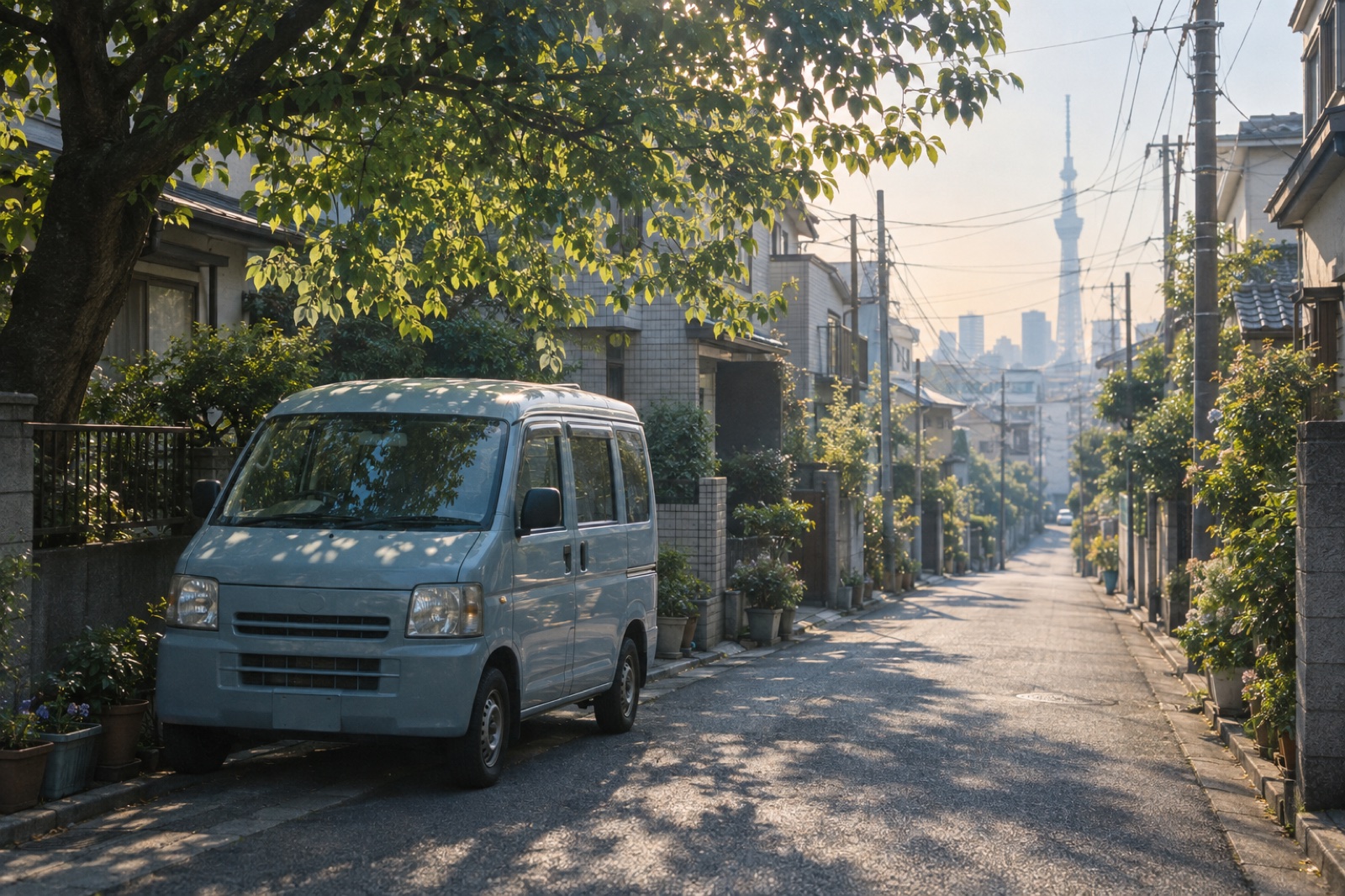
The film is built to make you practise it. It is shot in 4:3, a boxy old-fashioned frame, one of several nods to Yasujirō Ozu – as is the character’s name, which Wenders lifted from a recurring Ozu character. Then watch what keeps filling that narrow frame. Hirayama loves trees. The film keeps putting the Tokyo Skytree in his windscreen instead: the tallest thing in the country, unmissable, and completely useless to him.
The one question that breaks him
Now the scene that reorganises the film, and the detail in it that almost nobody mentions.
Hirayama’s niece Niko turns up at his door without warning, having run away from his estranged sister Keiko. He does not interrogate her. He gives her a place to sleep and takes her along to work for two days. They photograph trees. They ride bikes.
Then Keiko comes to collect her, in a chauffeured car. She tells Hirayama their father’s dementia has got worse. She asks whether he will visit the nursing home. She says their father does not recognise anything anymore and will not behave the way he used to.
Hirayama refuses. It plainly costs him, and he refuses anyway. Then he hugs his sister goodbye.
And then, almost as an afterthought, before she gets in the car, she asks him whether he really cleans toilets for a living.
He says yes.
As the car pulls away, he breaks down and cries inconsolably – in the street, in a way nothing earlier in the film prepares you for.
Look at the order. He held through the news about his father. He held through refusing to go. He held through the embrace. The collapse arrives after the smallest question in the scene, the one about his job.
That sequence is a choice, and it is doing something specific. The question is not really about toilets. It is his sister checking whether the thing she has decided about him is still true – and the entire film up to that point is, in a sense, the case for the defence. He does not make it. He says yes, and lets her drive off believing whatever she already believes.
It is also the only hard information the film ever gives you about where he came from: a chauffeur, a nursing home, a father he will not see. Which is almost nothing. Perfect Days will show you this man’s dreams every night of the film and his memory not once. There is not a single flashback in it.
The five pages Wim Wenders wrote and would not show you
That absence is not vagueness, and it is not improvisation.
Wenders wrote Hirayama a past. “Indeed, there was a backstory,” he told Tricycle. “I had to write it down, at least for myself, to imagine the character of Hirayama when we wrote the screenplay. So I wrote five pages to know for myself who Hirayama was.” He wrote it in the first person, as Hirayama looking back over his own life. He gave it to Kōji Yakusho just before shooting started, and to his co-writer.
He did not give it to you. “We thought it was much better to keep it in the dark and relatively unexplained,” he said, “so it is up to every viewer to fill in this blank.”
He did eventually let some of it slip, to Ed Rampell at The Progressive, and he was unhappy about it afterwards: “That was the backstory. I did give it away – against my will.”
In those pages, Hirayama was a businessman. Rich, unhappy, drinking heavily, his life “going down the drain.” One morning he wakes in a cheap hotel room with no memory of getting there, hates his life, and plays with the idea of ending it. Then an early ray of sunlight lands on the wall in front of him, falling through a small tree outside the window. He stares at it and starts crying, because he has never seen anything so beautiful. And Wenders adds the line that matters: “He probably has seen it, but he hasn’t noticed.”
So he quits. The car, the job, all of it. He becomes a gardener, and then the keeper of these toilets – “because they’re all in little parks.”
Watch the film again carrying that, and the lunch break stops being a charming habit. The thing he photographs every day is the thing that stopped him dying. The script was titled Komorebi before they started shooting; Wenders has said so plainly. Those sandwich breaks are a man going back, daily, to the exact event.
And you are not told any of it. The actor knew. The co-writer knew. You get a dream, a crying fit, and a sister in a nice car. That withholding is a real technique, not a coyness – Naoki Urasawa does something related in Monster, where the whole thesis is buried in a children’s picture book rather than in the ending.
What the ending of Perfect Days means
Which brings you to the last few minutes.
Another working week. Hirayama drives to work. He puts in a cassette, Nina Simone sings “Feeling Good,” and the camera settles on his face and stays there.
Wenders has described what he actually told his lead actor, and it is almost nothing. Hirayama knows the words to this song, they mean a lot to him, and through them “he sees his whole life in front of him” – and one question: “Did he make the right decision to live the life he is living now?” Wenders: “That’s all I told Koji Yakusho as ‘direction.’ Little did I know how far he was going to take that scene…”
His cinematographer, Franz Lustig, was sitting in the passenger seat. Wenders says Lustig started weeping and could no longer look through the viewfinder, and that he prayed the shot was still being held. What Yakusho does inside it, Wenders says, he had not known an actor could do: “Laughing and crying at the same time, letting his entire life show – his doubts, but also, his joy and his confidence…”
Then the film ends on a definition. A title card explains komorebi: the play of light and shadow made by leaves moving in the wind, which exists once, in that moment, and never again.
That is the argument, placed at the exit, after you can no longer do anything with it. It is a trick worth noticing, and not unique to this film – the real explanation of The Bear’s first-season ending is also sitting somewhere other than where everyone looks for it.
There is an old line about mornings that people print on mugs. “They are new every morning.” It gets handed over as reassurance, the way you would hand someone a blanket.
It comes from Lamentations, which is a book about a destroyed city. The man writing it opens by saying he is the one who has seen affliction. A few lines before he gets to “new every morning,” he is still saying that his soul remembers the wormwood and the gall, and remembers them exactly.
Then, in the same breath, taking none of it back: the mercies of God are not used up, and they are new every morning.
Not instead of the grief. Alongside it, in one sentence, at dawn – which is the only form in which either half is true. Nothing suggests Wenders was reaching for that, and the film makes no claim on it. But it is the exact expression on Kōji Yakusho’s face in a van in Tokyo traffic: a man laughing and crying at once, on his way to clean toilets, in light that will not be there tomorrow.
The title card is not a comfort. It is the condition. It only exists once.
Back to the scrap of paper in the stall
One last thread the film keeps going, quietly, almost from the start.
In one of the toilets, Hirayama finds a folded piece of paper tucked out of sight. Someone has drawn a noughts-and-crosses grid on it and made a move. He plays his move and puts it back where he found it. The game carries on across the whole film.
He never meets the person. He never learns who it is. There is no result he could hold up to anybody, no proof it happened, nobody keeping score.
Which is the same act as the photographs he cannot keep, and the cleaning nobody watches, and the light at the shrine that will be different tomorrow. Perfect Days is not telling you to live like Hirayama. It is quieter than that, and harder. It is asking you to notice that he noticed – the way Sophie’s World hides its twist on page one and waits to see whether you were paying attention.
Over to you
Wenders calls Hirayama “indeed a free man.” I am not sure the film agrees with him – a free man probably does not fall apart in the street because somebody asked what he does for work. So which is it: is Hirayama content, or is he managing? Tell me what you think in the comments.
Perfect Days: Common Questions
What is Perfect Days actually about?
Perfect Days is a 2023 Japanese-language film directed by Wim Wenders and co-written with Takuma Takasaki, starring Kōji Yakusho as Hirayama, a man who cleans public toilets in Tokyo for The Tokyo Toilet project. On the surface it is a film about a repeated daily routine – dawn, the van, cassette tapes, work, a sandwich under the trees at a shrine, a book before sleep. Underneath, the repetition is scaffolding rather than subject. What the film is really about is attention: a man who has organised his entire life so that he is free to notice small, temporary things, above all the light falling through leaves.
What does komorebi mean in Perfect Days?
Komorebi is the Japanese word for sunlight filtered through the leaves of trees – the shifting pattern of light and shadow made by foliage moving in the wind. In Perfect Days it is what Hirayama photographs on film during his lunch breaks, and it is the idea the whole film is organised around: the film closes on a title card explaining that komorebi exists only once, in that moment, and never the same way again. Wim Wenders has said the screenplay was actually titled Komorebi before shooting began.
What does the ending of Perfect Days mean?
The ending of Perfect Days is a single long shot of Hirayama’s face as he drives to work listening to Nina Simone’s “Feeling Good,” and his expression moves between joy and grief without the film explaining it. Wim Wenders has said the only direction he gave Kōji Yakusho was that Hirayama hears his whole life in the song’s words, and one question with it – whether he made the right decision to live the life he is now living. The film deliberately refuses to answer it, and then cuts to a definition of komorebi: something that exists once and never returns.
Why does Hirayama cry in Perfect Days?
Hirayama breaks down in Perfect Days after his estranged sister Keiko collects her daughter Niko from him. In that scene Keiko tells him their father’s dementia has worsened and asks whether he will visit the nursing home, and Hirayama refuses. He does not cry at that. He cries after she asks, almost offhandedly, whether he really cleans toilets for a living and he answers yes. The order of the scene is the point: the thing that undoes him is not the dying father but the question about his work, which is really a question about whether his whole life counts.
Is Perfect Days based on a true story?
No. Perfect Days is fiction, though the setting is real: it was filmed at The Tokyo Toilet, a genuine project that redesigned seventeen public toilets across Tokyo’s Shibuya district with work by architects including Tadao Ando, Toyo Ito and Kengo Kuma. Wim Wenders did write a five-page backstory for Hirayama, in the character’s own first-person voice, which he gave to Kōji Yakusho and his co-writer and deliberately kept out of the finished film.
Worth sharing
- In Perfect Days, Hirayama holds it together through the news that his father is dying, and through refusing to visit him, and through hugging his sister goodbye. He falls apart after she asks whether he really cleans toilets for a living. The order of that scene is the whole film.
- Wim Wenders wrote five pages of Hirayama’s life story in the first person, handed them to Kōji Yakusho before shooting, and then kept every word of it out of Perfect Days. The actor knew. You don’t.
- Perfect Days shows you a man’s dreams every single night and his memories not once. There is not one flashback in the entire film, and that is a decision, not a gap.