 0
 0
A man is lying at the bottom of a well in Istanbul, and he is irritated. Not frightened. Not in pain. Irritated. Nobody has found him yet, and he would very much like someone to notice.
He is dead. He is also the first voice you hear in My Name Is Red. Search for “My Name Is Red meaning” and you will mostly get East versus West — Ottoman miniature painting on one side, Venetian perspective on the other. That argument is genuinely in the book. It is not the thing the book does to you.
The novel is Orhan Pamuk’s, published in Turkish in 1998 as Benim Adım Kırmızı and in English in 2001 in Erdağ M. Göknar’s translation. It has since gone into more than sixty languages. The man in the well is called Elegant Effendi, and he gilded pages for the Sultan’s workshop.
And here is the shape of what follows. You do not find his killer through a confession, or a witness, or a dropped knife. You find him by looking at a drawing of a horse and noticing that its nose is wrong.
What the murder in My Name Is Red is actually about
The setting is Istanbul in 1591, during the reign of Sultan Murad III, who appears in the book as a character. The crime grows out of a commission.
Enishte Effendi — uncle to Black, father to Shekure, and the man managing the work — has been asked to produce a book in secret, in the Venetian manner. That sounds like a note about style. It is not. It is a question about who the world belongs to.
The painters of that workshop had inherited a way of making pictures that showed things as they are known to be. A mosque is large because a mosque is large. A dog is dog-sized. The picture reports the truth of the thing, not the accident of where one person happened to be standing.
The Frankish method does the opposite. It paints from a spot. From that spot a fly near your eye can be larger than a mosque down the street, and the painting will say so without apology. The world stops being what everybody knows and becomes what one man saw.
Elegant Effendi worked on that secret book and then started saying the word heresy out loud. That is why he is in the well.
Pamuk does not settle the argument for the reader, and the characters do not settle it for each other. Three master miniaturists — known in the workshop as Butterfly, Stork and Olive — want three different things from a picture, and old Master Osman, who trained all of them, wants a fourth. The fear of what the preachers will say is real inside the book, and the book keeps it a live argument rather than an answered one.
My Name Is Red meaning: why style is a flaw
Butterfly gets a chapter that is really three short stories, labelled with letters of the alphabet, and all three are about signing your name.
In one, a sultan’s son signs a painting. The sultan looks at the signature and concludes that the painting bears a flaw. Not because the brushwork was poor. Because a signature is a confession. It says: the imperfect parts of this are mine.
Imperfection, Butterfly says, is what gives rise to the thing we call style. The highest compliment available in that tradition runs the other way entirely — that a picture is so Bihzad it needs no signature at all. Perfection has no author. If you can be recognised, something has gone wrong.
The sentence that runs the whole novel is spoken early, by the murderer, in his own chapter: “What was venerated as style was nothing more than an imperfection or flaw that revealed the guilty hand.”
He is talking about painting. He also has a guilty hand.
The horse that solves the murder
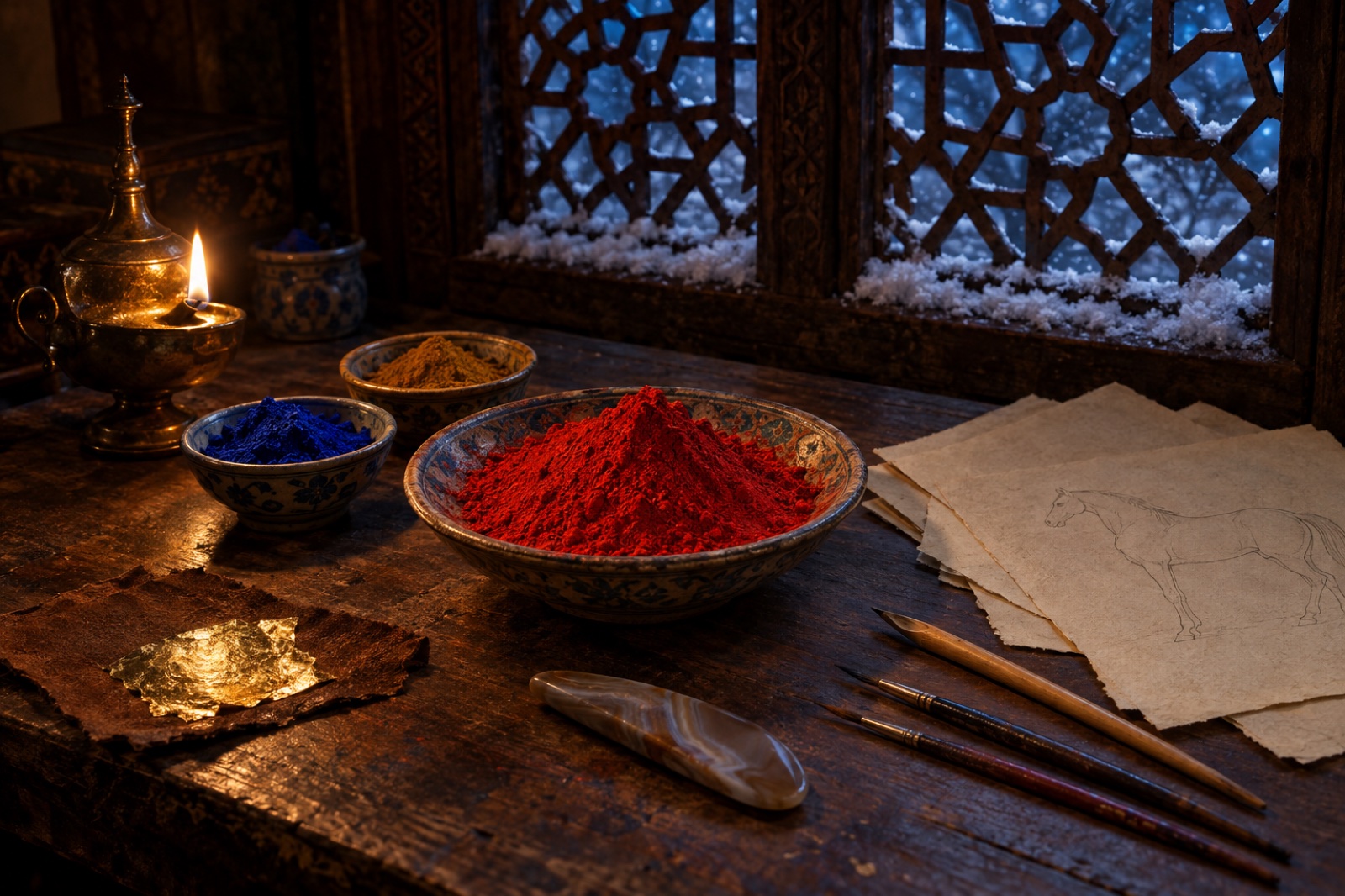
A drawing of horses turns up, and Elegant Effendi’s widow insists her husband never drew it. Master Osman studies the nostrils. They are cut open — slit, the way the horses of the Mongols were. Nobody decides to draw a nose that way. It comes out of a hand without being asked.
So the Sultan arranges a competition. Each miniaturist is to draw a horse, for the pleasure of it, as a test of skill. It is a fingerprint lift dressed as a party game. In the end it is Stork who says the name aloud: Olive drew the horse.
There is a quiet symmetry in how Pamuk arms both halves of this. Enishte Effendi is killed with an inkpot brought from Mongolia. The killer is convicted by a horse with a Mongol nose.
Meanwhile Master Osman, searching the Royal Treasury among the masterpieces of the past, finds the needle that Bihzad is said to have used both to paint and to blind himself. Osman puts it into his own eyes. He lives two more years. The man whose entire doctrine was that one particular eye should not matter stops using his.
The thing most readers miss
The murderer narrates. Several chapters are his, and the heading on them is “I will be called a murderer” — will be, not am. He tells you what he is frightened of and what he thinks pictures are for. He does not tell you his name.
So the novel refuses to let you catch him by name. The only way to catch him is by manner: by what he keeps circling back to, by the particular pitch of his guilt, by the obsession that leaks out of him in every chapter he gets. You are doing Master Osman’s job. You are hunting a hand by its flaws.
Which means the book is built entirely out of the thing its painters consider a sin. Every chapter is a separate first-person voice, and almost every one of them is recognisable before it introduces itself. A corpse. A dog. A tree. A counterfeit gold coin. Death. Satan. Two dervishes. The colour red. A novel whose characters believe style is an imperfection is written as nothing but styles, stacked one on top of another, and it hands the reader the job of telling them apart. Pamuk is not the only novelist to let the dead do the talking — Juan Rulfo’s Comala is louder in its dead half than its living one — and he is not the only one to build a book out of narrators who are not its subject, which is also what Han Kang does in The Vegetarian. But no other novel I know uses the device as its own murder weapon.
Here is the part that is easy to read straight past. Those talking-object chapters are not Pamuk leaning in from outside the story. They are sourced inside it. Every night a storyteller in a coffeehouse hangs a picture on the wall and performs in its voice — the dog, the tree, the coin, Death, the horse, the two dervishes, red itself. The tree’s own chapter mentions having been sold to him. The weirdest pages in the novel are a stage act happening a few streets from the murder.
And then the followers of a preacher who objects to coffeehouses, to bawdy stories and to pictures of living things wreck the place and kill him. The one man in the book who can make a picture speak without signing it is the one voice that gets silenced.
A signature is an admission
Stay with what the workshop believes, because it is a serious position and not a quaint one. In that room, being identifiable is a form of guilt. The part of your work that is unmistakably yours is the part that went wrong.
Anyone who has ever made anything knows that fear from the inside. The sentence that sounds most like you is the one you suspect of being self-indulgent. The habit a friend recognises in your work is the habit you keep trying to edit out.
And the oldest writing we have about being recognised runs on the same method and arrives somewhere else. It also identifies people by what they cannot help — not by their finest work, but by what they are made of. One old psalm puts it almost bluntly: God knows our frame, and remembers that we are dust.
That is Master Osman’s technique exactly. The flaw is the identification. The difference is what the identification is for. Osman is looking for somebody to punish. The psalm is describing tenderness. Same evidence, opposite verdict.
The novel does not choose between them, and it would be a worse novel if it did. The book inside the book is never finished.
How My Name Is Red ends
Olive is cornered. Black produces Bihzad’s needle and threatens him with it, there is a struggle, and Olive is blinded in both eyes. Olive gets a knife into Black’s shoulder and runs. He makes it to the workshop and there meets Hasan, who is out with a blade for his own reasons and takes him for one of Black’s men. Hasan cuts off his head. The most important death in the novel is a case of mistaken identity — in a book where identity is established by looking very carefully at a drawing.
The secret book is never completed. Black lives another twenty-six years with wounds that will not heal, and drops dead beside a well, which is the shape the novel opened with.
Shekure gets the last chapter. She says there were two pictures she wanted in her life: a portrait of her own face, and a picture of bliss — a mother with her two children. Her son Orhan tells her the second one cannot be painted. She hands him the letters and the few surviving illustrations and tells him the whole story. Then she warns you about him. For the sake of a story that delights and convinces, there is not much Orhan would not invent.
So the last thing the book gives you is the admission its painters spent four hundred pages dreading. The account you have just read has a hand on it. It has a flaw. Somebody’s style is all over it. Shekure tells you so on her way out, and that is as close as the novel ever comes to a signature. If that move interests you, it is close kin to the question of who is holding the pen in Kim Jiyoung, Born 1982.
Questions About My Name Is Red
What is My Name Is Red actually about?
On the surface, My Name Is Red is a murder mystery set in the Ottoman painters’ workshop in Istanbul in 1591: a gilder is killed, then the man organising a secret book is killed, and Black is asked to find out who did it. Underneath, it is about whether a picture should show the world as everyone knows it to be or as one person sees it from where he stands. The painters in Orhan Pamuk’s novel treat an individual style as a flaw, which is precisely why a flaw can be used to identify a killer.
Who is the murderer in My Name Is Red?
Olive, one of the three master miniaturists, is the murderer in My Name Is Red. He killed Elegant Effendi, the gilder found at the bottom of the well, and then Enishte Effendi, the man assembling the secret book. He narrates several chapters himself under the heading “I will be called a murderer” without ever giving his name, so the reader is left to identify him by his manner rather than by a confession.
Why does the colour red narrate a chapter in My Name Is Red?
Pamuk gives chapters to a dog, a tree, a gold coin, Death, Satan, a horse, two dervishes and the colour red, and the device comes from inside the story rather than being imposed on it. A coffeehouse storyteller in the novel hangs an illustration on the wall each night and performs in that picture’s voice. The strange chapters are his act. When the followers of a preacher who opposes coffeehouses and figurative painting destroy the coffeehouse, they kill him too.
What does the ending of My Name Is Red mean?
The ending of My Name Is Red turns the novel’s own fear back on itself. Olive is blinded, then beheaded by Hasan, who mistakes him for someone else; the secret book is never finished; and in the final chapter Shekure reveals that she told the whole story to her son Orhan, warning that he will embellish it for the sake of a good story. A novel whose painters believe a signature is an admission of imperfection ends by admitting that the account you have read bears somebody’s hand.
Is My Name Is Red based on a true story?
My Name Is Red is a work of fiction, but its world is real. The Ottoman court workshop existed, Sultan Murad III did reign in 1591 and appears as a character, and the masters the painters revere — above all Bihzad of Herat — were real artists around whom legends, including the story of his self-blinding, had gathered long before the novel. The English translation by Erdağ M. Göknar won the International Dublin Literary Award in 2003.
One question, if you have read it
Master Osman blinds himself on purpose, and the novel treats it as something closer to a reward than a punishment. Did you read it that way — as an arrival — or as the saddest thing in the book? I genuinely want to know. Tell me in the comments.
If you want to share it
My Name Is Red solves a murder by looking at a horse’s nostrils. The painters in it believe style is a flaw that gives away the guilty hand — and Pamuk wrote the entire novel out of nothing but styles. A dog, a coin, Death, the colour red.
The murderer in My Name Is Red narrates his own chapters and never once gives his name. You can only catch him by his manner. Pamuk puts you in the detective’s chair without telling you he has done it.
Nobody warns you that the talking-tree and talking-dog chapters in My Name Is Red are a coffeehouse act happening inside the plot — or that the man performing them gets killed for it.