 0
 0
Your power bill went up again. You did not add a room to the house. You did not buy a new freezer. The number just moved.
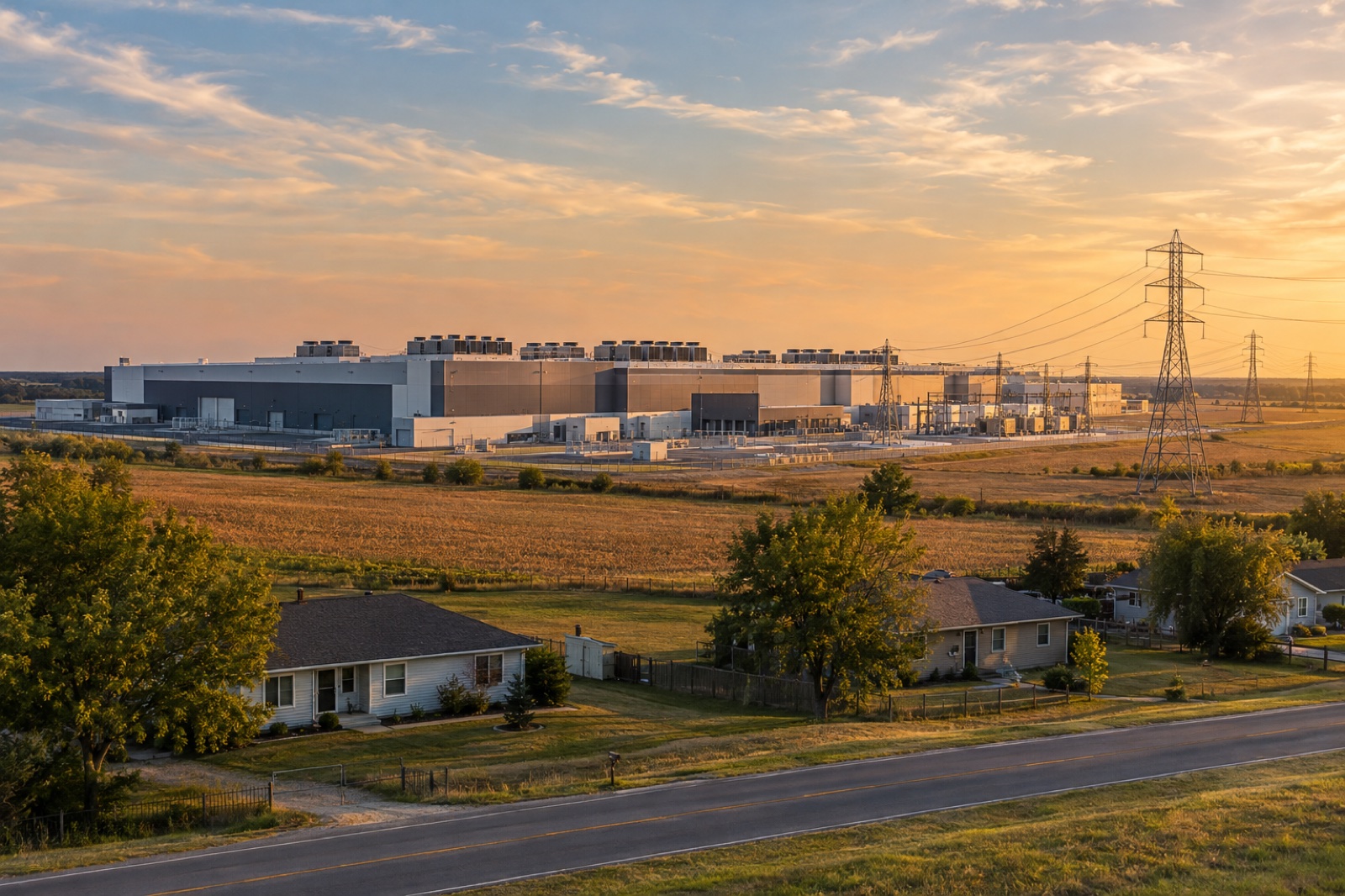
Meanwhile, a few kilometres away, there is a building you have never been inside. Long, low, almost no windows. A fence around it. A steady hum from the roof. Nobody you know works there. Data center electricity use has quietly become one of those arguments everyone has an opinion about — and until this month, nobody had a solid number to argue with.
Now there is one. On 16 November 2026, a Harvard-led team published a study in the journal Nature Sustainability. They counted 403 of the largest data centers in the United States and estimated how much electricity those buildings pulled over a single year.
The answer landed between 68 and 99 terawatt-hours. The top of that range is close to what an entire American state gets through in a year — a state the size of Indiana, Michigan or Tennessee.
That is the headline, and it is a fair one. But it is not the most interesting number in the study. The most interesting number is much smaller, and it changes the whole story.
What Data Center Electricity Use Actually Looks Like
The buildings in the study are called hyperscale data centers: the very large facilities that run cloud storage, streaming, search and, increasingly, artificial intelligence. They are the plumbing underneath almost everything you do on a screen.
The research team found all 403 of them using satellite imagery. Sit with that for a second. To work out where a measurable slice of a country’s electricity goes, researchers had to look down from space.
Here is what they estimated for the twelve months from May 2024 to April 2025:
- 68 to 99 terawatt-hours of electricity. The range depends on how hard the machines are assumed to have been running.
- About 54% of that power came from fossil fuels — roughly 38% natural gas and 15% coal.
- About 25.7 million metric tons of carbon dioxide, worked out from each facility’s regional grid mix using US Environmental Protection Agency data.
- Two to three times higher than an earlier estimate for 2018. That is roughly six years apart.
That last line is the one that tells you this is a story about speed rather than size. Whatever you make of the total, it did not creep.
If the slow grind of ordinary costs is what is actually wearing you down right now, there is a free video guide and companion PDF below about finding God in exactly those unglamorous, unbeautiful moments.
The One Number That Changes the Whole Story
All 403 of those buildings, running for a full year, came to about 1.8% of total United States electricity consumption.
Less than two percent. That is every hyperscale facility in the country, combined.
So why does it feel enormous? Because electricity is not a national thing. You do not buy power from a country. You buy it from a grid that covers your region, and that grid has a fixed set of power stations, a fixed amount of capacity, and a fixed set of customers to share it between.
Which is where the study gets genuinely interesting. Four states — Virginia, Oregon, Ohio and Iowa — together accounted for more than half of all the electricity used by those 403 facilities.
More than half. Four states.
So the load is not really big. The load is concentrated. Spread across a whole country it is close to a rounding error. Landed on four places, it is a completely different conversation — and that is the shape of almost every cost that feels unfair. It is rarely the size of the bill. It is where the bill lands. The same pattern shows up at the supermarket till, where prices climb in steps while pay catches up slowly.
What the Study Does Not Say
This is the part most coverage skipped, and it is the part that makes the study worth trusting. The researchers put their own limits in writing.
- They could not include every facility. There was not enough available data to study every hyperscale data center in the country. So the figure is a floor, not a ceiling.
- They could not separate AI from everything else. The data did not let them split power used for AI-specialised work from power used for ordinary, general-purpose computing. If you were hoping for “here is what AI costs” — this study cannot tell you that, and it says so plainly.
- The numbers are already out of date. Lead author Gianluca Guidi put it simply: “The data center boom hasn’t slowed down since our study period ended in April 2025.” The 2026 figures, he said, could already be substantially larger.
- Health effects were not measured. Corresponding author Francesca Dominici said that quantifying health impacts is “an important next step” — meaning this study did not attempt it.
One more detail worth keeping: about a quarter of the electricity came from grid regions with a dirtier-than-average mix. Not all of the load lands on clean power. Not all of it lands on dirty power either. Where a building gets put decides an enormous amount.
A careful range with four admitted holes in it is worth more than a confident round number. And it leaves the hard question exactly where it has always been — which was never a technical question anyway. Who gains from a big build, and who absorbs it, is an argument that long predates computers; it is the same question behind the finding that the share of national income going to workers recently hit a record low while profits hit a record high.
Who Pays for What Gets Built
Here is the part that is not really about electricity at all.
Every large build has two lists. There is a list of people who get the thing. And there is a list of people who carry the cost of it. When those two lists are mostly the same people, nobody complains much. When they drift apart, something breaks — and it almost never breaks on the day of the ribbon cutting. It breaks a generation later.
There is an account roughly three thousand years old that reads almost like a case study in this. A king builds on a scale nobody in that part of the world had seen. A temple. A palace. A city wall. Fortified towns. The record says he made silver in the capital as common as stones. It was genuinely magnificent, and everybody agreed that it was magnificent.
It was paid for with a levy. Thirty thousand men rotating in shifts — a month away, two months home — plus tens of thousands more hauling stone and cutting timber in the hills. The glory was concentrated in one city. The bill was spread across the whole country.
Nothing broke while the builder was alive. The trouble arrived when his son took the throne. A delegation turned up almost immediately with a single request: lighten it. Not end it. Lighten it. The older advisers told him that if he gave these people one good word, he would have them for life. The young men he had grown up with told him to go the other way. He went the other way. “I will add to your yoke,” he told them.
The country came apart almost at once. And here is the detail that is easy to read straight past: when the crowd finally turned violent, they did not go for the king. They went for the official who was over the forced labour. He was the one they could actually see. (The same record names a man over the levy a generation earlier with an almost identical name. Whether that was the same man grown old, or his successor, the account does not say.)
That is the whole thing, really. People will carry an astonishing amount for something they helped choose. What they will not carry is the bill for a monument they were never asked about — and when they go looking for someone to hand it back to, they reach for whoever is standing closest to the meter.
It is an old question, and the old books treat it as a moral one rather than an engineering one. God seems considerably more interested in who is carrying a weight than in how impressive the building turned out. That is not an argument against building. It is an argument for counting both lists before you start.
So What Do You Actually Do With This
Nothing here lets you negotiate with a hyperscale facility, and it would be dishonest to pretend otherwise. But two small things are genuinely within reach.
Read your own bill properly, once. Not the total at the top — the total is the part designed to be glanced at. Find the per-unit rate. Find the fixed charges that apply whether you use anything or not. Then put it beside a bill from a year ago. Most people have never done this, and it takes about ten minutes. If you want something simple to do the arithmetic around it, our free budget calculator will lay it out for you.
Then ask the small version of the big question. In your own house, your own team, your own family: is there something impressive being built where the cost is quietly landing on somebody who never got asked?
The buildings will keep going up. They always have, and mostly that is a good thing — someone has to build. The question underneath them has not changed in three thousand years, and it turns out to be a surprisingly useful one to carry around: who is paying for this, and do they know?
Questions People Are Asking
How much electricity do data centers use?
A Harvard-led study published in Nature Sustainability in November 2026 estimated that 403 hyperscale data centers in the United States used between 68 and 99 terawatt-hours of electricity in the year from May 2024 to April 2025. That works out to roughly 1.8% of total US electricity consumption, and the upper end of the range is close to the annual electricity use of a state such as Indiana, Michigan or Tennessee.
Which US states have the most data center electricity use?
Virginia, Oregon, Ohio and Iowa together accounted for more than half of all the electricity used by the 403 hyperscale data centers in the November 2026 Harvard-led study. That concentration is why a load that is small as a national share can be a very large deal in a handful of regions.
Do data centers run on fossil fuels?
In the November 2026 Harvard-led study of 403 US hyperscale data centers, about 54% of the electricity supplying them came from fossil fuels — roughly 38% natural gas and 15% coal. About a quarter of the total came from grid regions with a dirtier-than-average mix. The researchers estimated the associated emissions at about 25.7 million metric tons of carbon dioxide, two to three times an earlier estimate for 2018.
Is AI the reason data centers use so much power?
That study could not answer it. Its authors stated that the available data did not let them separate electricity used for AI-specialised work from electricity used for general-purpose computing, so the figures cover both together. They also noted that their estimate likely understates current use, because the build-out continued after the study period ended in April 2025.
Does data center electricity use raise my power bill?
The November 2026 Harvard-led study did not examine household bills, so it cannot answer that for any particular home, and nobody should claim otherwise from this data. What it does establish is that the load is heavily concentrated: four US states accounted for more than half of it, even though all 403 facilities together came to only about 1.8% of national electricity use. A cost that is small spread nationally can be much larger where it is concentrated.
One Question Worth Arguing About
Think of something impressive that got built in your lifetime — a stadium, a motorway, a shining office tower, a company you once worked for. Was the bill carried by the people who got the benefit, or by somebody else entirely? Pick one and make the case. Leave it in the comments; this question is far more interesting with real examples than with opinions.
Worth Sharing
If something here landed, here it is already written for you:
403 US data centers: 68-99 TWh of electricity in a year. Together just 1.8% of US power — but four states carry over half. Not a size problem, a concentration one. https://bgodinspired.com/index.php/bgodinspired-news/bgodinspired-technology-news/data-center-electricity-use/
Harvard researchers counted 403 US hyperscale data centers and found them using 68-99 terawatt-hours of electricity in a single year — the top of that range is close to a whole state’s annual use. The part that stopped me: all of them together are only about 1.8% of US electricity, yet Virginia, Oregon, Ohio and Iowa account for more than half of it. The cost of a big build is almost never about its size. It is about where it lands. https://bgodinspired.com/index.php/bgodinspired-news/bgodinspired-technology-news/data-center-electricity-use/
There is a three-thousand-year-old version of the data center argument. A king built something magnificent and paid for it with a levy on the whole country. Nothing broke until his son promised to make the levy heavier. When the crowd finally turned, they did not go for the king — they went for the official in charge of the levy. He was the one they could see. https://bgodinspired.com/index.php/bgodinspired-news/bgodinspired-technology-news/data-center-electricity-use/