 0
 0
You have probably seen it on a card, or in someone’s profile, or at the end of a message from a friend who did not know what else to say. Four words: Live the questions now.
It tends to arrive when someone is stuck inside something that will not resolve — a diagnosis, a marriage, a city they are not sure they should stay in. And it helps, because it hands them permission to not know yet.
The line is genuine and correctly attributed. Rainer Maria Rilke wrote it in the summer of 1903, in the fourth of the ten letters later collected as Letters to a Young Poet. There is nothing here to correct. But almost nobody passing it on knows who he was writing to, what he was living through that particular week, or what the very next sentence says — and all three change it.
What “Live the Questions Now” Is Actually Asking
Most of the time the line gets used to mean: it is all right to stay in the question. Stop pushing. Make a home in the not-knowing.
That is not quite what the sentence says.
In the German, the weight falls on the verb. Leben Sie jetzt die Fragen. Live the questions now. A. S. Kline’s English translation keeps the emphasis in the same place. So the instruction is not really about the questions at all. It is an instruction about living, and the questions are what you are being told to live.
Then comes the sentence that almost never travels with it. Vielleicht leben Sie dann allmählich, ohne es zu merken, eines fernen Tages in die Antwort hinein. Perhaps you will then gradually, without noticing it, on some distant day live your way into the answer.
There is an answer in Rilke’s sentence. It is simply a long way off, and you get there by walking rather than by asking harder. He is not describing a room to settle in. He is describing a road.
The line just before the famous one is sharper still. Do not search now for the answers, he writes, because they cannot be given to you — weil Sie sie nicht leben könnten, because you would not be able to live them. That is a bigger claim than “be patient”. He is not saying there is no answer. He is saying an answer handed over too early would be no use to you, because you are not yet the person who could carry it.
Read that way, “live the questions now” is not a permission slip. It is a deadline with no date written on it. It sits close to what Kierkegaard meant when he said that life can only be understood backwards, though Rilke is the more hopeful of the two — he thinks you walk forward into the answer, not only recognise it afterwards.
Who He Was Writing To
Not to readers in general. To one young man, by name.
Franz Xaver Kappus was nineteen, an officer cadet at the Theresian Military Academy in Wiener Neustadt. By his own account, written in Berlin in 1929, he was sitting in the academy park under old chestnut trees reading Rilke’s poems when one of the masters noticed the book.
That master was Horaček, the academy chaplain — the only one of them who was not an officer. He turned the book over, asked whether these were Rilke’s poems, leafed through it, and remarked that young René Rilke had become a poet.
He knew because he had been chaplain at the military lower school at Sankt Pölten, where Rilke had been sent as a boy to be turned into an officer. He remembered him as quiet, clever and solitary, a boy who bore the boarding-school discipline patiently and whose health gave out before the training did. Rilke left that system ill and finished his schooling at home in Prague.
That chance recognition is the only reason the letters exist. And it means that when Kappus asked what he was really asking — should I give my life to poetry, or stay in the army — he was asking the one man he knew of who had been inside the same machine and got out.
What Rilke Was Living Through That Week
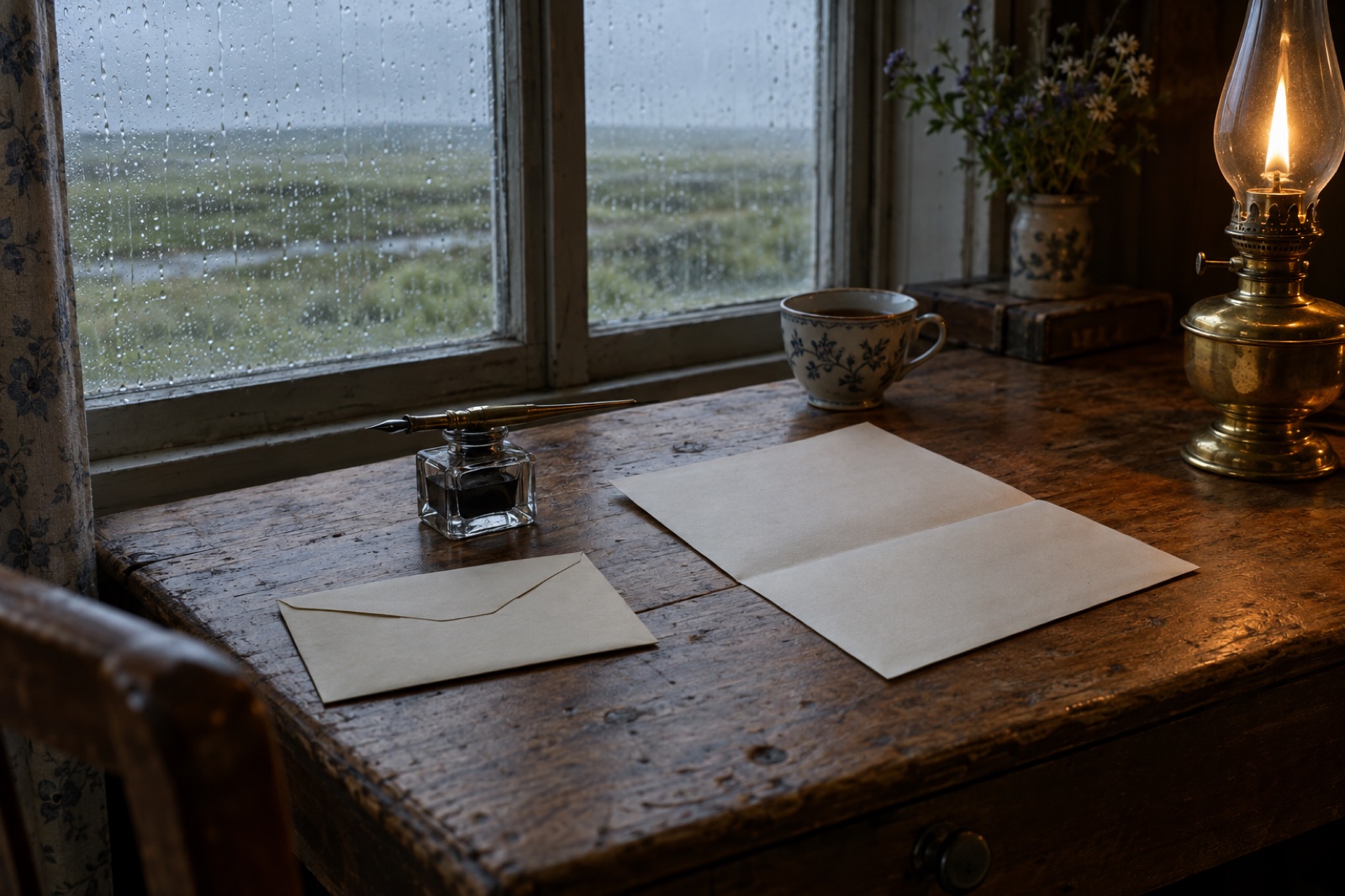
The fourth letter is headed Worpswede near Bremen, 16 July 1903. Its first line is not advice. Vor etwa zehn Tagen habe ich Paris verlassen, recht leidend und müde — about ten days ago I left Paris, really unwell and tired — and travelled out into a great northern plain.
Rilke was twenty-seven. Seven years older than the cadet. He had gone to Paris the previous summer to write a book about the sculptor Auguste Rodin, which had come out that spring; to manage it, he and his wife, the sculptor Clara Westhoff, had given up their household and left their small daughter with her grandparents. Paris had not gone well. He had fled it, sick, for a village of painters.
Two days after posting the letter to Kappus, he wrote another one — to Lou Andreas-Salomé, who had been his own mentor. Same village, 18 July 1903. In it he told her that Paris had been an experience like the military school: that the same great anxious astonishment had gripped him then, and that now the horror had come at him again.
Sit those two letters side by side. In the same week, at the same desk, a man wrote to a twenty-year-old telling him to have patience with everything unresolved in his heart — and wrote to his own mentor to say he was frightened and could not turn what he had seen into anything.
That is not hypocrisy. It is closer to the opposite. He was not handing down a conclusion he had safely reached. He was passing on the only thing he had, while he was still inside it himself. “Live the questions now” is not the advice of a man with answers. It is what one person says to another when neither of them has any.
For Ninety Years We Only Had His Half
Kappus published the ten letters in 1929, three years after Rilke died, with Insel Verlag in Leipzig. He printed Rilke’s replies and a short introduction of his own, and left his own letters out of it entirely.
So everyone who has ever read the book has been reading one side of a conversation, reconstructing the questions from the answers. We knew Rilke told a young man not to seek the answers. We did not know, in his own words, what he had asked.
That half has since surfaced. Kappus’s letters to Rilke were found in the family archive and published in German by the scholar Erich Unglaub — ninety years after Kappus published Rilke’s side — with an English edition following in 2020.
And Kappus himself? He stayed. He finished his training and served around fifteen years as an officer in the Austro-Hungarian army, and later worked as a newspaper editor and journalist, writing poems, stories, novels and screenplays. In his introduction he put it gently: the correspondence faded as his life carried him into exactly the paths Rilke had hoped to steer him away from.
Which makes what he did in 1929 rather moving. The man who did not take the advice is the only reason anybody else has it.
People Have Been Keeping the Question a Very Long Time
Rilke’s instruction has an older habit standing behind it, and there is no reason to think he had it in mind.
Psalm 13 opens with a question asked over and over: “How long wilt thou forget me, O LORD? for ever? how long wilt thou hide thy face from me?” (Psalm 13:1). The next verse asks how long twice more.
No answer arrives. Not in the following verse, not in the last one. The psalm asks how long, names what it is afraid of, and then turns — with nothing settled — and says the writer will sing anyway.
Here is the part worth noticing. Somebody kept it. That unanswered question was not filed away as a weak draft or quietly tidied up. It was copied out, set to music, and placed in the songbook of a whole people, and it is still there three thousand years later, still unanswered, still being sung. A question with no answer attached was treated as something worth preserving and saying out loud in public.
That is a stranger idea than it first sounds, and it is a very old one. Even the Hebrew word the Bible uses for hope, tikvah, is not a mood — at root it is a cord, a rope, something held onto while you wait. Hope in that language is the thing in your hand during the waiting, not the end of the waiting.
Which is close to what Rilke told the cadet. Not: your question is fine where it is. Rather: hold it, keep walking, and one day you may find you have walked into the answer.
Back to the Four Words
Nothing about the line is wrong. It is Rilke’s, it is from the fourth letter, and it means something good.
It is just smaller and warmer than the poster version. It was never a philosophy. It was a reply — from an unwell twenty-seven-year-old in a rainy village, to a twenty-year-old in a military academy who wanted to know whether to give his life to poetry, written in a week when the older of the two was writing to his own mentor in something close to panic.
If you are holding a question right now that will not close, that is the company you are actually in. Not a sage looking down from a height. Someone a few years ahead of you, soaked and tired, who thought the question might be the way through and said so.
And if what you are really trying to work out is whether to keep going or stop, that is a different question from this one — and there are plainer ways to tell “not yet” from “never”.
Over to You
Which line have you leaned on hardest when you could not see a way forward — and did you ever find out where it came from? And while we are here: is there a saying you have always assumed was in the Bible? Tell us in the comments. Half the sayings we end up looking into start as somebody’s “wait, isn’t that a verse?”
Questions People Ask
Who said “Live the questions now”?
“Live the questions now” was written by the poet Rainer Maria Rilke. It comes from the fourth of ten letters he wrote to a young officer cadet named Franz Xaver Kappus, dated Worpswede near Bremen, 16 July 1903. Kappus published the letters in 1929, three years after Rilke’s death, as Letters to a Young Poet. The German original reads Leben Sie jetzt die Fragen.
What did Rilke mean by “Live the questions now”?
Rilke meant that some answers cannot be handed over, only grown into. In the letter he tells Kappus not to search for answers that cannot be given to him “because you would not be able to live them” — and then adds the sentence most people never see: perhaps you will gradually, without noticing it, on some distant day live your way into the answer. So “Live the questions now” is not a recommendation to settle permanently into uncertainty. It treats the question as a road you walk rather than a place you stay. The emphasis in the German falls on the verb — live the questions.
Which letter is “Live the questions now” from?
“Live the questions now” is from the fourth letter in Letters to a Young Poet, headed Worpswede near Bremen, 16 July 1903. The same paragraph contains the better-known phrase about having patience with everything unresolved in your heart and trying to love the questions themselves, “like locked rooms and like books written in a very foreign language”. People often quote that passage as though it were from the opening letter; it is the fourth.
Is “Live the questions now” in the Bible?
No, “live the questions now” is not in the Bible. It is a line from a private letter written by Rainer Maria Rilke in 1903. The Bible does, though, keep unanswered questions in its text rather than smoothing them away — Psalm 13 begins “How long wilt thou forget me, O LORD? for ever? how long wilt thou hide thy face from me?” and never receives an answer inside the psalm.
Who was the young poet in Letters to a Young Poet?
The young poet was Franz Xaver Kappus, born in 1883 in Temesvár, then part of Austria-Hungary. He was a nineteen-year-old officer cadet at the Theresian Military Academy in Wiener Neustadt when he first wrote to Rilke in late 1902, and he wrote because the academy chaplain had once been Rilke’s chaplain at military school. Kappus did not become a poet; he served about fifteen years as an army officer and later worked as a newspaper editor, journalist and novelist. His own letters to Rilke were missing for ninety years and were published in English in 2020.
If You Want to Pass This On
1. I’ve quoted “live the questions now” for years. I had no idea Rilke wrote it to a 20-year-old army cadet — ten days after fleeing Paris, ill — or that the very next sentence says you’ll one day live your way into the answer. It’s a road, not a resting place.
2. Rilke told a young cadet to be patient with everything unresolved in his heart. Two days later he wrote to his own mentor to say he was frightened and couldn’t make sense of what he’d seen. That’s not hypocrisy — that’s the only honest way anyone gives that advice.
3. For ninety years, readers of Letters to a Young Poet only had Rilke’s half of the conversation. The young man’s own letters were missing until recently. And the man who never took the advice is the reason the rest of us have it.