 0
 0
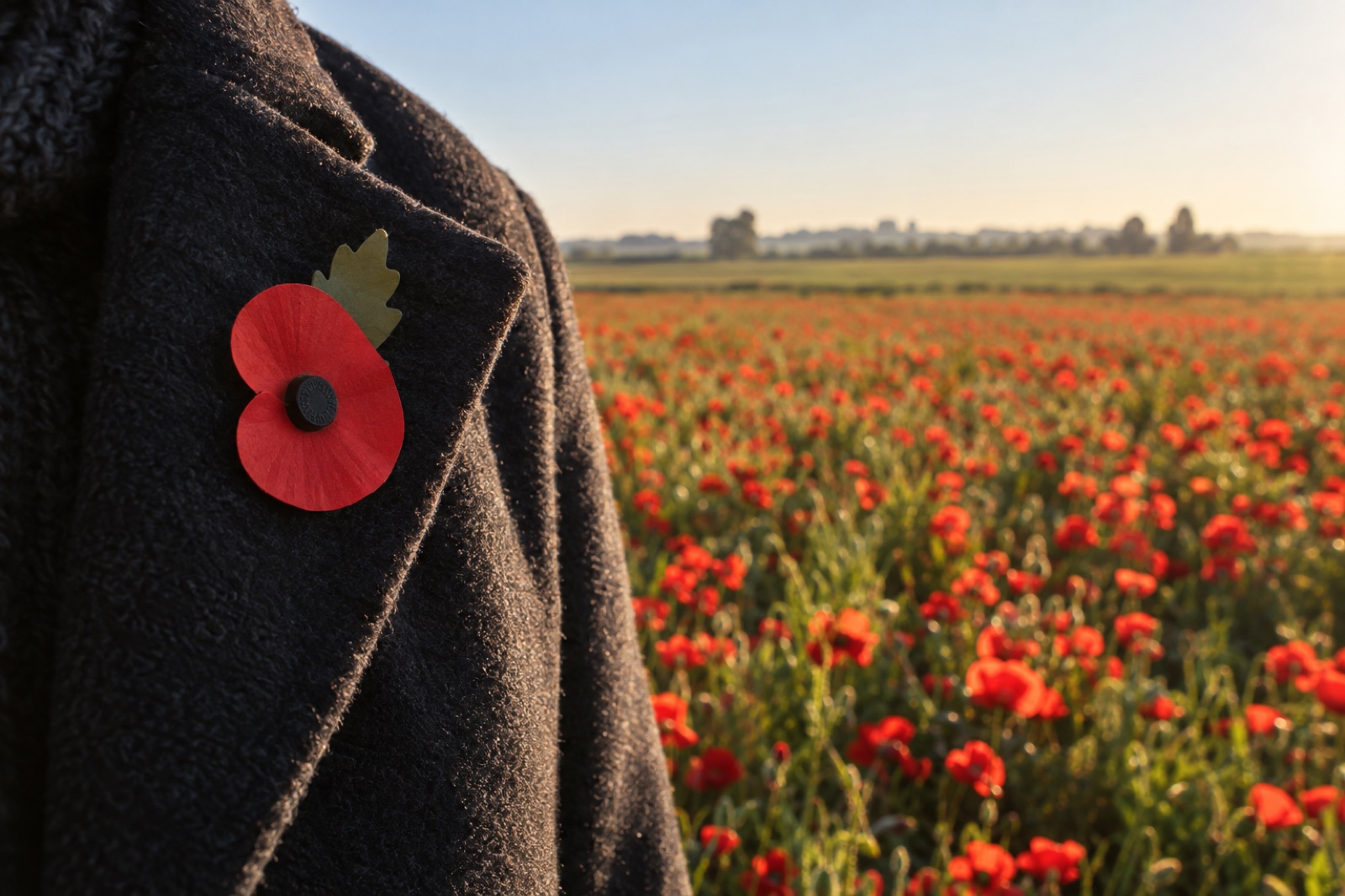
Every November, in Canada, Britain, Australia and a long list of other countries, people pin a small red paper flower to their coat. Then, at eleven in the morning on the eleventh day, they stop. Traffic slows. Shops go quiet. Two minutes of silence, and the flower sits over the heart the whole time.
If you grew up with it, you may never have asked why. If you did not, it looks a little strange: millions of adults wearing the same flower on the same week, for a war that ended more than a hundred years ago. So why do people wear red poppies on Remembrance Day? The honest answer is a chain of four things: a battlefield, a doctor, a seed, and a question a child asks.
Why Do People Wear Red Poppies on Remembrance Day? Start With the Battlefield
In the spring of 1915, the fields around Ypres, in the Flanders region of Belgium, had been shelled, dug, trenched and buried in for months. The ground was torn open. Very little should have grown there.
Instead, red poppies came up everywhere. They came up between the graves. They came up on the lips of shell holes. Soldiers wrote home about them.
This was not new. More than two hundred years earlier, after the Battle of Landen in 1693, a Scottish nobleman wrote to his sister that the next summer the ground where the armies had fought broke out in millions of scarlet poppies. The historian Thomas Macaulay later repeated the line. People had noticed, long before the First World War, that this one flower seems to follow armies.
The reason is in the seed, and we will get to it. But the reason the poppy became a symbol, rather than just a strange thing soldiers noticed, comes down to one man and one bad day.
The Canadian Doctor Who Wrote It Down
John McCrae was a doctor from Guelph, Ontario. He was 42, a surgeon and a soldier, serving with a Canadian artillery brigade near Ypres. On 2 May 1915 his friend, a 22-year-old lieutenant named Alexis Helmer, was killed instantly when a shell burst beside him. The chaplain was away, so McCrae led the burial himself.
The next day, by most accounts, he sat in the back of an ambulance and wrote fifteen lines. They begin: “In Flanders fields the poppies blow, between the crosses, row on row.”
A sergeant major named Cyril Allinson watched him write it and later said the poem was almost an exact description of the scene in front of them both. One story, repeated often, says the whole thing took about twenty minutes. Nobody can confirm that. What is better documented is that McCrae kept working on it for months before he thought it was finished, and that he was not sure it was any good. The legend says he crumpled the page and threw it away, and another officer picked it up.
He sent it to a London magazine, The Spectator. They turned it down. He sent it to Punch, which printed it on 8 December 1915 with no author’s name. Within a few years it was one of the most quoted poems in the English language.
McCrae never saw what it became. He died of pneumonia and meningitis in a hospital in northern France on 28 January 1918, ten months before the war ended, and before anyone had thought to pin a poppy on a coat for it.
There is something fitting in the fact that the two most famous poems to come out of hospital beds and field dressing stations were both written by sick or grieving men who had no idea they were writing anything lasting. William Ernest Henley wrote “Invictus” in a hospital ward forty years before McCrae wrote his. Neither man set out to be remembered. Both were.
Three Things About the Poem Most People Miss
The first line is not settled. Allinson said the poem originally began “the poppies grow,” not “blow.” McCrae’s own handwritten copies use both words. The printed version says “blow,” and the last stanza says “grow.” When the Bank of Canada put the poem on the ten-dollar bill in 2001, it received complaints from people who were sure the first line was wrong.
The last stanza is a call to fight. The first two stanzas are grief: the dead speaking from the ground, remembering that they loved and were loved. The third stanza turns and says, “Take up our quarrel with the foe.” Governments noticed. Lines from the poem were used to recruit soldiers and to sell war bonds. The poem that now marks the end of a war was, in its own time, used to keep one going. That tension is real, and the poppy has carried it ever since. For some people the poppy is about mourning. For others it is about duty. McCrae’s poem holds both, which is probably why it has lasted.
The friend has no known grave. Alexis Helmer was buried near Ypres, but the grave did not survive the war. His name is carved on the Menin Gate memorial in Ypres, which lists tens of thousands of soldiers whose graves were never found. The poem that began at his graveside is, in a sense, the only marker he has.
How the Flower Got From the Poem to Your Coat
Two women did this, and they did not know each other at first.
In the United States, a teacher named Moina Michael read the poem in a magazine in November 1918, two days before the armistice. She vowed to wear a red poppy for the rest of her life and turned up at a conference with a silk one pinned to her coat. She bought more and handed them out. She spent the next several years, mostly at her own expense, pushing for the poppy to become a universal symbol of remembrance.
In France, a woman named Anna Guérin saw a second use: the flower could raise money. Widows and orphans in the ruined parts of France could make paper poppies and sell them, and the money could go to veterans and to rebuilding. In 1921 she travelled to Canada, where a veterans’ association adopted the poppy in July, and then to London, where the newly founded British Legion agreed to try it. Guérin paid for the first batch of British poppies herself.
The first British Poppy Day was 11 November 1921. The Legion had ordered nine million poppies. Every one of them sold. The money went to housing and jobs for men who had come home wounded. It has happened every year since.
So the poppy is a symbol, but it was also, from the first year, a practical thing. You buy one. The money helps someone who served. The flower on your coat is both a memory and a receipt.
Why Poppies Grow Where the Ground Was Torn
Here is the part the poem does not explain, and it is the best part.
The common red poppy’s seeds need light to germinate. A seed that falls on open ground sprouts. A seed that gets buried does not die. It waits. It can wait for a very long time, far longer than a single growing season, until something turns the soil over and brings it back up into the light.
Farmers have always known this. Plough a field and the poppies come. Leave it alone and they vanish, not because the seeds are gone but because they are in the dark.
Now think about what an army does to a field. Thousands of boots. Trenches dug by hand. Shells that lift tonnes of earth and drop it somewhere else. Graves. The Western Front was the most thoroughly turned-over soil in Europe, and every seed that had been waiting in the dark for years came up at once.
The poppy did not grow in spite of the war. It grew because of what the war did to the ground. The flower that marks the dead was waiting under their feet the whole time, and it needed the earth to be broken to bloom.
There is an old idea, older than any of this, that remembering is not something you feel but something you build. Ancient wisdom is full of people being told to set up a pile of stones by a river, or to keep a meal every year, not so they would feel sad, but so that one day a child would point and ask, “What does this mean?” and someone would have to answer. The object comes first. The question comes next. The story gets told because the object made someone ask. Most cultures have landed on some version of this. The altars built for Day of the Dead in Mexico work the same way: you put the thing out, and the thing makes you speak.
That is exactly what a poppy is. It is a small red object pinned where a child can see it, and the entire tradition survives on the child asking. You are reading this because someone, somewhere, asked.
Where It Is Worn, and When
The poppy is worn mainly in countries that fought with Britain in the First World War, but not only there.
- Canada wears it from the last Friday in October until 11 November. Many people place their poppy on the local war memorial when the ceremony ends.
- The United Kingdom sells it from mid-October through Remembrance Sunday and 11 November.
- Australia wears it on Remembrance Day, 11 November.
- New Zealand mostly wears it on Anzac Day, 25 April, instead.
- The United States ties the poppy to Memorial Day in late May rather than to 11 November, which it marks as Veterans Day.
- Ukraine has worn the poppy since 2014 as a symbol of victory over Nazism.
- Several Caribbean countries, including Jamaica, Barbados, and Trinidad and Tobago, use the Canadian design.
There is no single correct way to wear it. The most common advice is to pin it on the left, over the heart, and to treat it as something you wear rather than something you display.
What to Do With the Day
None of this requires money, a church, or a ceremony near you.
- At eleven o’clock on 11 November, stop for two minutes. Wherever you are. Put the phone down.
- If you know the name of one person in your family or your town who served, say it out loud. One name is enough. The whole tradition is built on one grave.
- If a child asks about the poppy, answer them. Tell them about the doctor and his friend. The asking is the point.
- If the day lands on a fresh loss of your own, be gentle with yourself. Remembrance days have a way of opening doors you thought were shut. This short grief check-in can help you name where you actually are.
The poppy will fall off your coat by December. It always does. The seed it stands for does not. It is still in the ground in Flanders, waiting for the light, the way it has been for three hundred years and more. Every November a few million people turn the soil over on purpose, just a little, so something can come up.
Discussion Question
McCrae’s poem is half mourning and half a call to keep fighting. Do you think a symbol of remembrance should stay purely about grief, or is it right that it also carries a sense of duty? Tell us what the poppy means to you in the comments.
Share This
I did not know a Canadian doctor wrote “In Flanders Fields” the day after burying his friend, or that the friend has no grave. This is why the poppy. https://bgodinspired.com/?p=120121
Poppy seeds can wait in the dark for years. They only bloom when the ground gets torn open. That is why they covered the battlefields. I will never see the poppy the same way. https://bgodinspired.com/?p=120121
Ever wondered why people wear red poppies on Remembrance Day? A battlefield, a doctor, a seed, and a question a child asks. Worth five minutes: https://bgodinspired.com/?p=120121
Questions People Ask About Red Poppies
Why do people wear red poppies on Remembrance Day?
People wear red poppies on Remembrance Day because red poppies grew across the shelled battlefields of Flanders in the First World War, and a Canadian army doctor, John McCrae, described them in his 1915 poem “In Flanders Fields.” After the war, an American teacher, Moina Michael, and a Frenchwoman, Anna Guérin, promoted the poppy as a symbol of remembrance and a way to raise money for veterans. Britain’s first Poppy Day was 11 November 1921, and the practice spread across Canada, Australia and other Commonwealth countries.
Who wrote “In Flanders Fields” and when?
“In Flanders Fields” was written by John McCrae, a Canadian doctor and soldier from Guelph, Ontario. He wrote it in early May 1915 near Ypres, Belgium, the day after burying his friend Lieutenant Alexis Helmer, who was killed by a shell on 2 May 1915. The poem was first printed, without McCrae’s name, in the London magazine Punch on 8 December 1915. McCrae died of pneumonia and meningitis in France on 28 January 1918.
Why did poppies grow on the First World War battlefields?
Poppies grew on the First World War battlefields because common poppy seeds need light to sprout and can lie dormant in dark soil for many years. Shelling, trench digging and grave digging turned over the soil of northern France and Belgium on a huge scale, bringing buried seeds back to the light all at once. The same effect was noticed after the Battle of Landen in 1693, when a witness wrote that the ground broke out in millions of scarlet poppies the following summer.
Which side should you wear a poppy on?
Most people wear the poppy on the left side of the coat or shirt, over the heart. There is no official rule in most countries, and veterans’ organisations generally say there is no wrong way to wear it as long as it is worn with respect. In Canada it is common to place the poppy on a war memorial at the end of the Remembrance Day ceremony.
Is the poppy worn in the United States?
Yes, but on a different day. In the United States the red poppy is linked to Memorial Day in late May, not to 11 November, which Americans mark as Veterans Day. The American tradition began with Moina Michael, a teacher from Georgia who read “In Flanders Fields” in November 1918 and campaigned for the poppy to be adopted as a memorial symbol.