 0
 0
Most of us met the same tidy story somewhere in a schoolbook. Earth was young, bare and hot. Then comets came in, carrying the chemicals that living things are built from, and seeded the planet like a hand scattering grain.
It is a good story. Versions of it have been told for over a century. A new study from the University of Cambridge has just made it a lot less likely.
So: did comets bring life to Earth? The team did something simple and slightly cruel to the idea. Instead of asking whether comets carry the right chemicals, they modelled the landing. And the landing is where the story comes apart.
What the New Study Actually Tested
The paper is called Cometary impacts an unlikely pathway towards the origins of life on Earth, published in Scientific Reports at the end of October 2026. It was led by Dr Richard Anslow at Cambridge’s Institute of Astronomy.
They tracked one molecule in particular: hydrogen cyanide, usually shortened to HCN.
If that name makes you flinch, you are right to. Hydrogen cyanide is a poison. It is also one of the most useful starting materials chemists have for building the parts of a living cell, and it genuinely does turn up in comets across our solar system. That is the strange thing about the raw material of life. It is not gentle. It is reactive, and reactive is exactly what you need.
The question was never whether comets have it. They do. The question is whether any of it could possibly reach the ground in a usable state.
Why the Landing Destroys the Cargo
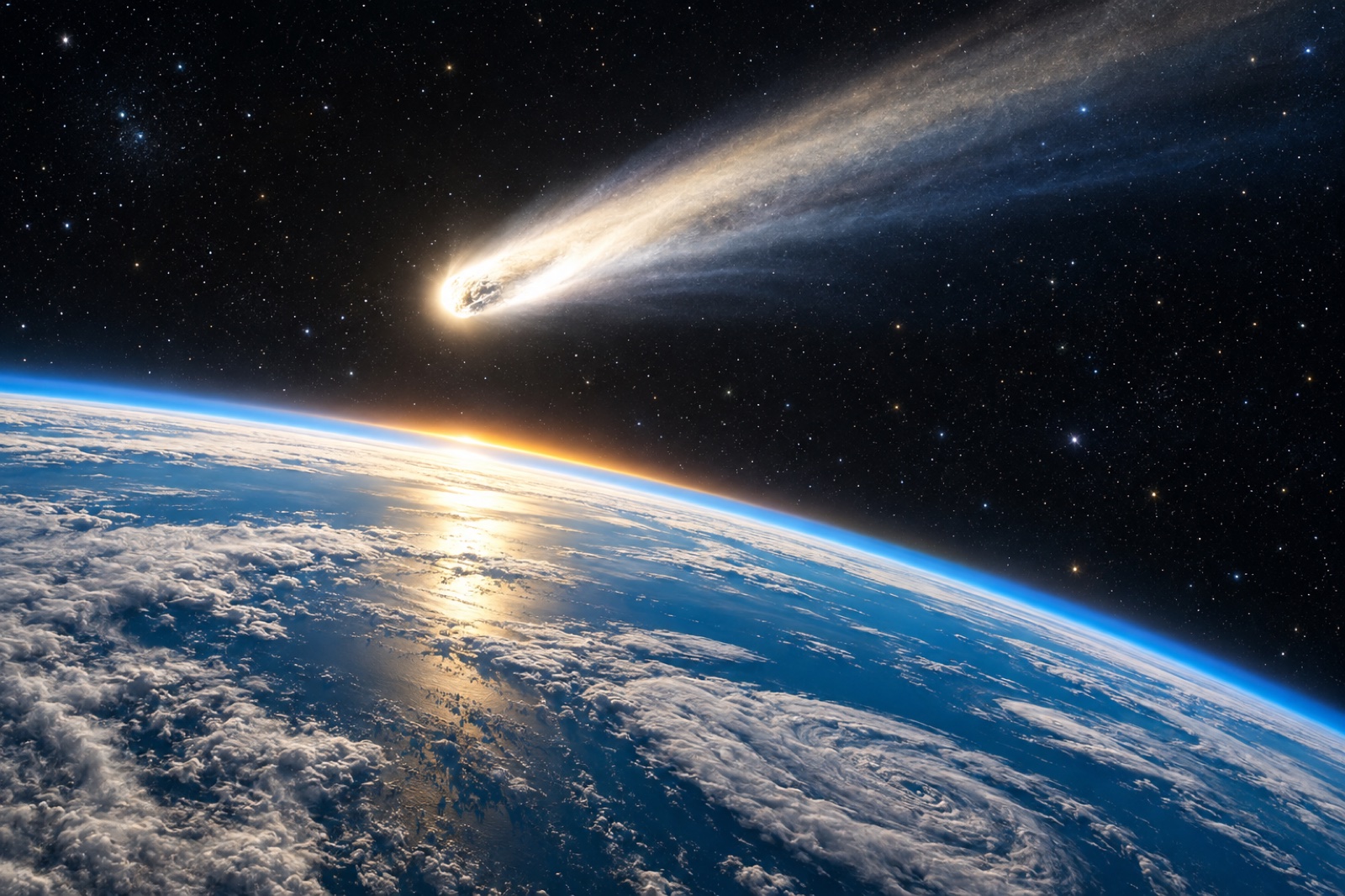
A comet does not pull up and park. It arrives fast, and usually at a steep angle, and the combination is brutal. The study found that at the speeds and angles comets really hit Earth, those fragile molecules would almost certainly be vaporised on impact. The delivery vehicle destroys the delivery.
Three further findings stack on top of that, and together they matter more than the first one:
- Even in the rare runs where some HCN came through, impacts delivering a useful amount were extremely uncommon.
- Comet impacts dropped off quickly during Earth’s first 500 million years, so there were only ever a handful of chances.
- Anything that did survive would not have stayed concentrated for long. It spreads out and thins away. So the next steps of the chemistry would have had to happen almost immediately.
That last point is the quiet killer. You do not just need the ingredient to arrive. You need it to arrive, stay thick enough to react, and then react in sequence, all inside a short window. Anslow described the best case as a one-off fluke.
The Same Scientist Already Worked Out When It Could Work
Here is the part that did not make the headlines, and it is the most interesting thing in the whole story.
This is not a sceptic knocking down someone else’s theory. In November 2023, the same lead author published a paper in Proceedings of the Royal Society A arguing that comets could deliver these molecules to rocky planets. The work of finding the conditions that make delivery possible was already done, by the same person.
That earlier paper named a speed limit. The comet has to be travelling below roughly 15 kilometres per second, which is still about 54,000 kilometres an hour, or the molecules break apart. And it described how a planet could get a slow comet: in systems where several planets sit close together, a comet can be tugged by one planet’s gravity and handed on to the next, losing speed each time, until it finally lands softly enough to matter.
So the 2023 work asked: where in the galaxy could this happen? The 2026 work asked the harder question: did it happen here?
And the answer, measured against those same criteria, was mostly no. Our solar system is not packed tightly enough to slow comets down that way. Earth sits behind a thick atmosphere. The comets that reached us came in too hot.
Publishing the conditions under which an idea would work, and then testing your own planet against them, is not a failure. It is the whole method working in public, which is rarer and better than it sounds.
What the Study Does Not Say
This is where it would be easy to overreach, so it is worth being exact.
The study does not say nobody knows how life began, and it does not say the chemicals had to come from nowhere. It tested one route: comets delivering HCN. The researchers are careful about this. Anslow said plainly, “We can’t rule out for certain that it happened that way.”
Two other routes are still standing, and the researchers point at both. Asteroids hit Earth far more often than comets do. And the precursors may simply have formed on Earth, out of what was already here, with nothing delivered at all.
There is also a sideways finding worth keeping. Mars is smaller and its atmosphere is much thinner, so a comet there is more likely to reach the surface intact. The team calls it a slightly more promising candidate, and then immediately pours cold water on it. In Anslow’s words: “This is not to say it definitely happened on Mars.” Slightly better odds on a very long shot are still a very long shot.
If you have followed this subject before, you will recognise the shape. A meteorite that turned out to hold more than 91,000 organic molecules and still no life. A single ice grain from one of Saturn’s moons that said less about that moon’s whole ocean than the headlines suggested. Every time, the ingredients are real. Every time, the recipe is missing.
Did Comets Bring Life to Earth? What Is Left of the Question
Honestly, the question moved rather than closed.
And that is the pattern you see when you line up a century of answers to “where did life come from”. Comets delivered it. Lightning in a warm pool made it. Deep-sea vents cooked it. Clay surfaces held it still long enough to assemble. Each one gets tested. Each one shrinks to a maybe. The question stands up again, slightly rephrased, and waits.
That can be read two ways. You can read it as a gap that will close eventually, and it might. Or you can notice that this particular question has been outlasting its answers for a very long time, and start to wonder whether it is a different kind of question than we assumed.
The Oldest Answer Is Not an Answer
There is a long poem, written thousands of years ago, that is usually read as a book about suffering. A man has lost nearly everything and spends most of it demanding an explanation. He has every right to one.
What he finally gets is not an explanation. God answers him with a tour of the natural world — the sea, the weather, the light, the wild animals that answer to nobody — and a long series of questions he cannot answer either. Where were you when the ground was laid out. Do you know how any of this holds together. He never does find out why. He stops needing to, which is stranger and more interesting.
For a book that old to handle the biggest question available by asking better questions back, rather than by naming a mechanism, is a genuinely odd choice. It also happens to be the posture a good scientist ends up in.
Wonder is not the consolation prize for failing to find an answer. It might be the accurate response.
Where That Leaves Us
Nothing about your week changes because comets probably did not seed the Earth. But something small is on offer here, and it is worth taking.
We are trained to treat “I don’t know” as an embarrassment, something to cover up quickly with the nearest confident-sounding guess. A Cambridge team just spent serious effort narrowing a beloved theory, said out loud that they cannot rule it out completely, and handed the question back in better condition than they received it.
That is not defeat. That is what honesty looks like when the subject is genuinely bigger than the people studying it.
Next clear night, go outside and look up for a minute. Nobody has closed this one. You are allowed to just find that remarkable.
Questions People Are Asking
Did comets bring life to Earth?
Probably not, according to a study published in Scientific Reports in October 2026 by a University of Cambridge team led by Dr Richard Anslow. Comets do carry molecules such as hydrogen cyanide that are useful for building life, but the modelling found comets strike Earth too fast and at too steep an angle for those fragile molecules to survive impact. The researchers describe successful delivery as exceedingly rare and say they cannot rule it out completely, but they consider it unlikely to be how life’s building blocks arrived.
What molecule did the comet study focus on?
Hydrogen cyanide, abbreviated HCN. It is a poison, and it is also one of the most important feedstock chemicals in origin-of-life research, because it can be built up into components of living cells. HCN is commonly found in comets in our solar system, which is why it has long been treated as the strongest candidate for something a comet could usefully deliver.
How fast is too fast for a comet to deliver life’s building blocks?
A 2023 paper in Proceedings of the Royal Society A by the same lead author found that a comet needs to be travelling below roughly 15 kilometres per second, around 54,000 kilometres per hour, for complex molecules to survive the impact. Above that speed the molecules break apart. That paper also described how tightly packed planetary systems can slow a comet down by passing it between planets, which is a condition our own solar system does not meet.
If comets did not deliver life’s building blocks, what did?
The study does not answer that, and it was not designed to. The researchers point to two routes that remain open. Asteroids strike Earth far more frequently than comets do and are therefore a live possibility. Alternatively, the precursor chemicals may have formed on Earth itself from materials already present, with nothing delivered from space at all. As of the 2026 study, the origin of life on Earth remains an unresolved scientific question.
Could comets have delivered life’s building blocks to Mars instead?
The Cambridge team found Mars to be a slightly more promising candidate than Earth, because Mars is smaller and has a much thinner atmosphere, so a comet is more likely to reach the surface with its cargo intact. They stress that it is still highly unlikely. Lead author Richard Anslow said, “This is not to say it definitely happened on Mars.”
Over to You
When a long-standing scientific explanation gets narrowed like this, does it make you trust science more or less? Some people read it as the system correcting itself honestly. Others read it as a sign the earlier confidence was never earned. We would genuinely like to know which way you lean — leave a comment and tell us.
Share This
- Comets were supposed to have delivered life’s ingredients to Earth. New Cambridge modelling says the molecules would not survive the landing. The best case, per the lead author: a one-off fluke. https://bgodinspired.com/index.php/bible-resources/bible-and-science/did-comets-bring-life-to-earth/
- Favourite detail in this: the scientist who just narrowed the comet theory is the same one who, in 2023, worked out the exact conditions under which it would work. Then the same team tested Earth against them. Earth mostly failed. https://bgodinspired.com/index.php/bible-resources/bible-and-science/did-comets-bring-life-to-earth/
- A century of answers to “where did life come from” — comets, lightning, deep-sea vents, clay. Each one tested. Each one shrinks to a maybe. The question keeps standing back up. https://bgodinspired.com/index.php/bible-resources/bible-and-science/did-comets-bring-life-to-earth/