 0
 0
On 29 October 2026, NASA asked the space industry a simple question. Can anyone lift the Hubble Space Telescope back up before it falls out of the sky?
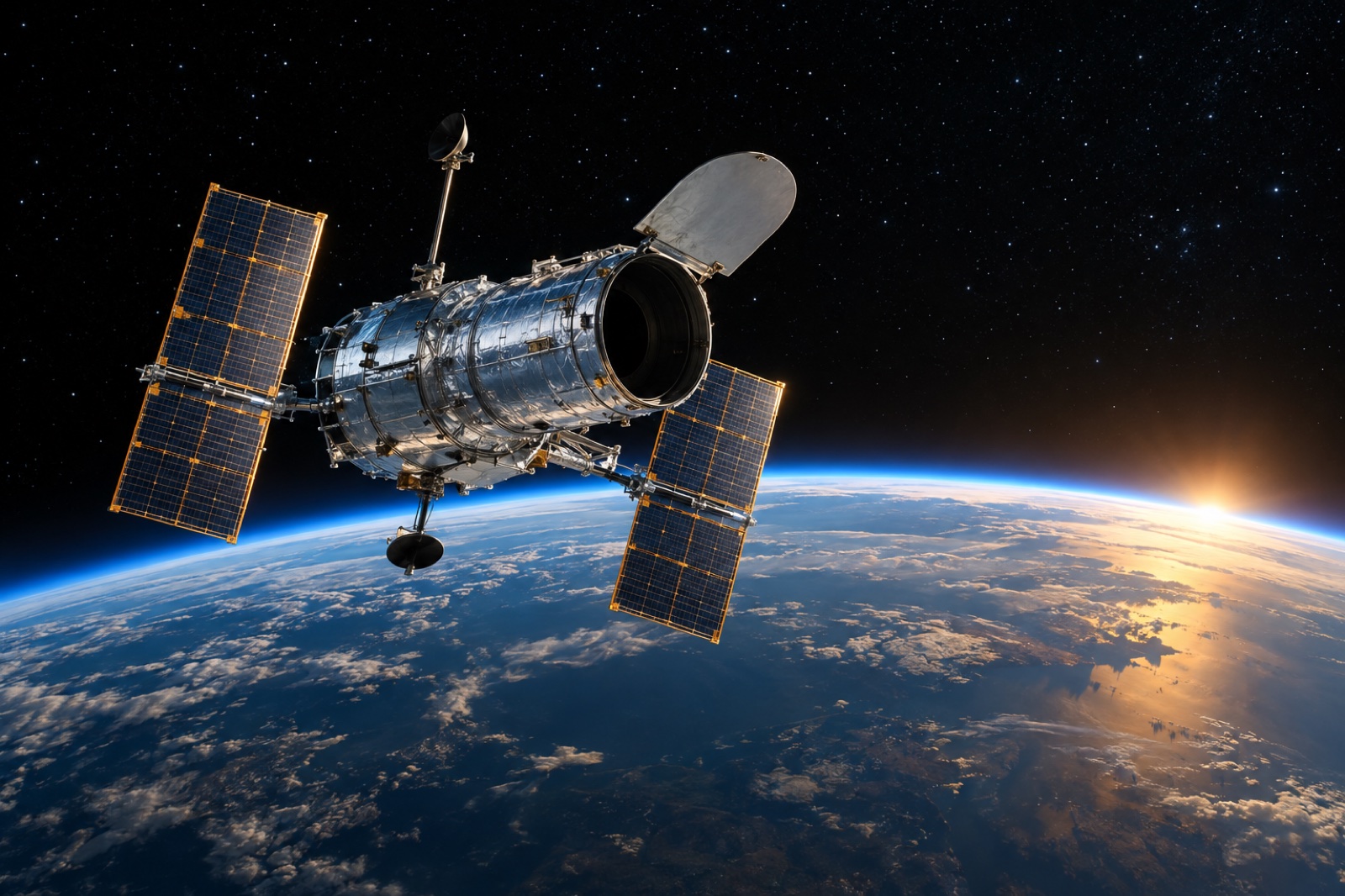
That is the Hubble reboost question, and the odd part is how plain the problem is. Hubble has no engine of its own. It cannot climb. It can only sink, a little at a time, and it has been doing that for decades.
Why Hubble Is Sinking
Hubble circles Earth at about 470 km up. That sounds like empty space, but it is not quite empty. A very thin trace of air still reaches that high, and it drags on the telescope like a hand held out of a moving car window. The drag is tiny. It never stops.
Every spacecraft that low has the same problem. Most carry fuel and small engines to push back. Hubble was built to be visited instead. Astronauts flew to it on the Space Shuttle to repair it and to lift it. Space Shuttle Columbia last raised its orbit, to 583 km, in 2002. The last visit of all was Space Shuttle Atlantis in May 2009. The shuttles are gone now, so nobody can make that visit.
What NASA Is Actually Asking
The request is a “request for information.” It is a question, not an order. NASA wants to hear three kinds of ideas: lift Hubble higher, service it, or bring it down safely. Companies have until 30 November 2026 to answer.
A few details matter here:
- A boost would need to reach at least 600 km, and it must not harm the telescope.
- Any mission would need to fly by 2032.
- NASA says it is not promising to buy a mission, and reports say no money has been set aside for one.
- In 2024, NASA decided not to pursue a reboost. This is a reopened question, not a finished plan.
NASA’s analysis points to a likely fall in 2033 or 2034, though one report puts a 10% chance of re-entry by September 2032. Other sources give different dates, so treat any single year as an estimate. The honest answer is “around the early 2030s, and sooner if the sun is stormy.”
NASA’s leader, Jared Isaacman, has said he wants to hear about innovative and cost-effective ways to extend the life of an asset that is already in orbit.
The Part Most Reports Skip
Here is the detail that stayed with me. The 2009 repair did something clever for exactly this day. Astronauts added a soft-capture mechanism, a fitting meant to give a future spacecraft something to grab. Someone fixed Hubble and, in the same visit, left a handle on it for a rescuer they could not name yet.
That handle sat unused for 17 years. The people who bolted it on did not know who would ever reach for it, or whether anyone would.
A rescue is also harder than it sounds. A robot would have to meet a fast, delicate telescope, grab it gently, and push without breaking anything. NASA has tried a rescue like this before, and it did not go smoothly. We wrote about the rescue spacecraft that broke, too, and about the Swift team that switched its falling telescope back on anyway.
Why Does It Matter If One Telescope Falls?
Because of what it has done. Hubble has been looking at the universe from above the air for over 30 years, and astronomers still use it. When it comes down, a lot of what it can see goes dark. Nothing else does quite the same job in the same light.
And there is something quietly human in the whole thing. We built a machine to last. It lasted longer than almost anyone expected. And now the question is not “how clever is it?” but “who can hold it up?”
Everything we build has this in it. Hubble is only the version you can see from the ground on a clear night. A bridge, a business, a plan, a body. Each one is made well and each one slowly loses height. None of them can lift itself. Almost every old idea about God starts at that same quiet fact, that what cannot hold itself up still seems to be held. Some people hear that and shrug. Some stay with it a little longer than they planned to. Either way, it is a hard thing to unsee once you have noticed it.
What Happens Next
After 30 November, NASA will read what comes back. It might be a few clever sketches. It might be nothing usable. The telescope will keep circling, lower each year, still sending back pictures of galaxies so far away that their light left before anyone was here to see it.
If you want another look at how strange it is to see our world from up there, try what astronauts see from space.
Discussion Question
Should the world spend money to keep an old telescope up, or save it for a new one? There is no wrong answer. Tell us what you think in the comments.
Share This
- NASA just asked the space industry to lift Hubble back up. It has no engine and has been sinking for decades. https://bgodinspired.com/index.php/bgodinspired-news/bgodinspired-science-news/hubble-reboost-nasa-asks-industry/
- In 2009 astronauts left a handle on Hubble for a rescuer they could not name. It has waited 17 years.
Questions People Ask About the Hubble Reboost
Why is the Hubble Space Telescope falling?
Hubble orbits about 470 km above Earth, where a very thin trace of air still drags on it. The drag is small but constant, and Hubble has no engine to push back, so its orbit slowly lowers.
What is NASA asking for in the Hubble reboost request?
On 29 October 2026, NASA asked industry for ideas to raise Hubble’s orbit, service it, or bring it down safely. Answers are due 30 November 2026. It is a request for information, not a promise to fund a mission.
When will Hubble fall out of the sky?
NASA’s analysis points to a likely re-entry in 2033 or 2034. One report gives a 10% chance by September 2032. These are estimates, and they change with the sun’s activity.
Can anyone still reach Hubble?
The Space Shuttle fleet has retired, so a new kind of spacecraft would be needed. The 2009 repair added a soft-capture fitting that is meant to make a future docking easier.