 0
 0
There is a kind of broke that has nothing to do with budgeting.
It is the kind where the money is gone and the people are gone too. Nobody to call. Nobody who would not be made uncomfortable by the asking. You have already been through every option twice, and the thinking has stopped producing new options. It just loops.
If that is roughly where you are, there is one verse people will quote at you. It gets printed on mugs and posted under hard news. So it is worth knowing what it actually says. Here is the plain Philippians 4:19 meaning — the sentence in its own setting, including the two verses right before it that almost nobody reads.
The promise has an address on it. And the people living at that address had less than you might think.
Philippians 4:19 Meaning: What the Verse Actually Says
Here it is in the King James Version:
“But my God shall supply all your need according to his riches in glory by Christ Jesus.” (Philippians 4:19, KJV)
Start with what is not in it.
There is no amount. No date. No method. The verse does not say the money will come, or the job, or the help, or when. It is a flat statement about who God is, pointed at a particular group of people.
And a sentence pointed at particular people is not the same as a sentence floating free. So the honest question is the one in the title of this article. Who was Paul writing to?
That answer is sitting two verses earlier, and it is strange enough that most people read straight past it.
Read Verse 17 First: Paul Will Not Call It a Gift
This whole section of the letter is a thank-you note. Paul was in chains, and a church had sent him money. He is writing back.
But watch how he handles the thanks:
“Not because I desire a gift: but I desire fruit that may abound to your account.” (Philippians 4:17, KJV)
He will not let it be a gift to him.
Read on and the language stays in the counting house. “I have all, and abound: I am full” (Philippians 4:18). A gift. An account. Fruit that abounds. Paul is writing them something closer to a receipt than a thank-you card.
And then, two sentences later, comes verse 19.
Line them up in order and the shape of it is hard to miss. They sent money they could not spare. Paul says: do not put that down as a payment to me, put it in your own account. Then he tells them who settles that account — and it is not him, because he has nothing. It is God, “according to his riches in glory.”
Verse 19 is not a blank cheque written to the world. It is the last line of a reckoning, and it is addressed to people who had just emptied their hands.
If you have met verse 13 of this same chapter on a locker-room wall, the same thing is going on there. We walked through it in what Philippians 4:13 actually means — the famous line sits in the middle of this identical thank-you note.
Who the Promise Was Written To
The letter is addressed “to all the saints in Christ Jesus which are at Philippi” (Philippians 1:1). Not to one person. To a whole congregation.
Philippi was a Macedonian city. Acts 16:12 calls it “the chief city of that part of Macedonia.” So the church there was one of the Macedonian churches — which matters, because Paul describes those churches somewhere else, and the description is blunt:
“How that in a great trial of affliction the abundance of their joy and their deep poverty abounded unto the riches of their liberality.” (2 Corinthians 8:2, KJV)
Deep poverty. Not a tight month. Not belt-tightening. That is Paul’s own word for the financial condition of the people who kept sending him money.
And here is the part that stopped me, because I had never noticed it. He says they had to talk him into taking it:
“Praying us with much intreaty that we would receive the gift, and take upon us the fellowship of the ministering to the saints.” (2 Corinthians 8:4, KJV)
Poor people, begging for the chance to give. Paul had to be persuaded to accept it.
Read that next to verse 19 and something turns over. These are not people who got the promise because their finances were in good order. Their finances were a wreck. Nothing in the letter says that ever changed. Paul does not tell them their poverty will end — he tells them God will supply their need, which is a different sentence, and he says it to people who had just made themselves poorer on purpose.
Philippians 4:19 was written to people who gave away money they did not have.
Why It Says “My God” and Not “Your God”
One more small thing, easy to read past.
Paul does not write “God shall supply.” He writes “my God shall supply all your need.” He is vouching. He is a man in chains with nothing in his hands, pointing at his own experience and saying: this is the One I have been doing business with, and I can tell you what God is like with an account.
Which raises the obvious question — where was he when he wrote it? The letter never says. He mentions “my bonds” (Philippians 1:13) and sends greetings from “they that are of Caesar’s household” (Philippians 4:22), and the traditional answer has long been Rome. But scholars have also argued for Ephesus and for Caesarea, and the question is genuinely unsettled. Anyone who tells you flatly which prison cell this was written from is more certain than the evidence allows.
What is not in dispute is the condition of the writer. He was a prisoner. He was dependent on other people for food. And he was the one writing the provision verse.
What This Means If You Have Nothing Left and Nobody to Ask
Here is where it lands, and it may not be where you expect.
Philippians 4:19 is not a promise that money is coming. If someone has taught you that enough faith produces funds, that teaching did not come from this verse, and it collapses the moment you read verse 17, where Paul refuses to treat money as a transaction at all.
But look at what the letter actually shows happening, because the letter is not theory. It is a live case.
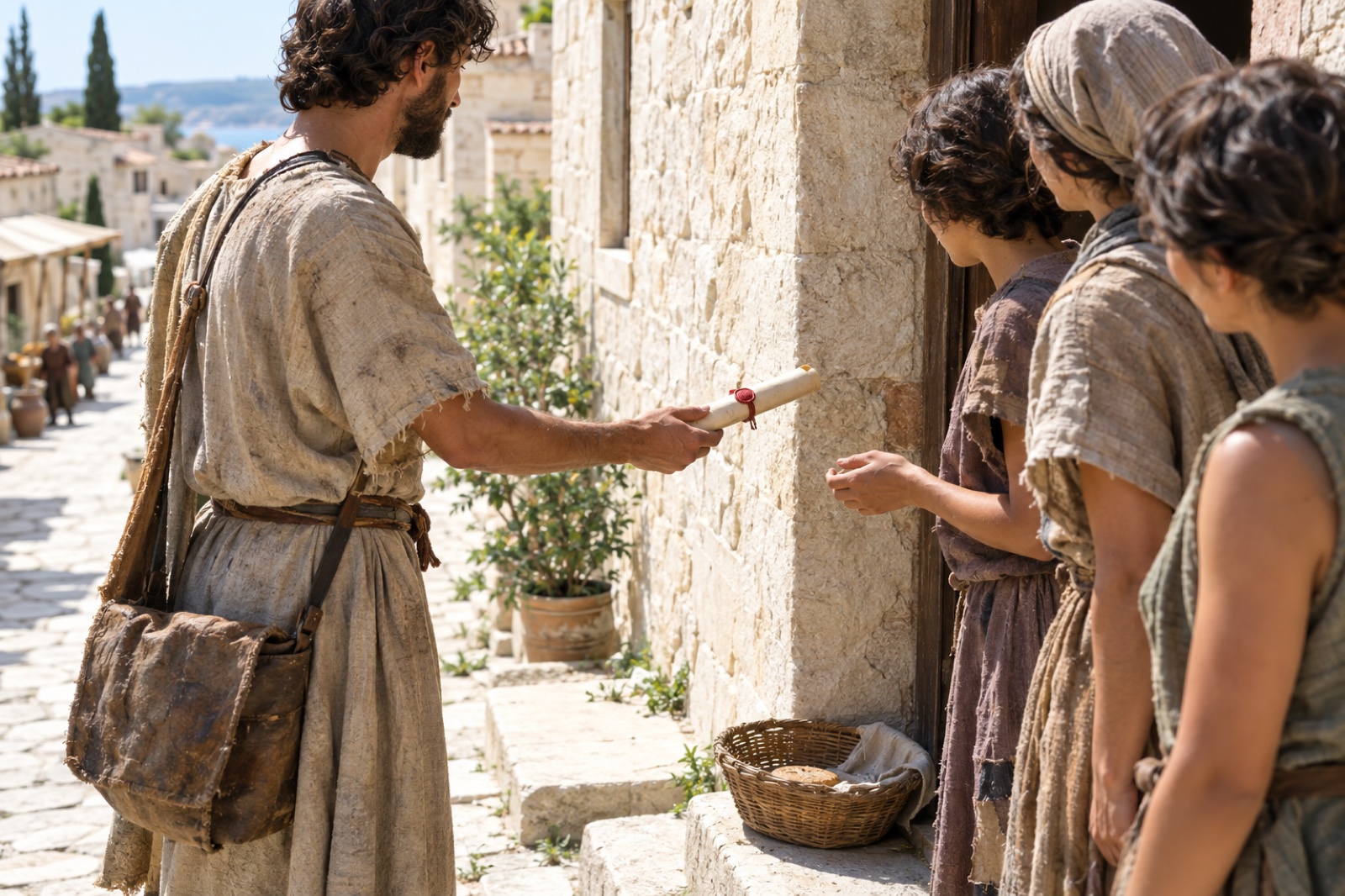
Paul had a need. God supplied it. And the supply did not fall out of the sky. It came in a parcel, carried on foot, sent by people who could not afford to send it.
That is the only mechanism this letter ever puts on display. Provision moved through people. Poor ones.
Which changes what you are looking for. If you have been waiting for the sky to open, you may have been watching the wrong place the whole time — and worse, you may have been discounting the help that did arrive, because it came with a human face on it and therefore did not count as God. A neighbour’s pot of food. Somebody covering a fare without being asked twice. This is the ordinary shape of it. Galatians 6:2 says to bear one another’s burdens, and that instruction only works if somebody is willing to be on the receiving end of it.
And there is a second turn, harder and better. The Macedonians were broke and still asked to be let in on the giving. Being the one with nothing did not disqualify them from being the channel. It is worth asking what you still have — an hour, a skill, a spare meal, a seat at your table — because the people in this story were poorer than you and still ended up on the supplying end.
Where a Person With No Money Actually Goes
This is not a benefits agency and it would be dishonest to pretend otherwise. But two things are true and worth saying plainly.
First: most local churches and community organisations hold some small fund, food store, or quiet list of people who help, and almost none of them advertise it. You generally have to ask. You ask by naming one specific thing — a meal, a fare, one bill, a week of a child’s school cost — not by asking for help in general. A named need can be met. “I’m struggling” usually gets sympathy and stops there.
Second: the asking is the part most people never do, and the reason is almost always shame rather than lack of options. The Philippians did the opposite of shame. They pleaded to be allowed to help. Somebody near you may be in exactly that position right now and simply does not know what you need.
If you want to sit with what scripture says about the specific thing you are carrying, the free What Does the Bible Say About What I’m Facing? tool will point you to passages for your situation in about a minute.
Actions to Take
- Read Philippians 4:15-19 out loud. It takes two minutes. Watch for the word “account” in verse 17, and notice that verse 19 arrives two sentences later. Read in that order, it stops sounding like a slogan.
- Write down the one specific thing you need this week. Not “help.” One thing with a name and a size. A meal. A fare. One bill. A week of someone’s school cost. Needs that have a shape can be met.
- Send that one sentence to one person today. This is the hard one, and it is the one that matters. In this whole letter, the supply never arrives except through somebody who was told.
Journaling Prompts
- Who is the person you have already decided you cannot ask — and when exactly did you decide that?
- If help has reached you through another person before, what did you count it as at the time?
- The Philippians had almost nothing and still wanted to be the ones giving. What do you still have that someone near you needs this week?
A Prayer
God, I am out of money and I am nearly out of people, and I have read this verse before without once believing it was written for me. I am not asking You to prove anything tonight. I am asking You to supply what I actually need, and I am willing for it to arrive through a person, even though asking frightens me more than the empty account does. Show me the one person to tell. And if any of this is meant to move through me toward somebody with even less, I am willing for that too.
Discussion Question
Do you think most people quote Philippians 4:19 as a money promise because they have genuinely misread it — or because that is simply the promise they most want to be true? Tell me what you think in the comments.
Share This
- Philippians 4:19 was written to a church Paul described as living in “deep poverty,” who had just given away money they did not have. It is not a verse about getting rich. It is a verse about who settles the account.
- I always read “my God shall supply all your need” as a promise that money was coming. Then I read the two verses before it. Paul refuses to call their gift a gift — he calls it fruit in their own account, and then names who pays out on it. Completely different verse once you read it in order.
- In the letter where the famous provision verse lives, God’s supply arrives as a parcel carried on foot by people who could not afford to send it. That is the shape of it. It usually has a human face on it.
Questions People Ask About Philippians 4:19
What is the meaning of Philippians 4:19?
Philippians 4:19 in the King James Version reads, “But my God shall supply all your need according to his riches in glory by Christ Jesus.” In context it is the closing line of a thank-you passage, Philippians 4:10-20, written by Paul to the church at Philippi after that church sent him money while he was a prisoner. The verse states that God will meet the needs of those believers, measured against God’s own riches rather than against their means. It names no amount, no date, and no method.
Is Philippians 4:19 a promise that God will give me money?
No. Philippians 4:19 promises that God will supply need, and it specifies neither money, nor timing, nor method. Two verses earlier, in Philippians 4:17, Paul explicitly refuses to treat the Philippians’ financial gift as a transaction: “Not because I desire a gift: but I desire fruit that may abound to your account.” Reading the verse as a formula in which faith or giving produces wealth runs against the passage it belongs to. In the letter itself, the need that gets supplied is Paul’s, and it is supplied through a gift carried to him by other people.
Who was Philippians 4:19 written to?
Philippians 4:19 was written to the church at Philippi, addressed in Philippians 1:1 as “all the saints in Christ Jesus which are at Philippi.” Philippi was a Macedonian city, described in Acts 16:12 as “the chief city of that part of Macedonia.” Paul describes the Macedonian churches in 2 Corinthians 8:2 as giving out of “deep poverty,” and in 2 Corinthians 8:4 says they urged him with “much intreaty” to accept their gift. The promise was written to a congregation of poor people who had just given money away.
Where was Paul when he wrote Philippians 4:19?
The letter to the Philippians never names the place. Paul refers to “my bonds” in Philippians 1:13 and sends greetings from “they that are of Caesar’s household” in Philippians 4:22, which establishes that he was a prisoner. Rome is the traditional identification, but scholars have also argued for Ephesus and for Caesarea, and the question remains genuinely unsettled. What the text does make clear is that the writer was in chains and dependent on others for his material needs.
What does “according to his riches in glory” mean in Philippians 4:19?
The phrase sets the standard of the supply. In Philippians 4:19 the measure is not the resources of the people receiving the promise, and not the resources of Paul, who was a prisoner with nothing. The supply is measured against God’s riches. For the original readers — a church Paul elsewhere calls poor — the practical force of the phrase is that their own empty hands are not the limit on what God can meet.