 0
 0
The phrase sounds like it ought to look like something. And when most people try to picture walking with Jesus, what arrives is a painting: a dirt road, robes, sandals, somebody a few steps ahead. It is a lovely image, and it is no use at all on a Wednesday.
The Gospels do answer the question, though, and their answer is stranger and far more ordinary than the painting. They tell you where Jesus went when the choice was His, and how often He went there. He had a usual spot. And one verse takes that unremarkable habit and makes it heavy.
The Gospel Writers Keep Noting the Usual Thing
There is a small phrase the King James translators reach for again and again, and almost nobody preaches on it. It shows up when Jesus walks into His hometown synagogue:
“And he came to Nazareth, where he had been brought up: and, as his custom was, he went into the synagogue on the sabbath day, and stood up for to read.” (Luke 4:16, KJV)
It shows up again when He crosses into Judaea and the crowds find Him:
“and, as he was wont, he taught them again.” (Mark 10:1, KJV)
“As he was wont” is older English for as was his habit. Read those two lines side by side and notice what the writers are quietly telling you. This was not a one-off. It was the normal thing, the repeated thing, the thing you could have predicted about Him if you had followed Him around for a month.
That is already a different picture than the painting. The road is not the point. The repetition is.
He Had a Place, and It Had a Name
Luke describes Jesus’ last week in Jerusalem with the flatness of a travel log:
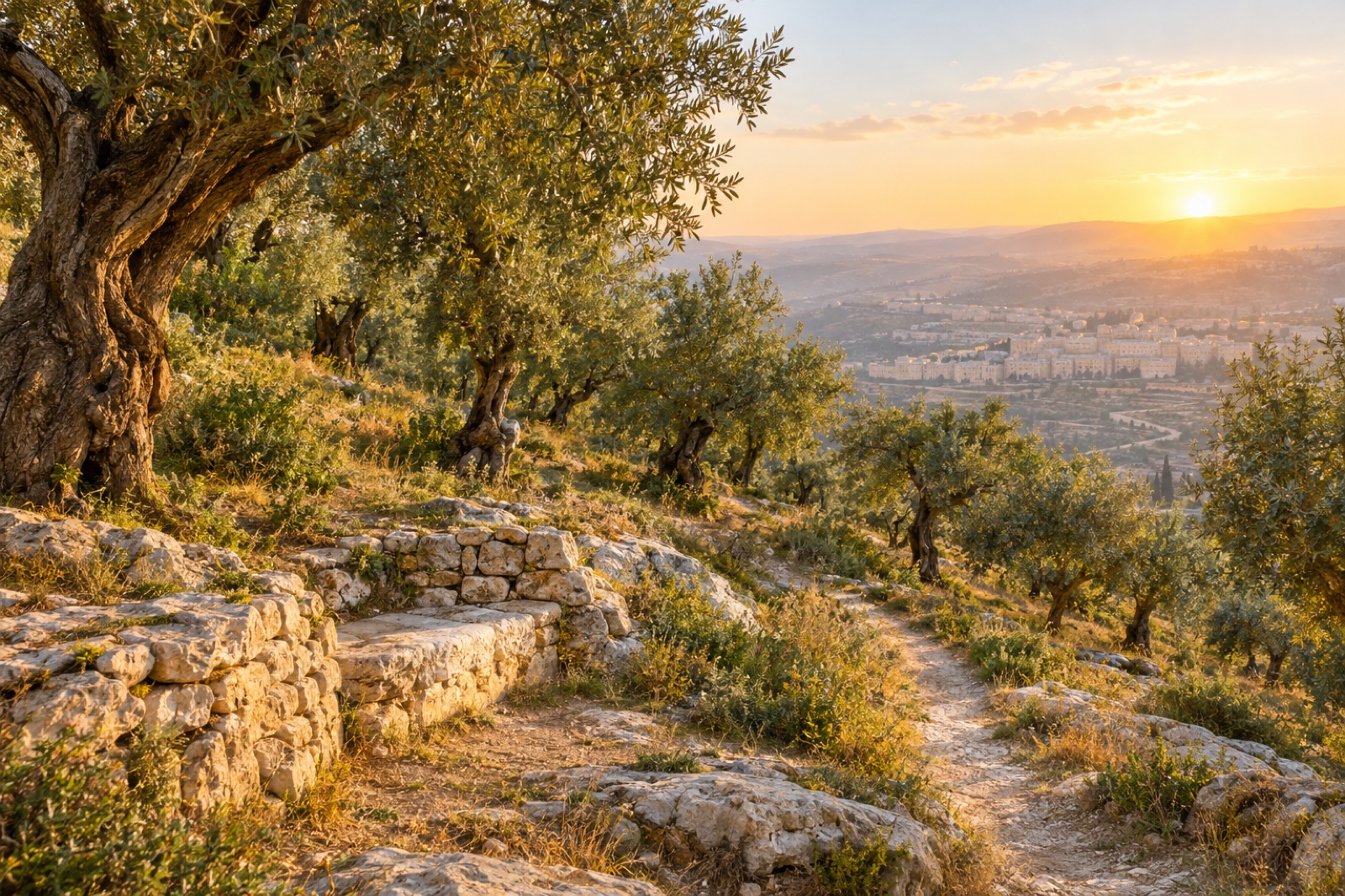
“And in the day time he was teaching in the temple; and at night he went out, and abode in the mount that is called the mount of Olives.” (Luke 21:37, KJV)
Days in the temple. Nights on the same hill. John describes the same rhythm from the other end: “Jesus went unto the mount of Olives. And early in the morning he came again into the temple” (John 8:1-2, KJV).
Then comes the night everything goes wrong, and Luke writes the sentence that makes the whole pattern visible:
“And he came out, and went, as he was wont, to the mount of Olives; and his disciples also followed him.” (Luke 22:39, KJV)
As he was wont. On that night, of all nights, Luke’s note is that Jesus did the usual thing. And a verse later Luke does not bother to explain which part of the hill: “And when he was at the place, he said unto them, Pray that ye enter not into temptation” (Luke 22:40, KJV). The place. Definite. Matthew is the one who gives it a name, “a place called Gethsemane” (Matthew 26:36, KJV), but Luke writes as if you would already know, because by then everyone in the story did.
The Line Most of Us Read Past
Here is where the habit stops being a cosy detail. John, telling the arrest, pauses to explain how Judas knew where to bring the soldiers:
“And Judas also, which betrayed him, knew the place: for Jesus ofttimes resorted thither with his disciples.” (John 18:2, KJV)
Read the reason John gives. Not a tip-off. Not surveillance. Judas knew the place because Jesus went there often. The routine is the mechanism. The most predictable thing about Jesus is precisely what made Him findable on the worst night of His life.
And that cuts both ways, which is the part worth carrying around. A habit is public. Because Jesus had a usual place, His friends always knew where He would be — and so did the man who sold Him. The same consistency that made Him easy to love made Him easy to betray. He kept it anyway. He went to the usual spot at the usual hour, and prayed there.
Nobody builds a routine like that for the feeling of it. He built it, by the Gospels’ own account, for the praying — and it was still standing on the night He needed it most.
So What Does Walking With Jesus Look Like?
Put the question to the only record we have of how Jesus Himself spent a day, and the answer comes back with three parts, none of them inspiring on paper.
A time: “And in the morning, rising up a great while before day, he went out, and departed into a solitary place, and there prayed” (Mark 1:35, KJV). A place: solitary, away, chosen in advance. And an activity, stated so plainly it is easy to skip — “he withdrew himself into the wilderness, and prayed” (Luke 5:16, KJV). Luke also records a night when He “went out into a mountain to pray, and continued all night in prayer to God” (Luke 6:12, KJV), so the habit clearly had room to stretch — but the baseline was small and repeatable.
That shape outlived Him, too. When Luke introduces Paul in a new city, he uses the same kind of phrase: “And Paul, as his manner was, went in unto them, and three sabbath days reasoned with them out of the scriptures” (Acts 17:2, KJV). The first generation of Christians learned the habit language from the person they had watched. It is also why the walking with Jesus scriptures describe a manner rather than a destination.
What Actually Changes in an Ordinary Week
Here is the practical shape of it, and it is smaller than you are expecting.
- Pick the place before you need it. Jesus did not find somewhere to pray in the middle of the crisis. He already had a spot. A chair, a car in a car park before the shift, a bench. Decide it once so you are not deciding it at 6:40 in the morning.
- Pick the time, and make it survivable. Ten minutes you will keep beats an hour you will abandon by Thursday. The point of a habit is that it costs nothing to begin.
- Let it be boring. A routine is not supposed to feel like anything. That is its whole advantage: it keeps running on the mornings you feel flat, which is the honest situation more often than anyone admits. We wrote about that specific emptiness in how to follow Jesus when you don’t feel anything.
- Expect it to be the thing that holds. By the second week you are not deciding whether. By the third you notice you are thinking about something He said while you are stuck in traffic.
And the honest part, because you deserve one: a routine is not a shield. Gethsemane was the hardest night of Jesus’ life, and the habit did not prevent one minute of it. What the habit did was put Him in the right place, already praying, before it started. People who love Jesus still get bad news. A daily walk does not buy you a protected life; it means you are not starting from nothing when the hard thing lands. That is also the thread in walking with Jesus starts with Him walking your way.
Thirty Days of Not Having to Decide
Almost nobody quits this because they stopped wanting it. They quit on day four, standing there with a whole Bible open and no idea what to read next. The deciding is the leak.
That is the only problem 30 Days Walking with Jesus was built to solve. It walks through the life of Jesus one day at a time, as a beginner-friendly reading plan through the Gospels, so tomorrow’s page is already chosen before you sit down. Each day takes under 10 minutes. You get 30 short devotional videos, each under 60 seconds, 30 full-chapter audio readings for the mornings your eyes will not focus, a complete PDF study guide with journal prompts, and 5 quick-reference scripture guides. If you would rather see the whole route first, the 30 days with Jesus reading plan is written out day by day.
And the ask, plainly: it is free. No payment, no card required, no upsell waiting on the other side. Instant access on any device, and it stays yours. The words of Jesus should not sit behind a paywall, so they do not.
Jesus had a usual place. You can pick yours tonight and be in it tomorrow.
Questions People Are Asking
Q: What does walking with Jesus look like day to day?
A: Judging by how the Gospels describe Jesus’ own days, it looks like a time, a place and a small repeated activity rather than a feeling. Mark 1:35 says, “And in the morning, rising up a great while before day, he went out, and departed into a solitary place, and there prayed.” Luke 21:37 describes His last week in Jerusalem as days teaching in the temple and nights on the mount of Olives. The striking thing is how unremarkable and repeatable it is: somewhere chosen in advance, returned to often enough that people knew where He would be.
Q: What does “as he was wont” mean in Luke 22:39?
A: “Wont” is older English for custom or habit, so “as he was wont” means “as was his habit.” Luke 22:39 reads, “And he came out, and went, as he was wont, to the mount of Olives; and his disciples also followed him.” The King James Version uses similar phrases elsewhere: “as his custom was” when Jesus enters the Nazareth synagogue in Luke 4:16, and “as he was wont, he taught them again” in Mark 10:1. Each one is the writer noting that what Jesus just did was the normal, repeated thing.
Q: How did Judas know where to find Jesus in the garden?
A: John gives the reason directly. John 18:2 says, “And Judas also, which betrayed him, knew the place: for Jesus ofttimes resorted thither with his disciples.” Judas did not need information from anyone; he knew the spot because Jesus went there regularly. Luke 22:39 notes that on that same night Jesus went to the mount of Olives “as he was wont,” and Matthew 26:36 names the spot “a place called Gethsemane.”
Q: Where did Jesus go to pray?
A: The Gospels describe Him choosing solitary places, and returning to them. Mark 1:35 has Him leaving before dawn for “a solitary place.” Luke 5:16 says, “And he withdrew himself into the wilderness, and prayed.” Luke 6:12 records a night when He “went out into a mountain to pray, and continued all night in prayer to God.” During His final week, Luke 21:37 says He spent the nights on the mount of Olives — the hillside He goes out to in Luke 22:39, where Matthew 26:36 names the spot “a place called Gethsemane.”
Q: How do I start a daily habit of walking with Jesus?
A: Decide the place and the time once, in advance, and keep the daily portion small enough that you will still do it on a bad morning. Ten minutes you will actually keep is worth more than an hour you abandon within a week. It also helps to remove the daily decision about what to read, since that is what most often ends a good intention by day four. The free 30 Days Walking with Jesus plan is a beginner-friendly route through the Gospels that takes under 10 minutes a day, with no payment or card required.