 0
 0
A woman of twenty-nine asks Ae-sun’s grandmother to come with her to a photo studio. She needs somebody there while the picture is taken — the formal one, the one that will stand beside a coffin.
She is not sick in any way the neighbours can see. She is a diver, and the diving has done what the diving does.
The show does not stop on this. No swelling music tells you to notice. Jeon Gwang-rye arranges her own funeral portrait the way you would arrange a new roof, and the scene moves on.
If you want the When Life Gives You Tangerines ending explained, that photo studio is where to start. Everything the finale does, fifteen hours later, is an answer to a bill that was quietly run up in that room.
The 2025 Netflix series, written by Lim Sang-choon and directed by Kim Won-seok, runs one woman’s whole life across sixteen episodes in four volumes. Oh Ae-sun, born on Jeju in 1951, from a girlhood spent wanting to be a poet to an old age on the same island. IU plays her young; Moon So-ri plays her middle-aged. Park Bo-gum and Park Hae-joon split her husband, Yang Gwan-sik, the same way. It took Best Drama and Best Screenplay at the 61st Baeksang Arts Awards, and most people who finish it describe the experience as being wrung out.
What almost nobody mentions is that the show’s real subject is an accounting problem. Not love. Not grief. Arithmetic.
A thank-you in a language that is dying
The Korean title is 폭싹 속았수다 — pokssak sogatsuda. It is not standard Korean. It is Jeju, and it means roughly “you have worked so hard.” The thing you say to somebody at the end of a day that cost them something.
Here is the part that should stop you.
In standard Korean, that same sound lands on the ordinary verb for being deceived. To a mainland ear, the title of this show can be heard as you were thoroughly fooled. It is a false friend — one phrase, two completely different sentences, depending on which language you happen to be listening in.
Both of them are the plot.
And then there is what has happened to the language itself. UNESCO classified Jeju’s language as critically endangered in 2010. The people who still speak it fluently are overwhelmingly in their seventies and older — which is to say, Ae-sun’s generation. The exact people the title is addressed to.
So the thank-you only decodes properly in a language that is dying along with the people being thanked. Say it in the language their children actually speak and it comes out sounding like an accusation of having been conned.
That is a very hard joke, and the show put it on the cover.
What the diving actually costs
The haenyeo are real, and in this series they are not a metaphor.
Women free-dive the water off Jeju with no air supply at all. No tanks, no hose. They go down around ten metres, hold roughly a minute, surface, and go again — up to seven hours in a day, about ninety days a year, gathering abalone and sea urchin. Some of them are still doing it in their eighties.
There is a sound they make coming up. The sumbisori: a long whistle of held breath being let go. It is the sound of a woman who has just spent every bit of air she had and now has to start again.
UNESCO added the culture of the Jeju haenyeo to its list of the intangible heritage of humanity in 2016.
Gwang-rye dies in 1961, at twenty-nine, of the diving sickness. Fifty-five years before anybody called it heritage.
Hold those two dates next to each other, because the show does. The last stretch of the series opens a museum for the haenyeo. The woman whose lungs paid for it has been dead for decades and will not be at the ribbon-cutting.
The honour arrives. It just arrives after.
The narrator is describing a decade she was not alive for
Now look at who is telling you all this.
Yang Geum-myeong — Ae-sun and Gwan-sik’s daughter, born in 1968 — is the series’ narrator, and the episodes are framed by her looking back from her fifties. IU plays her too.
Which means the first four hours of this show are a woman narrating her own mother’s childhood. The 1950s. Seven years before she exists.
That is not a storytelling convenience. That is the whole premise, hidden in plain sight. What you are watching is a woman in her fifties going back over a life that happened a metre away from her for decades and was never once explained to her, and filling it in herself. The form of the show is the act of doing the accounting.
And the series is honest about why it has to be reconstructed rather than simply remembered. Nobody told her. Gwan-sik sells his fishing boat — the family’s long-term income — to get their son Eun-myeong out of jail. He sells his cabbage field to put money behind his wife’s restaurant. None of it is ever presented to the children as a sacrifice. It is just what happened to the boat.
Korean fiction has been circling this for a while. Kim Jiyoung, Born 1982 does the ledger version of it, flat and clinical and unbearable. Kokoro does the version where the accounting arrives in a letter that can only be read once the writer is beyond answering. This show does the version where the person doing the sums is the daughter, and she started forty years late.
When Life Gives You Tangerines ending explained: the face behind the desk
Late in the series, Ae-sun — seventy now, widowed — stands at the water and talks to her mother, the way she did as a child. She wonders out loud whether her mother got born into a better life than the one she had. Something easier. Something out of the sea.
It is the kind of thing people say at gravesides. It is not supposed to be answered.
Then the show answers it.
Ae-sun’s poems finally become a book. The chief editor who takes it on is called Chloe H. Lee. And the actress playing her is Yeom Hye-ran — the same actress who played Jeon Gwang-rye.
The face that went into the water at twenty-nine comes back at the end of this series dry, indoors, and in charge. No wetsuit. A desk. The authority to say yes to somebody’s poems.
The show never states what that means. No character points at it. It is done entirely in casting, which is exactly why it lands on the audience instead of on the characters. Ae-sun cannot see it. We can.
That is the engine of the whole ending. Nothing in the plot repays Gwang-rye. Nothing can — she has been dead sixty years and she died owed. So the series pays her in the only currency a story has left by then. It gives her face the thing her daughter wished for her, in a scene her daughter will never get to watch.
The show is named after one line of a poem
Gwan-sik dies of cancer. Before he does, he gets to see one of Ae-sun’s poems in print. It is dedicated to him. Its closing line — “here’s to all you’ve been through” — is also the title of the final episode, and the English rendering of the show’s own Korean name.
So the title of this series is not the narrator’s summary of events. It is a line written by a girl who was never allowed to finish school, about her husband, published when she was old.
The only person in sixteen hours who gets to say the title out loud is the one character everybody had agreed was never going to be a poet.
What Ae-sun is doing at the water’s edge
There is a very old instruction about parents, and the strange thing about it is the verb.
It does not say love them. It does not say feel grateful. It says honour — and the Hebrew word underneath that, kabbed, comes from a root that means heavy. Weighty. The command is not about warmth at all. It is about mass. Treat them as something with weight.
The other odd thing is the clause bolted onto it: honour your father and your mother, so that your days may be long (Exodus 20:12). It is the one instruction in that list that comes with a note about time.
Which reads differently once you have watched this show. If the point were simple gratitude, you would want it prompt. You would want it said on the day. Instead the whole thing is framed in the register of long time — of years, of the slow pile-up of days — as though whoever wrote it already knew that this particular debt gets noticed late. In your fifties. Out loud. To somebody who cannot hear it.
That is precisely what Geum-myeong is doing for sixteen episodes, and precisely what Ae-sun is doing at the water’s edge. Neither of them is settling up. You cannot settle up: the person is gone and the cost was never itemised. What they are doing is refusing to let the work stay weightless. They are giving it mass. They are saying what it was, in the only language that has a word for it.
The series never tells you this is a sacred category. It just makes it one for sixteen hours and lets you sit in it.
The last thing the show gives her
By the closing stretch Ae-sun has a book in her hands with a dedication inside about every day having been spring, and a museum down the road for the women who went under the water. She teaches reading and writing at a nursing home on Jeju to people who never got the chance — which is, in the quietest possible way, her mother’s plan for her carried one generation further than her mother could carry it.
The sea is still there. It took her mother at twenty-nine and it is on a heritage list now, and both of those are true at once, and the show has no interest in resolving them.
What it has instead is a sentence in a language most of its viewers do not speak, which means: you have been through so much. It is addressed to a second person. It is the only line in the whole thing pointed outward.
If you want another Korean series that hides its real argument in its structure rather than its dialogue, Hellbound does something similar with a thing it refuses to show you.
One Question
Do you read Chloe H. Lee as Gwang-rye genuinely come back, or as the show simply refusing to let that face go? I go back and forth on it depending on the day. Tell me which way you land — and if you think the casting was meant to be noticed at all.
Share This
Nobody warned me that the editor at the end of When Life Gives You Tangerines is played by the same actress as Ae-sun’s mother. The show answers a 70-year-old woman’s wish in casting instead of plot, and she never finds out. Still not okay.
The Korean title of When Life Gives You Tangerines is Jeju for “you’ve worked so hard.” In standard Korean the same sound reads as “you were fooled.” UNESCO calls Jeju’s language critically endangered — the fluent speakers are mostly over seventy. The thank-you is dying with the people it’s for.
Realised halfway through When Life Gives You Tangerines that the narrator is describing her mother’s childhood — a decade she wasn’t alive for. It isn’t a framing device. It’s a woman in her fifties finally working out what the life next to her actually cost.
Q&A About When Life Gives You Tangerines
What does the ending of When Life Gives You Tangerines mean?
The ending of When Life Gives You Tangerines resolves a debt that cannot actually be repaid. Ae-sun’s mother, the haenyeo Jeon Gwang-rye, dies at twenty-nine having spent her health so her daughter would never have to dive. Decades later Ae-sun stands at the sea and wonders whether her mother was born into a better life. The series answers her through casting rather than plot: the chief editor who finally publishes Ae-sun’s poetry collection is played by Yeom Hye-ran, the same actress who played Gwang-rye — dry, indoors, with the authority her mother never had. Ae-sun never sees the connection. Only the audience does.
What does the title When Life Gives You Tangerines mean in Korean?
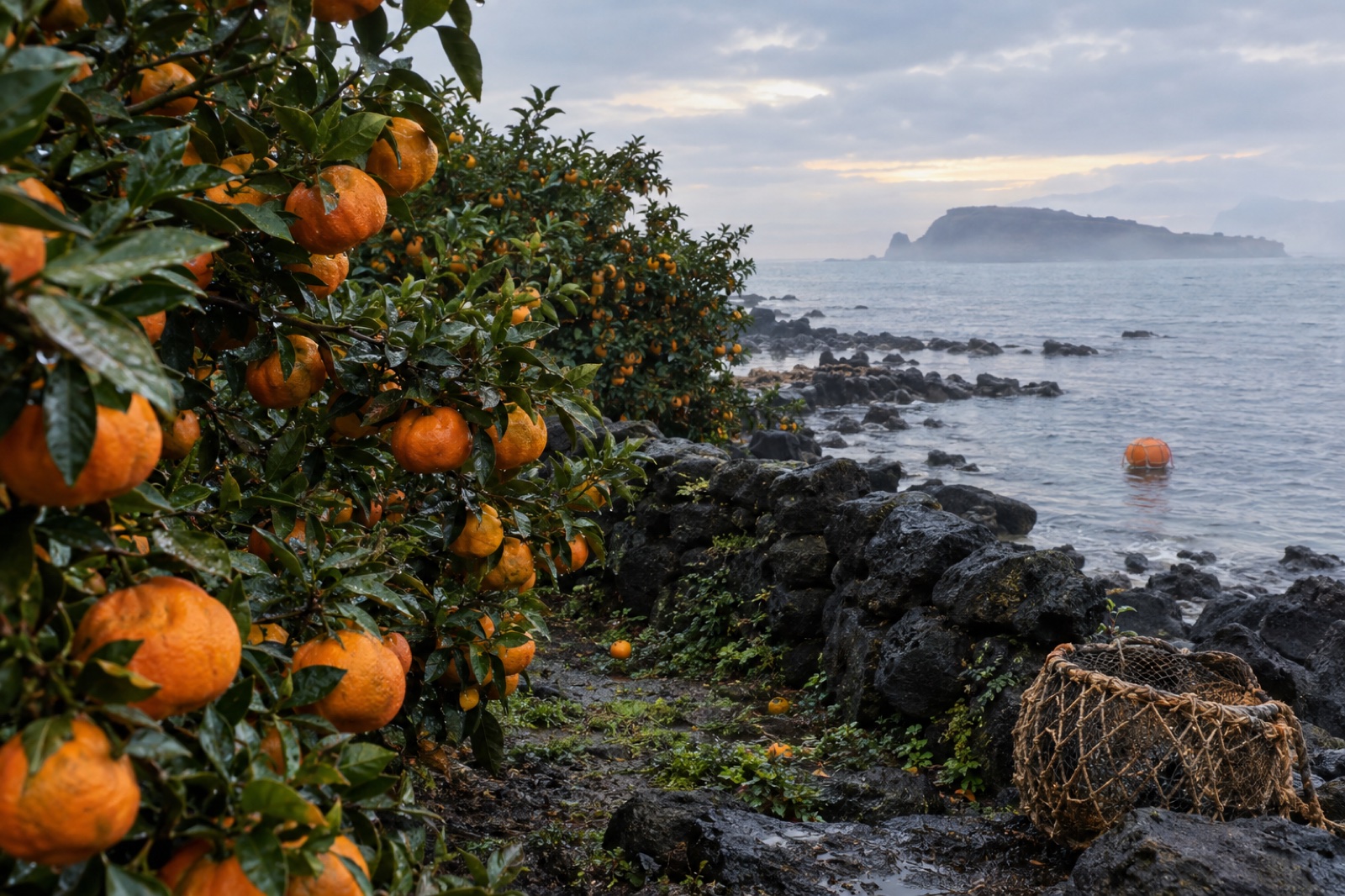
The Korean title of When Life Gives You Tangerines is 폭싹 속았수다 (pokssak sogatsuda), a Jeju-language phrase meaning roughly “you have worked so hard” or “thank you for all your hard work.” It is a false friend: in standard Korean the same sound maps onto the verb for being deceived, so it can be misheard as “you were thoroughly fooled.” The English title plays on the lemons-and-lemonade proverb, swapped for the mandarin oranges that Jeju actually grows.
Is When Life Gives You Tangerines based on a true story?
No. When Life Gives You Tangerines is an original story written by Lim Sang-choon for Netflix, not an adaptation of a book or a biography. Its setting is historically real — the haenyeo women divers of Jeju Island, whose culture UNESCO added to its intangible heritage list in 2016, and the economic hardship of Jeju from the 1950s onward — but Ae-sun, Gwan-sik and their family are invented characters.
Who plays the editor at the end of When Life Gives You Tangerines?
The chief editor Chloe H. Lee, who publishes Ae-sun’s poetry collection near the end of When Life Gives You Tangerines, is played by Yeom Hye-ran — the same actress who plays Ae-sun’s mother, the haenyeo Jeon Gwang-rye. Many viewers read the appearance as Gwang-rye reborn into the easier life Ae-sun wished for her. The series itself never says so out loud; it simply casts the same face and lets you notice.
What happens to Ae-sun’s mother in When Life Gives You Tangerines?
Jeon Gwang-rye, Ae-sun’s mother in When Life Gives You Tangerines, is a war orphan and a haenyeo — one of Jeju’s free-diving women. She dies in 1961 at the age of twenty-nine from worsening diving sickness, having worked herself into the ground specifically so that Ae-sun would never become a diver and could chase being a poet instead. Before she dies she arranges her own mortuary portrait and asks the family to look after her daughter.