 0
 0
Nobody on the road can tell him where the fort is.
That is how Dino Buzzati’s The Tartar Steppe begins. Giovanni Drogo, newly commissioned as a lieutenant, rides out of the city toward his first posting, and the people he asks along the way either do not know the Bastiani Fortress or will not quite admit it exists. When he finally reaches it, the first officer he talks to, Captain Ortiz, has been there eighteen years. The fort, Ortiz says, has never been of any use.
Drogo decides he will stay four months. Then he will get a doctor’s certificate and leave.
Most people looking for the Tartar Steppe meaning have already guessed how that goes. The book is famous for it. What is less often noticed is how Buzzati makes you feel it, and that is where this reading starts.
A Fort Built to Face Nothing
Buzzati published the novel in Italian in 1940 as Il deserto dei Tartari. In English it has gone by two names: The Tartar Steppe, in Stuart C. Hood’s translation, and The Stronghold, in Lawrence Venuti’s. Same book. Same fort.
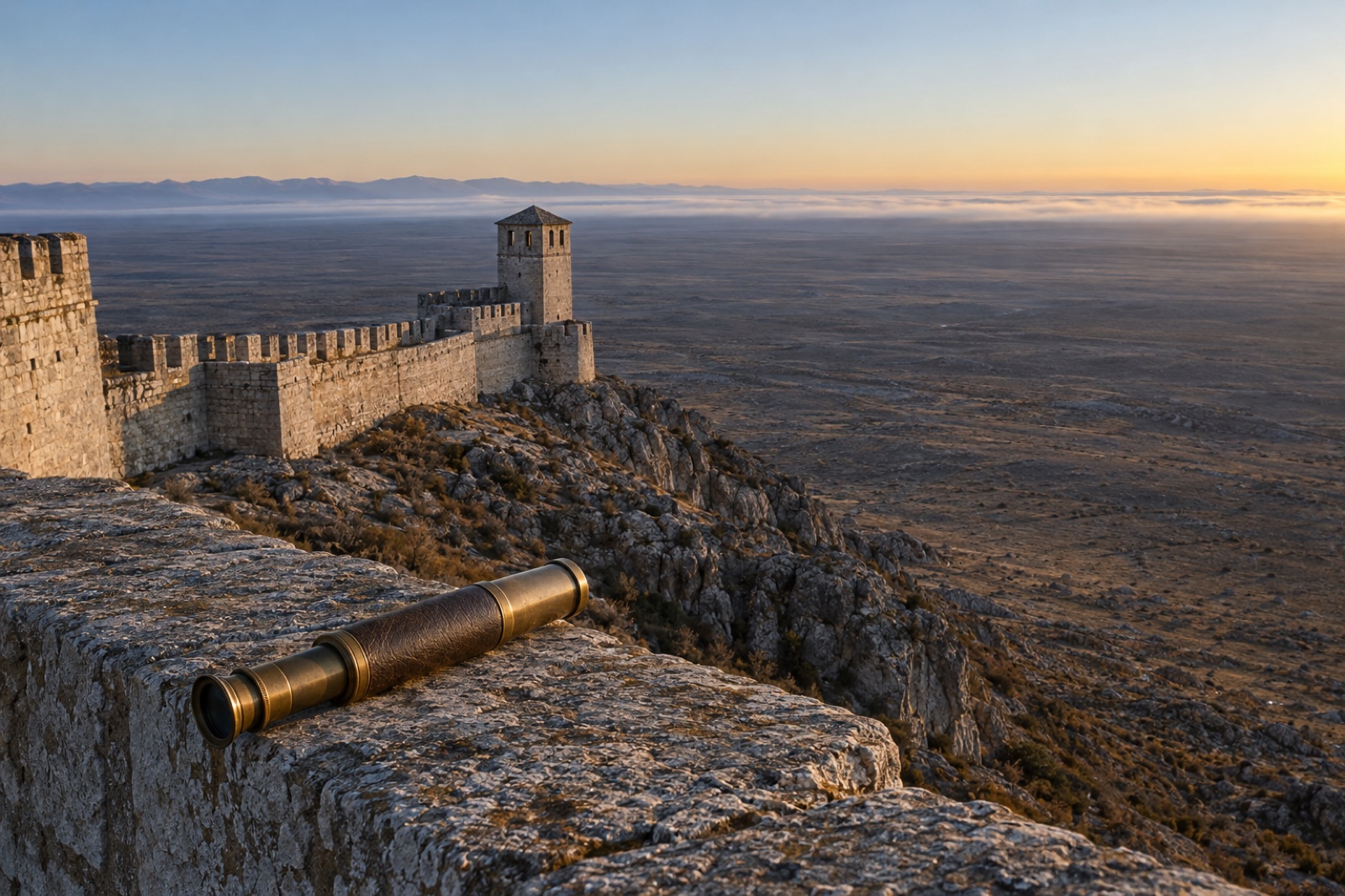
The Bastiani Fortress sits on a mountain frontier above a great stony plain. Somewhere beyond the plain is the Northern Kingdom. Somewhere in the stories the officers tell, there were once Tartars. Nobody has seen any.
And yet the whole garrison runs on the hope that one day something will come out of that desert. A war. A chance to be brave in front of witnesses. The thing that will make all the years of guard duty mean something after all.
Buzzati himself said the book probably began in the newsroom of the Milan newspaper Corriere della Sera, where he worked for years. It is easy to see why. A newsroom is a place full of people waiting for the big story. Buzzati moved that feeling to a military frontier, where waiting can at least wear a uniform.
The four months end. The doctor is ready to sign. Drogo looks at the fort and does not go. He cannot quite say why, and the book does not make him.
The Things That Almost Happen
What keeps Drogo there is not boredom. It is the near misses.
About two years in, a riderless horse appears on the plain below the New Redoubt. For one night it looks like a sign. It turns out to belong to a soldier from the fort’s own watch, who goes down to fetch it, comes back without the password, and is shot dead by a sentry from his own side. Nobody wins anything. A rule is kept.
Next morning a line of movement crosses the horizon. Troops. The fort wakes up. They turn out to be peaceful units from the Northern Kingdom, marking the border. Things settle back down.
Then a detachment climbs into the mountains to watch the frontier markers, and a snowstorm comes in. The northern troops already hold the summit. Lieutenant Angustina, already ill, plays cards with his captain out in the cold rather than look beaten in front of the other side. When the captain finally goes for shelter, Angustina will not follow. He dies there in the snow, with something like style. Drogo will remember it for the rest of the book.
Every one of these is almost the thing. That is the trap. If nothing ever happened, Drogo would leave. Because something nearly happens every so often, he stays to see the real one.
The Book Speeds Up As You Read It
Here is the part worth noticing, and the part most summaries skip.
Roughly the first two-thirds of The Tartar Steppe covers about four years of Drogo’s life. You know every corridor of that fort. You learn the officers’ habits, the passwords, the angle of the light on the plain. Each event gets room to breathe.
Then a lieutenant named Simeoni sees work going on far out in the desert. The Northern Kingdom is building a road. It is slow work, and Buzzati lets it be slow. And in the space of a page or two, fifteen years go by.
After that the book does not slow down again. Drogo becomes a captain, then a major. His mother dies. When he goes home on leave, the city does not know him and he does not know the city. On the road back he meets a new young officer, Moro, on his way up to the fort, and sees himself. He thinks about warning him. He doesn’t.
By the last chapters Drogo is fifty-four, second in command, and ill. The final thirty years take up less of the book than the first four did.
That is not a pacing mistake. It is the whole argument. Buzzati has built the novel so that you feel time the way Drogo feels it. Early on, a day is long and full of detail and there is plenty of it. Later, a decade is a paragraph. You do not notice it happening to you, because you are reading, and he does not notice it happening to him, because he is waiting.
That is what makes the book hit harder than a plain warning about wasted time. You were not told. You were shown, at the same speed he was. Like Ben Okri’s circling road, the shape of the book is the meaning, and the thing readers sometimes call a flaw turns out to be the design.
What the Ending Gives Him
Then, of course, it comes.
The road the Northern Kingdom spent all those years building finally carries soldiers. Battalions are on their way. The thing the fort was built for, the thing Drogo gave his life to wait for, is coming down that road.
And Simeoni, now the commandant and supposedly his friend, sends him away. Drogo is too sick to fight, and his room is needed for three new officers. He is driven down the mountain in a carriage, past fresh troops marching up toward the battle he waited for. One of them makes a dry remark about how comfortably he is travelling.
He stops for the night at an inn. From the window he cannot see the fort, or even the mountains. And there, alone, in a rented room, he understands that the real enemy has arrived. Not the Northern Kingdom. Death. It is not going to come with witnesses or a bugle. It is going to come here.
Buzzati could have ended on the cruelty of it, and plenty of readers take it that way. But that is not quite what the last page does. Drogo thinks of Angustina in the snow. He straightens up in his chair. He fixes his collar. And he smiles into the dark.
He gets his battle after all. It is just not the one he was looking at.
Numbering the Days Instead of Counting Them
Drogo is good with numbers. Four months until the certificate. Two months of leave. Eighteen years for Ortiz. Fifteen years for the road. He is always counting, but always counting toward something. The days themselves are just the price of the thing at the end.
There is an old prayer that sees the same trick in time that Buzzati saw. It is a psalm, the only one traditionally credited to Moses, a man who spent forty years in a desert himself. It says our years are gone like a story already told. It says a thousand years are like yesterday once they have passed. And then it asks for one thing: “teach us to number our days, that we may gain a heart of wisdom” (Psalm 90:12).
Numbering is not counting down. It is the opposite. It means looking at the day you are in and seeing that it is one of a limited number, which makes it worth something now, not later. Drogo’s whole life is counted. None of it is numbered.
The psalm also starts somewhere the novel never does. Its first line calls God a dwelling place, a home through every generation. Drogo’s home is a fortress, a building whose only purpose is to face outward and wait. The psalm asks for a heart that can live inside the day. The fort only knows how to look past it.
And what is quietly moving about Buzzati’s ending is that Drogo does learn it, very late. In the inn, with the battle somewhere else and nobody watching, he finally treats the moment in front of him as the one that counts. The heart of wisdom arrives in a rented room on the last page. The book does not pretend that was worth thirty years, and it does not take it away from him either.
Why It Still Lands
It is easy to read The Tartar Steppe as a book about soldiers, or about bureaucracy, or as a cousin of Kafka. It works better as none of those. It is a book about what a person does with the time before the thing they are waiting for, and it is hard to finish without counting your own.
The fort is still there at the end, facing the plain. Someone younger is on the walls now, watching the road. Buzzati never tells us whether Moro left after four months. He doesn’t have to. The book has already shown us how long four months can last.
If you like novels that make their meaning out of structure rather than speeches, Season of Migration to the North hides its whole argument in one locked room, and it rewards the same kind of slow reading.
Questions Readers Ask About The Tartar Steppe
What is The Tartar Steppe by Dino Buzzati about?
The Tartar Steppe (Il deserto dei Tartari, 1940) is a novel by the Italian writer Dino Buzzati about Giovanni Drogo, a young lieutenant posted to the remote Bastiani Fortress on a frontier facing a vast desert plain. The garrison lives on the hope that an enemy from the north will one day attack and give their service meaning. Drogo plans to stay four months but stays for decades, held by near misses and by the hope of glory, until he is old and ill. The novel is widely read as a story about waiting, ambition and the way a life can pass while it is being postponed.
What does the ending of The Tartar Steppe mean?
At the end of The Tartar Steppe, the enemy Drogo waited for his whole life finally marches on the Bastiani Fortress, but by then he is fifty-four and seriously ill, and the commandant Simeoni sends him away to make room for new officers. Alone in an inn, unable even to see the fort, Drogo realises that death is the real enemy he must face, with no witnesses and no glory. He remembers his friend Angustina’s dignified death in the snow, straightens himself and smiles into the dark. The ending is often read as tragic, but Buzzati also lets Drogo meet the moment with courage, so the battle he waited for does arrive, just not the one he expected.
Do the Tartars ever come in The Tartar Steppe?
No Tartars ever appear in The Tartar Steppe. The Tartars are a half-legend the officers of the Bastiani Fortress keep alive about the desert beyond the frontier. What eventually comes is the army of the Northern Kingdom, which spends about fifteen years building a road across the plain and finally sends battalions along it toward the fort. By the time the attack arrives, Giovanni Drogo has been sent away because of his illness, so he never sees the battle he waited for.
Is The Stronghold the same book as The Tartar Steppe?
Yes. The Stronghold and The Tartar Steppe are two English translations of the same Italian novel, Dino Buzzati’s Il deserto dei Tartari, first published in 1940. The Tartar Steppe is Stuart C. Hood’s translation and The Stronghold is Lawrence Venuti’s. The story, the characters and the Bastiani Fortress are the same in both.
Why does time speed up in The Tartar Steppe?
In The Tartar Steppe, Dino Buzzati spends roughly the first two-thirds of the novel on about four years of Giovanni Drogo’s life, then lets fifteen years pass in a page or two, and covers the rest of his life in quick strokes. The acceleration is deliberate: it makes the reader experience time the way Drogo does, with early days that feel long and full, and later decades that vanish unnoticed while he waits for something to happen.
One Question
When Drogo meets young Moro on the road and sees his own younger self, he thinks about warning him and says nothing. Was that kindness, cowardice, or the only honest thing he could do? I keep changing my mind. Tell me how you read it in the comments.
Share This
The Tartar Steppe spends about two-thirds of its pages on four years of Drogo’s life. Then fifteen years go by in a page or two. Buzzati does not tell you time is slipping. He makes it slip on you while you read.
Drogo counts everything in The Tartar Steppe: four months, two months’ leave, fifteen years for the road. He never once numbers a day. Counting is waiting for the next thing. Numbering is seeing that today is one of a limited number.
The enemy finally comes down the road to the Bastiani Fortress, and Drogo is sent away sick before he can see it. Then, alone in an inn, he meets the real enemy with a straight back and a smile. He got his battle. It just was not the one he was watching for.