 0
 0
There is a particular kind of tiredness that comes from trying to be good enough for God.
You give more. You serve more. You show up on days you did not want to show up. And somewhere underneath all of it sits a quiet question you never quite say out loud: is that enough yet? Because if you are honest, nobody has ever told you where the line is. So you keep raising your own offer, hoping that one day the feeling of falling short will finally go quiet.
That exact tiredness is what Micah 6:8 was written to answer. Not as a poster. As a verdict.
Micah 6:8 Explained: The Verse Is the End of a Court Case
Micah 6:8 almost never appears with the eight verses in front of it. That is the whole problem, because those eight verses are a courtroom.
The chapter opens with a summons: “Hear ye now what the LORD saith; Arise, contend thou before the mountains, and let the hills hear thy voice” (Micah 6:1). Then the charge is read out loud: “for the LORD hath a controversy with his people, and he will plead with Israel” (Micah 6:2). The word there, controversy, is legal language. A case. A dispute brought before witnesses — and the witnesses called are the mountains, because they have been standing there the whole time and have seen everything.
Then something happens that almost nobody expects. God speaks first, and God speaks as the defendant.
“O my people, what have I done unto thee? and wherein have I wearied thee? testify against me.”
Micah 6:3, KJV
Read that again slowly. God opens the trial by inviting the accusation. Tell me where I wore you out. Say it. I will stand here while you do. That is not the tone of someone about to hand down an impossible standard. It is the tone of someone who already knows the relationship has gone strange and wants to hear why.
The Bidding War in Verses 6 and 7
The people answer. And their answer is not an argument. It is an auction.
“Wherewith shall I come before the LORD, and bow myself before the high God? shall I come before him with burnt offerings, with calves of a year old? Will the LORD be pleased with thousands of rams, or with ten thousands of rivers of oil? shall I give my firstborn for my transgression, the fruit of my body for the sin of my soul?”
Micah 6:6-7, KJV
Watch the bid climb. It starts somewhere ordinary — burnt offerings. Then it gets more expensive: calves a year old, animals at their most valuable. Then it stops being realistic at all: thousands of rams. Ten thousands of rivers of oil. Nobody on earth has ever had ten thousand rivers of oil. That is not a plan. That is panic doing arithmetic.
And then the last bid, the one that should stop the room cold: shall I give my firstborn. A child. That is where the escalation ends up when nobody knows what the price is — eventually somebody offers the thing they love most, because surely that would settle it.
This is the question verse 8 is answering. Not “what is the meaning of life.” Something far more desperate: how much will it take to make this right?
What Micah 6:8 Actually Says
“He hath shewed thee, O man, what is good; and what doth the LORD require of thee, but to do justly, and to love mercy, and to walk humbly with thy God?”
Micah 6:8, KJV
Start with the first three words, because they are doing more work than the famous part. He hath shewed thee. Past tense. This is not new information being handed down. It is old information being pointed at again. The reply to the bidding war is not a higher price — it is a reminder that the answer was already given, a long time ago, and the people shouting offers across the courtroom already had it.
Then three things, and in Hebrew each one is sharper than the English makes it sound.
Do justly
The Hebrew pairs a plain verb for doing with the noun mishpat — judgment, a legal ruling, the right call. It is not a feeling about fairness. It is the act of giving somebody what they are actually owed. In a courtroom chapter, that word choice is not an accident.
Love mercy
The word behind “mercy” here is chesed — one of the heaviest words in the Hebrew Bible. It is not pity, and it is not being nice. It is loyal love that keeps showing up long after the relationship stops requiring it. We looked at it closely in the Hebrew word for loving-kindness, and it changes this line completely: the instruction is not do mercy. It is love it. Want it. Be the kind of person who is glad when someone gets a break they did not earn.
Walk humbly
Here is the detail almost nobody mentions. The Hebrew word translated “humbly” appears only twice in the entire Hebrew Bible. Once here. And once in a short line about pride:
“When pride cometh, then cometh shame: but with the lowly is wisdom.”
Proverbs 11:2, KJV
Two appearances in the whole collection. One is a warning about pride, and the other is this. Whatever that word means, it is not a common mood that drifts in and out. And notice it is attached to a verb of motion — walk. Not feel humble. Not think humble thoughts. Walk. It is a way of moving through a day, which means it is something your feet do and not only something your heart manages. If you want the wider picture of how Scripture treats this, what the Bible says about humility is a good next stop.
The Part Nobody Quotes: Verses 10 to 12
If Micah 6:8 were only a beautiful summary of the good life, the chapter could have ended there. It does not. Two verses later, the same voice gets extremely specific about what “do justly” had failed to mean in that town:
“Are there yet the treasures of wickedness in the house of the wicked, and the scant measure that is abominable? Shall I count them pure with the wicked balances, and with the bag of deceitful weights?”
Micah 6:10-11, KJV
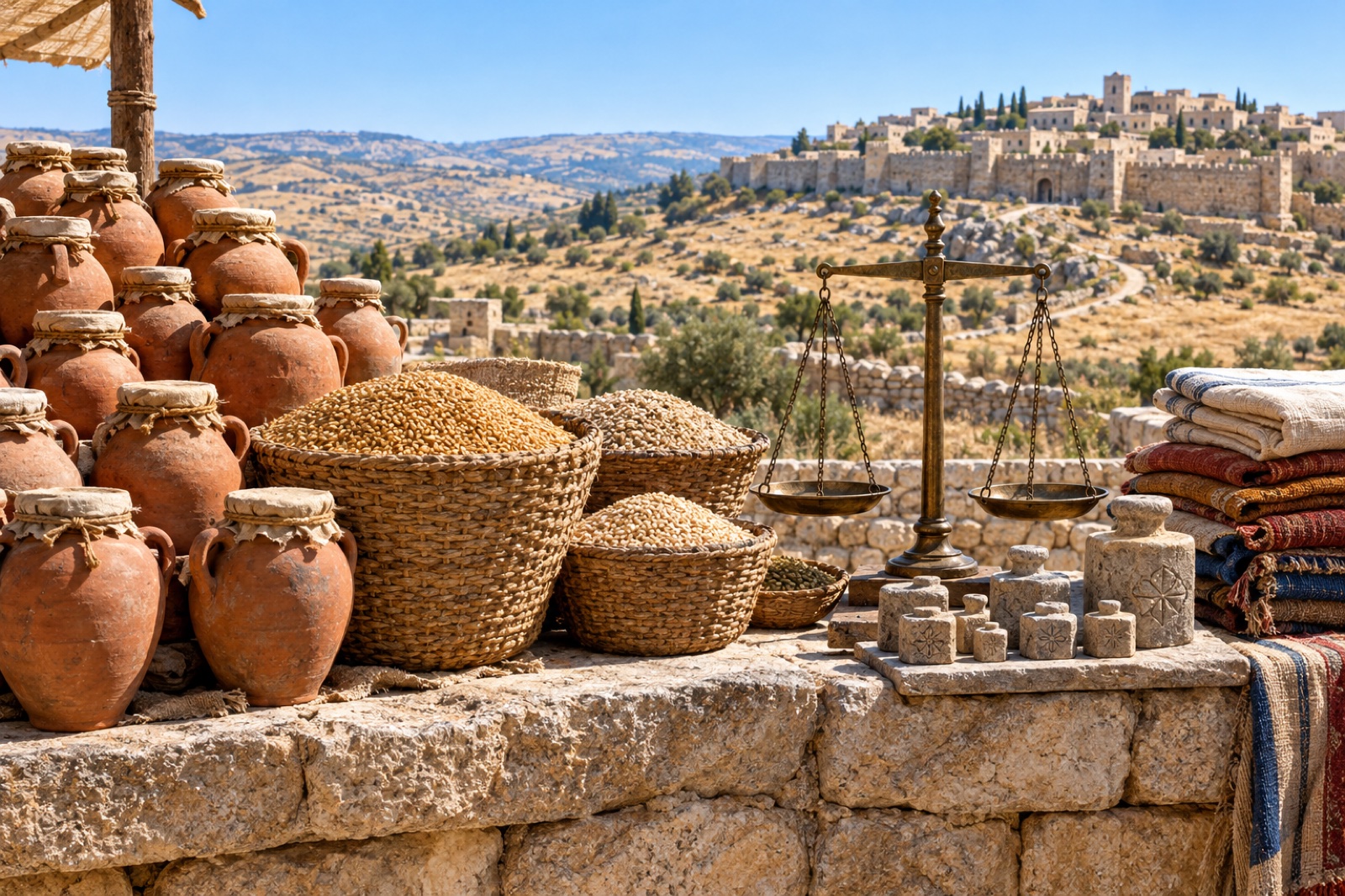
Rigged scales. A short measure. A bag of weights that lie. This is not grand national injustice — it is market-stall cheating, the kind that shorts a poor customer by a handful of grain and nobody notices. Then verse 12 names who was doing it: “the rich men thereof are full of violence.” Not strangers. The people doing well.
That is the thing almost no one carries away from this verse. “Do justly” had an address. It lived in the weights people used at work. The same thing happens two chapters earlier with Micah’s famous line about swords and plowshares — the half everyone quotes and the half nobody does, which we unpacked in what swords into plowshares really means.
Why the Answer Feels Smaller Than the Question
Here is what makes this verse land differently once you have read the whole scene.
The people wanted a big answer, because a big answer is easier. Ten thousand rivers of oil is a crushing price, but at least it is a price — pay it once and you are done, and you never have to change anything about how you weigh grain on an ordinary Tuesday. A huge sacrifice can be a way of avoiding a small honesty.
What came back was smaller and much harder. Give people what they are owed. Love it when mercy happens. Walk through your day without needing to be above anyone. Nothing in that list can be paid off on a Sunday and left there. All of it happens in the place where you actually live — the counter, the queue, the message you were about to send, the person you could quietly short by a little and nobody would know.
And the whole thing is framed by he hath shewed thee. The tiredness of trying to be good enough is not usually a shortage of information. It is almost always a shortage of rest in what we already knew.
A good place to start: The Beginner’s Guide to Feeling God’s Presence Every Day — a short, simple way to notice God in the ordinary hours, not only the big ones. Get the free guide. Free.
Three Things to Do With This Today
- Find your own scale. Take two minutes and name the one place where you quietly give a little less than is owed — minutes at work, attention at home, the full truth in a reply. Just name it. You do not have to fix it in the same two minutes.
- Let one mercy happen without comment. Today, somebody will get away with something small — a late reply, a forgotten thing, a mistake that costs you a little. Let it go without the sentence that makes sure they know you let it go.
- Correct one weight. Pick the smallest unfair thing you named in step one and put it right this week: send the money back, give the honest number, say the harder sentence. Small and real beats large and imagined.
Questions to Sit With
- When you imagine God being satisfied with you, what does the picture require of you — and where did that picture come from?
- Micah 6:8 attaches humility to walking rather than feeling. What would be different about tomorrow if you only had to change how you moved, not how you felt?
A Prayer
God, I am tired of guessing the price. I have been offering bigger and bigger things, and I think I have been doing it partly so I would not have to change the small ones. Show me the weights I am using. Help me give people what they are actually owed, and help me want mercy instead of just allowing it. And teach me to walk with You today without needing to stand above anybody. Amen.
One Question for You
Why do you think a huge sacrifice is so much easier for people to imagine than a small, daily honesty? Share your thoughts in the comments — this one is worth talking through together.
Share This
- Micah 6:8 is not a poster. It is the last line of a court case where frightened people kept raising their offer — thousands of rams, rivers of oil, finally a child — and the answer came back smaller and much harder than the question.
- “He hath shewed thee.” Three words before the famous part, and they change everything. The answer was never withheld. It was just never as expensive as we assumed.
- The word translated “humbly” in Micah 6:8 shows up only twice in the whole Hebrew Bible. And it is attached to a verb of motion — walk. Not a mood. A way of moving.
Micah 6:8 Questions and Answers
What does Micah 6:8 mean?
Micah 6:8 states that God has already shown people what is good, and that what God requires is to do justly, to love mercy, and to walk humbly with God. In the King James Version it reads: “He hath shewed thee, O man, what is good; and what doth the LORD require of thee, but to do justly, and to love mercy, and to walk humbly with thy God?” It is the closing answer in a courtroom scene that runs from Micah 6:1 to 6:8, in which the people ask how large an offering it would take to satisfy God.
What is the context of Micah 6:8?
Micah 6 is written as a legal dispute. In verses 1 and 2 the mountains and hills are summoned as witnesses because, as the text says, “the LORD hath a controversy with his people.” In verse 3 God speaks first and invites the accusation: “O my people, what have I done unto thee? and wherein have I wearied thee? testify against me.” In verses 6 and 7 the people respond by escalating a series of offerings, ending with a firstborn child. Verse 8 is the reply to that escalation.
What does “do justly” mean in Micah 6:8?
The Hebrew behind “do justly” combines a common verb for doing or making with the noun mishpat, meaning judgment or a right legal ruling. Micah 6 defines it concretely only two verses later, where the complaint is about “the scant measure,” “the wicked balances,” and “the bag of deceitful weights” — short measures and rigged scales used in everyday trade. In Micah’s setting, doing justly meant honest weights in the market, not an abstract attitude toward fairness.
Why is the word “humbly” in Micah 6:8 unusual?
The Hebrew word translated “humbly” in Micah 6:8 appears only twice in the entire Hebrew Bible. Its single other appearance is Proverbs 11:2: “When pride cometh, then cometh shame: but with the lowly is wisdom.” The rarity matters because the word is paired with a verb meaning to walk, which frames humility as a way of moving through ordinary life rather than as a passing feeling.
Is Micah 6:8 a summary of the whole law?
Micah 6:8 is often described that way, and it does gather several major themes of the Hebrew prophets into one line. The verse itself does not claim to replace or summarize the law; it says that God “hath shewed thee” what is good, pointing back to what was already known rather than announcing something new. Read in context, it functions as the answer to a specific question — how much would it take to satisfy God — rather than as a standalone ethical formula.