 0
0
 0
0
You have probably already tried the thing that was supposed to work.
The medicine. The appointment. The advice from someone who loves you. You did what you were told, you waited, and the ache was still there in the morning.
It is a strange kind of tired. Not the tired of doing nothing. The tired of doing everything and still not being well.
There is a man in the Bible who felt exactly that, and he asked a question about it that people still quote 2,600 years later: “Is there no balm in Gilead?”
Most of us hear that as poetry. It was not poetry. He was asking about a product. A real one. Something a trader carried on a camel, that you could buy, keep in a jar, and put on a wound.
And a study published this month makes that question sharper than it has been in a long time.
Scientists Made Stone Age Tree Tar and Tested It on Wound Bacteria
In 2026, a team led by Tjaark Siemssen — working across the University of Cologne, Oxford, the University of Liege and Cape Breton University in Canada — published a study in the journal PLOS One with a simple question behind it.
Neanderthals made a sticky black tar out of birch bark. We already knew they used it as glue. Could it also have worked as medicine?
So the team made some. Six batches, from two kinds of European birch, using methods reconstructed from what Stone Age people could actually have done — bark heated in a sealed pit with the air shut out, bark burned so the vapour condensed on a hard surface, and one modern version as a control.
Then they tested it against two bacteria. Staphylococcus aureus, which is behind a lot of ordinary skin and wound infections. And Escherichia coli.
Here is what they found, exactly as they found it.
Against Staphylococcus aureus, most of the tar did something. The authors describe the overall effect as moderate. One batch was clearly the best of them. One batch did nothing at all.
Against E. coli, not one sample worked. The researchers report no measurable effect from any of them.
And for scale: the modern antibiotic they tested alongside the tar cleared a zone roughly three times wider than the best batch of tar managed.
The researchers themselves are careful, and they deserve to be quoted carefully. They do not claim Neanderthals treated wounds with this. They say only that the material those people could make had properties that could have been useful. They tested it in a dish, not on skin. They ran no safety testing. They call their own study exploratory and say more work is needed.
So the honest summary is this. The oldest medicine we can reliably rebuild works. A bit. On some things. Not reliably.
Hold that sentence. You will need it in a minute.
What Was the Balm of Gilead?
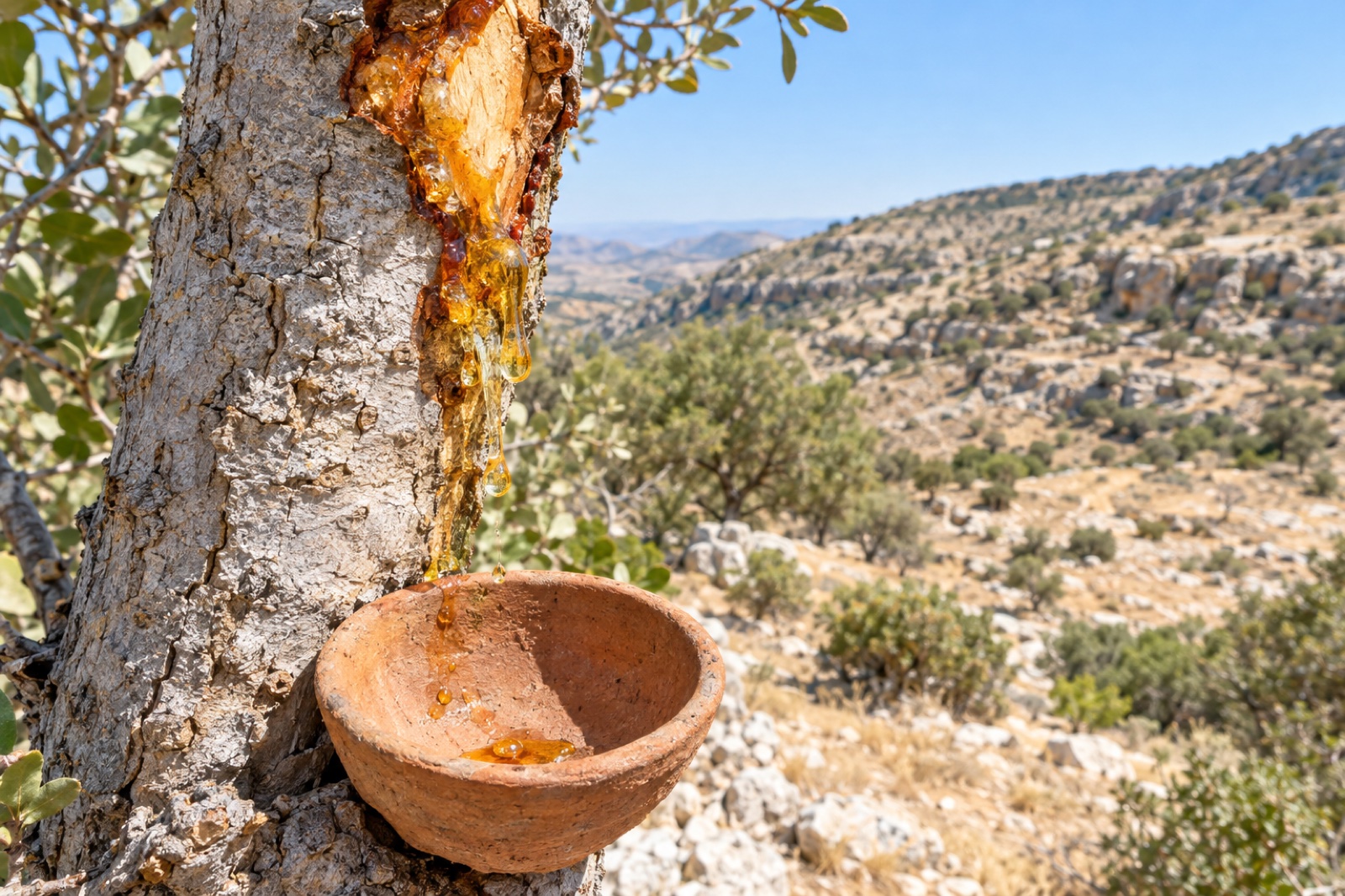
The balm of Gilead was the same kind of thing: a resin that seeps out of a tree when the bark is cut.
It shows up early in the Bible. In Genesis 37:25, the brothers who have just thrown Joseph into a pit sit down to eat, look up, and see traders going past — “a company of Ishmeelites came from Gilead with their camels bearing spicery and balm and myrrh, going to carry it down to Egypt.”
Notice what balm is in that sentence. Cargo. It is loaded on a camel next to the spices, on its way to market.
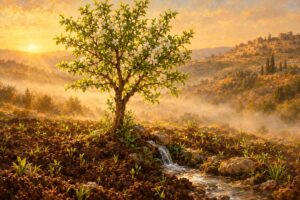
Gilead was the hill country east of the Jordan River, in what is now the country of Jordan. Its balm was a trade good, and a famous one. The Hebrew word is tsori, and it carries the sense of something that flows or drips — which is exactly what resin does.
By Jeremiah’s day, “go to Gilead and get balm” was the obvious thing to say to someone who was hurt. It was the first thing you reached for. Which is why, later, Jeremiah can use it as a bitter joke: “Go up into Gilead, and take balm, O virgin, the daughter of Egypt: in vain shalt thou use many medicines; for thou shalt not be cured” (Jeremiah 46:11).
Take the famous medicine. It will not help you.
Nobody Actually Knows Which Tree It Came From
Here is the strange part.
For all its fame, scholars have never settled which plant the balm of Gilead came from. The names that get proposed include a species of Commiphora (the myrrh family), the mastic tree (Pistacia lentiscus), and a kind of rock rose. There is no agreement, and the honest position is that the identification is unresolved.
Then, in 2024, something odd happened.
A team led by Sarah Sallon published work in the journal Communications Biology on a seedling they had grown from a single seed found in a cave in the Judean Desert. Radiocarbon dating put the seed somewhere between roughly 993 and 1202 AD. They nicknamed the plant Sheba.
DNA placed it in the genus Commiphora — but it matched no species anyone had ever sampled. Its closest known relatives grow in southern Africa. The team had wondered whether it might be the famous fragrant balsam of Judea. The chemistry said no, because the plant is not fragrant at all.
What it is full of is medicinal compounds. So the authors offered a careful suggestion: this may be a source of tsori — the balm. A candidate, they said. Not a conclusion. Without flowers or fruit, the species cannot be named with certainty.
Sit with that for a second. The most famous medicine in the Bible is a medicine we cannot fully identify, possibly from a tree that no longer exists, which appears to have worked about as well as birch tar worked in that German lab.
Really. Partly. Not enough.
Jeremiah Already Told Us the Balm Was Not Enough
Now go back and read the whole passage, not just the famous line.
Jeremiah 8 is a chapter about a people who have run out of time. “The harvest is past, the summer is ended, and we are not saved” (Jeremiah 8:20). Then the prophet stops speaking about them and starts speaking as one of them: “For the hurt of the daughter of my people am I hurt; I am black; astonishment hath taken hold on me” (Jeremiah 8:21).
And then the line everybody knows: “Is there no balm in Gilead; is there no physician there? why then is not the health of the daughter of my people recovered?” (Jeremiah 8:22).
Read it slowly and you will notice it is three questions, not one.
Is there no balm? Is there no physician? Then why is nobody getting better?
Everyone remembers the first question. The second one is the one doing the work.
Because eleven verses earlier, Jeremiah had already answered the first one. He says the healers of his people “have healed the hurt of the daughter of my people slightly, saying, Peace, peace; when there is no peace” (Jeremiah 8:11).
Slightly. That is the word. Not “not at all.” Slightly.
The balm was there. It was being applied. It was doing a little — covering the wound, making it look tended, letting everybody say the word peace out loud and go home. And the infection underneath carried on.
Which is, almost exactly, what a lab result looks like when a resin only moderately slows one bacterium and does nothing at all to another. Something is happening. Nothing is being cured.
The balm was real. It worked slightly. That was never going to be enough.
The Question Was Never Really About the Balm
So Jeremiah’s grief is not that the shelves were empty.
The shelves were full. Gilead was open for business. The traders were still on that road, exactly as they had been on the day Joseph’s brothers watched them pass.
His grief is that his people had settled for a treatment that only ever worked slightly, and never went to the Physician who could do more.
And this is where it stops being about ancient trees.
Most of us are not short of balm. We have more balm than any generation in history. Something for the pain. Something for the sleep. Something for the scrolling, the silence, the Sunday afternoons. Most of it does something. Almost none of it touches the thing underneath.
The question God puts through Jeremiah is not “why have you not tried anything?” It is “why are you still not well, when there is a Physician right here?”
That is not a rebuke of medicine. Jeremiah never says throw the resin away. Take the balm. Take the appointment. Take the help. He is pointing at the gap between relief and healing, and asking why we keep moving in and living there.
Centuries later, a carpenter from Nazareth sat down to eat with the wrong people, got criticised for it, and answered with Jeremiah’s second question — except He answered it as a statement: “They that be whole need not a physician, but they that are sick” (Matthew 9:12). Jeremiah asked whether there was a physician in Gilead. Jesus walked into a room full of sick people and took the title.
And in the same book where the famous question sits unanswered, God had already said what the answer sounds like: “For I will restore health unto thee, and I will heal thee of thy wounds, saith the LORD” (Jeremiah 30:17).
Not slightly. Restore.
If you want to go further into that word, the Hebrew word for healing, rapha, is worth an afternoon — it is used for mending water, altars and whole nations, not just bodies. And if what you actually need today is a verse that fits the exact shape of how you feel, our free Bible Verse for How I Feel tool will find you one in about thirty seconds.
A good place to start:
The Beginner’s Guide to Feeling God’s Presence Every Day
A simple 3-step rhythm for noticing God inside an ordinary day — the kind of day where nothing has been fixed yet.
Get the free guide
Free.
Three Things to Do Today
- Name the thing you are only treating slightly. One sentence, out loud or on paper: “I keep managing ______, and I have never actually asked God to heal it.” Thirty seconds. Being specific is the whole exercise.
- Take the balm anyway. If there is an ordinary, unglamorous step you have been skipping — drinking water, going to bed at a sane hour, taking the medicine you were given, telling one person the truth — do that one today. Jeremiah never despised the resin. He just refused to call it a cure.
- Ask once, directly, and then be quiet. Pray Jeremiah 17:14 in your own voice: “Heal me, O LORD, and I shall be healed.” Then stop talking and sit still for two minutes. Most of us ask and immediately start filling the silence.
Journaling Prompts
- Which wound have you quietly stopped expecting to heal — and when did you stop?
- “Peace, peace” is what Jeremiah’s healers said over a wound that was not better. What words do you use to cover something that still hurts?
- If God fully restored that thing, what would have to change about tomorrow? Be honest about whether part of you would miss it.
A Prayer for the Thing That Has Not Healed
God, I am tired of managing this. I have used every balm I could find, and some of it helped a little, and none of it reached the bottom of it. I am not asking for a trick or a shortcut — I am asking the Physician, because I finally believe there is one. Restore what I have stopped expecting to see restored. And while I wait, keep me from calling “slightly better” the same thing as healed.
One Question to Sit With
Do you think most people would rather have relief that works a little, or healing that costs them something to ask for? Tell us what you think in the comments — we read every one.
Share This
- “Is there no balm in Gilead?” I always heard that as poetry. It was a real medicine, traded on camels. And eleven verses earlier, Jeremiah says the healers treated the wound “slightly.” That changed how I read the whole chapter.
- Scientists rebuilt Stone Age birch tar and tested it on wound bacteria. It worked — moderately, on one bug, not at all on the other. The oldest medicine we can rebuild was real and never enough. Jeremiah worked that out 2,600 years ago.
- I have more balm than any generation in history. Something for the pain, the sleep, the silence. Most of it does something. None of it touches the thing underneath.
Q&A: Balm of Gilead Questions
What was the balm of Gilead?
The balm of Gilead was a fragrant, sticky resin that seeped from a tree growing in Gilead, the hill country east of the Jordan River in what is now the country of Jordan. It was used as a medicine and as a perfume ingredient, and it was valuable enough to be carried by trading caravans. The Hebrew word behind it is tsori, which suggests something that flows or drips. Genesis 37:25 describes traders carrying balm from Gilead down into Egypt alongside spices and myrrh.
Is the balm of Gilead a real plant?
The balm was a real substance, but the exact plant has never been firmly identified. Scholars have proposed a species of Commiphora (the same family as myrrh), the mastic tree Pistacia lentiscus, and a kind of rock rose, with no consensus among them. In 2024, a research team led by Sarah Sallon published a study in Communications Biology on a seedling grown from a seed found in a Judean Desert cave and dated to roughly 993 to 1202 AD. Its DNA matched no known species, and the team suggested it as a possible source of tsori — a careful proposal, not a settled answer.
What does Jeremiah 8:22 mean?
Jeremiah 8:22 reads: “Is there no balm in Gilead; is there no physician there? why then is not the health of the daughter of my people recovered?” It is three questions, not one, and the prophet already knows the answer to the first two. Gilead’s medicine existed and healers were working. Eleven verses earlier, in Jeremiah 8:11, he says those healers had treated the nation’s wound “slightly” while telling everyone “Peace, peace; when there is no peace.” The verse is grief over a people who accepted a surface treatment and never turned to God, who could actually heal them.
Does the Bible say medicine is wrong?
No. The Bible treats medicine as ordinary and useful. Balm, oil, wine and figs all appear as treatments, and Luke, who wrote a Gospel and the book of Acts, is described as a physician. What scripture repeatedly warns against is treating medicine as a replacement for God rather than a gift alongside God. In 2 Chronicles 16:12, King Asa is criticised not for seeing physicians but because “in his disease he sought not to the LORD, but to the physicians.” The problem named there is the order of trust, not the treatment.
What did scientists discover about Stone Age birch tar?
In 2026, a research team led by Tjaark Siemssen, with researchers from the University of Cologne, Oxford, the University of Liege and Cape Breton University, published a study in PLOS One testing birch tar made using Neanderthal-era methods. Six samples were produced and tested against two bacteria. Most showed a moderate effect against Staphylococcus aureus, a common cause of wound infection, and one sample showed none; no sample had any measurable effect on Escherichia coli. The researchers stress that this does not prove Neanderthals used the tar on wounds, that the work was done in a dish rather than on skin, and that no safety testing was carried out.
Where was Gilead in the Bible?
Gilead was a region of hills and woodland east of the Jordan River, in the territory of modern Jordan. It was known for pasture, for balm, and as a place people fled to — Jacob ran there from Laban, and David crossed into it while escaping Absalom. Its balm was famous enough that “balm in Gilead” became a figure of speech for the obvious remedy, which is exactly how Jeremiah uses it in Jeremiah 8:22 and again, bitterly, in Jeremiah 46:11.
Sources
- Siemssen et al., “Antibacterial properties of experimentally produced birch tar and its medicinal affordances in the Pleistocene,” PLOS One, 2026.
- Sallon et al., Communications Biology, 2024, on the Commiphora seedling germinated from an ancient Judean Desert seed.
- Scripture quoted from the King James Version.