 0
0
 0
0
There is a particular kind of morning that arrives whether you are ready for it or not.
Someone has left. A parent, a manager, a pastor, a friend who always knew what to do. The role they held is now sitting on your shoulders, and nobody asked whether you felt up to it. You are standing at the edge of something wide, with people behind you waiting to see which way you move, and the only honest thing in your head is: I am not the person for this.
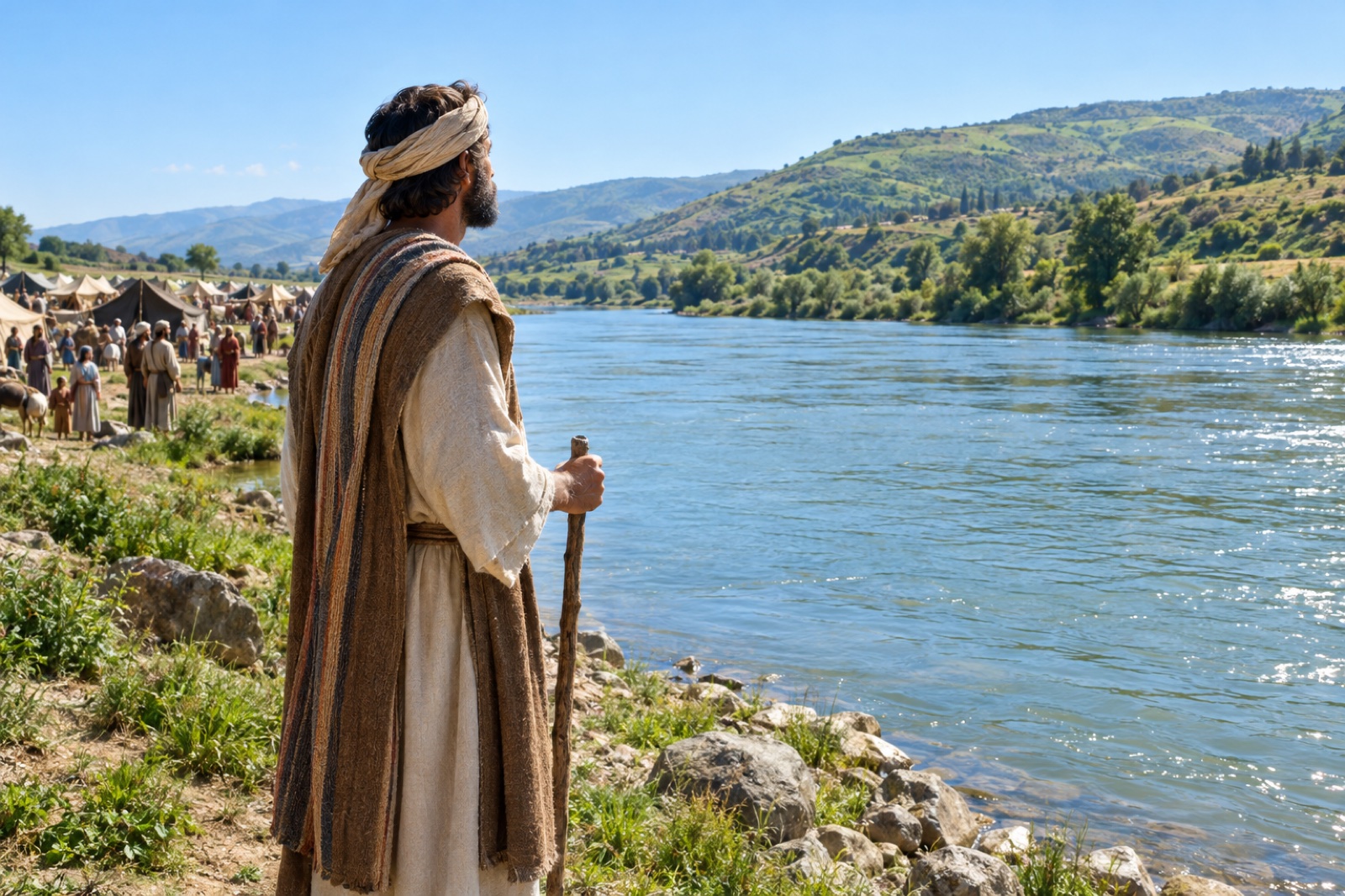
That is the exact morning Joshua 1:9 was spoken into. Not a sermon. Not a poster. A man on the bank of a river on the worst possible week to be promoted.
What Joshua 1:9 Actually Says
Here is the verse, in full:
“Have not I commanded thee? Be strong and of a good courage; be not afraid, neither be thou dismayed: for the LORD thy God is with thee whithersoever thou goest.” (Joshua 1:9, KJV)
Most people meet this verse on its own, printed on something. On its own it sounds like a pep talk.
In its chapter it is not a pep talk at all. It opens with a question, and the question is pointing backwards: Have not I commanded thee? Nothing new is being offered here. Joshua is being reminded that this was already an order.
The Week This Was Said
The book opens on a funeral.
“Now after the death of Moses the servant of the LORD it came to pass, that the LORD spake unto Joshua the son of Nun, Moses’ minister, saying, Moses my servant is dead; now therefore arise, go over this Jordan.” (Joshua 1:1-2, KJV)
Read what the text calls Joshua in that sentence. Not a prophet. Not a leader. Moses’ minister — his assistant. That is still his job title in the verse where he is handed the whole nation.
And the first instruction is not “grieve,” or “wait,” or “get yourself ready.” It is arise, go over this Jordan. Cross the water. Today.
So before a single word about courage is spoken, the situation is already set: the man everyone trusted is dead, the assistant is in charge, the river is in front of him, and there is no delay built into the plan.
God Says It Three Times in One Short Speech
Here is the detail that changes the verse, and it is sitting in plain sight three verses up.
“Be strong and of a good courage” is not said once. It is said three times, inside one speech, in the space of four verses.
- Verse 6 — “Be strong and of a good courage: for unto this people shalt thou divide for an inheritance the land, which I sware unto their fathers to give them.”
- Verse 7 — “Only be thou strong and very courageous, that thou mayest observe to do according to all the law, which Moses my servant commanded thee: turn not from it to the right hand or to the left.”
- Verse 9 — “Have not I commanded thee? Be strong and of a good courage; be not afraid, neither be thou dismayed.”
Three times. And each one is attached to a different reason.
The first is courage for the job — you are going to hand this land out to these people. The third is courage for the fear itself — do not be afraid, do not be shattered, because you are not alone out there.
The middle one is the one almost nobody quotes. And it is the only one with an intensifier on it.
The One Marked “Very” Is Not About the War
Look at verse 7 again, slowly.
“Only be thou strong and very courageous, that thou mayest observe to do according to all the law.”
Joshua is about to lead an invasion. There are fortified cities ahead of him. There is a river at flood stage in front of him. There are people behind him who watched his predecessor do the impossible and will compare every move he makes to a dead man.
And the only time God turns the dial up — the only “very” in the passage — is about keeping a book.
Not about Jericho. Not about the Jordan. About whether he would read the law, keep the law, and not drift off it “to the right hand or to the left.” The next verse spells out what that looks like in practice: “This book of the law shall not depart out of thy mouth; but thou shalt meditate therein day and night” (Joshua 1:8, KJV).
That is a quiet, private, unglamorous, nobody-is-watching kind of obedience. And in God’s own ranking, that is the part that needed very courageous.
The battle needed courage. The book needed more.
He Had Already Heard It. Several Times.
There is one more thing hiding behind the question “Have not I commanded thee?”
Joshua had heard these exact words before. More than once.
Back in Deuteronomy 31, in Moses’ final hours, the same short charge is handed out again and again. Moses says it to the whole nation (Deuteronomy 31:6). Then Moses turns and says it directly to Joshua, deliberately in public:
“And Moses called unto Joshua, and said unto him in the sight of all Israel, Be strong and of a good courage: for thou must go with this people unto the land which the LORD hath sworn unto their fathers to give them.” (Deuteronomy 31:7, KJV)
Then God gives Joshua the same charge personally: “Be strong and of a good courage: for thou shalt bring the children of Israel into the land which I sware unto them: and I will be with thee” (Deuteronomy 31:23, KJV).
Count them with the three in Joshua 1 and the same command lands on this one man six times in two chapters.
And then it happens a seventh time, from a direction nobody expects. At the end of Joshua 1, the people answer their new leader — and the very last thing they say to him is:
“only be strong and of a good courage.” (Joshua 1:18, KJV)
The people he was supposed to be carrying turned around and said it back to him.
Six times was not enough. He needed the seventh, and it came from the ones who were following him.
The Turn: Courage Here Is an Order, Not a Feeling
We usually read “be strong and of a good courage” as something God is hoping Joshua will manage to feel. Dig in, find it somewhere inside, muster up.
But the verse opens by calling it a command. Have not I commanded thee?
You cannot command a feeling. Nobody can order you to feel brave any more than they can order you to feel happy. What you can be ordered to do is go — walk to the river while still afraid, open the book on the days it does nothing for you, keep the promise when the feeling behind it has gone quiet.
Which takes all the pressure off the wrong thing. Joshua was not failing because he was afraid. The fear is assumed in the text — that is why the sentence has to be said seven times. He would have failed by not crossing.
And the back half of verse 9 is the reason the order is reasonable at all: “for the LORD thy God is with thee whithersoever thou goest.” Not if you go somewhere good. Whithersoever — wherever. Including the wrong turns, the hard house, the job you are not qualified for.
That is the same promise made earlier in the chapter, in the plainest words in the book: “as I was with Moses, so I will be with thee: I will not fail thee, nor forsake thee” (Joshua 1:5, KJV). Joshua did not get Moses’ confidence. He got Moses’ company.
A good place to start:
The Beginner’s Guide to Feeling God’s Presence Every Day
A simple guide to noticing God is with you in the ordinary days, not only the big frightening ones.
Get the free guide
Free.
What Joshua 1:9 Means for Your Week
Three things come out of this that are worth carrying around.
One: being afraid is not the failure. God repeats this line seven times to a man God has personally chosen. Repetition like that is not for people who are fine. If you need to hear it again this week, you are in the right company, not the wrong one.
Two: the hardest courage is usually the unwatched kind. Everyone expects to need nerve for the big visible thing — the conversation, the move, the diagnosis. God marked the quiet daily discipline as the one needing very courageous. Showing up to the small faithful thing on an ordinary Tuesday, with nobody clapping, is harder than the dramatic moment, and it is the part that actually decided how Joshua’s story went.
Three: you are allowed to be told it by other people. Joshua heard it from God, and he still needed to hear it from the people he was leading. If someone says a true thing to you this week, you do not have to be too proud to take it. And you are allowed to be the seventh voice for somebody else.
If you want the other side of this story, the friend who stood with Joshua as a young spy and was still asking for hard ground at 85 is worth meeting — who Caleb was and what he asked for. And if what you are actually carrying is fear rather than a new job, we pulled apart the fear 1 John 4:18 is really talking about, which is not the one most people assume.
Actions to Take Today
- Name the river. Write one sentence: “The thing in front of me I keep not starting is ___.” Do not solve it. Joshua was told to cross before anyone explained how the water would move.
- Do the small unwatched thing once, today. Five minutes of the discipline you keep postponing — the page, the walk, the message you owe someone. This is the part God marked very courageous, and five minutes is a real start.
- Be somebody’s seventh voice. Think of one person standing at their own edge this week and send them one plain sentence saying you believe they can do it. Joshua needed that from the people under him. Somebody near you needs it from you.
Journaling Prompts
- What have you been waiting to feel before you do? What would change if you treated it as something to do while still not feeling it?
- Where in your life is the quiet daily thing harder than the big dramatic thing, and what does that tell you about where your real courage is needed?
- Joshua was still called “Moses’ minister” in the verse where he was handed everything. What old title are you still measuring yourself by?
A Prayer for the Morning You Are Not Ready For
God, I am standing at the edge of something I did not choose and do not feel big enough for. I keep waiting to feel brave, and it is not coming. So I will do what Joshua did and go anyway. Help me cross the thing in front of me today, and help me be faithful in the small part nobody will see. Thank you that the promise was not that I would feel strong, but that God goes with me wherever I end up. Amen.
What Do You Think?
God turned the dial up — “very courageous” — on keeping the law rather than on the battles ahead. Do you think that is because private faithfulness is genuinely harder than public bravery, or because it is what everything else depended on? Share your thoughts in the comments below.
Share This
- “Be strong and of a good courage” is said to Joshua seven times in two chapters. Repetition like that is not for people who are fine. (Joshua 1:9)
- Joshua 1:9 opens with “Have not I commanded thee?” You cannot command a feeling. Courage here is not something to feel. It is something to do while still afraid.
- God says “be strong” three times in one speech to Joshua. The only one marked “very” is not about the war. It is about keeping a book nobody would see him read.
Questions People Ask About Joshua 1:9
What does Joshua 1:9 mean?
Joshua 1:9 is God’s charge to Joshua immediately after the death of Moses, as Israel prepares to cross the Jordan into Canaan. The verse reads: “Have not I commanded thee? Be strong and of a good courage; be not afraid, neither be thou dismayed: for the LORD thy God is with thee whithersoever thou goest.” It opens by pointing back to an order already given rather than offering new encouragement, and its reason is presence rather than ability — God is with Joshua wherever he goes, not only where he succeeds.
Who was Joshua 1:9 originally spoken to?
It was spoken to Joshua the son of Nun, who had served as Moses’ assistant. Joshua 1:1 calls him “Moses’ minister” in the same sentence that hands him leadership of Israel. The words come right after Moses’ death, with the Jordan river still to cross and the land of Canaan unconquered, which makes it a charge given to a second-in-command on his first day in the top job.
How many times does God tell Joshua to be strong and courageous?
Three times in the single speech of Joshua 1: verse 6, verse 7, and verse 9. The same charge had already been given to him in Deuteronomy 31 — by Moses in front of all Israel (Deuteronomy 31:7) and directly by God (Deuteronomy 31:23) — and the people of Israel repeat it back to Joshua at the end of the chapter in Joshua 1:18. In total the command lands on Joshua seven times across those two chapters.
Why does Joshua 1:7 say “very courageous” when the other verses do not?
Joshua 1:7 is the only one of the three charges that adds an intensifier, and it is attached to keeping the law rather than to the military campaign: “Only be thou strong and very courageous, that thou mayest observe to do according to all the law, which Moses my servant commanded thee: turn not from it to the right hand or to the left.” Joshua 1:8 then describes what that means day to day — meditating on the book of the law continually. The strongest call to courage in the passage is for private, ongoing obedience, not for battle.
Is Joshua 1:9 a promise that nothing bad will happen?
No. The verse does not promise safety or an easy outcome; it promises presence. The phrase is “the LORD thy God is with thee whithersoever thou goest” — wherever Joshua goes, not only where things go well. The same chapter makes the point in Joshua 1:5: “as I was with Moses, so I will be with thee: I will not fail thee, nor forsake thee.” The book of Joshua that follows records real losses, including the defeat at Ai in Joshua 7.
What does “dismayed” mean in Joshua 1:9?
In the King James Version, “be not afraid, neither be thou dismayed” pairs two related ideas: fear, and the collapse that fear can produce. The same pairing appears in Moses’ earlier charge in Deuteronomy 31:8, “fear not, neither be dismayed.” Read together, the command addresses both the feeling of fear and the giving up that can follow it, which is why the verse ends with a reason to keep going rather than with a reason not to be afraid.