 0
 0
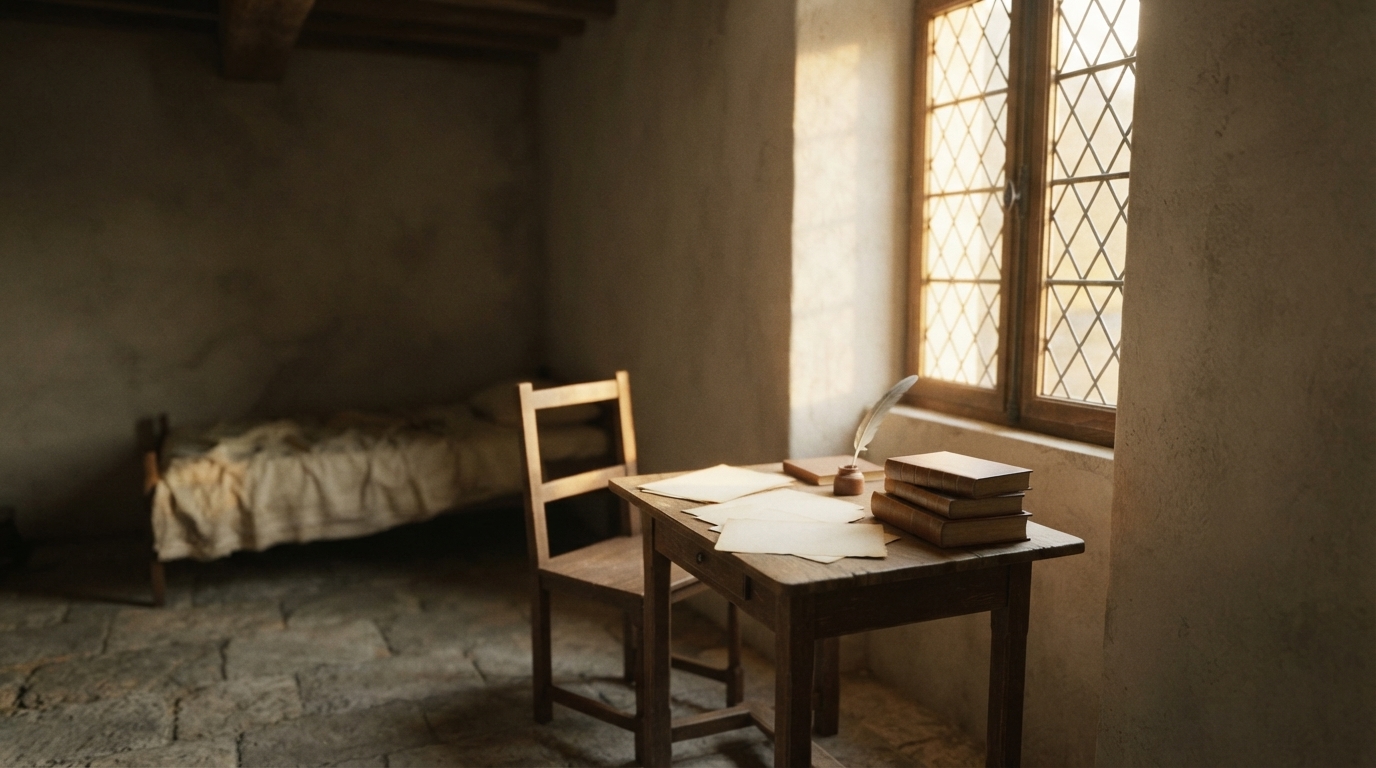
You have probably met it under a photograph of an empty room, or at the end of a long thread about phones.
“All of humanity’s problems stem from man’s inability to sit quietly in a room alone.”
It gets credited to Blaise Pascal, the French mathematician who died in 1662, and that credit holds up. The thought is his. That is why the line travels so well — a man writing by candlelight, three and a half centuries before anyone owned a phone, apparently describing the exact thing we do with our thumbs at a red light.
Here is the part that falls off on the way round.
The sentence Pascal wrote does not contain the word “problems.” It does not contain the word “alone.” And he did not stop there. The lines that come next in his own notes say why we cannot stay still — and that is the half almost nobody shares.
What the quote is actually claiming
Read the popular version on its own and it sounds like a mild telling-off about willpower. If people could just sit still, the world would calm down. It is the kind of line that pairs with a sunrise photo and a reminder to delete an app.
I do not think that is the claim at all.
Start with the word that got swapped. The French noun Pascal used is malheur — unhappiness, misery, the state of being wretched. Not “problems.” Problems are things you solve. Unhappiness is something you are in.
So he is not offering a fix. He is naming a source. All of it, he says, comes from one thing: we cannot stay at rest in a room.
That is a stranger claim than the poster version, because it treats the restlessness as useful. It is doing a job. It is keeping something out of sight.
And it explains something the tidy version cannot. People who have carefully arranged their lives for peace still reach for something the second a room goes quiet. A habit you could break with discipline would have broken by now. This one does not break, because it is not really a habit. It is a defence.
Pascal says so himself, a few sentences later. We will get there.
What Pascal actually wrote
In French the sentence runs: “j’ai dit souvent que tout le malheur des hommes vient d’une seule chose, qui est de ne savoir pas demeurer en repos dans une chambre.”
Taken piece by piece:
- tout le malheur des hommes — all the unhappiness of men. Not problems.
- de ne savoir pas demeurer en repos dans une chambre — not knowing how to stay at rest in a room. There is no word in there for “alone.”
- j’ai dit souvent — “I have often said.” He is not announcing a discovery. He is repeating himself.
The standard English translations keep all of that. W. F. Trotter’s version, the one reprinted for most of the last century, opens the passage “When I have occasionally set myself to consider the different distractions of men” and arrives at “that all the unhappiness of men arises from one single fact, that they cannot stay quietly in their own chamber.” A. J. Krailsheimer’s Penguin translation gives it as “I have often said that the sole cause of man’s unhappiness is that he does not know how to stay quietly in his room.”
Neither says “problems.” Neither says “alone.”
So where did the familiar wording come from? We could not find it in any published translation we checked. It looks like a paraphrase that broke loose and started travelling on its own, which is how a great many famous quotations actually work. That is not the same as saying no translator ever wrote it — only that we could not find one who did, and the versions we could check all say something different.
It also travels with a date attached. The year 1654 turns up a lot. Pascal did not date the note, and nobody else can date it either, because of what the Pensees actually is.
The book he never wrote
Pascal died on 19 August 1662, at thirty-nine. The Pensees was not finished. It was never really started, in the sense of being a book.
What he left behind was scraps of paper. In his last years he had been gathering notes toward a defence of the Christian faith, and before he died he collected those notes into bundles, each with a working title. He left no indication of the order in which any of it should be read.
Editors have been disagreeing about that order ever since, and they have never settled it. Which is why this one sentence carries two different addresses depending on which edition you pick up: it is fragment 139 in the Brunschvicg numbering and fragment 136 in Lafuma’s. Same words. Different number on the door.
The bundle it sits in has a one-word title. In English editions that word is “Diversion.”
Sit with that for a second. The most-shared sentence ever written about stillness survives because somebody sorted a dead man’s loose papers and had a guess at the running order.
The half that gets dropped
Pascal does not leave the famous sentence standing on its own. He goes straight on to the evidence, and then to the reason.
The evidence, in Trotter’s translation: “Hence it comes that men so much love noise and stir.” Prison, he points out, is so horrible a punishment — and the fact that we find that obvious is itself the clue. Then this, which is the line I cannot stop thinking about: “the pleasure of solitude is a thing incomprehensible.”
Incomprehensible. Not difficult. Not unfashionable. We cannot even picture it.
Then the reason. What a person meets when the room finally goes quiet is, in his words, “the natural poverty of our feeble and mortal condition.”
That is the diagnosis the shared version leaves out. We do not fail to sit still because we are weak-willed. We fail to sit still because sitting still works — it shows us the thing we spent the whole day arranging not to see.
Which means the extra word in the popular version, “alone,” is not a wild invention. Pascal’s own paragraph does talk about solitude. But the swap still costs something. “Cannot be alone” sounds like a social problem, the sort of thing a quiet person is immune to. “Cannot stay at rest” is wider than that. You can be in a full house and still be running.
Who was in the room
Now the part that changes the sentence completely.
The man writing that we cannot bear to stay in a room was, by his family’s account, almost never out of pain. His sister Gilberte wrote that from the age of eighteen he never passed a day without pain. At twenty-four he could take only liquid food, which his sisters or his nurse fed to him drop by drop. He fell seriously ill in 1659, and by 1662 the illness had turned violent. He died that August.
His final years were taken up with religious controversy, continual illness and loneliness. That is the room.
He was not a comfortable man leaning across the table to tell restless people to settle down. He had been handed the room, had very little say about staying in it, and was writing down what he found there. It is the same stretch of his life, and the same bundles of paper, that gave us his famous wager.
And then there is a detail that cuts the other way, which is worth keeping rather than quietly leaving out. In the last year of his life Pascal was behind one of the first public transport services in a city: carriages running fixed routes across Paris at a flat five-sou fare, inaugurated in 1662, months before he died. The man who wrote that our unhappiness comes from not being able to stay put spent his final months helping Parisians get about more easily. The lines never really paid; the last of them closed by 1675.
Make of that what you like. Read the passage closely, though, and the contradiction thins out. His complaint is not about movement. It is about movement used as an anaesthetic.
Somebody had already run the experiment
Pascal’s claim has a testable shape. If the unhappiness really comes from being unable to stay at rest, then give somebody unlimited means of never having to — every diversion money can buy — and see whether it lifts.
That experiment had already been run and written up, roughly two and a half thousand years earlier.
Ecclesiastes 2 is a first-person account of a man who set out to try everything on purpose. Houses. Vineyards. Gardens and orchards. Pools of water. Servants and herds. Silver and gold. Singers and musical instruments. He says he withheld nothing from himself. He was not drifting into distraction; he was running a trial, and he kept notes.
Then he stopped, looked at the results, and wrote them down:
“Then I looked on all the works that my hands had wrought, and on the labour that I had laboured to do: and, behold, all was vanity and vexation of spirit, and there was no profit under the sun.” — Ecclesiastes 2:11, KJV
That is Pascal’s paragraph reached from the opposite end. Pascal watched people run and worked out what they were running from. The writer of Ecclesiastes ran as hard as a man with a kingdom’s budget can run, then sat down in the room and reported back.
The interesting thing is not that they agree. Plenty of people agree about plenty of things. The interesting thing is the gap — something like twenty-three centuries, two languages, no contact between them — and the fact that neither one lands on “sit still harder.” Both treat the restlessness as a symptom of something true about being a person, not as a discipline problem to be sorted out before breakfast. This site has followed that same writer from the other end, into the question of whether work matters when nobody keeps it.
Humans keep arriving here. And then keep forgetting, which is why it has to be written down again every few centuries by somebody who is fairly sure they are the first to notice.
What the line looks like now
You can still share it. It is his thought, and it is a good one.
Just know what sort of sentence it is. It was never a tip. Pascal was not handing anybody a morning routine; he was a few paragraphs into an argument he did not live to finish.
So the next time a room goes quiet and your hand moves before you have decided anything — and that is most of us, most days — the line is not telling you that you lack discipline. It is saying that the reaching is doing something for you, and asking, fairly mildly, whether you want to know what.
That is a different question from “why can’t I focus,” and a kinder one. A short prayer in Psalm 119 asks for something close to it, and does not scold anybody either.
Questions people ask about this quote
Did Blaise Pascal really say “all of humanity’s problems stem from man’s inability to sit quietly in a room alone”?
The thought is Pascal’s, but the wording is not. The sentence appears in his Pensees, and in French it reads “j’ai dit souvent que tout le malheur des hommes vient d’une seule chose, qui est de ne savoir pas demeurer en repos dans une chambre.” The noun is malheur, unhappiness, rather than “problems,” and there is no word in the French for “alone.” W. F. Trotter’s English translation gives it as “all the unhappiness of men arises from one single fact, that they cannot stay quietly in their own chamber,” and A. J. Krailsheimer’s Penguin translation as “I have often said that the sole cause of man’s unhappiness is that he does not know how to stay quietly in his room.” The popular form — also shared as “all of humanity’s problems stem from our inability to sit quietly in a room alone” or “all of man’s problems stem from his inability to sit quietly in a room” — does not match any published translation we were able to check, so it is best described as a paraphrase rather than a quotation.
What did Pascal mean by “sit quietly in a room alone”?
Pascal meant that people cannot bear to stay at rest, and that the running is a defence rather than a bad habit. In the same passage he goes on to say “Hence it comes that men so much love noise and stir,” that prison is so horrible a punishment, and that “the pleasure of solitude is a thing incomprehensible.” Then he gives the reason: at rest a person meets “the natural poverty of our feeble and mortal condition.” So “sit quietly in a room alone” is not advice about focus or screen time. It is a claim that our unhappiness has one root — that stillness shows us something about ourselves we would rather not look at, so we keep ourselves busy instead. The bundle of notes it belongs to is titled “Diversion.”
Where in the Pensees is Pascal’s quote about not being able to stay in a room?
Pascal’s line about not being able to stay in a room is fragment 139 in the Brunschvicg numbering of the Pensees and fragment 136 in Lafuma’s — the same text with two different numbers. It sits in the group of notes titled “Diversion.” The double numbering exists because the Pensees is not a finished book: Pascal died on 19 August 1662 at the age of thirty-nine, leaving scraps of paper he had gathered into bundles with working titles and no indication of what order to read them in. Editors have disagreed about the arrangement ever since. For the same reason the fragment carries no date, so the year 1654 often attached to the quote online cannot be verified.
Is “all of humanity’s problems stem from man’s inability to sit quietly in a room alone” in the Bible?
No, “all of humanity’s problems stem from man’s inability to sit quietly in a room alone” is not in the Bible. It is Blaise Pascal’s, from the Pensees, written in the years before his death in 1662. The Bible does cover very close ground in Ecclesiastes 2, where a writer describes deliberately trying every diversion available to him — houses, vineyards, gardens, servants, herds, silver and gold, singers and musical instruments — and then reports in verse 11: “Then I looked on all the works that my hands had wrought, and on the labour that I had laboured to do: and, behold, all was vanity and vexation of spirit, and there was no profit under the sun.”
What is the full Pascal quote about sitting quietly in a room?
The fuller passage, in W. F. Trotter’s translation, begins “When I have occasionally set myself to consider the different distractions of men” and reaches the famous clause: “that all the unhappiness of men arises from one single fact, that they cannot stay quietly in their own chamber.” Pascal then adds the lines that rarely get quoted with it — “Hence it comes that men so much love noise and stir,” the remark that “the pleasure of solitude is a thing incomprehensible,” and the reason underneath them both, “the natural poverty of our feeble and mortal condition.” The short version everyone shares is the opening observation; the explanation is what follows it.
Over to you
Which line have you repeated for years without ever reading the page around it? And is there one you have always half-assumed came out of the Bible, and never actually looked up?
Share this
Turns out Pascal never wrote “problems” or “alone.” The French says all human unhappiness comes from not knowing how to stay at rest in a room. And then he explains why — which is the half none of us share.
I have been sharing the Pascal line about sitting quietly in a room for years. Just found out he wrote it as a man who, by his sister’s account, had not passed a day without pain since he was eighteen.
Pascal’s most famous sentence about stillness only survives because somebody sorted a dead man’s loose papers. It carries two different fragment numbers because nobody could agree what order he meant them in.